Fizz Shield Design Packet
R&D Engineering Challenge Beverage Systems Division
FIZZ SHIELD: SMART PACKAGING CHALLENGE
ISO-CO2-PRESERVE
Lead Engineer
Date / Period
Engineering Team
Prototype Codename
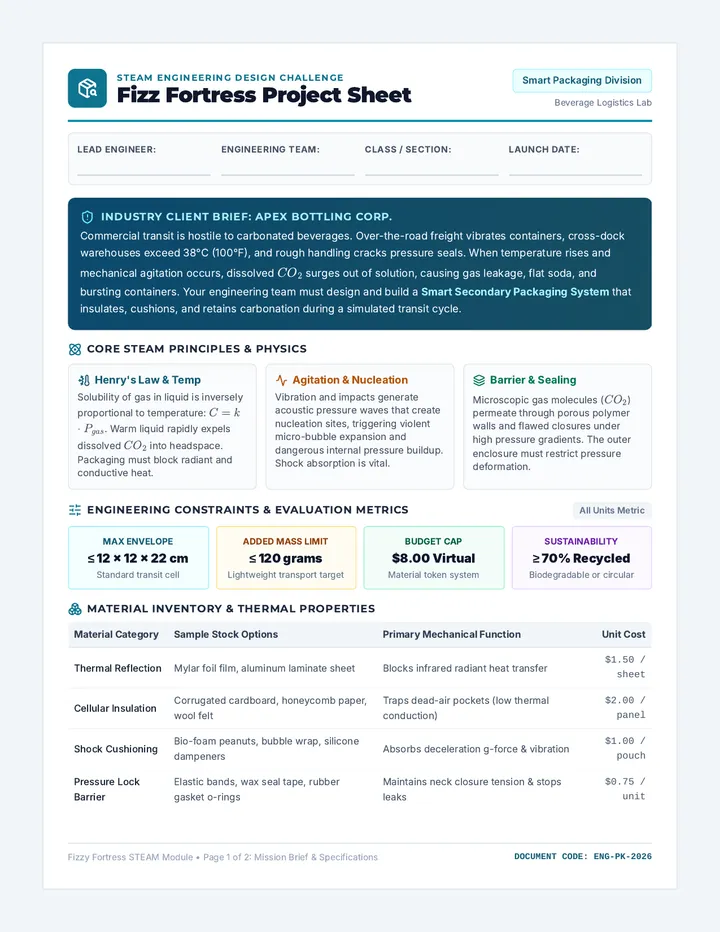
The Industry Problem
Carbonated beverages lose dissolved \( \text{CO}_2 \) during storage, transit, and repeated opening due to gas permeation, headspace volume expansion, and temperature swings.
Your Mission: Design a smart packaging prototype that actively or passively sustains carbonation (\( \text{CO}_2 \) retention) and optimal product quality from warehouse to final sip.
1. Project Criteria & Constraints
Define the performance requirements (success metrics) and project limitations (boundaries) for your smart container.
Design Criteria (Must-Haves) E.g., pressure seal, insulation
Identify 3 critical performance criteria your smart bottle/can must achieve:
C1
C2
C3
Project Constraints (Limitations) E.g., cost, weight, food-safe
Specify 3 real-world restrictions you must design within:
R1
R2
R3
2. STEAM Integration Matrix
How does your prototype incorporate each discipline?
Science
Henry's Law, gas diffusion, thermal transfer
Technology
Freshness sensors, smart indicators, nano-barriers
Engineering
Pressure valves, seals, ergonomics, layered wall
Art & UX
Visual branding, grip texture, user feedback cues
Math
Surface area-to-volume ratio, pressure rating, cost
Turn to Page 2 to chart your Engineering Design Process and sketch the prototype blueprint. Page 1 of 2
ENGINEERING BLUEPRINT & PROTOTYPE SPECS
Packaging ID:
3. The Engineering Design Process Tracker
Document your team's progression through each phase
1 Ask & Research
What exact mechanism causes carbonation loss?
2 Imagine & Brainstorm
Key smart solutions evaluated:
3 Plan & Select
Why this chosen concept beats alternatives:
4 Test & Iterate
How will you test carbonation retention?
4. Prototype Technical Blueprint & Cross-Section
Include: ① Pressure Seal ② Barrier Wall ③ Smart Sensor / Indicator
Isometric / Cross-Sectional View Scale: 1 : 1
[ Draw & Annotate Prototype Cross-Section Here ]
Annotation Keys: Use arrows with callout boxes to identify materials, wall thickness, and smart features.
Max Pressure Rating: ______ psi
5. Required Materials & Preservation Mechanisms
Explain how each material shields dissolved carbon dioxide
Component / Material
Function in Packaging
Carbonation Retention Mechanism
Peer Review Sign-off: Design verified for pressure safety, food contact grade, and feasibility.
Reviewer Signature: Page 2 of 2