Codebreaker Genetics Slides Biology Laboratory Module • Mendelian Genetics
GENE-201 // UNIT INHERITANCE
Genetic Codebreakers
Mastering Punnett squares, allele interactions, probability ratios, and multi-trait inheritance.
Monohybrid Crosses
Ratios & Probability
Dihybrid Mastery
Core Vocabulary // Decoding the Code 01 / 07
Gene vs. Allele
Gene: DNA segment coding for a specific trait (e.g., eye color).
Allele: A specific version of that gene (B for brown, b for blue).
Genotype vs. Phenotype
Genotype: The genetic allele pair inside the organism (BB, Bb, bb).
Phenotype: The physical, observable expression (e.g., brown eyes or blue eyes).
Homozygous Dominant BB Identical dominant alleles
Heterozygous Bb One dominant, one recessive
Homozygous Recessive bb Identical recessive alleles
Dominant alleles mask recessive alleles whenever present in heterozygous pairs.
Monohybrid Mechanics // Step-by-Step Setup 02 / 07
How Punnett Squares Predict Offspring
1
Identify Parental Genotypes
Example cross: Heterozygous brown eyes (Bb) × (Bb).
2
Separate Alleles into Gametes
Law of Segregation: Parent 1 gives B or b; Parent 2 gives B or b.
3
Cross Row & Column
Combine alleles in each inner quadrant to reveal potential zygotes.
Parent 1 Gametes (Top)
Parent 2 (Side) B b
B
b
BB Brown Eyes
Bb Brown Eyes
Bb Brown Eyes
bb Blue Eyes
Each inner square represents a 25% (1 in 4) chance for any single offspring.
Statistical Analysis // Interpreting Outcomes 03 / 07
Genotypic vs. Phenotypic Ratios (Bb × Bb)
Genotypic Ratio
1 : 2 : 1
1 BB (Homozygous Dominant) 1/4 = 25%
2 Bb (Heterozygous) 2/4 = 50%
1 bb (Homozygous Recessive) 1/4 = 25%
Phenotypic Ratio
3 : 1
Brown Eyes (Dominant) BB and Bb combined (1 + 2)
3/4 = 75%
Blue Eyes (Recessive) bb only (1)
1/4 = 25%
Remember: Every fertilization event is independent. A 75% probability resets for each individual child!
Two-Trait Inheritance // Dihybrid Crosses 04 / 07
Dihybrid Crosses: Tracking Two Traits at Once
Mendel's Law of Independent Assortment states that genes for different traits segregate independently during gamete formation.
The FOIL Method for Parent Genotype RrYy
R = Round, r = Wrinkled • Y = Yellow, y = Green
First Alleles RrYy RY
Outside Alleles Rryy Ry
Inside Alleles rrYy rY
Last Alleles rryy ry
These 4 unique gamete combinations become the column & row headers for the 4×4 grid!
A dihybrid cross creates a 4 × 4 grid with exactly 16 potential offspring boxes.
Dihybrid Results // Phenotypic Breakdown 05 / 07
The Classical 9 : 3 : 3 : 1 Phenotypic Ratio
When crossing two heterozygous dihybrids (RrYy × RrYy), the 16 boxes yield 4 distinct phenotype classes:
9/16
Dominant / Dominant
Round & Yellow
R_ Y_
3/16
Dominant / Recessive
Round & Green
R_ yy
3/16
Recessive / Dominant
Wrinkled & Yellow
rr Y_
1/16
Recessive / Recessive
Wrinkled & Green
rr yy
Quick Check: 9 + 3 + 3 + 1 = 16 total offspring possibilities 1/16 = 6.25% • 3/16 = 18.75% • 9/16 = 56.25%
Mission Briefing // Lab Protocol 07 / 07
LAB DIRECTIVE
Time to Decode: Grab Your Worksheet!
Apply these principles on the Allele Showdown Worksheet to solve genetics puzzles, calculate probabilities, and solve a full dihybrid cross.
PHASE 1
Vocab & Alleles
Classify genotypes and match traits.
PHASE 2
Monohybrid Crosses
Predict probabilities & ratios.
PHASE 3
Dihybrid Challenge
Complete the 16-box two-trait puzzle.
Aim for 100% accuracy on phenotypic and genotypic ratio predictions!
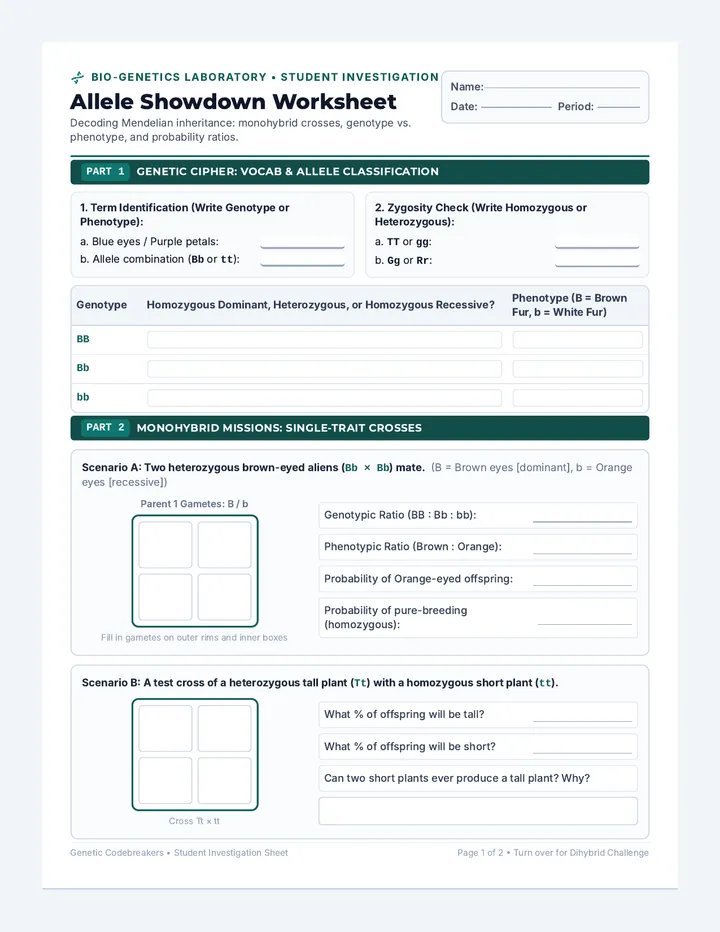
Allele Showdown Worksheet Bio-Genetics Laboratory • Student Investigation
Allele Showdown Worksheet
Decoding Mendelian inheritance: monohybrid crosses, genotype vs. phenotype, and probability ratios.
Name:
Date: Period:
PART 1
Genetic Cipher: Vocab & Allele Classification
1. Term Identification (Write Genotype or Phenotype):
a. Blue eyes / Purple petals:
b. Allele combination (Bb or tt):
2. Zygosity Check (Write Homozygous or Heterozygous):
a. TT or gg:
b. Gg or Rr:
Genotype
Homozygous Dominant, Heterozygous, or Homozygous Recessive?
Phenotype (B = Brown Fur, b = White Fur)
BB
|
| Bb |
|
|
| bb |
|
|
PART 2
Monohybrid Missions: Single-Trait Crosses
Scenario A: Two heterozygous brown-eyed aliens (Bb × Bb) mate. (B = Brown eyes [dominant], b = Orange eyes [recessive])
Parent 1 Gametes: B / b
Fill in gametes on outer rims and inner boxes
Genotypic Ratio (BB : Bb : bb):
Phenotypic Ratio (Brown : Orange):
Probability of Orange-eyed offspring:
Probability of pure-breeding (homozygous):
Scenario B: A test cross of a heterozygous tall plant (Tt) with a homozygous short plant (tt).
Cross Tt × tt
What % of offspring will be tall?
What % of offspring will be short?
Can two short plants ever produce a tall plant? Why?
Genetic Codebreakers • Student Investigation Sheet Page 1 of 2 • Turn over for Dihybrid Challenge
MODULE 2
Dihybrid Crosses & Two-Trait Independent Assortment
Student Name: _______________________
PART 3
The FOIL Method: Determining Gametes
In pea plants, seed shape (R = Round, r = Wrinkled) and seed color (Y = Yellow, y = Green) assort independently. A dihybrid parent has the genotype RrYy.
Use the FOIL rule to find all 4 possible gametes from parent RrYy:
FIRST (R + Y)
OUTSIDE (R + y)
INSIDE (r + Y)
LAST (r + y)
PART 4
The 16-Box Dihybrid Cross (RrYy × RrYy)
Write the parent gametes (RY, Ry, rY, ry) across the top and side headers. Then complete all 16 offspring genotype boxes:
×
PART 5
Phenotypic Tally & Probability Analysis
Phenotype
Tally / 16
Fraction
Round & Yellow (R_ Y_)
|
| Round & Green (R_ yy) |
|
|
| Wrinkled & Yellow (rr Y_) |
|
|
| Wrinkled & Green (rr yy) |
|
|
1. State the classical phenotypic ratio:
: : :
2. Probability of getting wrinkled green seeds?
3. Why do traits assort independently?
Genetic Codebreakers • Dihybrid Laboratory Challenge Page 2 of 2 • Complete & Submit for Assessment
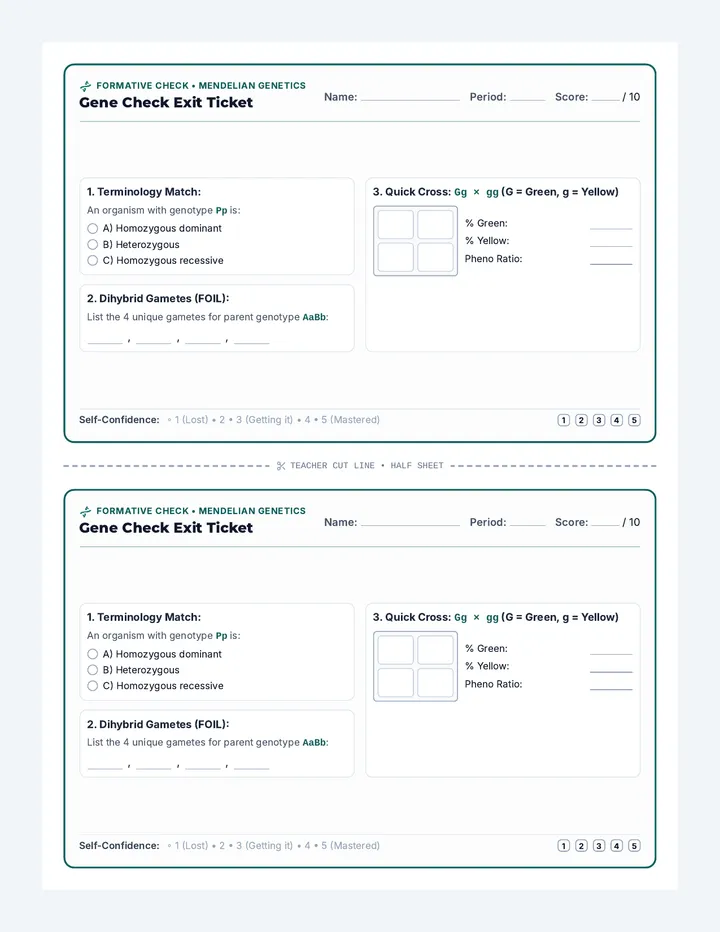
Gene Check Exit Ticket Formative Check • Mendelian Genetics
Gene Check Exit Ticket
Name:
Period:
Score: / 10
1. Terminology Match:
An organism with genotype Pp is:
A) Homozygous dominant B) Heterozygous C) Homozygous recessive
2. Dihybrid Gametes (FOIL):
List the 4 unique gametes for parent genotype AaBb:
, , ,
3. Quick Cross: Gg × gg (G = Green, g = Yellow)
% Green:
% Yellow:
Pheno Ratio:
Self-Confidence: ∘ 1 (Lost) • 2 • 3 (Getting it) • 4 • 5 (Mastered)
1 2 3 4 5
TEACHER CUT LINE • HALF SHEET
Formative Check • Mendelian Genetics
Gene Check Exit Ticket
Name:
Period:
Score: / 10
1. Terminology Match:
An organism with genotype Pp is:
A) Homozygous dominant B) Heterozygous C) Homozygous recessive
2. Dihybrid Gametes (FOIL):
List the 4 unique gametes for parent genotype AaBb:
, , ,
3. Quick Cross: Gg × gg (G = Green, g = Yellow)
% Green:
% Yellow:
Pheno Ratio:
Self-Confidence: ∘ 1 (Lost) • 2 • 3 (Getting it) • 4 • 5 (Mastered)
1 2 3 4 5
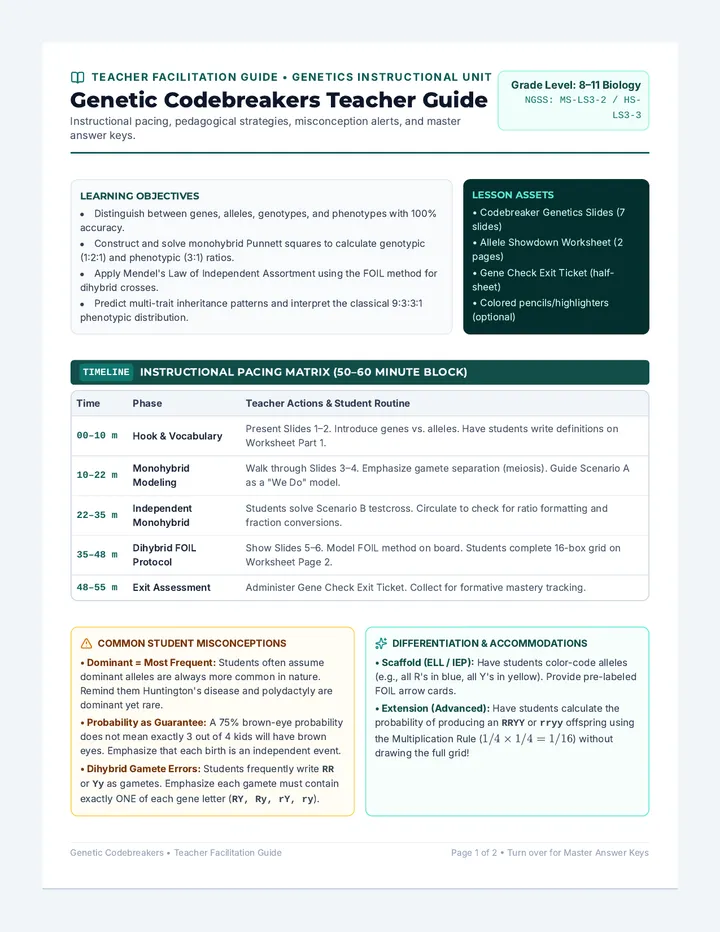
Genetic Codebreakers Teacher Guide Teacher Facilitation Guide • Genetics Instructional Unit
Genetic Codebreakers Teacher Guide
Instructional pacing, pedagogical strategies, misconception alerts, and master answer keys.
Grade Level: 8–11 Biology NGSS: MS-LS3-2 / HS-LS3-3
Learning Objectives
Distinguish between genes, alleles, genotypes, and phenotypes with 100% accuracy.
Construct and solve monohybrid Punnett squares to calculate genotypic (1:2:1) and phenotypic (3:1) ratios.
Apply Mendel's Law of Independent Assortment using the FOIL method for dihybrid crosses.
Predict multi-trait inheritance patterns and interpret the classical 9:3:3:1 phenotypic distribution.
Lesson Assets
• Codebreaker Genetics Slides (7 slides)
• Allele Showdown Worksheet (2 pages)
• Gene Check Exit Ticket (half-sheet)
• Colored pencils/highlighters (optional)
TIMELINE
Instructional Pacing Matrix (50–60 Minute Block)
Time
Phase
Teacher Actions & Student Routine
00–10 m
Hook & Vocabulary
Present Slides 1–2. Introduce genes vs. alleles. Have students write definitions on Worksheet Part 1.
10–22 m
Monohybrid Modeling
Walk through Slides 3–4. Emphasize gamete separation (meiosis). Guide Scenario A as a "We Do" model.
22–35 m
Independent Monohybrid
Students solve Scenario B testcross. Circulate to check for ratio formatting and fraction conversions.
35–48 m
Dihybrid FOIL Protocol
Show Slides 5–6. Model FOIL method on board. Students complete 16-box grid on Worksheet Page 2.
48–55 m
Exit Assessment
Administer Gene Check Exit Ticket. Collect for formative mastery tracking.
Common Student Misconceptions
• Dominant = Most Frequent: Students often assume dominant alleles are always more common in nature. Remind them Huntington's disease and polydactyly are dominant yet rare.
• Probability as Guarantee: A 75% brown-eye probability does not mean exactly 3 out of 4 kids will have brown eyes. Emphasize that each birth is an independent event.
• Dihybrid Gamete Errors: Students frequently write RR or Yy as gametes. Emphasize each gamete must contain exactly ONE of each gene letter (RY, Ry, rY, ry).
Differentiation & Accommodations
• Scaffold (ELL / IEP): Have students color-code alleles (e.g., all R's in blue, all Y's in yellow). Provide pre-labeled FOIL arrow cards.
• Extension (Advanced): Have students calculate the probability of producing an RRYY or rryy offspring using the Multiplication Rule (\(1/4 \times 1/4 = 1/16\)) without drawing the full grid!
Genetic Codebreakers • Teacher Facilitation Guide Page 1 of 2 • Turn over for Master Answer Keys
ANSWER KEY
Master Scoring Key: Worksheet & Exit Ticket
Confidential Teacher Resource
SOLUTIONS
Allele Showdown Worksheet • Page 1 Solutions
Part 1: Genetic Cipher
1a. Blue eyes / Purple petals = Phenotype
1b. Allele combination (Bb, tt) = Genotype
2a. TT or gg = Homozygous (Dominant / Recessive)
2b. Gg or Rr = Heterozygous
BB → Homozygous Dominant → Brown Fur
Bb → Heterozygous → Brown Fur
bb → Homozygous Recessive → White Fur
Part 2: Monohybrid Missions
Scenario A (Bb × Bb):
Grid: [BB, Bb / Bb, bb]
• Genotypic Ratio = 1 BB : 2 Bb : 1 bb
• Phenotypic Ratio = 3 Brown : 1 Orange
• Orange Probability = 1/4 or 25%
• Pure-breeding Probability = 2/4 or 50% (BB + bb)
Scenario B (Tt × tt):
Grid: [Tt, Tt / tt, tt]
• Tall = 50% | Short = 50%
• Short × short never yields tall because both parents only carry recessive alleles (t).
SOLUTIONS
Allele Showdown Worksheet • Page 2 Solutions (Dihybrid)
Part 3: FOIL Gametes for RrYy
First: RY • Outside: Ry • Inside: rY • Last: ry
Part 5: Phenotypic Tally
• Round & Yellow (R_ Y_): 9 / 16 (56.25%)
• Round & Green (R_ yy): 3 / 16 (18.75%)
• Wrinkled & Yellow (rr Y_): 3 / 16 (18.75%)
• Wrinkled & Green (rr yy): 1 / 16 (6.25%)
Phenotypic Ratio: 9 : 3 : 3 : 1
Part 4: 16-Box Grid Cell Matrix
Gametes: RY, Ry, rY, ry
Row 1 (RY): RRYY, RRYy, RrYY, RrYy
Row 2 (Ry): RRYy, RRyy, RrYy, Rryy
Row 3 (rY): RrYY, RrYy, rrYY, rrYy
Row 4 (ry): RrYy, Rryy, rrYy, rryy
Synthesis Q3: Independent assortment occurs because homologous chromosome pairs align randomly during Metaphase I of meiosis without influencing each other.
RUBRIC
Gene Check Exit Ticket Answer Key (10 Points)
Q1: Terminology (3 pts)
Correct Answer: B) Heterozygous .
Criteria: Full credit for identifying that uppercase and lowercase alleles constitute a heterozygous genotype.
Q2: FOIL Gametes (3 pts)
Gametes: AB, Ab, aB, ab .
Criteria: 0.75 pts per correct gamete. Deduct if students repeat alleles (e.g., AA) or omit letters.
Q3: Cross Gg × gg (4 pts)
Grid: Gg, Gg, gg, gg.
% Green = 50% | % Yellow = 50%
Phenotypic Ratio: 1 Green : 1 Yellow .
Genetic Codebreakers • Teacher Facilitation Guide Page 2 of 2 • Bio-Genetics Master Key