Curriculum Lexicon Cards
Lesson 1 of 4 Life Science Lexicon
Cut along dashed borders
Solar Energy & Producers
Unit: Ecosystem Dynamics • Autotrophic Energy Conversion
6 Printable Study Cards
L1 • Card 01 Noun
Photosynthesis
[foh-toh-SIN-thuh-sis]
Definition
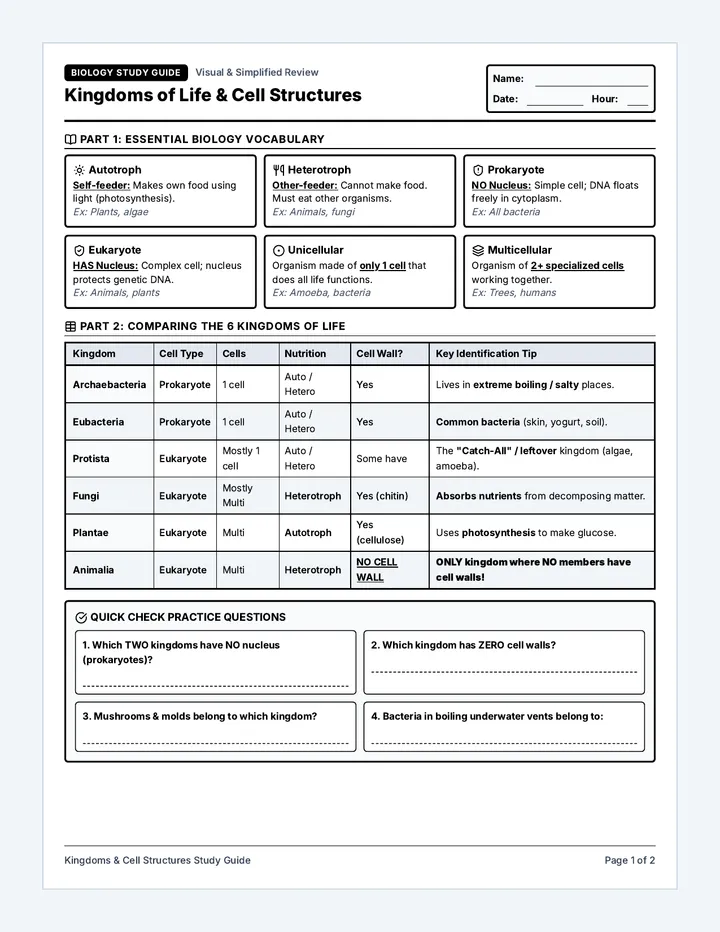
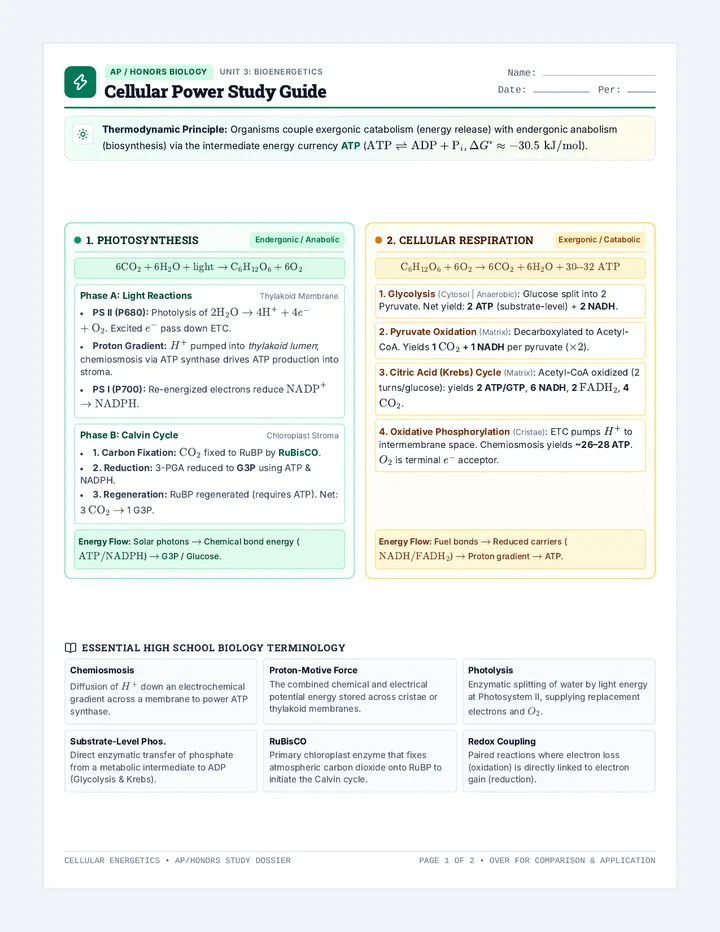
The biological process green plants use to convert sunlight, water, and carbon dioxide into oxygen and glucose.
In Context
"Leaves capture morning photons to trigger photosynthesis and produce chemical fuel."
Quick Check: Name the two non-living raw inputs plants absorb to create sugar.
L1 • Card 02 Noun
Chlorophyll
[KLOR-uh-fil]
Definition
The green photoreceptor pigment found in chloroplasts that absorbs light energy required for sugar synthesis.
In Context
"As autumn temperatures dip, trees break down chlorophyll to uncover golden pigments."
Quick Check: Why do subterranean roots rarely synthesize green chlorophyll?
L1 • Card 03 Noun
Producer
[pruh-DOO-ser] (Autotroph)
Definition
An organism that synthesizes organic nutrients and biomass directly from inorganic environmental energy sources.
In Context
"Microscopic phytoplankton serve as the premier primary producers in open ocean food chains."
Quick Check: Why must every terrestrial food web begin with an autotrophic producer?
L1 • Card 04 Noun
Glucose
[GLOO-kohss] • C₆H₁₂O₆
Definition
A six-carbon simple monosaccharide sugar that stores chemical potential energy for metabolic cellular work.
In Context
"Excess glucose generated in high sun is linked into starch chains and stored in taproots."
Quick Check: What do living cells extract from glucose molecules during nighttime hours?
L1 • Card 05 Noun (Plural)
Stomata
[stoh-MAH-tuh] (Singular: Stoma)
Definition
Microscopic epidermis pores flanked by guard cells that open and shut to modulate gas exchange and water loss.
In Context
"During severe midday heat, desert succulents clamp stomata shut to conserve moisture."
Quick Check: Which gas enters through stomata, and which gas exits during the day?
L1 • Card 06 Noun
Cellular Respiration
[SEL-yuh-ler res-puh-RAY-shun]
Definition
The biochemical pathway where living cells break down glucose and oxygen to release usable ATP energy and carbon dioxide.
In Context
"Unlike sunlight-dependent photosynthesis, cellular respiration operates 24 hours a day."
Quick Check: In what organelle does the majority of cellular respiration occur?
Lesson 2 of 4 Life Science Lexicon
Cut along dashed borders
Consumers & Energy Flow
Unit: Ecosystem Dynamics • Heterotrophs & Trophic Pyramids
6 Printable Study Cards
L2 • Card 07 Noun
Herbivore
[HUR-buh-vor] • Primary Consumer
Definition
An organism anatomically and physiologically adapted to feed primarily or exclusively on autotrophic plant tissue.
In Context
"Grazing elk herds function as herbivores that transfer grass energy to mountain predators."
Quick Check: What dental features help herbivores grind coarse cellulose?
L2 • Card 08 Noun
Carnivore
[KAHR-nuh-vor] • Secondary/Tertiary
Definition
A consumer that satisfies its caloric and nutritional requirements exclusively by hunting or scavenging animal meat.
In Context
"The barn owl hunts as a nocturnal carnivore, relying on acute hearing to track field mice."
Quick Check: Why are top apex carnivores always fewer in number than herbivores?
L2 • Card 09 Noun
Omnivore
[AHM-nuh-vor] • Multi-Tier Consumer
Definition
A flexible ecological consumer capable of digesting and obtaining metabolic sustenance from both flora and fauna.
In Context
"Grizzly bears demonstrate omnivore adaptability, eating wild huckleberries and salmon."
Quick Check: What survival benefit do omnivores hold during harsh winter droughts?
L2 • Card 10 Noun
Decomposer
[dee-kuhm-POH-zer] (Saprotroph)
Definition
An organism like fungus or soil bacteria that digests dead organic matter and recycles minerals back into the soil.
In Context
"Without active decomposers, forest floors would remain buried under dead branches."
Quick Check: Name one major nutrient that decomposers return to plant roots.
L2 • Card 11 Noun
Trophic Level
[TROH-fik LEV-uhl]
Definition
The specific nutritional position or step an organism occupies within an ecological food chain or energy pyramid.
In Context
"Roughly 10% of stored chemical energy successfully transfers up to the next trophic level."
Quick Check: Where does the missing 90% of energy go between trophic tiers?
L2 • Card 12 Noun
Biomass
[BY-oh-mass] • Dry Biological Mass
Definition
The total cumulative mass of living biological tissue present in a defined habitat, population, or trophic level.
In Context
"The combined plant biomass of the savannah vastly outweighs the total predator biomass."
Quick Check: Why is biomass measured using dry weight rather than fresh weight?
Lesson 3 of 4 Life Science Lexicon
Cut along dashed borders
Interactions & Balance
Unit: Ecosystem Dynamics • Symbiosis & Population Limits
6 Printable Study Cards
L3 • Card 13 Noun
Symbiosis
[sim-bee-OH-sis] • Inter-Species
Definition
A long-term, intimate biological association between members of two different species living closely together.
In Context
"Coral polyps and single-celled algae maintain a vital symbiosis that builds reef barriers."
Quick Check: True or False: Symbiosis always implies both species benefit.
L3 • Card 14 Noun
Mutualism
[MYOO-choo-uh-liz-um] • (+/+)
Definition
A symbiotic interaction where both participating organism species gain clear survival or reproductive advantages.
In Context
"Bees gather sweet nectar while pollinating apple blossoms, an iconic case of mutualism."
Quick Check: What reward does the plant provide, and what work does the bee perform?
L3 • Card 15 Noun
Parasitism
[PAIR-uh-sye-tiz-um] • (+/-)
Definition
A relationship where one organism (the parasite) benefits at the direct expense and physiological harm of the host.
In Context
"Deer ticks practice parasitism by extracting blood nutrients while spreading bacteria."
Quick Check: Why is it evolutionary disadvantageous for a parasite to quickly kill its host?
L3 • Card 16 Noun
Commensalism
[kuh-MEN-suh-liz-um] • (+/0)
Definition
An ecological bond wherein one species secures shelter, transit, or scraps without causing harm or helping the other.
In Context
"Barnacles hitched to whale skin enjoy commensalism, gaining moving feeding currents."
Quick Check: Why is true commensalism often tricky for biologists to verify?
L3 • Card 17 Noun
Carrying Capacity
[KAIR-ee-ing kuh-PASS-uh-tee] • (K)
Definition
The maximum population size of a species that a given ecosystem's resources can sustainably support indefinitely.
In Context
"When the trout population exceeds river carrying capacity, scarce food drives a decline."
Quick Check: List two environmental limiting factors that determine carrying capacity.
L3 • Card 18 Noun
Keystone Species
[KEE-stohn SPEE-sheez]
Definition
An organism that exerts outsized structural control over community diversity relative to its total abundance.
In Context
"Sea otters are keystone species; eating urchins preserves lush undersea kelp habitats."
Quick Check: What happens to an archway if the stone keystone is pulled out?
Lesson 4 of 4 Life Science Lexicon
Cut along dashed borders
Adaptations & Resilience
Unit: Ecosystem Dynamics • Evolution, Succession & Biodiversity
6 Printable Study Cards
L4 • Card 19 Noun
Adaptation
[ad-ap-TAY-shun] • Heritable Trait
Definition
An inherited physical trait or behavioral instinct that enhances an organism's survival and reproduction in its habitat.
In Context
"The polar bear's hollow, insulating hair fibers represent an Arctic thermal adaptation."
Quick Check: Differentiate an inherited adaptation from an individually acquired skill.
L4 • Card 20 Noun
Natural Selection
[NACH-er-uhl suh-LEK-shun]
Definition
The evolutionary process by which advantageous traits become more prevalent in generations as better-adapted individuals breed.
In Context
"Finches with stout beak phenotypes survived drought seeds through natural selection."
Quick Check: What essential factor must exist in a population for selection to operate?
L4 • Card 21 Noun
Succession
[suhk-SESH-un] • Community Shift
Definition
The gradual, predictable sequence of changes in community species composition and soil maturity over ecological time.
In Context
"Pioneering mosses and weeds colonized scorched ash, launching secondary succession."
Quick Check: What key environmental element exists in secondary succession that primary lacks?
L4 • Card 22 Noun
Biodiversity
[by-oh-dy-VER-suh-tee]
Definition
The variety, richness, and genetic variability of living organism species across an ecological habitat or biome.
In Context
"Dense rainforest canopies harbor staggering biodiversity, harboring thousands of insects."
Quick Check: Why are high-biodiversity ecosystems more resistant to pathogen outbreaks?
L4 • Card 23 Noun
Equilibrium
[ee-kwuh-LIB-ree-um] • Dynamic Balance
Definition
A dynamic state of ecological balance where biological populations and resource cycles remain relatively stable over time.
In Context
"Predator and prey numbers rise and fall in cycles while upholding long-term equilibrium."
Quick Check: What human or natural shocks commonly knock ecosystems out of equilibrium?
L4 • Card 24 Noun
Invasive Species
[in-VAY-siv SPEE-sheez]
Definition
A non-indigenous organism introduced to an area that spreads aggressively, outcompeting native wildlife and harming ecosystems.
In Context
"Zebra mussels introduced via ship ballast proliferated rapidly, crowding native shellfish."
Quick Check: Why do non-native invaders often multiply unchecked in new habitats?