Kingdom Fungi
4. Bacteria in boiling underwater vents belong to:
Kingdom Archaebacteria
Kingdoms & Cell Structures Study Guide Key Page 1 of 2
Teacher Master Reference
"Powerhouse" that makes energy: Mitochondria
"Control center" with DNA: Nucleus
Converts sunlight to glucose: Chloroplast
Flexible gatekeeper boundary: Cell Membrane
| Organelle | Primary Function | Analogy | Present In |
|---|---|---|---|
| Nucleus | Contains DNA; directs all cell activities | Brain / Control Center | Plant & Animal |
| Mitochondria | Breaks down food to produce cellular energy | Powerhouse / Battery | Plant & Animal |
| Cell Membrane | Regulates what enters and exits the cell | Gatekeeper / Doorway | ALL Cells |
| Cell Wall | Rigid outer layer for support & shape | Outer Shield / Armor | Plant (Not Animal) |
| Chloroplast | Carries out photosynthesis using sunlight | Solar Panels | Plant (Not Animal) |
| Vacuole | Stores water, nutrients, and waste products | Storage Tank | Plant (Huge) & Animal (Small) |
| Endoplasmic Reticulum | Passageways modifying and transporting chemicals | Highway System | Plant & Animal |
Kingdoms & Cell Structures Study Guide Key Page 2 of 2
12 Common bacteria found in yogurt, on skin, and on desks belong to which kingdom?
A Protista B Archaebacteria C Eubacteria
13 What characteristic is shared by BOTH Kingdom Animalia and Kingdom Fungi?
A Both consist of heterotrophs with eukaryotic cells (cells with a nucleus). B Both make their own food through photosynthesis. C Both are simple prokaryotes without a nucleus.
Section 4: Analysis & Application
14 Which statement correctly describes cell walls across the six kingdoms?
A All six kingdoms have cell walls surrounding their cells. B Kingdom Animalia is the ONLY kingdom where no members have cell walls. C Prokaryotic cells never have cell walls.
Kingdoms & Cell Structures Assessment Page 2 of 4
Section 4: Analysis & Application (Continued)
15 An unknown organism is multicellular, has a nucleus, does photosynthesis, and has a cell wall. Which kingdom is it?
A Kingdom Animalia B Kingdom Fungi C Kingdom Plantae
16 What is the main difference between prokaryotic and eukaryotic cells?
A Eukaryotic cells have a nucleus; prokaryotic cells do not. B Prokaryotic cells are always multicellular; eukaryotic cells are always single cells. C Eukaryotic cells do not contain any genetic material (DNA).
17 A student summarizes Kingdom Animalia: "Eukaryotic, Multicellular, Heterotrophic, No Cell Wall." Is this summary correct?
A Yes, this correctly lists the four key traits of animals. B No, because animals make their own food (autotrophic). C No, because animals have no nucleus (prokaryotic).
Section 5: Cell Structures & Organelles
18 Which organelle acts as the "control center" (brain) by containing DNA and directing cell activities?
A Mitochondria B Nucleus C Vacuole
19 Known as the "powerhouse of the cell," which organelle produces usable energy?
A Mitochondria B Chloroplast C Cell Membrane
20 Which organelle consists of passageways that manufacture, modify, and transport chemicals?
A Nucleus B Vacuole C Endoplasmic Reticulum (ER)
21 Plant cells contain one large central organelle that stores water, nutrients, and waste. What is it?
A Chloroplast B Vacuole C Mitochondria
Kingdoms & Cell Structures Assessment Page 3 of 4
Section 5: Cell Structures & Organelles (Continued)
22 Which flexible outer boundary surrounds ALL cells and controls what enters and exits?
A Cell Membrane B Cell Wall C Nucleus
23 Plant cells have a rigid outer layer that provides protection, support, and shape. What is it?
A Cell Membrane B Cell Wall C Endoplasmic Reticulum
24 Which organelle in plant cells catches sunlight energy to make food (glucose) by photosynthesis?
A Mitochondria B Cell Membrane C Chloroplast
25 Which TWO cellular structures are found in plant cells, but are absent in animal cells?
A Cell Wall and Chloroplast B Nucleus and Mitochondria C Cell Membrane and Vacuole
Plant Cell (Rigid Box Shape)
Animal Cell (Flexible Round Shape)
Kingdoms & Cell Structures Assessment Page 4 of 4 • End of Test
16. A
Primary Difference: Eukaryotic cells have a nucleus; prokaryotes do not.
17. A
Animalia Summary: "Eukaryotic, Multicellular, Heterotrophic, No Cell Wall" accurately defines animals.
18. B Nucleus: Cell "brain" housing DNA.
19. A Mitochondria: "Powerhouse" creating energy.
20. C Endoplasmic Reticulum: Chemical transport system.
21. B Vacuole: Large water storage organelle.
22. A Cell Membrane: Flexible gatekeeper boundary.
23. B Cell Wall: Rigid protective shell (plants).
24. C Chloroplast: Solar site of photosynthesis.
25. A Cell Wall & Chloroplast: Plant exclusives!
Total Points: 25 (4% each)
23-25: 92-100% (A) 20-22: 80-88% (B) 17-19: 68-76% (C) 15-16: 60-64% (D)
IEP Accommodations Implemented:
Kingdoms & Cell Structures Test Key Page 2 of 2 • Teacher Resource
12 Common bacteria found in yogurt, on skin, and on desks belong to which kingdom?
A Protista B Archaebacteria C Eubacteria
Section 4: Comparing Cell Types & Structures
13 What is the main difference between prokaryotic and eukaryotic cells?
A Eukaryotic cells have a nucleus; prokaryotic cells do not. B Prokaryotic cells are always multicellular; eukaryotic cells are always single cells. C Eukaryotic cells do not contain any genetic material (DNA).
14 Which organelle acts as the "control center" (brain) by containing DNA and directing cell activities?
A Mitochondria B Nucleus C Vacuole
Kingdoms & Cell Structures Assessment Page 2 of 3
Section 5: Essential Cell Structures & Organelles
15 Known as the "powerhouse of the cell," which organelle produces usable energy?
A Mitochondria B Chloroplast C Cell Membrane
16 Plant cells contain one large central organelle that stores water, nutrients, and waste. What is it?
A Chloroplast B Vacuole C Mitochondria
17 Which flexible outer boundary surrounds ALL cells and controls what enters and exits?
A Cell Membrane B Cell Wall C Nucleus
18 Plant cells have a rigid outer layer that provides protection, support, and shape. What is it?
A Cell Membrane B Cell Wall C Endoplasmic Reticulum
19 Which organelle in plant cells catches sunlight energy to make food (glucose) by photosynthesis?
A Mitochondria B Cell Membrane C Chloroplast
20 Which TWO cellular structures are found in plant cells, but are absent in animal cells?
A Cell Wall and Chloroplast B Nucleus and Mitochondria C Cell Membrane and Vacuole
Plant Cell (Rigid Box Shape)
Animal Cell (Flexible Round Shape)
Kingdoms & Cell Structures Assessment Page 3 of 3 • End of Test
15. A Mitochondria: Powerhouse producing cellular energy (ATP).
16. B Vacuole: Large central water and nutrient storage tank.
17. A Cell Membrane: Flexible gatekeeper boundary for all cells.
18. B Cell Wall: Rigid protective layer around plant cells.
19. C Chloroplast: Solar site of photosynthesis in plant cells.
20. A Plant Exclusives: Cell Wall & Chloroplast (absent in animals).
| Correct | Score | Grade | Correct | Score | Grade |
|---|---|---|---|---|---|
| 20 / 20 | 100% | A+ | 15 / 20 | 75% | C |
| 19 / 20 | 95% | A | 14 / 20 | 70% | C- |
| 18 / 20 | 90% | A- | 13 / 20 | 65% | D |
| 17 / 20 | 85% | B | 12 / 20 | 60% | D- |
| 16 / 20 | 80% | B- | 11 or less | <60% | F |
IEP Accommodation Notes (20-Question Format):
Designed specifically for students requiring shortened assessment length to reduce cognitive fatigue while retaining full standard coverage. Features 3 choices per item, high-contrast borders, bold terms, and side-by-side cell reference diagrams on the final page.
Kingdoms & Cell Structures (20Q Key) Page 2 of 2 • Teacher Resource
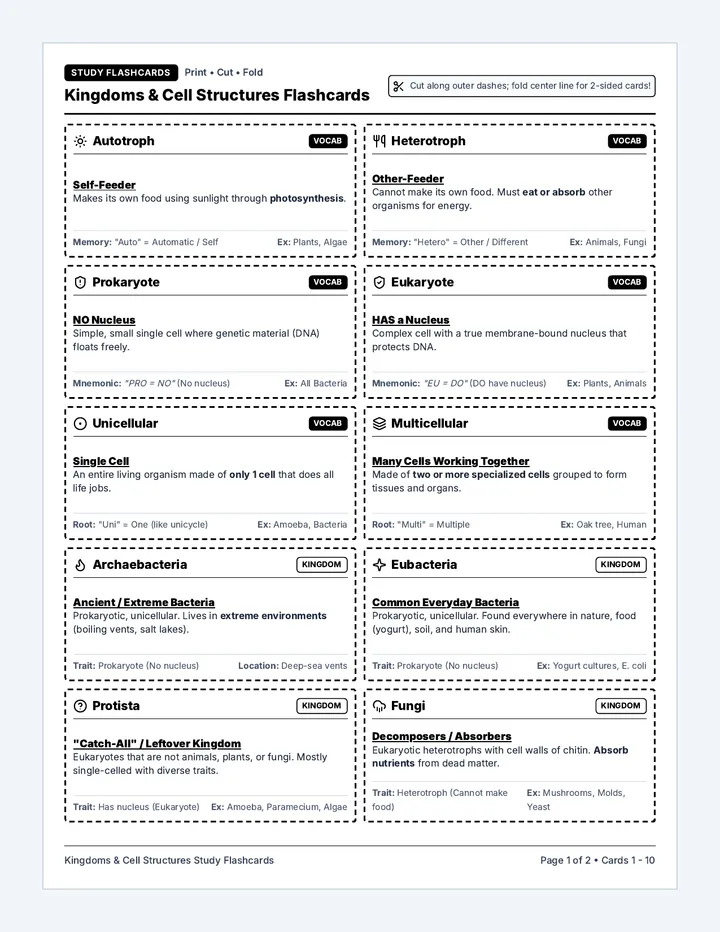
Protista
Kingdom
"Catch-All" / Leftover Kingdom
Eukaryotes that are not animals, plants, or fungi. Mostly single-celled with diverse traits.
Trait: Has nucleus (Eukaryote) Ex: Amoeba, Paramecium, Algae
Fungi
Kingdom
Decomposers / Absorbers
Eukaryotic heterotrophs with cell walls of chitin. Absorb nutrients from dead matter.
Trait: Heterotroph (Cannot make food) Ex: Mushrooms, Molds, Yeast
Kingdoms & Cell Structures Study Flashcards Page 1 of 2 • Cards 1 - 10
Study Flashcards Organelles & Final Kingdoms
Cut along outer dashes; fold center line for 2-sided cards!
Plantae
Kingdom
Multicellular Autotrophs
Uses chloroplasts for photosynthesis. Rigid cell walls made of cellulose.
Special: Cell Wall & Chloroplasts Ex: Trees, Ferns, Grass
Animalia
Kingdom
Multicellular Heterotrophs
Eukaryotic consumers. ONLY kingdom where NO members have cell walls!
Key Fact: ZERO cell walls Ex: Birds, Fish, Humans
Nucleus
Organelle
"Control Center" / Brain
Houses and protects DNA (genetic material). Directs all cell activities.
Analogy: Main Office / Brain In: Plants & Animals
Mitochondria
Organelle
"Powerhouse of the Cell"
Breaks down glucose food to produce usable energy (ATP) for the cell.
Analogy: Battery / Power Plant In: Plants & Animals
Cell Membrane
Organelle
Flexible Gatekeeper
Surrounds ALL cells. Regulates what materials enter and exit (homeostasis).
Analogy: Security Door / Gate In: ALL living cells
Cell Wall
Organelle
Rigid Outer Shield
Tough cellulose layer giving plants structure and shape. (Never in animals!)
Analogy: Cardboard Box / Armor In: Plants (NOT animals)
Chloroplast
Organelle
Solar Food Maker
Captures sunlight, water, and \(CO_2\) to produce sugar glucose (photosynthesis).
Analogy: Solar Panels / Kitchen In: Plants (NOT animals)
Vacuole
Organelle
Storage Tank
Stores water, nutrients, and waste. Plants have ONE giant central vacuole.
Analogy: Water Tower / Closet In: Plants (huge) & Animals
Endoplasmic Reticulum
Organelle
Delivery Highway System
Network of folded passageways that manufactures, modifies, and moves chemicals.
Analogy: Highway / Conveyor Belt In: Plants & Animals
Plant Only Structures
Rule
The Two C's of Plant Cells
Plant cells have TWO structures that animal cells NEVER have: 1. Cell Wall and 2. Chloroplast.
Memory Trick: The 2 C's Remember: Animal = No wall!
Kingdoms & Cell Structures Study Flashcards Page 2 of 2 • Cards 11 - 20