Cellular Power Study Guide
AP / Honors Biology Unit 3: Bioenergetics
Cellular Power Study Guide
Name:
Date: Per:
Thermodynamic Principle: Organisms couple exergonic catabolism (energy release) with endergonic anabolism (biosynthesis) via the intermediate energy currency ATP (\(\text{ATP} \rightleftharpoons \text{ADP} + \text{P}_i\), \(\Delta G^\circ \approx -30.5\text{ kJ/mol}\)).
1. Photosynthesis
Endergonic / Anabolic
\(6\text{CO}_2 + 6\text{H}_2\text{O} + \text{light} \rightarrow \text{C}_6\text{H}_{12}\text{O}_6 + 6\text{O}_2\)
Phase A: Light Reactions Thylakoid Membrane
- PS II (P680): Photolysis of \(2\text{H}_2\text{O} \rightarrow 4\text{H}^+ + 4e^- + \text{O}_2\). Excited \(e^-\) pass down ETC.
- Proton Gradient: \(H^+\) pumped into thylakoid lumen; chemiosmosis via ATP synthase drives ATP production into stroma.
- PS I (P700): Re-energized electrons reduce \(\text{NADP}^+ \rightarrow \text{NADPH}\).
Phase B: Calvin Cycle Chloroplast Stroma
- 1. Carbon Fixation: \(\text{CO}_2\) fixed to RuBP by RuBisCO.
- 2. Reduction: 3-PGA reduced to G3P using ATP & NADPH.
- 3. Regeneration: RuBP regenerated (requires ATP). Net: 3 \(\text{CO}_2\) \(\rightarrow\) 1 G3P.
Energy Flow: Solar photons \(\rightarrow\) Chemical bond energy (\(\text{ATP}/\text{NADPH}\)) \(\rightarrow\) G3P / Glucose.
2. Cellular Respiration
Exergonic / Catabolic
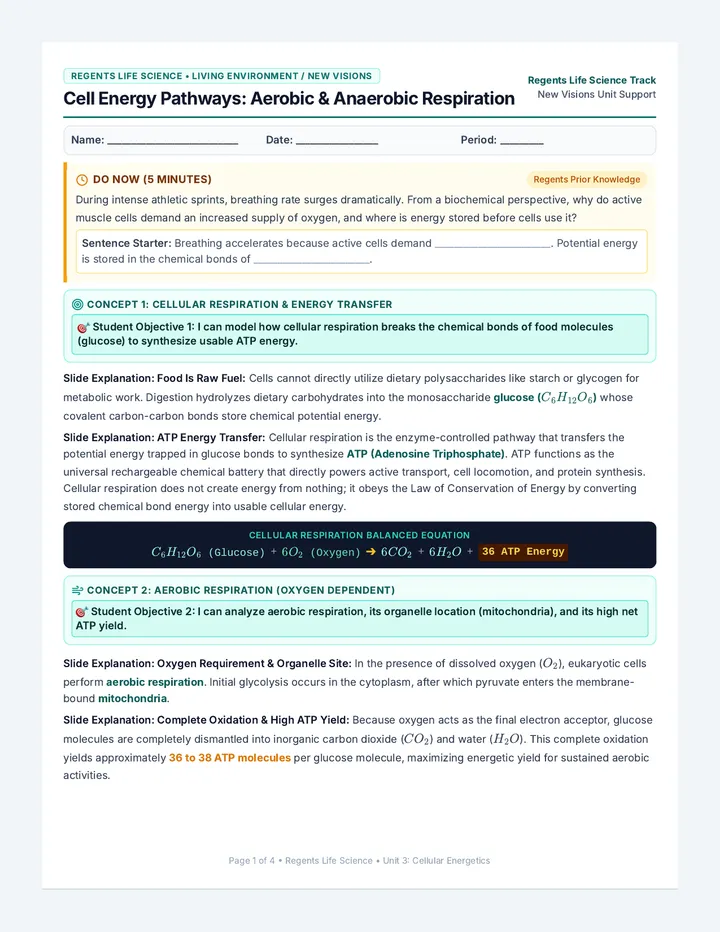
\(\text{C}_6\text{H}_{12}\text{O}_6 + 6\text{O}_2 \rightarrow 6\text{CO}_2 + 6\text{H}_2\text{O} + 30\text{--}32\text{ ATP}\)
1. Glycolysis (Cytosol | Anaerobic): Glucose split into 2 Pyruvate. Net yield: 2 ATP (substrate-level) + 2 NADH.
2. Pyruvate Oxidation (Matrix): Decarboxylated to Acetyl-CoA. Yields 1 \(\text{CO}_2\) + 1 NADH per pyruvate (\(\times 2\)).
3. Citric Acid (Krebs) Cycle (Matrix): Acetyl-CoA oxidized (2 turns/glucose): yields 2 ATP/GTP, 6 NADH, 2 \(\text{FADH}_2\), 4 \(\text{CO}_2\).
4. Oxidative Phosphorylation (Cristae): ETC pumps \(H^+\) to intermembrane space. Chemiosmosis yields ~26–28 ATP. \(O_2\) is terminal \(e^-\) acceptor.
Energy Flow: Fuel bonds \(\rightarrow\) Reduced carriers (\(\text{NADH}/\text{FADH}_2\)) \(\rightarrow\) Proton gradient \(\rightarrow\) ATP.
Essential High School Biology Terminology
Chemiosmosis
Diffusion of \(H^+\) down an electrochemical gradient across a membrane to power ATP synthase.
Proton-Motive Force
The combined chemical and electrical potential energy stored across cristae or thylakoid membranes.
Photolysis
Enzymatic splitting of water by light energy at Photosystem II, supplying replacement electrons and \(O_2\).
Substrate-Level Phos.
Direct enzymatic transfer of phosphate from a metabolic intermediate to ADP (Glycolysis & Krebs).
RuBisCO
Primary chloroplast enzyme that fixes atmospheric carbon dioxide onto RuBP to initiate the Calvin cycle.
Redox Coupling
Paired reactions where electron loss (oxidation) is directly linked to electron gain (reduction).
CELLULAR ENERGETICS • AP/HONORS STUDY DOSSIER PAGE 1 OF 2 • OVER FOR COMPARISON & APPLICATION
Synthesis, Comparative Analysis & Applications
Evaluate systemic relationships, anaerobic pathways, and experimental scenarios
UNIT 3 REVIEW
Master Comparative Matrix
| Feature | Photosynthesis | Cellular Respiration |
|---|
| Thermodynamics | Endergonic (\(+\Delta G\)); Anabolic build-up | Exergonic (\(-\Delta G\)); Catabolic breakdown |
| Primary Organelle | Chloroplast (Thylakoids & Stroma) | Mitochondria (Cristae & Matrix) + Cytosol |
| Electron Carriers | \(\text{NADP}^+ \rightleftharpoons \text{NADPH}\) (Phosphorylated) | \(\text{NAD}^+ \rightleftharpoons \text{NADH}\) and \(\text{FAD} \rightleftharpoons \text{FADH}_2\) |
| Terminal \(e^-\) Acceptor | \(\text{NADP}^+\) (forms NADPH in linear flow) | \(\text{O}_2\) (reduced to form \(\text{H}_2\text{O}\)) |
| Proton Reservoir | High \([H^+]\) inside Thylakoid Lumen (low pH) | High \([H^+]\) in Intermembrane Space |
Anaerobic Fermentation Pathways Absence of Final \(O_2\) Acceptor
Without \(O_2\), the mitochondrial ETC stalls. Fermentation yields 0 additional ATP; its vital purpose is to oxidize NADH back to \(NAD^+\) so glycolysis can continue generating 2 net ATP.
Lactic Acid: Pyruvate reduced directly by NADH to form Lactate (muscle cells, dairy bacteria). No \(\text{CO}_2\) released.
Alcoholic: Pyruvate converted to Acetaldehyde (\(\text{CO}_2\) released), then reduced to Ethanol (yeast brewing, baking).
Deep Application & AP-Style Free Response Prompts
Complete with precise biochemical reasoning
Scenario 1 (Mitochondrial Uncouplers): Dinitrophenol (DNP) makes the inner mitochondrial membrane leaky to protons (\(H^+\)), dissipating the proton gradient. Predict the effect on (a) oxygen consumption rate and (b) ATP synthesis rate. Justify.
Scenario 2 (Isotopic Tracing): Algae are cultured in water enriched with oxygen-18 (\(\text{H}_2{}^{18}\text{O}\)) and regular carbon dioxide (\(\text{C}^{16}\text{O}_2\)). Will the released \(O_2\) or the synthesized glucose contain the \({}^{18}\text{O}\) label? State the exact reaction mechanism.
Scenario 3 (Allosteric Control): High cellular concentrations of ATP and citrate allosterically inhibit phosphofructokinase-1 (PFK-1) in glycolysis. Explain the physiological advantage of this feedback inhibition to cellular energy homeostasis.
Review Mastery:
Light vs. Calvin Reactions 4 Respiration Stages Chemiosmosis & Gradients Fermentation \(NAD^+\) Cycling
CELLULAR ENERGETICS • AP/HONORS STUDY DOSSIER PAGE 2 OF 2 • HIGH SCHOOL BIOLOGY REVIEW