Cell Specialization Worksheet
Biology • TEKS BIO.6.B • Dr. Marsha Bolden
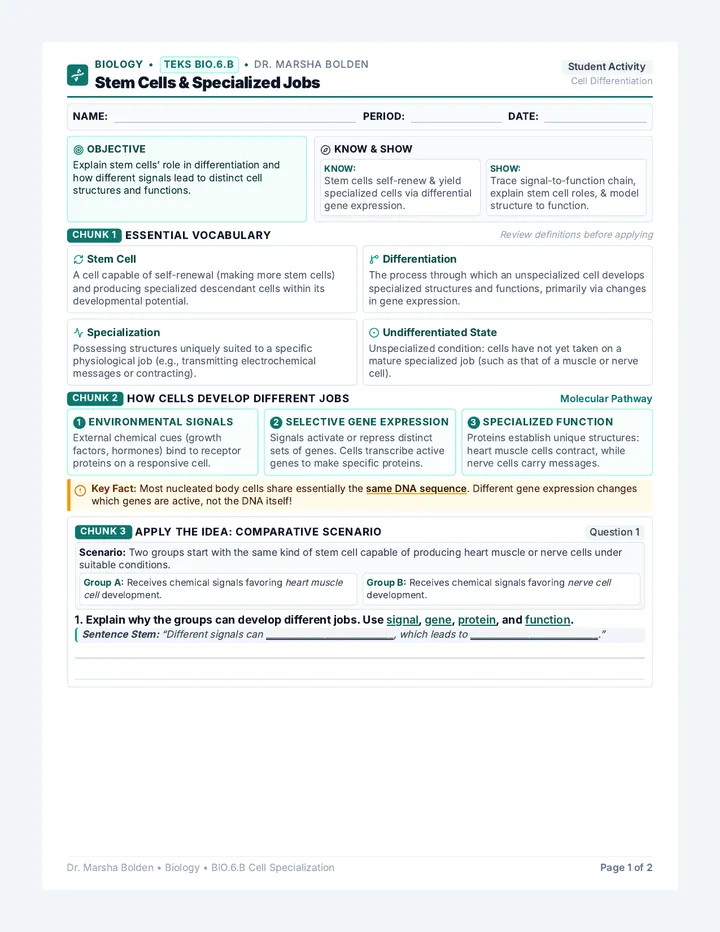
Stem Cells & Specialized Jobs
Student Activity Cell Differentiation
Name:
Period:
Date:
Objective
Explain stem cells’ role in differentiation and how different signals lead to distinct cell structures and functions.
Know & Show
KNOW: Stem cells self-renew & yield specialized cells via differential gene expression.
SHOW: Trace signal-to-function chain, explain stem cell roles, & model structure to function.
Chunk 1
Essential Vocabulary
Review definitions before applying
Stem Cell
A cell capable of self-renewal (making more stem cells) and producing specialized descendant cells within its developmental potential.
Differentiation
The process through which an unspecialized cell develops specialized structures and functions, primarily via changes in gene expression.
Specialization
Possessing structures uniquely suited to a specific physiological job (e.g., transmitting electrochemical messages or contracting).
Undifferentiated State
Unspecialized condition: cells have not yet taken on a mature specialized job (such as that of a muscle or nerve cell).
Chunk 2
How Cells Develop Different Jobs
Molecular Pathway
1 Environmental Signals
External chemical cues (growth factors, hormones) bind to receptor proteins on a responsive cell.
2 Selective Gene Expression
Signals activate or repress distinct sets of genes. Cells transcribe active genes to make specific proteins.
3 Specialized Function
Proteins establish unique structures: heart muscle cells contract, while nerve cells carry messages.
Key Fact: Most nucleated body cells share essentially the same DNA sequence. Different gene expression changes which genes are active, not the DNA itself!
Chunk 3
Apply the Idea: Comparative Scenario
Question 1
Scenario: Two groups start with the same kind of stem cell capable of producing heart muscle or nerve cells under suitable conditions.
Group A: Receives chemical signals favoring heart muscle cell development.
Group B: Receives chemical signals favoring nerve cell development.
1. Explain why the groups can develop different jobs. Use signal, gene, protein, and function.
Sentence Stem: “Different signals can ____________________________, which leads to ____________________________.”
Dr. Marsha Bolden • Biology • BIO.6.B Cell Specialization Page 1 of 2
Part 2: Visual Modeling & Synthesis • TEKS BIO.6.B
My Specialized Cell Model
Think silently for 45s first
Name:
2. Choose a nerve cell or heart muscle cell. Draw a large model. Label the cell type, a signaling cue, a gene-use change, and one structure that helps its function. Connect labels with arrows.
Cell Type:
Signal:
[ Diagram Canvas: Sketch Cell Structure & Annotation Arrows ] Microscopic View
Signal may be hypothetical. Connect signals → gene-use change → specialized structure → job.
My structure helps the cell’s job because:
Summary
Key Understanding
2–3 Sentences
3. In 2–3 sentences, explain stem cells’ role and how signals can lead to different jobs. Include self-renewal and differentiation.
Exit Ticket
Misconception Evaluation
Work Independently
4. A student says: “A nerve cell and heart muscle cell must have different DNA because they have different jobs.” Evaluate the claim and explain.
Stem: “I agree / disagree because _____________________________________________________”
Student Self Check
Mark Yes / Not yet for each Show criterion
Explained how signals affect genes, proteins, and cell function.
Explained self-renewal and differentiation.
My model connects a labeled structure to its function.
Confidence: 0: Need help 1: With support 2: Independently 3: Explain with evidence
My Level:
Dr. Marsha Bolden • Biology • BIO.6.B Cell Specialization Page 2 of 2
Spanish Cell Specialization Worksheet
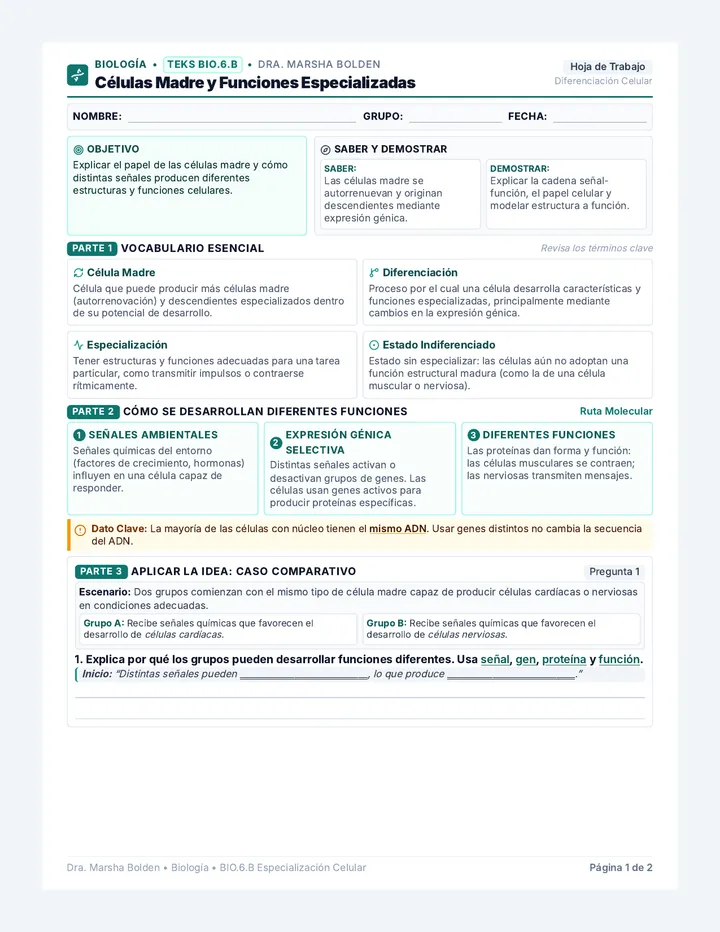
Biología • TEKS BIO.6.B • Dra. Marsha Bolden
Células Madre y Funciones Especializadas
Hoja de Trabajo Diferenciación Celular
Nombre:
Grupo:
Fecha:
Objetivo
Explicar el papel de las células madre y cómo distintas señales producen diferentes estructuras y funciones celulares.
Saber y Demostrar
SABER: Las células madre se autorrenuevan y originan descendientes mediante expresión génica.
DEMOSTRAR: Explicar la cadena señal-función, el papel celular y modelar estructura a función.
Parte 1
Vocabulario Esencial
Revisa los términos clave
Célula Madre
Célula que puede producir más células madre (autorrenovación) y descendientes especializados dentro de su potencial de desarrollo.
Diferenciación
Proceso por el cual una célula desarrolla características y funciones especializadas, principalmente mediante cambios en la expresión génica.
Especialización
Tener estructuras y funciones adecuadas para una tarea particular, como transmitir impulsos o contraerse rítmicamente.
Estado Indiferenciado
Estado sin especializar: las células aún no adoptan una función estructural madura (como la de una célula muscular o nerviosa).
Parte 2
Cómo se Desarrollan Diferentes Funciones
Ruta Molecular
1 Señales Ambientales
Señales químicas del entorno (factores de crecimiento, hormonas) influyen en una célula capaz de responder.
2 Expresión Génica Selectiva
Distintas señales activan o desactivan grupos de genes. Las células usan genes activos para producir proteínas específicas.
3 Diferentes Funciones
Las proteínas dan forma y función: las células musculares se contraen; las nerviosas transmiten mensajes.
Dato Clave: La mayoría de las células con núcleo tienen el mismo ADN. Usar genes distintos no cambia la secuencia del ADN.
Parte 3
Aplicar la Idea: Caso Comparativo
Pregunta 1
Escenario: Dos grupos comienzan con el mismo tipo de célula madre capaz de producir células cardíacas o nerviosas en condiciones adecuadas.
Grupo A: Recibe señales químicas que favorecen el desarrollo de células cardíacas.
Grupo B: Recibe señales químicas que favorecen el desarrollo de células nerviosas.
1. Explica por qué los grupos pueden desarrollar funciones diferentes. Usa señal, gen, proteína y función.