Sarcomere Showdown Skeleton Notes
Sarcomere Showdown
SKELETON NOTES • CRASH COURSE ANATOMY & PHYSIOLOGY #21: ATHLETIC PHYSIOLOGY
Name:
Date:
Class/Period:
Athletic Cues
As you watch the video, record notes connecting cellular biology to actual athletic performance and strength gains.
Force Output:
How does our central nervous system regulate total lifting power?
Muscle Wrappings:
Why do muscle sheaths matter for transferring force to our bones?
Hydration & Cramps:
Why are calcium and electrolytes so crucial for high-intensity training?
Video Guide
Pay close attention to motor units and nerve triggers at 2:30 to 4:45!
STAGE 1
The Three Muscle Types: Functional Roles
Skeletal (The Engine)
Striated, voluntary. Moves bones. The primary target of training.
Cardiac (The Pump)
Striated, involuntary. Highly resistant to fatigue. Optimized by conditioning.
Smooth (The Regulator)
Involuntary, non-striated. Regulates blood pressure by dilating or contracting internal blood .
HIERARCHY
Force Transfer & Connective Tissue
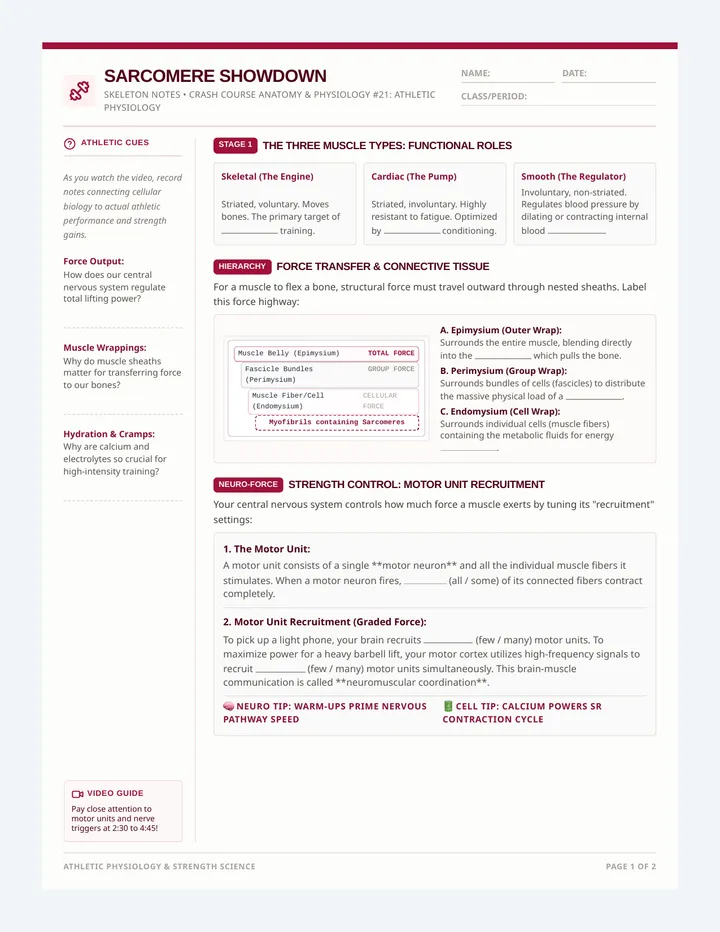
For a muscle to flex a bone, structural force must travel outward through nested sheaths. Label this force highway:
Muscle Belly (Epimysium) TOTAL FORCE
Fascicle Bundles (Perimysium) GROUP FORCE
Muscle Fiber/Cell (Endomysium) CELLULAR FORCE
Myofibrils containing Sarcomeres
A. Epimysium (Outer Wrap):
Surrounds the entire muscle, blending directly into the which pulls the bone.
B. Perimysium (Group Wrap):
Surrounds bundles of cells (fascicles) to distribute the massive physical load of a .
C. Endomysium (Cell Wrap):
Surrounds individual cells (muscle fibers) containing the metabolic fluids for energy .
NEURO-FORCE
Strength Control: Motor Unit Recruitment
Your central nervous system controls how much force a muscle exerts by tuning its "recruitment" settings:
1. The Motor Unit:
A motor unit consists of a single **motor neuron** and all the individual muscle fibers it stimulates. When a motor neuron fires, (all / some) of its connected fibers contract completely.
2. Motor Unit Recruitment (Graded Force):
To pick up a light phone, your brain recruits (few / many) motor units. To maximize power for a heavy barbell lift, your motor cortex utilizes high-frequency signals to recruit (few / many) motor units simultaneously. This brain-muscle communication is called **neuromuscular coordination**.
🧠 Neuro tip: Warm-ups prime nervous pathway speed 🔋 Cell tip: Calcium powers SR contraction cycle
ATHLETIC PHYSIOLOGY & STRENGTH SCIENCE PAGE 1 OF 2
Sarcomere Showdown
SKELETON NOTES • CRASH COURSE ANATOMY & PHYSIOLOGY #21: ATHLETIC PHYSIOLOGY
Unit: Muscle Hypertrophy
Part 2: Sarcomeres & Growth
Athletic Cues
Record structural principles linking cross-bridge cycling to physical power output.
The Fuel Source:
What are the immediate energy sources that power the power stroke?
Muscle Growth:
How does progressive resistance training alter sarcomere structure?
Gym Science
- Hypertrophy (Cell growth)
- Micro-tears (Stimulus)
- Actin-Myosin Overlap
- Cross-Bridge Density
STAGE 2
Filament Density & Force Output
Strength is determined by the number of active **cross-bridges** (connections between Myosin and Actin) formed simultaneously:
Actin (Thin Filament)
Bound to Z-lines. Anchors tropomyosin shields. Higher protein availability means (more / less) potential binding paths.
Myosin (Thick Filament)
Heavy fibers studded with active power heads. Progressive resistance training increases thick filament density for (greater / lower) force production.
ADAPTATION
The Growth Loop: From Gym to Sarcomere
Strength gains depend on a continuous bio-feedback loop. Sequence these steps from 1 to 4:
A
Micro-Damage (Stimulus): Heavy lifting (resistance close to mechanical failure) causes microscopic tears in the muscle cell's membrane, known as the , and physical structures of the sarcomeres.
B
Protein Synthesis (Recovery): During sleep and rest, with adequate dietary protein, the body triggers cellular repair pathways. Ribosomes synthesize new and proteins to reinforce the damaged myofibrils.
C
Mechanical Tension (The Workout): High physical strain forces Myosin heads to pull with maximum force against Actin. This intense cross-bridge binding triggers chemical stress signals inside the cell's .
D
Hypertrophy (Strength Gains): Myofibrils pack together with denser protein filaments, making the muscle cell thicker and increasing potential force output. This expansion of the muscle's cross-sectional area is called .
Training Sequence:
Step 1: _____ Step 2: _____ Step 3: _____ Step 4: _____
Cornell Summary: Biology of Athletic Optimization
Explain how understanding motor unit recruitment and sarcomere micro-damage (micro-tears) helps an athlete optimize their training loads (tension), nutritional timing, and sleep for maximum strength adaptation.
ATHLETIC PHYSIOLOGY & STRENGTH SCIENCE PAGE 2 OF 2
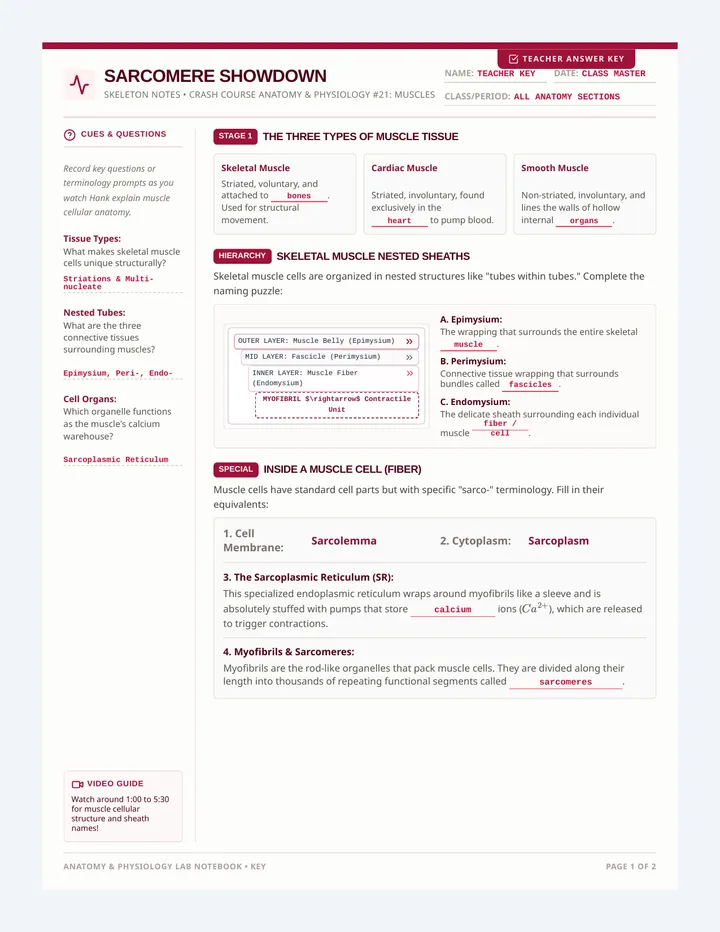
Sarcomere Showdown Answer Key
Teacher Answer Key
Sarcomere Showdown
SKELETON NOTES • CRASH COURSE ANATOMY & PHYSIOLOGY #21: MUSCLES
Name: TEACHER KEY
Date: CLASS MASTER
Class/Period: ALL ANATOMY SECTIONS
Cues & Questions
Record key questions or terminology prompts as you watch Hank explain muscle cellular anatomy.
Tissue Types:
What makes skeletal muscle cells unique structurally?
Striations & Multi-nucleate
Nested Tubes:
What are the three connective tissues surrounding muscles?
Epimysium, Peri-, Endo-
Cell Organs:
Which organelle functions as the muscle's calcium warehouse?
Sarcoplasmic Reticulum
Video Guide
Watch around 1:00 to 5:30 for muscle cellular structure and sheath names!
STAGE 1
The Three Types of Muscle Tissue
Skeletal Muscle
Striated, voluntary, and attached to bones. Used for structural movement.
Cardiac Muscle
Striated, involuntary, found exclusively in the heart to pump blood.
Smooth Muscle
Non-striated, involuntary, and lines the walls of hollow internal organs.
HIERARCHY
Skeletal Muscle Nested Sheaths
Skeletal muscle cells are organized in nested structures like "tubes within tubes." Complete the naming puzzle:
OUTER LAYER: Muscle Belly (Epimysium)
MID LAYER: Fascicle (Perimysium)
INNER LAYER: Muscle Fiber (Endomysium)
MYOFIBRIL $\rightarrow$ Contractile Unit
A. Epimysium:
The wrapping that surrounds the entire skeletal muscle.
B. Perimysium:
Connective tissue wrapping that surrounds bundles called fascicles.
C. Endomysium:
The delicate sheath surrounding each individual muscle fiber / cell.
SPECIAL
Inside a Muscle Cell (Fiber)
Muscle cells have standard cell parts but with specific "sarco-" terminology. Fill in their equivalents:
1. Cell Membrane: Sarcolemma
2. Cytoplasm: Sarcoplasm
3. The Sarcoplasmic Reticulum (SR):
This specialized endoplasmic reticulum wraps around myofibrils like a sleeve and is absolutely stuffed with pumps that store calcium ions (\(Ca^{2+}\)), which are released to trigger contractions.
4. Myofibrils & Sarcomeres:
Myofibrils are the rod-like organelles that pack muscle cells. They are divided along their length into thousands of repeating functional segments called sarcomeres.