Matter Morphers Worksheet
Science Homework • NC PS.5.1
Matter Morphers
Name:
Date:
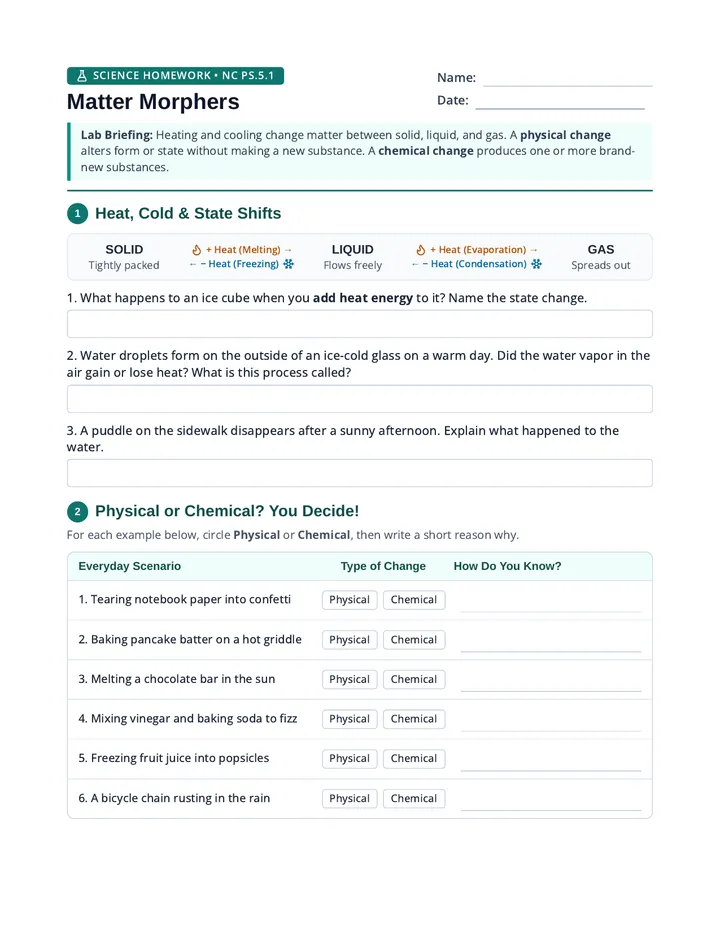
Lab Briefing: Heating and cooling change matter between solid, liquid, and gas. A physical change alters form or state without making a new substance. A chemical change produces one or more brand-new substances.
1
Heat, Cold & State Shifts
SOLID
Tightly packed
+ Heat (Melting) → ← − Heat (Freezing)
LIQUID
Flows freely
+ Heat (Evaporation) → ← − Heat (Condensation)
GAS
Spreads out
1. What happens to an ice cube when you add heat energy to it? Name the state change.
2. Water droplets form on the outside of an ice-cold glass on a warm day. Did the water vapor in the air gain or lose heat? What is this process called?
3. A puddle on the sidewalk disappears after a sunny afternoon. Explain what happened to the water.
2
Physical or Chemical? You Decide!
For each example below, circle Physical or Chemical, then write a short reason why.
Everyday Scenario
Type of Change
How Do You Know?
1. Tearing notebook paper into confetti
Physical Chemical
2. Baking pancake batter on a hot griddle
Physical Chemical
3. Melting a chocolate bar in the sun
Physical Chemical
4. Mixing vinegar and baking soda to fizz
Physical Chemical
5. Freezing fruit juice into popsicles
Physical Chemical
6. A bicycle chain rusting in the rain
Physical Chemical
Matter Morphers • Page 2 NC Standard PS.5.1
3
Clue Hunters: Signs of a Chemical Change
Circle the best answer for each question. Look for clues that a new substance formed!
1. You snap a glow stick, and it suddenly begins to shine bright green without batteries. Which clue shows a chemical change took place?
A. A solid melted into a liquid
B. Light was given off
C. The plastic changed shape
D. Water evaporated into the air
2. Milk left out of the refrigerator for a week smells sour and forms thick white lumps. Which clues show a new substance formed?
A. Change in size and freezing
B. Melting and dissolving
C. New odor and a solid forming
D. Boiling and changing shape
3. Which of the following is a physical change, NOT a chemical change?
A. A silver spoon tarnishing black
B. Sugar dissolving in warm tea
C. Fireworks exploding in the sky
D. Wood burning into ash and smoke
4
Kitchen Lab Challenge
Use what you know about states of matter, physical changes, and chemical changes to circle the best answer.
4. You put a slice of bread in a toaster until it turns crispy brown, then spread cold butter on it so the butter melts. Which statement is true?
A. The butter melting is a chemical change because it turns into a liquid.
B. The bread toasting brown is a physical change because it only changes shape.
C. The butter melting is a physical change because it is still butter, just in liquid form.
D. Both the bread toasting and the butter melting are chemical changes.
5. While boiling water on the stove for pasta, you see steam rising from the pot. What caused the liquid water to change into a gas?
A. Removing heat energy caused the water to condense.
B. Adding heat energy caused the water to evaporate.
C. Mixing the water with air caused a chemical reaction.
D. Cooling the pot caused the water to freeze.
Before Turning This In — Check Your Understanding:
I can explain how heat changes solids, liquids, and gases.
I can tell physical changes apart from chemical changes.
I can spot clues that a new substance formed.
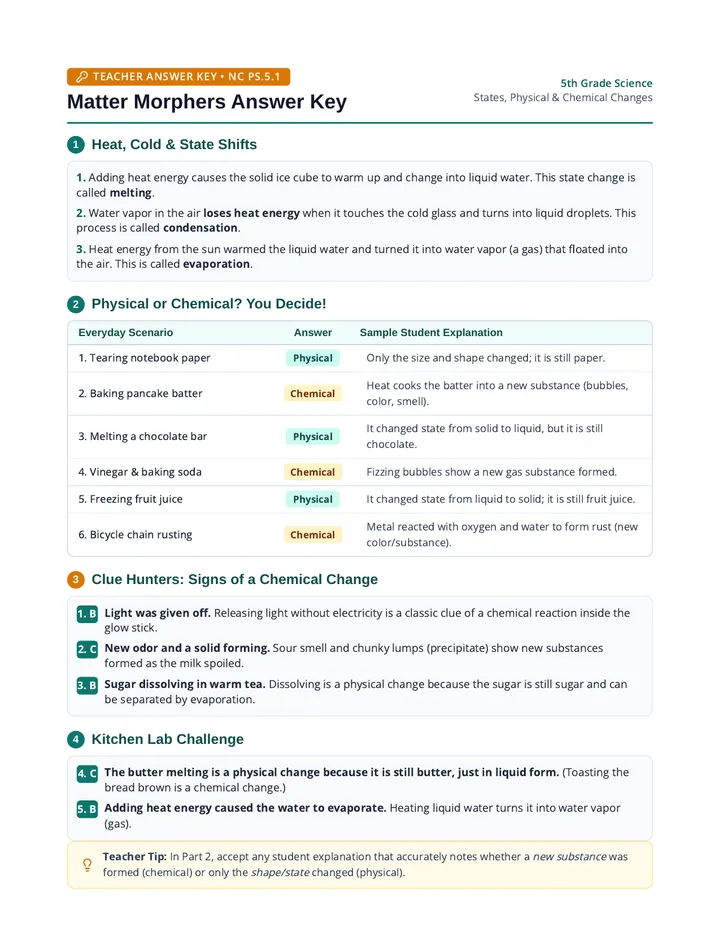
Matter Morphers Answer Key
Teacher Answer Key • NC PS.5.1
Matter Morphers Answer Key
5th Grade Science
States, Physical & Chemical Changes
1
Heat, Cold & State Shifts
-
Adding heat energy causes the solid ice cube to warm up and change into liquid water. This state change is called melting.
-
Water vapor in the air loses heat energy when it touches the cold glass and turns into liquid droplets. This process is called condensation.
-
Heat energy from the sun warmed the liquid water and turned it into water vapor (a gas) that floated into the air. This is called evaporation.
2
Physical or Chemical? You Decide!
Everyday Scenario
Answer
Sample Student Explanation
1. Tearing notebook paper
Physical
Only the size and shape changed; it is still paper.
2. Baking pancake batter
Chemical
Heat cooks the batter into a new substance (bubbles, color, smell).
3. Melting a chocolate bar
Physical
It changed state from solid to liquid, but it is still chocolate.
4. Vinegar & baking soda
Chemical
Fizzing bubbles show a new gas substance formed.
5. Freezing fruit juice
Physical
It changed state from liquid to solid; it is still fruit juice.
6. Bicycle chain rusting
Chemical
Metal reacted with oxygen and water to form rust (new color/substance).
3
Clue Hunters: Signs of a Chemical Change
1. B Light was given off. Releasing light without electricity is a classic clue of a chemical reaction inside the glow stick.
2. C New odor and a solid forming. Sour smell and chunky lumps (precipitate) show new substances formed as the milk spoiled.
3. B Sugar dissolving in warm tea. Dissolving is a physical change because the sugar is still sugar and can be separated by evaporation.
4
Kitchen Lab Challenge
4. C The butter melting is a physical change because it is still butter, just in liquid form. (Toasting the bread brown is a chemical change.)
5. B Adding heat energy caused the water to evaporate. Heating liquid water turns it into water vapor (gas).
Teacher Tip: In Part 2, accept any student explanation that accurately notes whether a new substance was formed (chemical) or only the shape/state changed (physical).