Lenny.com
Explore
Create
ActivitiesNewMathEnglish Language ArtsScience & EngineeringSocial StudiesGlobal LanguagesHealth & Physical EducationSpecial EducationCounseling & Life SkillsArts & CreativityESL
Lenny.com
Lenny.com
Explore
Create
ActivitiesNewMathEnglish Language ArtsScience & EngineeringSocial StudiesGlobal LanguagesHealth & Physical EducationSpecial EducationCounseling & Life SkillsArts & CreativityESL
Lenny.com
Lenny.com

Solutions

Lenny for EducatorsLenny for SchoolsLenny for Districts

Product

ExploreSign inCreateSupportAbout

Resources

Getting startedMTSS Acceleration Program

© 2026 Lenny Learning Inc.

TermsPrivacyAccessibility
LinkedInInstagramX
Lenny
Science & EngineeringLife ScienceLiving ThingsAnimalsPlantsBody SystemsTraitsAdaptationsCellsEcosystemsHeredityGenes to TraitsCell DivisionPhysicsComparing MaterialsShapes and PropertiesMagnetsMagnetismLightSoundLight and SoundMatterStates of MatterChanges of StateMixturesPhysical and Chemical ChangeHeating and CoolingHeat and Thermal EnergyEnergyForce and MotionElectrical CircuitsAtoms and MoleculesPeriodic TableMotion in One DimensionMotion in Two DimensionsScalars and VectorsForces and Laws of MotionCircular Motion and GravityMomentum and ImpulseWork, Energy, and PowerWavesElectromagnetic WavesGeometric OpticsElectricity and MagnetismSimple Harmonic MotionThermodynamicsNuclear PhysicsEarth Science & AstronomyWeatherWater CycleRocks and MineralsFossilsEarth's FeaturesEarth's ResourcesEarth's StructureWeather and ClimateEarth EventsFossils and Geologic TimePlate TectonicsHuman ImpactsAstronomyChemistryUnits and MeasurementAtomic StructurePeriodic TrendsChemical BondingNomenclatureMolecular StructureIntermolecular ForcesThe MoleStoichiometryProperties of GasesSolutionsChemical ReactionsBalancing EquationsEnergy ChangesRates of ReactionsEquilibriumAcids and BasesQuantum ModelBiologyClassificationCell StructureThe Chemistry of LifeBiomoleculesCellular TransportCell EnergyCell Growth and DivisionDNAProtein SynthesisMeiosis and Sexual ReproductionPatterns of InheritanceMulticellular OrganismsEvolutionEcologyBiodiversityComputer ScienceAlgorithms and Computational ThinkingProgramming LanguagesComputing SystemsNetworks and InternetData AnalysisCybersecurityAI and Machine LearningSoftware Design and DevelopmentBlockchainEngineering & AIDesigning ExperimentsEngineering PracticesDesign ThinkingEngineering Design ProcessMechanical EngineeringElectrical EngineeringMaterials and StructuresCAD and 3D DesignRoboticsArtificial Intelligence BasicsVibe CodingMachine LearningAI Ethics and SocietySystems ThinkingEntrepreneurship & InnovationEntrepreneurial MindsetBusiness Idea DevelopmentBusiness Plan BasicsMarketing & Customer DiscoveryFinancial Management for Startups

Molecular Architecture

A high school Regents Life Science lesson exploring atomic structure, chemical bonding, and molecular energy storage in biological systems. Students analyze how subatomic particles form bonds, assemble essential macromolecules, and store potential energy in glucose and ATP.

Jjelterman

(3) They are both waste products of cellular respiration.

(4) They are both necessary to transfer information from the nucleus to the cytoplasm.

Part 3 Question 4 (Constructed Response)

NYS Living Environment Regents Exam • June 2015, Question 56

Explain why complex molecules, such as proteins and starches, must be broken down by digestion before they can be absorbed and utilized by body cells. [1]

NYS P-12 Science Learning Standards • Life Science: Biology Student Packet • Page 1 of 2 (Side A)

Ciencias de la Vida Regents de NYS • Unidad 1: Bioquímica

Arquitectura Molecular: Materia, Átomos y Enlaces

Página 1 de 2

Edición en Español • Reverso: English

Nombre del Estudiante:

Fecha:

Período:

Parte 1

Bloques de Construcción Elemental en Sistemas Vivos (CHNOPS)

Meta NYSSLS HS-LS1-6

ElementoSímboloe⁻ ValenciaEnlacesFunción Primaria en los Seres Vivos
CarbonoC44Forma cadenas, ramificaciones y anillos en las 4 macromoléculas orgánicas
HidrógenoH11Se une al carbono; transfiere protones y electrones en la bioenergética celular
OxígenoO62Presente en glúcidos, lípidos, proteínas, ácidos nucleicos; aceptor aerobio
NitrógenoN53Componente clave de los aminoácidos (proteínas) y las bases nitrogenadas
FósforoP53 o 5Forma cabezas hidrofílicas de fosfolípidos y enlaces de alta energía en ATP

Parte 2

Preguntas Auténticas de Exámenes Regents (Verbatim)

Archivos Oficiales de Living Environment de NYSED

Pregunta 1 Examen Regents Living Environment NYS • Junio 2010, Pregunta 3

¿Cuáles dos elementos deben estar presentes en una molécula para que la molécula se considere orgánica?

(1) carbono e hidrógeno

(2) carbono y oxígeno

(3) hidrógeno y oxígeno

(4) nitrógeno y carbono

Pregunta 2 Examen Regents Living Environment NYS • Junio 2017, Pregunta 3

¿Qué enunciado describe a los almidones, las grasas, las proteínas y el ADN?

(1) Se usan para almacenar información genética.

(2) Son moléculas complejas formadas a partir de moléculas más pequeñas.

(3) Se usan para ensamblar materiales inorgánicos más grandes.

(4) Son moléculas simples usadas para restablecer el equilibrio en el cuerpo.

Pregunta 3 Examen Regents Living Environment NYS • Junio 2015, Pregunta 3

¿Qué enunciado sobre los azúcares simples y los aminoácidos es correcto?

(1) Ambos son componentes químicos fundamentales de moléculas más grandes.

(2) Ambos son producidos por la acción de enzimas durante la fotosíntesis.

(3) Ambos son productos de desecho de la respiración celular.

(4) Ambos son necesarios para transferir información del núcleo al citoplasma.

Parte 3 Pregunta 4 (Respuesta Construida)

Examen Regents Living Environment NYS • Junio 2015, Pregunta 56

Explique por qué las moléculas complejas, tales como las proteínas y los almidones, deben descomponerse mediante la digestión antes de que puedan ser absorbidas y utilizadas por las células del cuerpo. [1]

Estándares de Ciencias P-12 de NYS • Ciencias de la Vida: Biología Paquete del Estudiante • Página 1 de 2 (Lado B)

NYS Regents Life Science • Unit 1: Biochemistry

Molecular Architecture: Synthesis & Bond Energy

Page 2 of 2

English Edition • Reverse: Español

Student Name:

Date:

Period:

Part 4

Dehydration Synthesis, Respiration & The ATP Bond Cycle

NYSSLS HS-LS1-7 Target

Dehydration Synthesis (Building Biomolecules)

Cells link simple monomers into complex polymers by removing water. Forges new covalent bonds and stores matter and potential energy.

ATP – ADP Cycle (Transferring Energy)

Chemical energy in food is transferred during cellular respiration into high-energy phosphate bonds in ATP: \(\text{ATP} \rightleftharpoons \text{ADP} + P_i\).

Part 5

Authentic Regents Examination Questions (Verbatim)

NYS Living Environment Archives

Question 5 NYS Living Environment Regents Exam • January 2016, Question 4

In all organisms, the chemical energy stored in food is used to produce

(1) oxygen

(2) DNA

(3) ATP

(4) carbon dioxide

Question 6 (Constructed Response) NYS Living Environment Regents Exam • June 2019, Question 57

Explain how the carbon atoms present in a carbon dioxide molecule in the atmosphere could become part of an amino acid molecule in an animal. [1]

Question 7 (Constructed Response) NYS Living Environment Regents Exam • August 2016, Question 57

State what happens to the energy stored in food molecules when the chemical bonds in food are broken during cellular respiration. [1]

Question 8 (Constructed Response) NYS Living Environment Regents Exam • June 2018, Question 58

State the relationship between the number of chemical bonds in an organic molecule and the amount of potential energy stored in the molecule. [1]

NYS P-12 Science Learning Standards • Life Science: Biology Student Packet • Page 2 of 2 (Side A)

Ciencias de la Vida Regents de NYS • Unidad 1: Bioquímica

Arquitectura Molecular: Síntesis y Energía de Enlace

Página 2 de 2

Edición en Español • Reverso: English

Nombre del Estudiante:

Fecha:

Período:

Parte 4

Síntesis por Deshidratación, Respiración y el Ciclo de Enlaces de ATP

Meta NYSSLS HS-LS1-7

Síntesis por Deshidratación (Construcción)

Las células unen monómeros simples para formar polímeros complejos al eliminar agua. Forma enlaces covalentes y almacena energía potencial.

Ciclo ATP – ADP (Transferencia de Energía)

La energía química de los alimentos se transfiere durante la respiración celular a los enlaces fosfato del ATP: \(\text{ATP} \rightleftharpoons \text{ADP} + P_i\).

Parte 5

Preguntas Auténticas de Exámenes Regents (Verbatim)

Archivos Oficiales de Living Environment de NYSED

Pregunta 5 Examen Regents Living Environment NYS • Enero 2016, Pregunta 4

En todos los organismos, la energía química almacenada en los alimentos se utiliza para producir

(1) oxígeno

(2) ADN

(3) ATP

(4) dióxido de carbono

Pregunta 6 (Respuesta Construida) Examen Regents Living Environment NYS • Junio 2019, Pregunta 57

Explique cómo los átomos de carbono presentes en una molécula de dióxido de carbono en la atmósfera podrían llegar a formar parte de una molécula de aminoácido en un animal. [1]

Pregunta 7 (Respuesta Construida) Examen Regents Living Environment NYS • Agosto 2016, Pregunta 57

Indique qué sucede con la energía almacenada en las moléculas de alimento cuando los enlaces químicos en el alimento se rompen durante la respiración celular. [1]

Pregunta 8 (Respuesta Construida) Examen Regents Living Environment NYS • Junio 2018, Pregunta 58

Indique la relación entre el número de enlaces químicos en una molécula orgánica y la cantidad de energía potencial almacenada en la molécula. [1]

Estándares de Ciencias P-12 de NYS • Ciencias de la Vida: Biología Paquete del Estudiante • Página 2 de 2 (Lado B)

Question 4 (Constructed Response) • June 2015, Question 56 [1 Credit] 1 Point Maximum

NYSED Official Rating Guide Acceptable Responses (Allow 1 credit for an acceptable explanation):

  • Large molecules such as starches and proteins are too large to pass through/diffuse across cell membranes.
  • Digestion breaks complex polymers into smaller, soluble building blocks (simple sugars and amino acids) that can enter the bloodstream and cells.
  • Molecules must be broken down to a size that allows them to diffuse into body cells for energy release and protein synthesis.

Do NOT allow credit for: Stating vaguely that “they have to be digested because they are food” or “they must be broken down to get smaller” without specifying membrane permeability or diffusion into cells.

New York State Education Department • Living Environment Rating Guide Reference Molecular Architecture Scoring Key • Page 1 of 2

NYS Regents Life Science • Teacher Resource

Molecular Architecture: Scoring Key & Rating Guide

Teacher Key

Page 2 of 2 • English Only

Focus Area: Energy Transfer, ATP Cycle & Constructed Response Scoring Rating Policy: Strict NYSED Criteria

Part 5

Student Packet Page 2 Solutions & Official Rubrics

Question 5 • NYS Living Environment January 2016, Question 4 Correct Answer: (3)

NYS Regents Rationale: Cellular respiration breaks down the chemical bonds of glucose and other food molecules to transfer potential energy into ATP molecules, which provide immediate energy for cellular processes.

Question 6 (Constructed Response) • June 2019, Question 57 [1 Credit] 1 Point Maximum

NYSED Official Rating Guide Acceptable Responses (Allow 1 credit for an acceptable explanation):

  • Plants take in \(CO_2\) during photosynthesis and use the carbon to make glucose. When animals eat the plant, the carbon is rearranged to form amino acids.
  • Carbon dioxide is fixed into organic sugars by autotrophs, which are then consumed by animals to build proteins.
  • Plants use carbon from \(CO_2\) to produce sugar, which an animal consumes; the carbon atoms are combined with nitrogen to synthesize amino acids.

Note: Student response must link the carbon from \(CO_2\) through autotrophic synthesis (photosynthesis/glucose) to animal ingestion/rearrangement.

Question 7 (Constructed Response) • August 2016, Question 57 [1 Credit] 1 Point Maximum

NYSED Official Rating Guide Acceptable Responses (Allow 1 credit for stating what happens to the energy):

  • The energy is transferred/used to produce ATP molecules.
  • It is stored in the chemical bonds of ATP.
  • The energy is released and some is used to make ATP and some is lost as heat.

Do NOT allow credit for: Saying energy is “created” or “destroyed” (violates conservation of energy).

Question 8 (Constructed Response) • June 2018, Question 58 [1 Credit] 1 Point Maximum

NYSED Official Rating Guide Acceptable Responses (Allow 1 credit for stating the relationship):

  • As the number of chemical bonds in an organic molecule increases, the amount of potential energy stored in the molecule increases.
  • Molecules with more bonds store more energy.
  • The more bonds a molecule has, the more energy it contains.
  • There is a direct relationship between bond count and stored chemical potential energy.

Common Regents Misconceptions to Address During Review

Students frequently confuse dehydration synthesis (linking monomers by removing water to store matter/energy) with hydrolysis (splitting polymers with water during digestion). Remind students that energy in cellular respiration is transferred into ATP rather than created anew, and that food does not “produce pure energy”—it produces ATP chemical bonds.

New York State Education Department • Living Environment Rating Guide Reference Molecular Architecture Scoring Key • Page 2 of 2

You might also like

Helix Studio Slides

Candy Code Sequence

A multi-day competency-based biology sequence exploring DNA architecture, complementary base pairing, and semi-conservative replication through tactile candy modeling and evidence-based assessment.

TM

Teri Minami

6
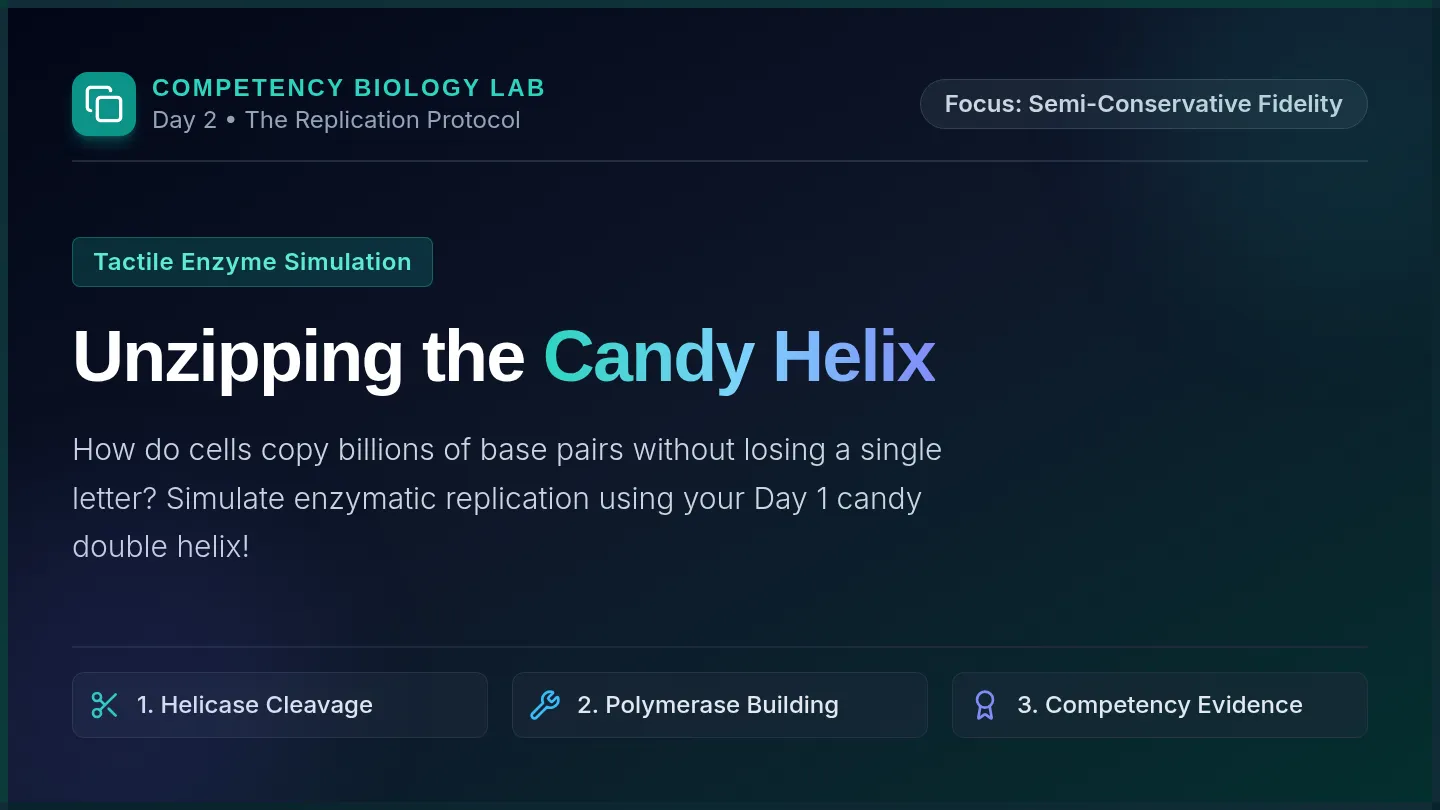
Replication Protocol Slides

Replication Protocol

Students simulate semi-conservative DNA replication by enzymatically unzipping candy strands and building complementary daughter helices, demonstrating competency through lab evidence and knowledge checks.

TM

Teri Minami

3
Grid to Plug Slides

Grid to Plug Slides

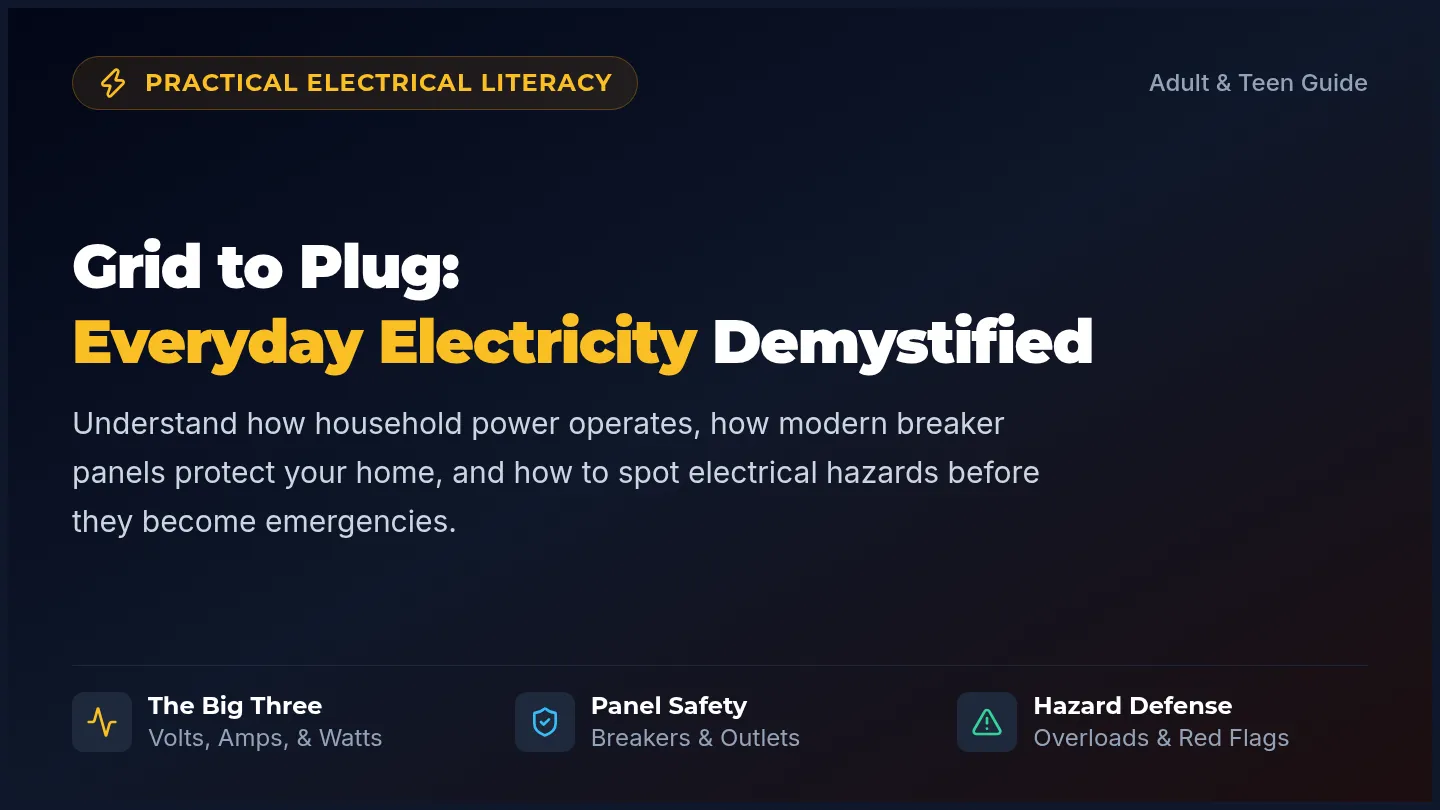
An engaging, practical 8-slide presentation designed for teens and adults covering home electricity fundamentals, including voltage and current, service panels, outlet anatomy, GFCI/AFCI protection, circuit overload limits, and critical safety rules.

JW

J Watson

Helix Studio Slides

Candy Code Sequence

A multi-day competency-based biology sequence exploring DNA architecture, complementary base pairing, and semi-conservative replication through tactile candy modeling and evidence-based assessment.

TM

Teri Minami

4
Helix Studio Slides

Helix Studio

Students dissect nucleotide anatomy and discover base pairing rules by engineering an accurate candy double helix model with complementary nitrogenous bases and sugar-phosphate backbones.

TM

Teri Minami

3
Replication Protocol Teacher Guide

Replication Protocol Teacher Guide

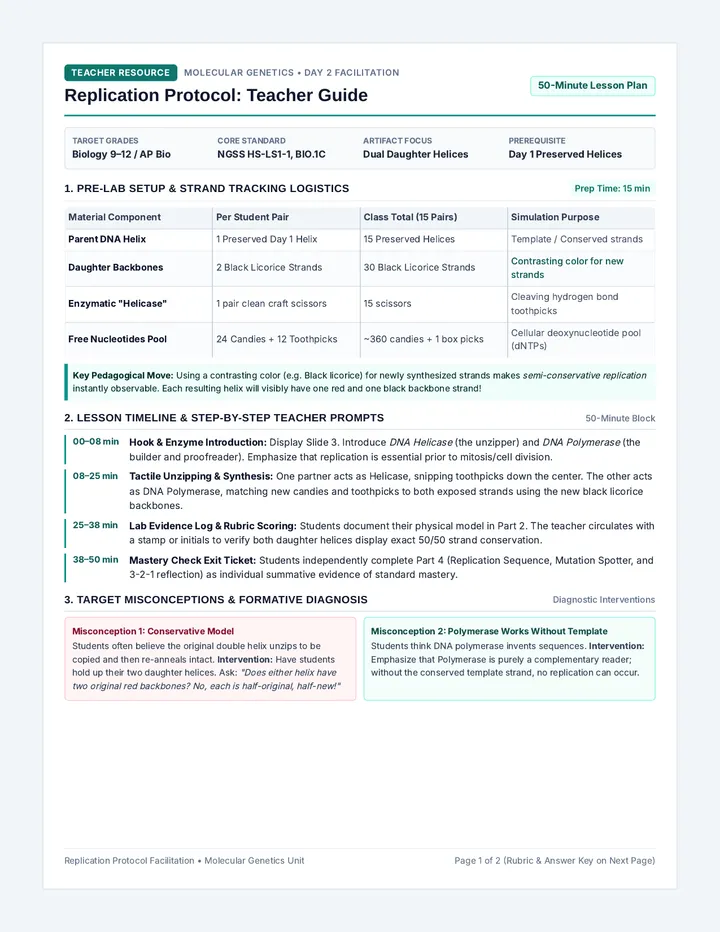
A complete 2-page teacher facilitation guide and rubric calibration key for Lesson 2 (Replication Protocol), detailing enzymatic unzipping logistics, strand tracking procedures, misconception remediation, and full answers for the competency assessment and exit ticket.

TM

Teri Minami

Broadcast Breakthroughs Slides

Broadcast Tech Spotlight

A dynamic multimedia project sequence where students investigate cutting-edge sports broadcasting technologies, craft scripted storyboards, and produce professional recorded voiceover presentations.

S

Stacy.Bogart

5
Chemical Bonding Foldable Activity

Chemical Bonding

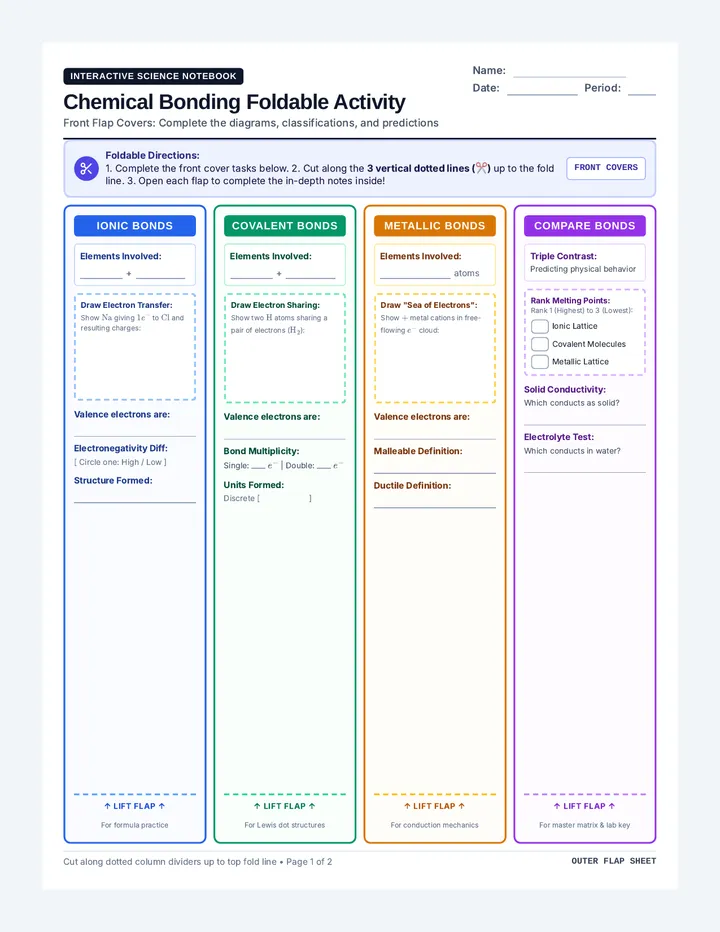
A foundational chemistry lesson exploring ionic, covalent, and metallic bonding through interactive modeling, detailed reference notes, and comparative property analysis.

OM

Olutoyin Makinde

3
Helix Studio Teacher Guide

Helix Studio Teacher Guide

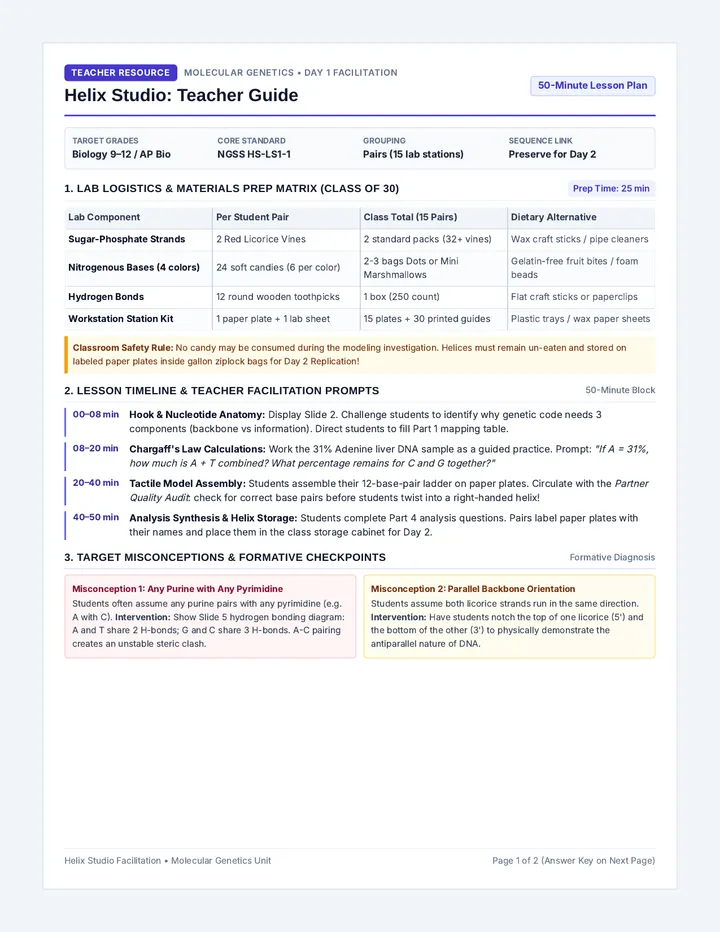
A comprehensive 2-page teacher facilitation guide and answer key for Lesson 1 (Helix Studio), featuring candy prep logistics, a 50-minute pacing timeline, misconception interventions, and complete mathematical and structural solutions for the student lab guide.

TM

Teri Minami

Building Blocks Slides

Atomic Foundations

A 3-part comprehensive scaffolded unit exploring matter, atomic architecture, subatomic particles, nuclear calculations, and atomic variations like ions and isotopes.

M

meagan_asp

6
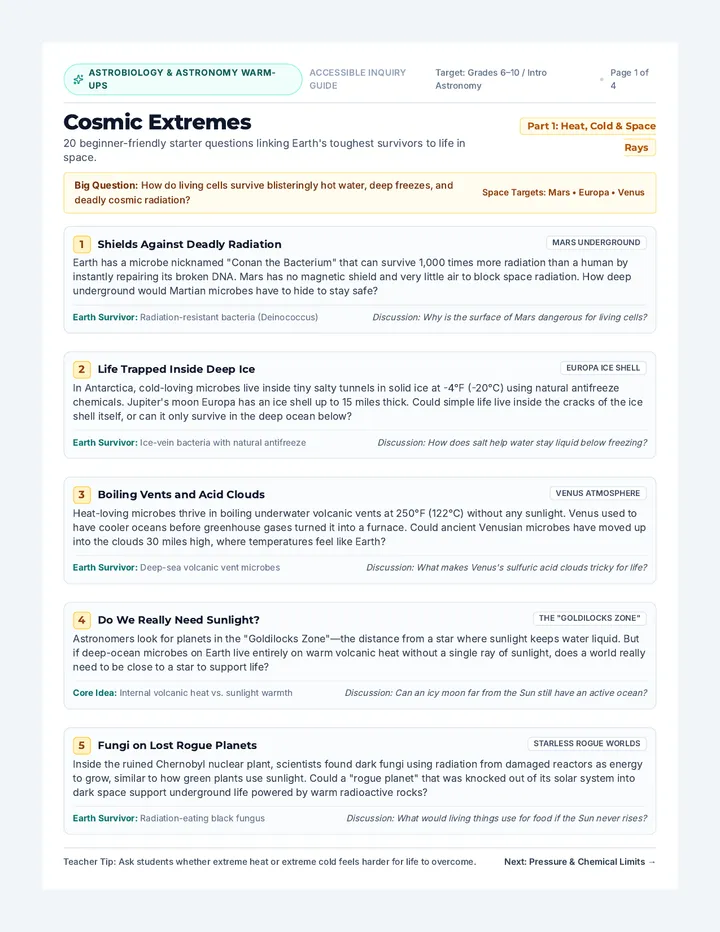
Cosmic Extremes Question Bank

Cosmic Extremes

An astrobiology exploration unit connecting Earth's most resilient extremophiles to planetary exploration across the solar system, habitable zones, and the search for alien life.

M

Megan.Tanner

3
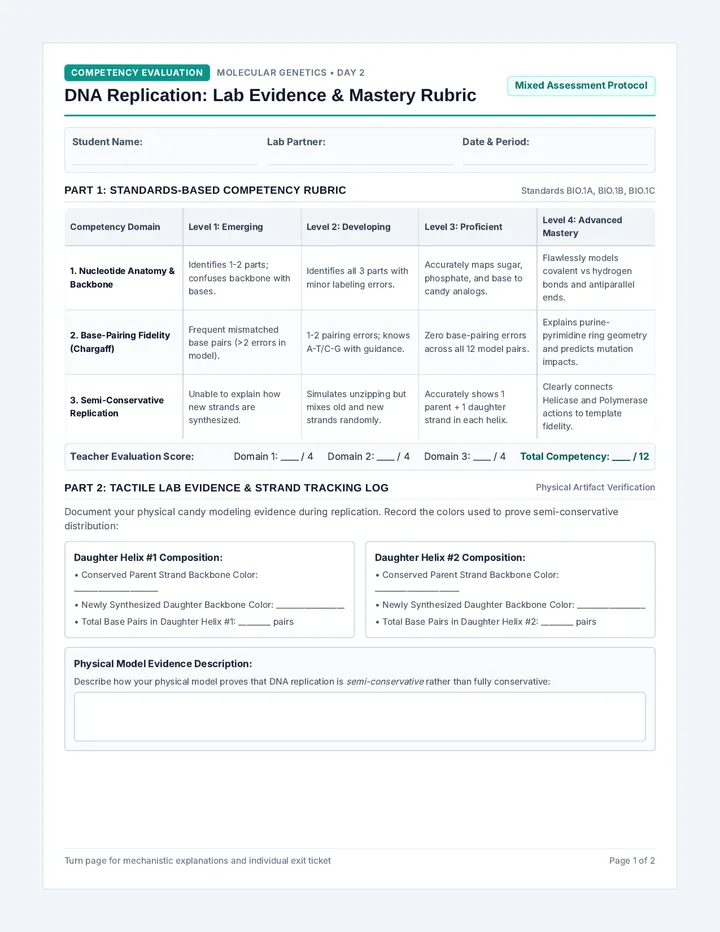
Replication Evidence Assessment

Replication Evidence Assessment

A multi-part competency assessment combining a 4-level standards rubric, tactile lab evidence documentation, mechanistic written explanations, and an individual exit ticket.

TM

Teri Minami