Scientist Clues Slides
Kindergarten Science Wonder
Science Notebooks
How Do Scientists Save Their Thoughts?
Brain ideas can vanish fast! Let's discover how scientists trap them on paper.
1. Draw
What eyes see
2. Count
Tallies & dots
3. Label
Key words
1
Way Number One
They Draw Pictures!
Look with scientist eyes
Shape & Color
Scientists don't need to be fancy artists. They draw the real shapes and colors!
"A drawing helps us remember before the bug crawls away!"
What a Scientist Notebook Looks Like:
🍃
Green Leaf
Has pointy edges!
🐞
Ladybug
6 tiny black spots!
Draw what is true, not just what is cute!
Turn to your neighbor: What would you draw first on a leaf?
2
Way Number Two
They Count and Track Numbers!
Numbers tell true clues
6
Count the Parts
How many legs? How many petals? How many seeds?
Ant = 6 Legs
||||
Make Quick Tallies
One line for each bird! Tick, tick, tick!
4 Birds in Tree
Compare Sizes
Big or tiny? Heavy or light? Taller than my hand?
3 Cubes Long
Let's count together: How many buttons are on your shirt right now?
3
Way Number Three
They Label with Words!
Arrows point the way
🍎
Scientist's Apple
Stem
Holds to the tree
Skin
Smooth & shiny red
Seed
Tucked deep inside
Even writing the first sound like "S" for Stem is real science!
Mission Time!
Your Turn, Little Scientists!
Grab your paper and crayons. Let's record our mystery object!
1
Look & Draw
What shape is it? Draw the outline carefully.
2
Color It Real
Match the crayon to what your eyes see!
3
Add a Mark
Write a number, initial, or first letter sound!
You are officially a Science Notebook Thinker!
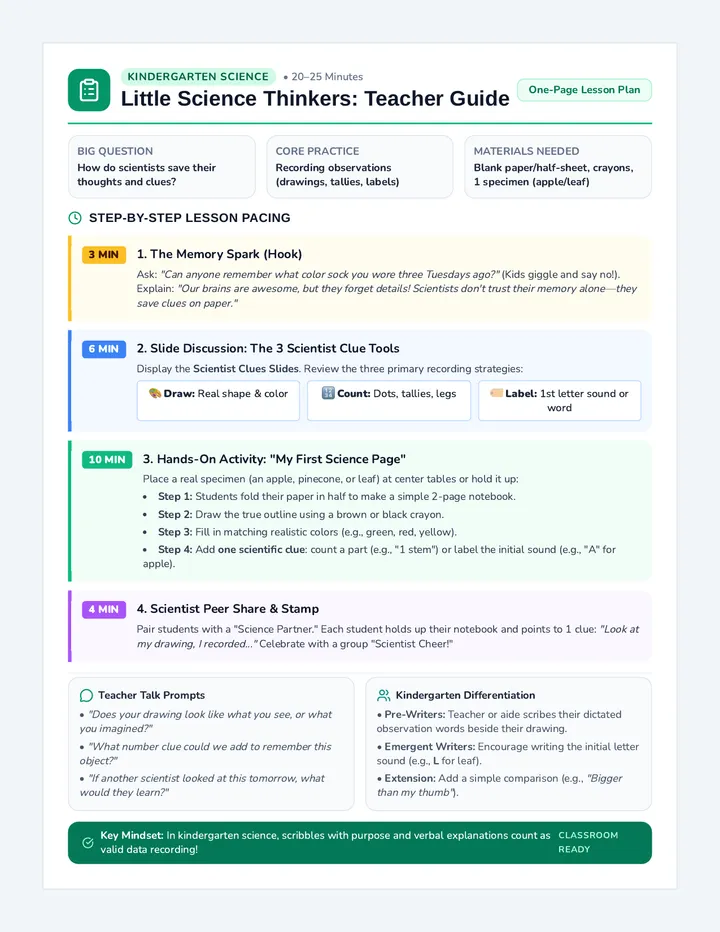
Scientist Clues Teacher Guide
Kindergarten Science • 20–25 Minutes
Little Science Thinkers: Teacher Guide
One-Page Lesson Plan
Big Question
How do scientists save their thoughts and clues?
Core Practice
Recording observations (drawings, tallies, labels)
Materials Needed
Blank paper/half-sheet, crayons, 1 specimen (apple/leaf)
Step-by-Step Lesson Pacing
3 Min
1. The Memory Spark (Hook)
Ask: "Can anyone remember what color sock you wore three Tuesdays ago?" (Kids giggle and say no!). Explain: "Our brains are awesome, but they forget details! Scientists don't trust their memory alone—they save clues on paper."
6 Min
2. Slide Discussion: The 3 Scientist Clue Tools
Display the Scientist Clues Slides. Review the three primary recording strategies:
🎨 Draw: Real shape & color 🔢 Count: Dots, tallies, legs 🏷️ Label: 1st letter sound or word
10 Min
3. Hands-On Activity: "My First Science Page"
Place a real specimen (an apple, pinecone, or leaf) at center tables or hold it up:
- Step 1: Students fold their paper in half to make a simple 2-page notebook.
- Step 2: Draw the true outline using a brown or black crayon.
- Step 3: Fill in matching realistic colors (e.g., green, red, yellow).
- Step 4: Add one scientific clue: count a part (e.g., "1 stem") or label the initial sound (e.g., "A" for apple).
4 Min
4. Scientist Peer Share & Stamp
Pair students with a "Science Partner." Each student holds up their notebook and points to 1 clue: "Look at my drawing, I recorded..." Celebrate with a group "Scientist Cheer!"
Teacher Talk Prompts
- • "Does your drawing look like what you see, or what you imagined?"
- • "What number clue could we add to remember this object?"
- • "If another scientist looked at this tomorrow, what would they learn?"
Kindergarten Differentiation
- • Pre-Writers: Teacher or aide scribes their dictated observation words beside their drawing.
- • Emergent Writers: Encourage writing the initial letter sound (e.g., for leaf).