01
Identify the problem, criteria, and material constraints.
Define
02
Sketch labeled top & side views with dimensions.
Design
03
Buy supplies, manage budget, and construct lander.
Construct
04
Drop from 2.5m & 4.5m. Record flight time & damage.
Evaluate
05
Diagnose points of failure and blueprint Model 2.0.
Improve
Real engineers never expect Model 1.0 to be perfect—failure reveals how to improve. Continuous Loop
Testing Sequence
Level 4
Zero cracks. Shell is completely intact and flawless.
100% Score
Level 3
Minor surface fissure, but no fluid leaks out. Membrane intact.
80% Score
Level 2
Deep crack with slight liquid leakage inside the bag.
50% Score
Level 1
Complete shell destruction and total rupture.
20% Score
Countdown Protocol: 3... 2... 1... RELEASE! Drop analyst records time with stopwatch. Inspect capsule on landing tarp!
Engineering Debrief
Where exactly did the structure give way? Did the parachute fail to open, or did the crumple base bottom out?
Did expensive materials give you a proportional advantage, or could a cheaper combination have survived?
If given another $25 Egg Bucks and 15 minutes, what specific modification would guarantee 100% survival?
Complete your Engineering Flight Log and Model 2.0 Blueprint in your packet now!
Phase 3 Engineering
Must Be Approved Before Construction
1. Explain how your structural design will increase impact time (\(\Delta t\)) when hitting the floor:
2. How does your design ensure the egg stays upright and lands on the designated crumple zone?
Technical Schematic Diagram (Front / Side View) Include labeled parts, dimensions, and crumple zone points
[TOP: PARACHUTE / CANOPY ATTACHMENT] SCALE: 1 GRID = 2 CM
[CENTER: EGG SUSPENSION CAPSULE] [BOTTOM: IMPACT CRUMPLE TRUSS]
Callout A
Crumple Zone / Ground Shock Absorbers
Callout B
Egg Safety Cradle & Internal Cushioning
Callout C
Aerodynamic Drag System / Canopy
Callout D
Rapid Access Hatch (60s timer)
Engineering Gate: Teacher Blueprint Sign-Off CFO cannot purchase Depot supplies until this box is signed by the instructor.
Teacher Initials
Date & Status
EGG DROP CRASH LAB • STUDENT JOURNAL PAGE 2 OF 3
Phases 4 & 5 Testing
Target: Drop Pad Bullseye
Integrity Scale: 4 (Pristine), 3 (Hairline), 2 (Cracked), 1 (Ruptured)
| Trial Level | Drop Height | Descent Time (s) | Touchdown Orientation | Integrity Rating (1–4) |
|---|---|---|---|---|
| Flight 1 (Calibration) | 2.5 Meters | |||
| Flight 2 (High Drop) | 4.5 Meters |
1. Detailed Inspection: What specific parts of your lander crushed, snapped, buckled, or worked flawlessly?
2. Physics Analysis: Did the egg experience excessive impact force (\(F\)), uneven rotation, or premature bottoming out? Explain why:
Hypothetical Budget Grant: +$25.00
Specific Structural Upgrades & Material Replacements:
Quick Redesign Sketch (Model 2.0)
Structural Efficiency Index Formula: \(\text{Efficiency} = \frac{\text{Height (cm)}}{\text{Total Mass (g)} \times \text{Cost (\$)}}\)
TEAM FINAL SCORE:
___________ pts
EGG DROP CRASH LAB • STUDENT JOURNAL PAGE 3 OF 3
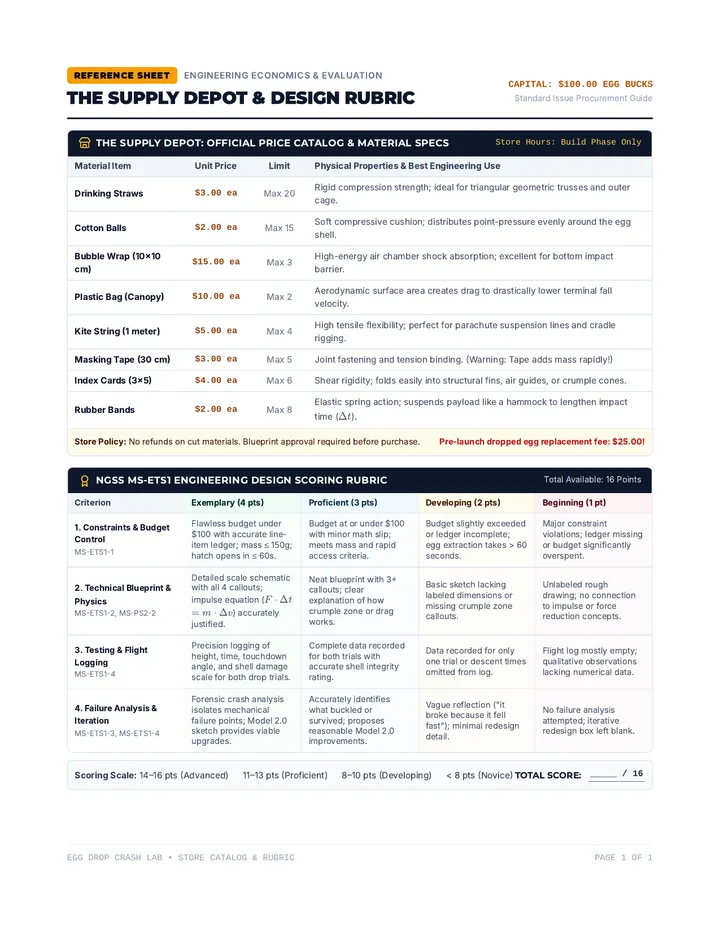
| Budget slightly exceeded or ledger incomplete; egg extraction takes > 60 seconds. |
| Major constraint violations; ledger missing or budget significantly overspent. |
| 2. Technical Blueprint & Physics MS-ETS1-2, MS-PS2-2 | Detailed scale schematic with all 4 callouts; impulse equation (\(F \cdot \Delta t = m \cdot \Delta v\)) accurately justified. | Neat blueprint with 3+ callouts; clear explanation of how crumple zone or drag works. | Basic sketch lacking labeled dimensions or missing crumple zone callouts. | Unlabeled rough drawing; no connection to impulse or force reduction concepts. |
| 3. Testing & Flight Logging MS-ETS1-4 | Precision logging of height, time, touchdown angle, and shell damage scale for both drop trials. | Complete data recorded for both trials with accurate shell integrity rating. | Data recorded for only one trial or descent times omitted from log. | Flight log mostly empty; qualitative observations lacking numerical data. |
| 4. Failure Analysis & Iteration MS-ETS1-3, MS-ETS1-4 | Forensic crash analysis isolates mechanical failure points; Model 2.0 sketch provides viable upgrades. | Accurately identifies what buckled or survived; proposes reasonable Model 2.0 improvements. | Vague reflection ("it broke because it fell fast"); minimal redesign detail. | No failure analysis attempted; iterative redesign box left blank. |
Scoring Scale: 14–16 pts (Advanced) 11–13 pts (Proficient) 8–10 pts (Developing) < 8 pts (Novice)
TOTAL SCORE: _____ / 16
EGG DROP CRASH LAB • STORE CATALOG & RUBRIC PAGE 1 OF 1