Coulomb Clash FRQ Document
AP Physics Advanced Placement Practice
SECTION II: FREE-RESPONSE
QUESTION 1: EXPERIMENTAL DESIGN
15 Points • Suggested Time: 25 Minutes
Directions: Show all work. Clear explanations, algebraic derivations, and unit consistency are required.
A team of physics students is tasked with verifying Coulomb's inverse-square law and determining the magnitude of an unknown net charge \(Q\) deposited uniformly on two identical, small conductive spheres. The spheres have a radius of \(0.50\text{ cm}\). Sphere A is mounted atop a rigid insulating rod secured to a digital balance (tared to \(0.000\text{ g}\)). Sphere B is affixed to a vertically adjustable insulating arm mounted on a millimeter-graduated vertical track directly above Sphere A.
Insulating Support Arm +Q Sphere B r +Q Sphere A 0.000 g Digital Scale Insulating Rod
Figure 1: Apparatus for electrostatic force measurement versus separation distance.
(a) Design an experimental procedure using the apparatus above to investigate how the repulsive electrostatic force \(F_e\) depends on the separation distance \(r\), and to gather data that can be used to determine the unknown charge \(Q\).
i. Identify the variables in your experiment:
Independent Variable:
Dependent Variable:
Controlled Variable:
ii. Detailed Experimental Procedure: Provide step-by-step instructions so another student can replicate the experiment. Include specific steps to minimize experimental uncertainty (e.g., charge leakage, induction effects, alignment errors).
AP Physics 2 • Electrostatics Page 1 of 3
AP Question 1 (Continued)
Data Analysis & Graphing
(b) Describe how the data collected from your procedure can be analyzed to produce a straight-line graph that confirms Coulomb's law and allows you to determine the charge \(Q\).
(c) The students perform the experiment and record the downward repulsive force \(F_e\) (calculated from the balance reading) at various center-to-center distances \(r\). The measured data are shown in the table below.
| Separation \(r\)
\((\text{cm})\) | Electric Force \(F_e\)
\((\text{mN})\) | Calculated Quantity:
(units: __________) | Calculated Quantity:
(units: __________) |
| --- | --- | --- | --- |
| 4.0 | 36.2 | | |
| 5.0 | 22.8 | | |
| 6.0 | 16.3 | | |
| 8.0 | 8.8 | | |
| 10.0 | 5.9 | | |
i. Indicate the quantities to be graphed to yield a straight line. Use the blank columns above to record your calculated values.
Vertical Axis:
Horizontal Axis:
ii. On the grid below, plot your data points. Clearly label both axes, including appropriate scale and units.
Vertical Axis: Quantity (Units)
Horizontal Axis: Quantity (Units)
AP Physics 2 • Electrostatics Page 2 of 3
AP Question 1 (Continued)
Slope Determination & Physical Analysis
(d) Graphical Analysis and Charge Determination:
i. On the grid on page 2, draw a line of best fit for the data points plotted.
ii. Using your line of best fit, calculate the experimental slope of the line. Clearly identify the two points on the line used for the slope calculation and include appropriate units.
Selected points on line: \((x_1, y_1) = \) _______________________, \((x_2, y_2) = \) _______________________
iii. Using the slope calculated in part (d)(ii), determine an experimental value for the charge \(Q\) on each sphere. Assume Coulomb's constant \(k = 8.99 \times 10^9\text{ N}\cdot\text{m}^2/\text{C}^2\).
(e) Experimental Uncertainty and Error Analysis:
i. Suppose the laboratory had moderate relative humidity, causing a continuous leakage of charge into the ambient air throughout the trial run (from \(r = 4.0\text{ cm}\) at \(t = 0\) to \(r = 10.0\text{ cm}\) at \(t = 10\text{ min}\)). Would the magnitude of the slope calculated from this data be greater than, less than, or equal to the slope obtained with perfectly isolated, non-leaking charges?
Greater than Less than Equal to
Briefly explain your physical reasoning:
ii. If a sixth trial were attempted at a very small center-to-center separation distance (\(r = 1.2\text{ cm}\)), the measured repulsive force is found to be noticeably smaller than the value predicted by Coulomb's law for point charges. Explain this deviation based on the distribution of mobile charges on conducting spheres.
AP Physics 2 • Electrostatics Page 3 of 3
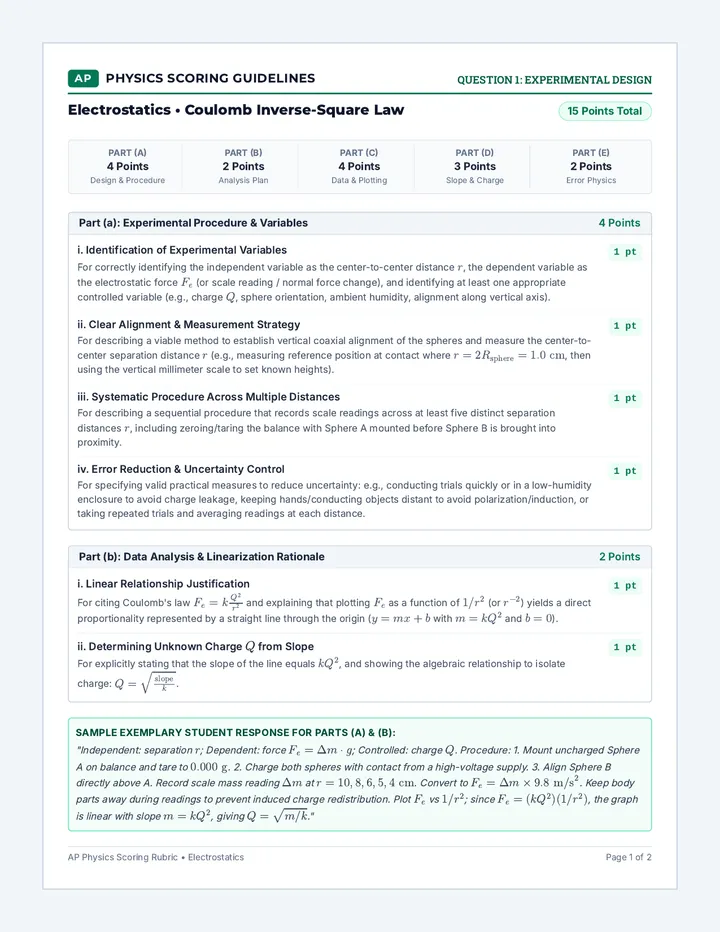
Coulomb Clash Scoring Rubric
AP Physics Scoring Guidelines
QUESTION 1: EXPERIMENTAL DESIGN
Electrostatics • Coulomb Inverse-Square Law
15 Points Total
Part (a)
4 Points
Design & Procedure
Part (b)
2 Points
Analysis Plan
Part (c)
4 Points
Data & Plotting
Part (d)
3 Points
Slope & Charge
Part (e)
2 Points
Error Physics
Part (a): Experimental Procedure & Variables 4 Points
i. Identification of Experimental Variables
For correctly identifying the independent variable as the center-to-center distance \(r\), the dependent variable as the electrostatic force \(F_e\) (or scale reading / normal force change), and identifying at least one appropriate controlled variable (e.g., charge \(Q\), sphere orientation, ambient humidity, alignment along vertical axis).
1 pt
ii. Clear Alignment & Measurement Strategy
For describing a viable method to establish vertical coaxial alignment of the spheres and measure the center-to-center separation distance \(r\) (e.g., measuring reference position at contact where \(r = 2R_{\text{sphere}} = 1.0\text{ cm}\), then using the vertical millimeter scale to set known heights).
1 pt
iii. Systematic Procedure Across Multiple Distances
For describing a sequential procedure that records scale readings across at least five distinct separation distances \(r\), including zeroing/taring the balance with Sphere A mounted before Sphere B is brought into proximity.
1 pt
iv. Error Reduction & Uncertainty Control
For specifying valid practical measures to reduce uncertainty: e.g., conducting trials quickly or in a low-humidity enclosure to avoid charge leakage, keeping hands/conducting objects distant to avoid polarization/induction, or taking repeated trials and averaging readings at each distance.
1 pt
Part (b): Data Analysis & Linearization Rationale 2 Points
i. Linear Relationship Justification
For citing Coulomb's law \(F_e = k \frac{Q^2}{r^2}\) and explaining that plotting \(F_e\) as a function of \(1/r^2\) (or \(r^{-2}\)) yields a direct proportionality represented by a straight line through the origin (\(y = mx + b\) with \(m = kQ^2\) and \(b = 0\)).
1 pt
ii. Determining Unknown Charge \(Q\) from Slope
For explicitly stating that the slope of the line equals \(k Q^2\), and showing the algebraic relationship to isolate charge: \(Q = \sqrt{\frac{\text{slope}}{k}}\).
<table class="w-full text-center border-collapse border border-slate-300 bg-white"><tbody><tr class="bg-slate-100 font-semibold text-[10px]"><td class="border border-slate-300 p-0.5">\(r\text{ (m)}\)</td><td class="border border-slate-300 p-0.5">\(F_e\text{ (mN)}\)</td><td class="border border-slate-300 p-0.5">\(1/r^2\text{ (m}^{-2}\text{)}\)</td><td class="border border-slate-300 p-0.5">\(F_e\text{ (N)}\)</td></tr><tr><td class="border border-slate-300">0.040</td><td class="border border-slate-300">36.2</td><td class="border border-slate-300 font-mono font-bold text-emerald-700">625</td><td class="border border-slate-300 font-mono">0.0362</td></tr><tr><td class="border border-slate-300">0.050</td><td class="border border-slate-300">22.8</td><td class="border border-slate-300 font-mono font-bold text-emerald-700">400</td><td class="border border-slate-300 font-mono">0.0228</td></tr><tr><td class="border border-slate-300">0.060</td><td class="border border-slate-300">16.3</td><td class="border border-slate-300 font-mono font-bold text-emerald-700">278</td><td class="border border-slate-300 font-mono">0.0163</td></tr><tr><td class="border border-slate-300">0.080</td><td class="border border-slate-300">8.8</td><td class="border border-slate-300 font-mono font-bold text-emerald-700">156</td><td class="border border-slate-300 font-mono">0.0088</td></tr><tr><td class="border border-slate-300">0.100</td><td class="border border-slate-300">5.9</td><td class="border border-slate-300 font-mono font-bold text-emerald-700">100</td><td class="border border-slate-300 font-mono">0.0059</td></tr></tbody></table>