Heat Hacker Teacher Guide Heat Hacker Guide
Mastering Convection Currents • Grade 6
Duration
40
Minutes
Learning Objective
Students will be able to explain how heat transfer through fluids (convection) occurs due to changes in density, and illustrate this process using real-world examples like ocean currents or air movement.
Materials Needed
Clear plastic tub or tank
Red (hot) & Blue (cold) food coloring
Warm and ice-cold water
Fluid Motion Doodle Notes
Convection Flow Slides
Small dropper or pipette
Key Concept
Density & Temperature
Hot fluids expand, become less dense, and rise. Cold fluids contract, become more dense, and sink.
The Cycle
The continuous rising and falling creates a circular "current" that transfers heat.
Lesson Roadmap
0-5 min
The Hook: Thermal Mystery
Show a quick "tea bag ghost" demo or a video of a lava lamp. Ask: "Why does the wax keep moving up and down without a motor?"
5-15 min
Direct Instruction: The Cycle
Use the Convection Flow Slides . Students fill in the Fluid Motion Doodle Notes as you explain the molecular behavior of hot vs. cold fluids.
15-35 min
Lab: Tank Currents
Execute the Lava Logic Lab . Students drop blue dye into one side of a tank and red dye over a heat source (warm water bag underneath) to watch the current form.
35-40 min
Closing: Real World Hack
Quick-fire exit ticket: "Why are heaters usually on the floor and AC vents often on the ceiling?"
Teacher Support & Differentiation
Check for Understanding
During the lab, walk around and ask: "Where is the water the least dense right now? How do you know based on the dye's movement?"
Common Misconceptions
Students often think "heat rises." Clarify that hot fluids rise because they are pushed up by denser, colder fluids.
Convection only happens in fluids (liquids/gases), not solids.
Support & Enrichment
Scaffolding
Provide a pre-labeled diagram of the convection cycle for students who struggle with spatial organization on doodle notes.
Enrichment
Challenge early finishers to research "Mantle Convection" and explain how this process moves tectonic plates.
Quick Talk Moves
"So, if we take away the heat source, what happens to the cycle?"
"Can someone build on what they said about density?"
Safety Scanner
Ensure water is warm but not scalding. Remind students to handle dye carefully to avoid staining clothes. If using candles as a heat source for a demo, exercise extreme caution and maintain a fire extinguisher nearby.
Convection Flow Slides Operation: Thermal Flow
Heat Hacker
Cracking the Code of Convection
Wait... What?
In a lava lamp, the wax goes up, then falls back down.
The Mission:
Explain the movement without saying "magic."
The Density Secret
HOT Fluid
Molecules expand
Lower Density
IT RISES
COLD Fluid
Molecules contract
Higher Density
IT SINKS
The Convection Cycle
RISE
Cooling
SINK
HEAT SOURCE
Looping Heat
Operation: Dye Tank
Time to visualize the invisible. We are going to "hack" the heat to see the currents move.
1
Red dye over the heat source.
2
Blue dye in the cold corner.
Hacker Challenge
Why are air conditioning vents usually found on the ceiling, while heaters are on the floor?
Hint: Think about where the fluid wants to go based on its density!
Fluid Motion Doodle Notes Fluid Motion Doodle Notes
The Heat Hacker Field Guide
Hacker Name:
Date:
What is it?
Heat transfer through FLUIDS.
Liquids
Gases
The Secret Code
Hot Fluids
Molecules spread out!
Density: ________
Cold Fluids
Molecules clump up!
Density: ________
Sketch it!
The Convection Cycle
Fluid __________
(Less Dense)
Fluid __________
(More Dense)
Cools Down
HEAT SOURCE
COLOR ME!
Hacking the Real World
Give 2 examples of where you see this loop in nature:
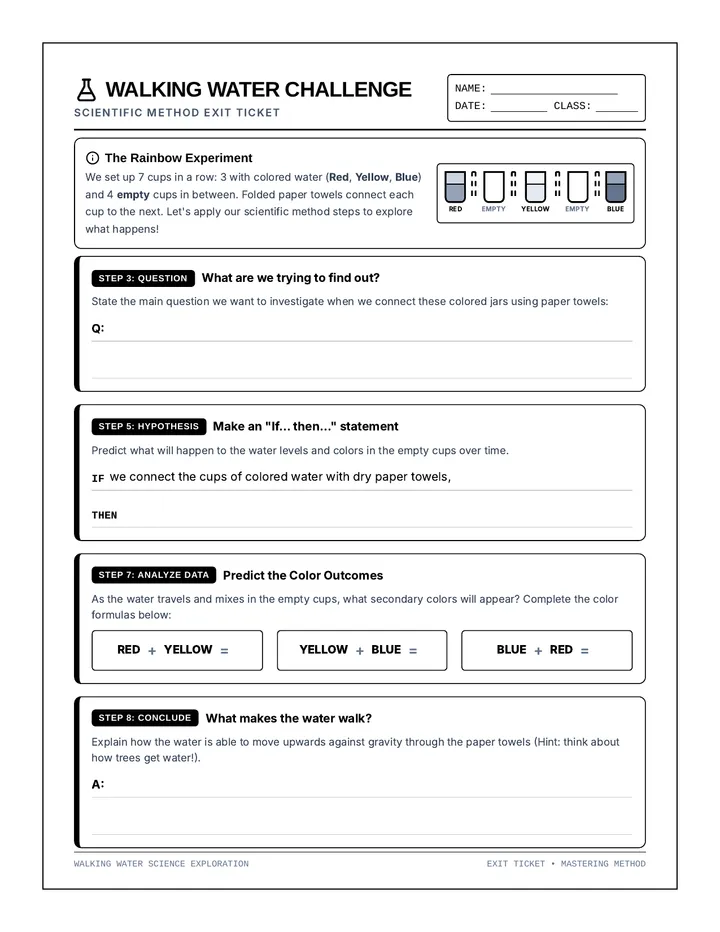
Lava Logic Lab Guide Experimental Lab 01
Operation: Lava Logic
The Convection Tank Hack
Hacker Group
Date
The Gear
Clear plastic tank
Red Food Coloring
Blue Food Coloring
Hot Water "Heater"
Dropper/Pipette
Hypothesis
If we add red dye over the hot water, then I predict it will move:
BECAUSE: ____________________________________________________________________
The Mission Steps
01
Set the Stage
Fill the tank with room-temp water. Place the tank so one side sits over the "heater" (the hot water bag/source).
02
Hack the Heat
Carefully drop 1-2 drops of Red Dye at the bottom of the tank, directly above the heater.
03
Trace the Cold
Drop 1-2 drops of Blue Dye on the far side of the tank (away from the heater). Watch the flow!
Visual Evidence
Observations: 1 Minute In
Observations: 5 Minutes In
Analysis Deck
Q1 Describe the path of the RED DYE. Why did it move that way?
Q2 What happened to the BLUE DYE? How does this compare to the red dye?
The Ultimate Hacker Challenge
Imagine you are a giant molecule in the tank. Write a 2-sentence "Field Report" describing your journey from the heat source to the cold side.
Master Conclusion
Circle the correct word to complete the "Hacker Code of Convection":
When a fluid gets hot, it EXPANDS / CONTRACTS, which makes it LESS / MORE dense. This causes it to RISE / SINK.