Lenny.com
Explore
Create
ActivitiesNewMathEnglish Language ArtsScience & EngineeringSocial StudiesGlobal LanguagesHealth & Physical EducationSpecial EducationCounseling & Life SkillsArts & CreativityESL
Lenny.com
Lenny.com
Explore
Create
ActivitiesNewMathEnglish Language ArtsScience & EngineeringSocial StudiesGlobal LanguagesHealth & Physical EducationSpecial EducationCounseling & Life SkillsArts & CreativityESL
Lenny.com
Lenny.com

Solutions

Lenny for EducatorsLenny for SchoolsLenny for Districts

Product

ExploreSign inCreateSupportAbout

Resources

Getting startedMTSS Acceleration Program

© 2026 Lenny Learning Inc.

TermsPrivacyAccessibility
LinkedInInstagramX
Lenny

Forces and Laws of Motion

Newton’s laws of motion, net forces, and the relationship between mass and acceleration. Examines friction, gravity, and inertia through practical applications in physical systems.

Science & EngineeringLife ScienceLiving ThingsAnimalsPlantsBody SystemsTraitsAdaptationsCellsEcosystemsHeredityGenes to TraitsCell DivisionPhysicsComparing MaterialsShapes and PropertiesMagnetsMagnetismLightSoundLight and SoundMatterStates of MatterChanges of StateMixturesPhysical and Chemical ChangeHeating and CoolingHeat and Thermal EnergyEnergyForce and MotionElectrical CircuitsAtoms and MoleculesPeriodic TableMotion in One DimensionMotion in Two DimensionsScalars and VectorsForces and Laws of MotionCircular Motion and GravityMomentum and ImpulseWork, Energy, and PowerWavesElectromagnetic WavesGeometric OpticsElectricity and MagnetismSimple Harmonic MotionThermodynamicsNuclear PhysicsEarth Science & AstronomyWeatherWater CycleRocks and MineralsFossilsEarth's FeaturesEarth's ResourcesEarth's StructureWeather and ClimateEarth EventsFossils and Geologic TimePlate TectonicsHuman ImpactsAstronomyChemistryUnits and MeasurementAtomic StructurePeriodic TrendsChemical BondingNomenclatureMolecular StructureIntermolecular ForcesThe MoleStoichiometryProperties of GasesSolutionsChemical ReactionsBalancing EquationsEnergy ChangesRates of ReactionsEquilibriumAcids and BasesQuantum ModelBiologyClassificationCell StructureThe Chemistry of LifeBiomoleculesCellular TransportCell EnergyCell Growth and DivisionDNAProtein SynthesisMeiosis and Sexual ReproductionPatterns of InheritanceMulticellular OrganismsEvolutionEcologyBiodiversityComputer ScienceAlgorithms and Computational ThinkingProgramming LanguagesComputing SystemsNetworks and InternetData AnalysisCybersecurityAI and Machine LearningSoftware Design and DevelopmentBlockchainEngineering & AIDesigning ExperimentsEngineering PracticesDesign ThinkingEngineering Design ProcessMechanical EngineeringElectrical EngineeringMaterials and StructuresCAD and 3D DesignRoboticsArtificial Intelligence BasicsVibe CodingMachine LearningAI Ethics and SocietySystems ThinkingEntrepreneurship & InnovationEntrepreneurial MindsetBusiness Idea DevelopmentBusiness Plan BasicsMarketing & Customer DiscoveryFinancial Management for Startups

Videos

How to Calculate Weight and Mass on Different Planets

How to Calculate Weight and Mass on Different Planets

This educational video clarifies the fundamental difference between mass and weight, concepts often confused in daily life but distinct in physics. Through clear explanations and practical examples involving astronauts and space travel, the video demonstrates that while mass (the amount of matter) remains constant regardless of location, weight (the force of gravity) changes depending on the gravitational pull of the planet or moon one is standing on. The content walks students through the mathematical relationship between these concepts using Newton's Second Law. It derives the formula w = mg from F = ma and guides viewers through step-by-step calculations. Students learn to calculate weight on Earth, in deep space, and on the Moon, emphasizing the importance of significant figures and unit conversions between Newtons and pounds. Teachers can use this video to introduce forces and gravity or to reinforce algebra skills within a science context. The step-by-step problem-solving sections are particularly valuable for modeling how to show work in physics problems, handle units properly, and apply mathematical concepts to real-world (and off-world) scenarios.

Miacademy & MiaPrep Learning ChannelMiacademy & MiaPrep Learning Channel

10mins 11s

How Gravity Shapes Orbits in Space

How Gravity Shapes Orbits in Space

This educational video from Crash Course Kids explores the mechanics of orbits in space, moving beyond simple planetary rotation to explain the gravitational forces that govern the universe. The host, Sabrina Cruz, breaks down why lighter objects orbit heavier ones, using the relationship between Earth and the Sun as a primary example. The video expands this concept to the galactic scale, explaining how the entire solar system orbits a supermassive black hole at the center of the Milky Way without getting swallowed up.

Crash Course KidsCrash Course Kids

4mins 31s

How Gravity Works: The Invisible Force That Pulls Us Down

How Gravity Works: The Invisible Force That Pulls Us Down

This engaging educational video introduces students to the fundamental concept of gravity, explaining it as an invisible force that pulls objects toward one another. Through clear demonstrations and real-world examples like falling leaves and skydiving, the host illustrates how gravity acts on everything on Earth. The video distinguishes between push and pull forces, using a simple ball toss experiment to show how gravity counters upward momentum. The content explores the history of gravitational theory, retelling the famous story of Isaac Newton and the falling apple. It expands the concept beyond Earth, explaining how the same force that drops an apple also keeps planets in orbit around the sun. The relationship between mass and gravity is introduced, clarifying that while all objects have gravity, it is the Earth's massive size that makes its pull the most observable force in our daily lives. Ideal for elementary science classrooms, this resource demystifies abstract physics concepts using accessible language and visuals. It concludes with a built-in multiple-choice quiz, making it a complete lesson package for teachers to check for understanding immediately after viewing. The video effectively bridges the gap between everyday observations—like dropping a ball—and larger astronomical concepts, providing a solid foundation for physical science units.

Next Generation ScienceNext Generation Science

4mins 59s

How Ramps Make Work Easier: Simple Machines Explained

How Ramps Make Work Easier: Simple Machines Explained

Join Jessi and her robot rat friend Squeaks in this engaging introduction to simple machines, focusing specifically on the inclined plane or ramp. When the duo returns from a library book sale with heavy boxes that are too difficult to carry up the stairs, they encounter a common physical problem: moving heavy loads against gravity. Through problem-solving, they discover how using a ramp can transform an impossible lifting task into a manageable pushing task. The video explores key physics concepts appropriate for young learners, including the definition of a machine as anything that helps us do work, the concept of slope (steepness), and the fundamental trade-off in mechanics: trading distance for effort. By experimenting with two different ramps—a short, steep one and a long, gentle one—Jessi visually demonstrates that while a longer ramp requires traveling a greater distance, it significantly reduces the force needed to move an object. This resource is an excellent tool for early elementary science classrooms introducing forces, motion, and engineering. It takes abstract physics concepts and grounds them in a relatable scenario with clear visual demonstrations. Teachers can use this video to kickstart units on simple machines, inspire hands-on engineering challenges, or explain accessibility features like wheelchair ramps in the real world.
SciShow KidsSciShow Kids

4mins 9s

Building Paper Airplanes and Learning How They Fly

Building Paper Airplanes and Learning How They Fly

This educational video from SciShow Kids guides students through the hands-on process of building a paper airplane while simultaneously introducing the fundamental physics concepts that allow planes to fly. Hosted by Jessi and her robot companion Squeaks, the video combines a practical maker activity with clear, age-appropriate scientific explanations of aerodynamic forces. The content focuses on two primary forces: thrust and lift. It explains how thrust provides forward movement (created by engines in real planes and by a throwing arm for paper planes) and how lift acts against gravity to keep the plane in the air. The video uses clear animations to demonstrate how air moving over wings creates lift, simplifying complex fluid dynamics into an accessible concept for young learners. For the classroom, this video serves as an excellent dual-purpose resource. It functions as a step-by-step instructional guide for a fine motor activity while also serving as a science lesson on forces and motion. Teachers can use it to introduce a STEM unit on flight, anchoring the theoretical concepts of physics in a tangible, fun activity that encourages experimentation and engineering design.

SciShow KidsSciShow Kids

4mins 18s

How Simple Machines Create Mechanical Advantage

How Simple Machines Create Mechanical Advantage

This video provides an engaging and clear introduction to the physics of simple and compound machines, focusing on the concept of mechanical advantage. The lesson begins by contrasting a human jump with the height achievable on a swing, using this analogy to explain how simple machines allow us to "smear out" effort over a longer distance to achieve a greater result with less immediate force. The narrator systematically breaks down the six classic simple machines: the inclined plane, pulley, wheel and axle, lever, wedge, and screw.

Miacademy & MiaPrep Learning ChannelMiacademy & MiaPrep Learning Channel

8mins 45s

Materials

PVC Parallel Bars Workbook

PVC Parallel Bars Workbook

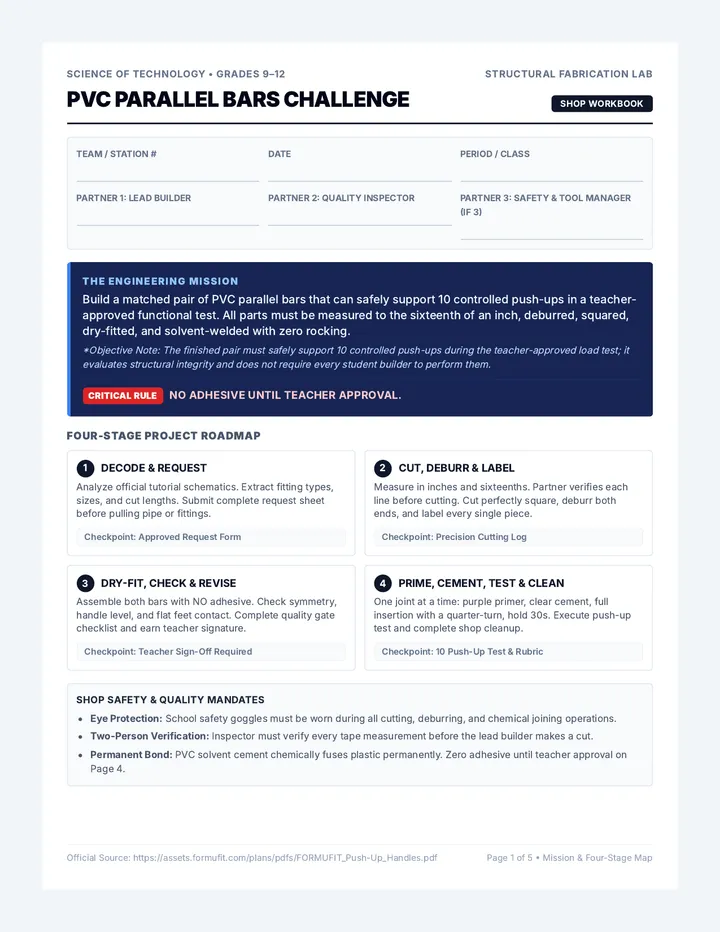
A comprehensive 5-page student workbook for the PVC Parallel Bars Challenge in Grade 9-12 Science of Technology. Features tight individual crops of only the original FORMUFIT black line-art silhouettes on Page 2, a 14-piece cutting log on Page 3, official 4-step assembly diagrams on Page 4, and consistent shop deburring terminology throughout.

KI

Koah Ing

Newton Laws Practice Worksheet

Newton Laws Practice Worksheet

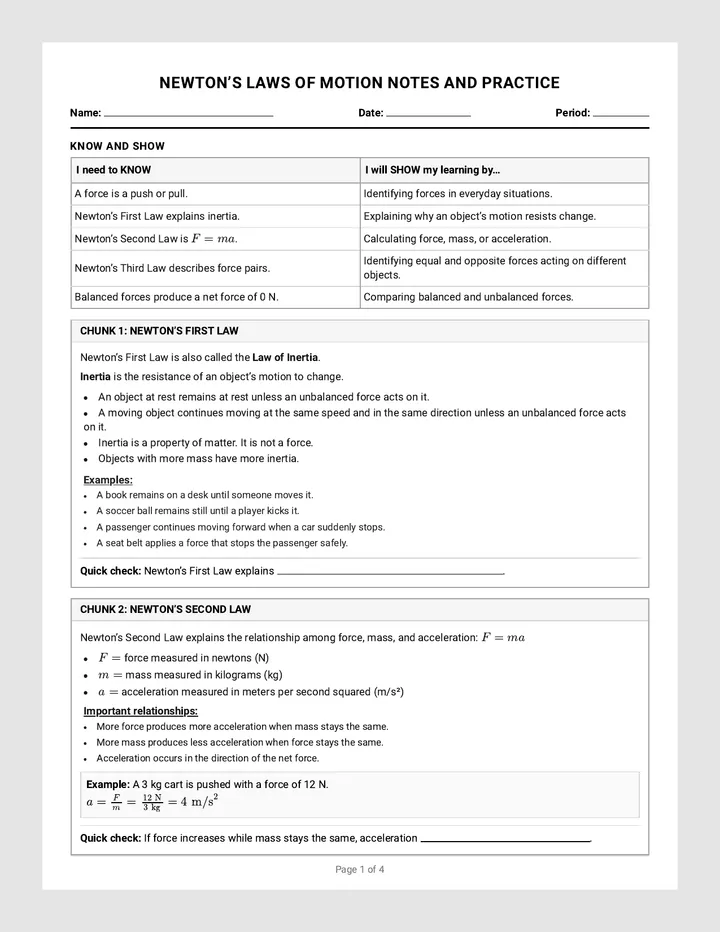
A four-page Newton's Laws guided notes and practice worksheet formatted in a classic, professional Microsoft Word document style. Features black-and-white print-friendly typography, standard bordered tables, structured fill-in-the-blank notes, selected response, short answer prompts, self-evaluation, and an exit ticket.

MB

Marsha Bolden

Motion Masters Reading Sheet

Motion Masters Reading Sheet

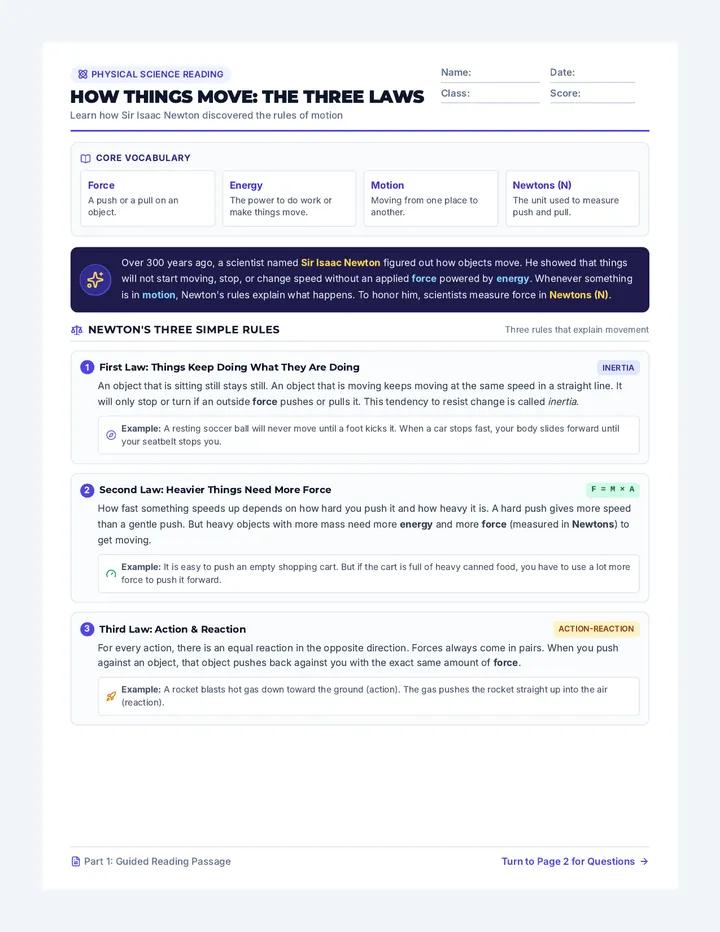
A simplified two-page reading passage and comprehension worksheet introducing Sir Isaac Newton, core physics vocabulary (force, energy, motion, Newtons), and the Three Laws of Motion with accessible explanations, everyday examples, and structured response questions.

AC

Aaron Conlin

Deformation Variables Worksheet

Deformation Variables Worksheet

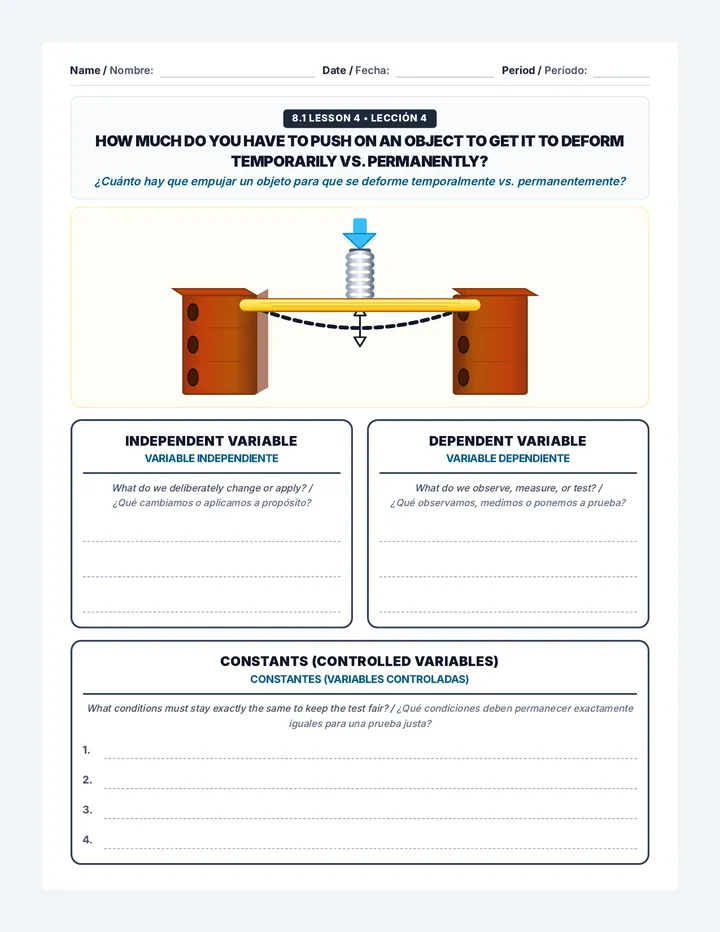
Bilingual science anchor chart worksheet for OpenSciEd 8.1 Lesson 4 examining how force deforms an object temporarily versus permanently, with English and Spanish labels for the independent variable, dependent variable, and controlled constants.

JD

Jenna Dzioba

Crash Course Guided Notes

Crash Course Guided Notes

A two-page printable guided notes packet for 5th graders aligned with the Collisions slides, featuring fill-in-the-blank definitions, an interactive desk lab observation log, collision motion analysis, and real-world safety engineering connections.

LB

Lora Burt

Dynamique Master Corrigé Final

Dynamique Master Corrigé Final

Un corrigé type complet et rédigé pour le contrôle de dynamique (PAM2). Le document inclut les solutions détaillées pour la conservation de la quantité de mouvement, la machine d'Atwood et les oscillations d'un système masse-ressort, avec calculs et schémas améliorés pour la lisibilité et les sauts de page.

WK

wiem Karboul

Sequences

Planet Profile Slides

Infinite Frontier

A comprehensive Hi-Lo unit for 6th graders exploring the scale of the universe, our place in the Milky Way, the technology used to explore space, and the history of human spaceflight.

JS

Janette Sullivan

54
Naval Architect Challenge Answer Key

Fluid Dynamics

A series of lessons exploring the physics of fluids, including buoyancy, pressure, and fluid flow.

CM

Chuguna Murugesan

28
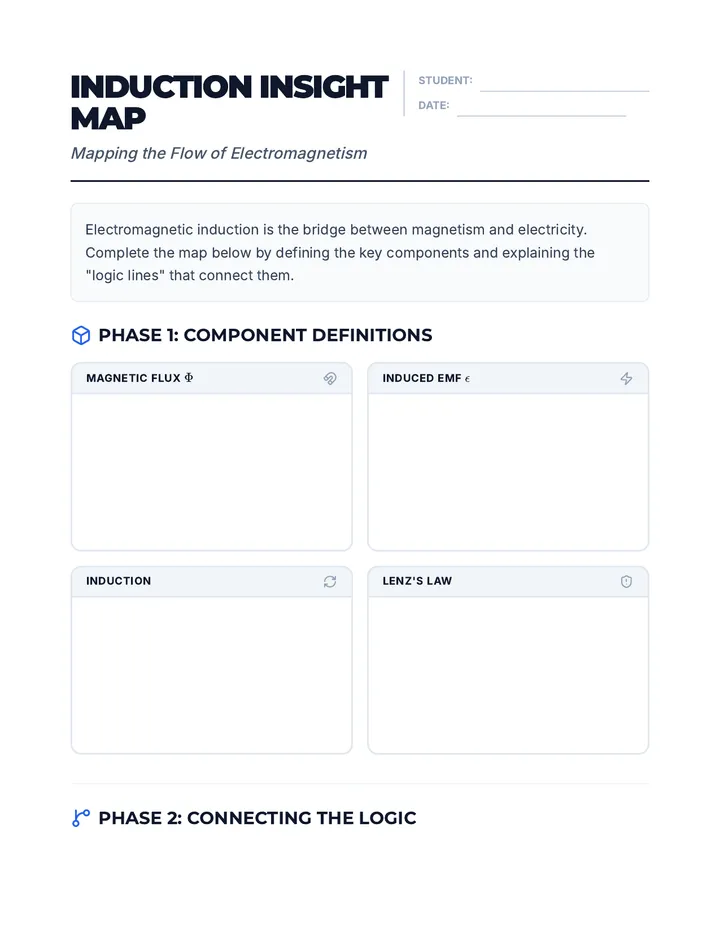
Induction Insight Map Handout

Magnetic Forces Investigation

A 5-day intensive exploration of magnetic forces and fields, focusing on atomic-level causes, field interactions, and mathematical modeling of forces on charged particles. Students progress from anchoring phenomena to complex mathematical applications and a comprehensive unit review.

OM

Olutoyin Makinde

68
Mission Scoring Rubric

Physics Frontiers Research Project

A partner-based research project for 9th-grade conceptual physics students focusing on diverse topics from celestial mechanics to the physics of dance. Students move through a structured research process with mandatory teacher checkpoints for source reliability.

C

ckroeker

13
Climate Crisis Slides

Science Essentials Vault

A comprehensive collection of core science units covering Environmental Science, Biology, and Physical Science. This sequence provides high-impact instructional slides, hands-on lab experiences, guided notes, and differentiated assessments for five major scientific domains.

CB

Chloe Brown

25
Pressure Poster Workshop Handout

Pressure Power

A comprehensive 5-day chemistry unit investigating the relationships between gas pressure, volume, temperature, and moles using lab inquiries, mathematical modeling, and real-world applications.

OM

Olutoyin Makinde

69

Lessons

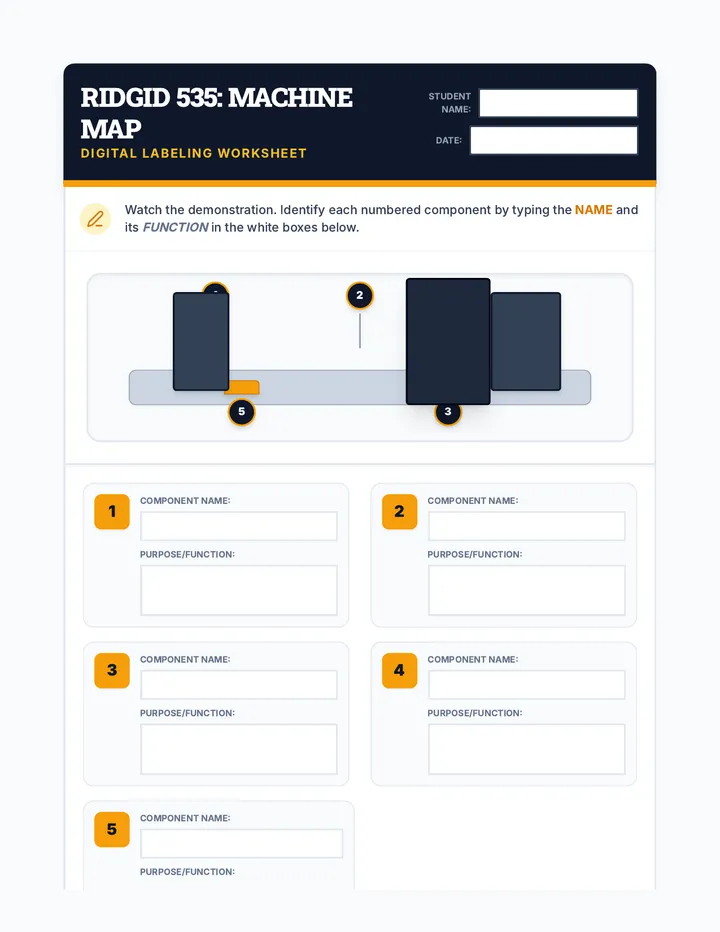
Machine Map Worksheet Digital

Threader Mastery

A 10-minute introductory lesson for 10th-grade students on the safe and basic operation of the Ridgid 535 pipe threader, focusing on safety protocols and component identification.

M

mcapeless

8
Quake Coords Map Activity

Tectonic Tremors

A comprehensive GED science lesson on tectonic activity, focusing on seismic wave analysis, seismograms, and the Richter scale. Students will learn to calculate S-P intervals and interpret map data to locate epicenters and volcanic hotspots.

CL

Carmela Leone

5
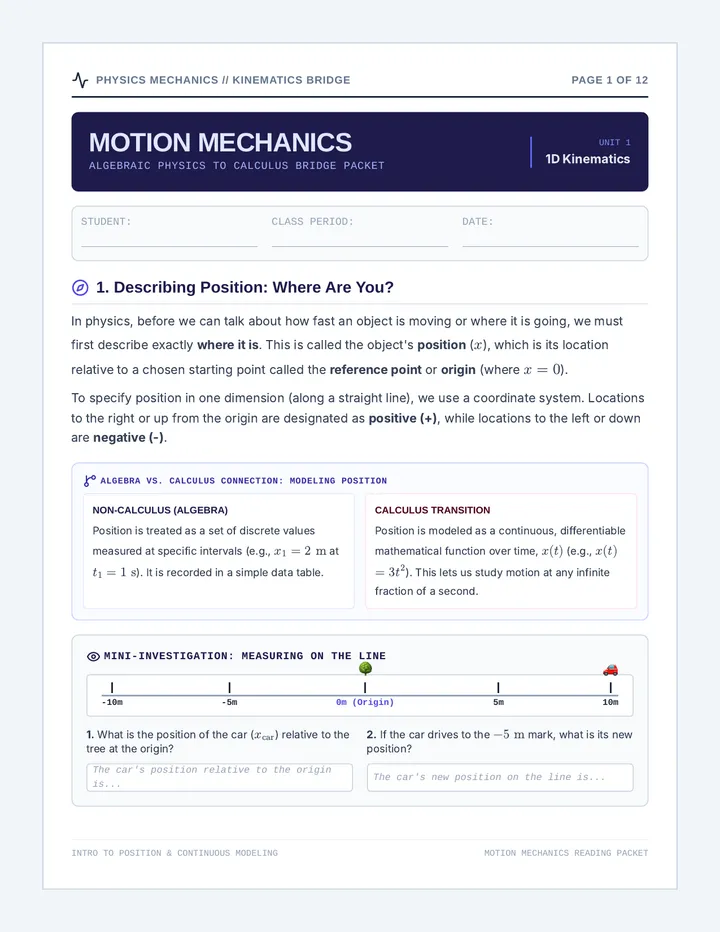
Motion Mechanics Reading Packet

Motion Mechanics

A comprehensive physics lesson bridging algebraic kinematics to introductory calculus. Includes a 12-page side-by-side reading packet, 13 instructional presentation slides, active learning Think-Pair-Share worksheets, a conceptual transition workbook, and a detailed teacher guide with full answer keys.

CM

Chuguna Murugesan

24
Evidence Detectives Slides

Evidence Detectives

A 50-minute lesson focusing on the CERNU conclusion framework (Claim, Evidence, Reasoning, Next steps, Unanswered questions). Students learn to analyze experimental data, connect claims to evidence, and formulate professional scientific conclusions using a detective-themed investigation approach.

CP

Carmen Pavlovsky

10
Flow State Reading Guide Expanded

Flow State

This lesson explores the fundamental properties of fluids, including the molecular differences between solids, liquids, and gases, the concept of density, and the characteristics of ideal fluids. Students will learn to distinguish states of matter through atomic interactions and apply the density formula to various substances.

CM

Chuguna Murugesan

33
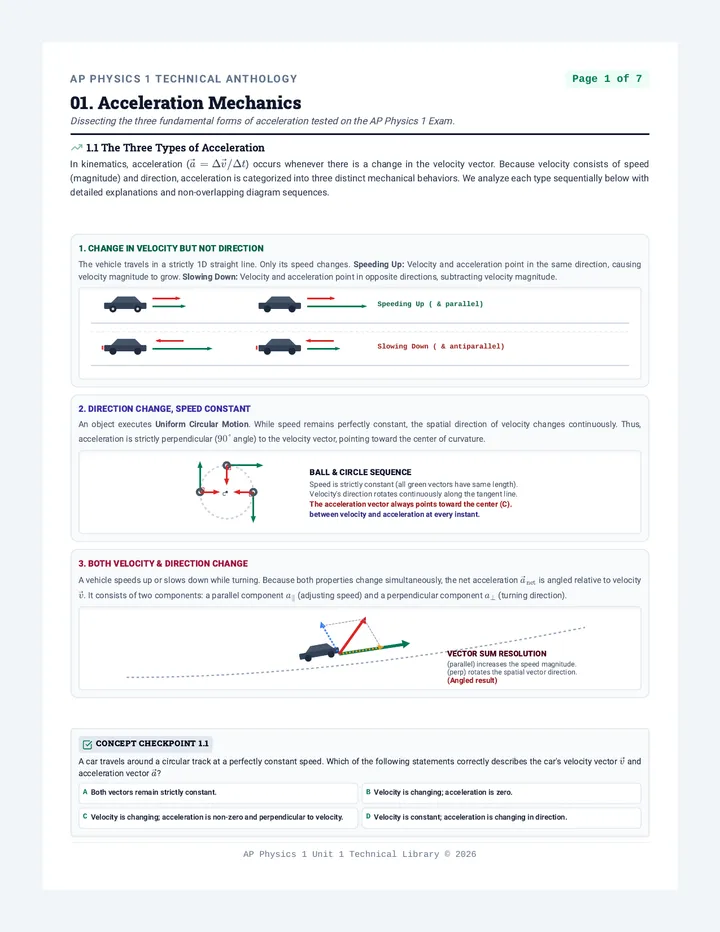
Motion Mechanics Anthology

Motion Mechanics

An AP Physics 1 lesson focusing on the advanced graphical, algebraic, and vector representations of velocity and acceleration. Includes a comprehensive 12-page reading anthology and a matching 12-page student analysis packet.

CM

Chuguna Murugesan

14