Lenny.com
Explore
Create
ActivitiesNewMathEnglish Language ArtsScience & EngineeringSocial StudiesGlobal LanguagesHealth & Physical EducationSpecial EducationCounseling & Life SkillsArts & CreativityESL
Lenny.com
Lenny.com
Explore
Create
ActivitiesNewMathEnglish Language ArtsScience & EngineeringSocial StudiesGlobal LanguagesHealth & Physical EducationSpecial EducationCounseling & Life SkillsArts & CreativityESL
Lenny.com
Lenny.com

Solutions

Lenny for EducatorsLenny for SchoolsLenny for Districts

Product

ExploreSign inCreateSupportAbout

Resources

Getting startedMTSS Acceleration Program

© 2026 Lenny Learning Inc.

TermsPrivacyAccessibility
LinkedInInstagramX
Lenny

Properties of Gases

Kinetic molecular theory and the physical relationships between pressure, volume, and temperature. Applies gas laws to predict molecular behavior and calculate changes in state across varying conditions.

Science & EngineeringLife ScienceLiving ThingsAnimalsPlantsBody SystemsTraitsAdaptationsCellsEcosystemsHeredityGenes to TraitsCell DivisionPhysicsComparing MaterialsShapes and PropertiesMagnetsMagnetismLightSoundLight and SoundMatterStates of MatterChanges of StateMixturesPhysical and Chemical ChangeHeating and CoolingHeat and Thermal EnergyEnergyForce and MotionElectrical CircuitsAtoms and MoleculesPeriodic TableMotion in One DimensionMotion in Two DimensionsScalars and VectorsForces and Laws of MotionCircular Motion and GravityMomentum and ImpulseWork, Energy, and PowerWavesElectromagnetic WavesGeometric OpticsElectricity and MagnetismSimple Harmonic MotionThermodynamicsNuclear PhysicsEarth Science & AstronomyWeatherWater CycleRocks and MineralsFossilsEarth's FeaturesEarth's ResourcesEarth's StructureWeather and ClimateEarth EventsFossils and Geologic TimePlate TectonicsHuman ImpactsAstronomyChemistryUnits and MeasurementAtomic StructurePeriodic TrendsChemical BondingNomenclatureMolecular StructureIntermolecular ForcesThe MoleStoichiometryProperties of GasesSolutionsChemical ReactionsBalancing EquationsEnergy ChangesRates of ReactionsEquilibriumAcids and BasesQuantum ModelBiologyClassificationCell StructureThe Chemistry of LifeBiomoleculesCellular TransportCell EnergyCell Growth and DivisionDNAProtein SynthesisMeiosis and Sexual ReproductionPatterns of InheritanceMulticellular OrganismsEvolutionEcologyBiodiversityComputer ScienceAlgorithms and Computational ThinkingProgramming LanguagesComputing SystemsNetworks and InternetData AnalysisCybersecurityAI and Machine LearningSoftware Design and DevelopmentBlockchainEngineering & AIDesigning ExperimentsEngineering PracticesDesign ThinkingEngineering Design ProcessMechanical EngineeringElectrical EngineeringMaterials and StructuresCAD and 3D DesignRoboticsArtificial Intelligence BasicsVibe CodingMachine LearningAI Ethics and SocietySystems ThinkingEntrepreneurship & InnovationEntrepreneurial MindsetBusiness Idea DevelopmentBusiness Plan BasicsMarketing & Customer DiscoveryFinancial Management for Startups

Videos

Creating an Invisible Fire Extinguisher with Chemistry

Creating an Invisible Fire Extinguisher with Chemistry

This video demonstrates a classic science experiment that illustrates evidence of a chemical change and the properties of carbon dioxide gas. Using common household items—vinegar and bicarbonate soda (baking soda)—the presenter creates a chemical reaction inside a beaker. The video clearly visualizes the immediate reaction, characterized by rapid foaming and bubbling, which serves as a primary indicator that a chemical change is occurring. The second half of the video explores the invisible byproduct of this reaction: carbon dioxide gas. The presenter performs a fascinating demonstration by "pouring" the invisible gas over lit tea light candles. Although no liquid touches the flames, the candles are extinguished one by one. This powerful visual helps students understand that gases are matter, have mass, and can displace other gases like oxygen. For educators, this video serves as an excellent hook for units on matter, chemical reactions, or fire safety. It provides a safe, clear visualization of concepts that are often abstract, such as the existence and behavior of invisible gases. The clear text overlays and narration make it accessible for upper elementary and middle school students to grasp the connection between chemical changes and the formation of new substances.

Next Generation ScienceNext Generation Science

1min 39s

Explaining Kinetic Molecular Theory and Gas Laws Through Song

Explaining Kinetic Molecular Theory and Gas Laws Through Song

This high-energy educational music video serves as a memorable mnemonic device for mastering the complexities of gas behavior in high school chemistry. Set to a catchy parody rhythm of Falco's 'Rock Me Amadeus,' the song systematically breaks down the Kinetic Molecular Theory, explaining how gas particles move, collide, and interact with their containers. It distinguishes between 'ideal' and 'real' gases, highlighting the specific conditions—high temperature and low pressure—under which real gases behave ideally. The content covers essential chemistry concepts including Avogadro's Hypothesis (equal volumes contain equal molecules at the same temperature and pressure), the definition of a mole (6.02 x 10^23), and the mathematical relationships found in Boyle's, Charles', and Gay-Lussac's laws. It visualizes abstract ideas through diagrams of molecular motion and clearly displays the formulas for calculating changes in pressure, volume, and temperature, culminating in the Combined Gas Law. Teachers can use this video as an engaging hook to introduce a unit on gases or as a powerful review tool before an assessment. The lyrics provide a verbatim checklist of the assumptions of the Kinetic Molecular Theory, making it an excellent resource for 'decoding the text' activities where students identify scientific principles hidden within the rhyme. The humor and rhythm help solidify abstract facts, such as the conditions for ideal gas behavior, into long-term memory.

Mark RosengartenMark Rosengarten

3mins 8s

Understanding and Improving Indoor Air Quality

Understanding and Improving Indoor Air Quality

This educational video explores the critical topic of indoor air pollution, revealing the surprising fact that indoor air quality is often significantly worse than outdoor air. The video breaks down the primary sources of indoor pollutants, categorization them into visible particles like dust and smoke, chemical compounds like Volatile Organic Compounds (VOCs), and hidden hazards such as mold, carbon monoxide, lead, and asbestos. It explains the scientific composition of these pollutants and how they become airborne and affect our respiratory systems. The content delves into the health implications of poor indoor air quality, noting that humans spend approximately 90% of their time indoors. It provides a historical case study on lead paint regulations to illustrate how scientific evidence leads to public health protections. The video connects these concepts to human biology, specifically how pollutants trigger asthma, allergies, and other health issues over long periods of exposure. Designed for students, the video emphasizes practical application by offering actionable strategies to improve air quality. It covers ventilation techniques, smarter consumer choices regarding cleaning products and paints, and preventative habits like removing shoes and using exhaust fans. The host encourages students to become "scientists" in their own homes by identifying potential hazards and making simple changes to create a healthier living environment.

Miacademy & MiaPrep Learning ChannelMiacademy & MiaPrep Learning Channel

9mins 10s

Extreme Weather on the Gas Giants: Diamond Rain and Mega Storms

Extreme Weather on the Gas Giants: Diamond Rain and Mega Storms

This engaging educational video takes students on a virtual tour of the outer solar system to explore the extreme weather conditions found on the gas giants: Jupiter, Saturn, Uranus, and Neptune. Hosted by Sabrina Cruz, the video contrasts the solid surfaces of rocky planets with the turbulent, gaseous atmospheres of these massive worlds. It explains complex meteorological phenomena using clear comparisons to Earth, helping students understand the scale and intensity of planetary weather. The video covers key scientific themes including the difference between weather and climate, the mechanics of jet streams, and how atmospheric pressure affects states of matter. Specific topics include Jupiter's Great Red Spot, Saturn's supersonic winds, the chemical composition leading to Uranus's "diamond rain," and the mystery of Neptune's energy source. The content bridges planetary science with basic chemistry and physics concepts appropriate for elementary and middle school learners. For educators, this resource serves as an excellent hook for units on the solar system, meteorology, or states of matter. It transforms abstract facts into memorable visual narratives—like rains of diamonds or storms that last for centuries—that spark student curiosity. The video's clear definitions and visual aids make it a versatile tool for introducing vocabulary, prompting creative writing assignments about space travel, or launching inquiry-based research projects about planetary atmospheres.

Crash Course KidsCrash Course Kids

4mins 43s

How Heat and Pressure Turn Corn Into Popcorn

How Heat and Pressure Turn Corn Into Popcorn

This engaging video breaks down the science behind one of the world's most popular snacks: popcorn. Hosted by a young presenter in a "Lighthouse Lab" setting, the video takes students on a journey from the farm to the bowl, explaining specifically how hard corn kernels transform into fluffy white clouds. It introduces the specific type of corn required for popping (Zea mays everta) and dissects the anatomy of a kernel to reveal the critical components: the hull, the starch, and the tiny droplet of water trapped inside. The core of the video focuses on the physical changes that occur during heating. Through clear animations, students visualize how heat turns the internal water into steam, creating immense pressure against the strong hull until it eventually explodes. This demonstration of phase changes (liquid to gas) and pressure offers a perfect real-world example of chemistry and physics concepts in action. The video concludes with a practical demonstration using an air popper and a five-question interactive quiz to reinforce learning. For educators, this resource serves as an excellent hook for lessons on states of matter, heat energy, or plant biology. It provides a relatable entry point for discussing how temperature affects matter and introduces scientific vocabulary like "starch," "hull," and "pressure" in a context students already enjoy. The combination of live-action demonstration and diagrammatic animation helps varied learners grasp the invisible forces at work inside the kernel.

Next Generation ScienceNext Generation Science

4mins 52s

The Matter Song: Properties, States, and Changes

The Matter Song: Properties, States, and Changes

A high-energy, pop-rock educational song that provides a comprehensive overview of the scientific concept of matter. The video features a static visual while the lyrics deliver a dense stream of scientific definitions, examples, and distinctions, covering everything from atomic structure to phase changes. The song breaks down complex chemistry topics into rhyming verses that are easy for students to memorize and recall. The content moves systematically through key topics: defining matter (mass and volume), atomic composition (protons, neutrons, electrons), states of matter (solid, liquid, gas), phase changes (melting, freezing, evaporation, condensation), and the difference between physical and chemical changes. It explicitly addresses misconceptions by listing things that are not matter, such as energy forms like light and sound. This resource is an excellent tool for auditory learners and can serve as an engaging hook to start a unit or a mnemonic device for review. Teachers can use the lyrics as a text for close reading to unpack vocabulary like "oxidation," "density," and "substance," or use the song's structure to organize a series of lessons on the properties and changes of matter.

Have Fun TeachingHave Fun Teaching

4mins 33s

Materials

Matter Science Anchor Charts

Matter Science Anchor Charts

A complete set of eight illustrated, large-print science anchor charts covering Matter, Atom, Element, Property, States of Matter, Solid, Liquid, and Gas for 6th-grade special education science students.

PL

Patrick l

Matter Models Interactive Notebook

Matter Models Interactive Notebook

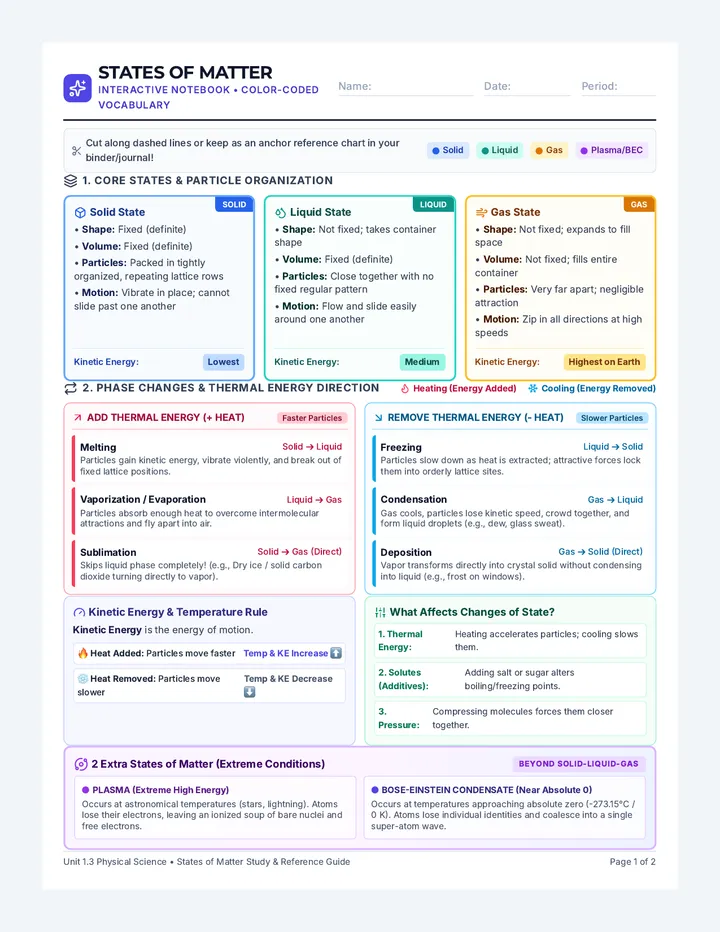
A 2-page interactive science notebook resource featuring color-coded vocabulary in distinct dotted cut-out sections and a unified single-tab 3-flap states of matter particle foldable with increasing energy progression.

RL

RMS Lenny

You Matter Bulletin Board Kit

You Matter Bulletin Board Kit

A revised 5-page printable bulletin board kit featuring giant cut-out heading letters with BOTH 'T's for 'MATTER!', colorful sub-headline quote boxes, scientific molecular models of the three states of matter (Solid, Liquid, Gas), and a modern, labeled Bohr model of an atom.

LN

Leah Nickols

Sequences

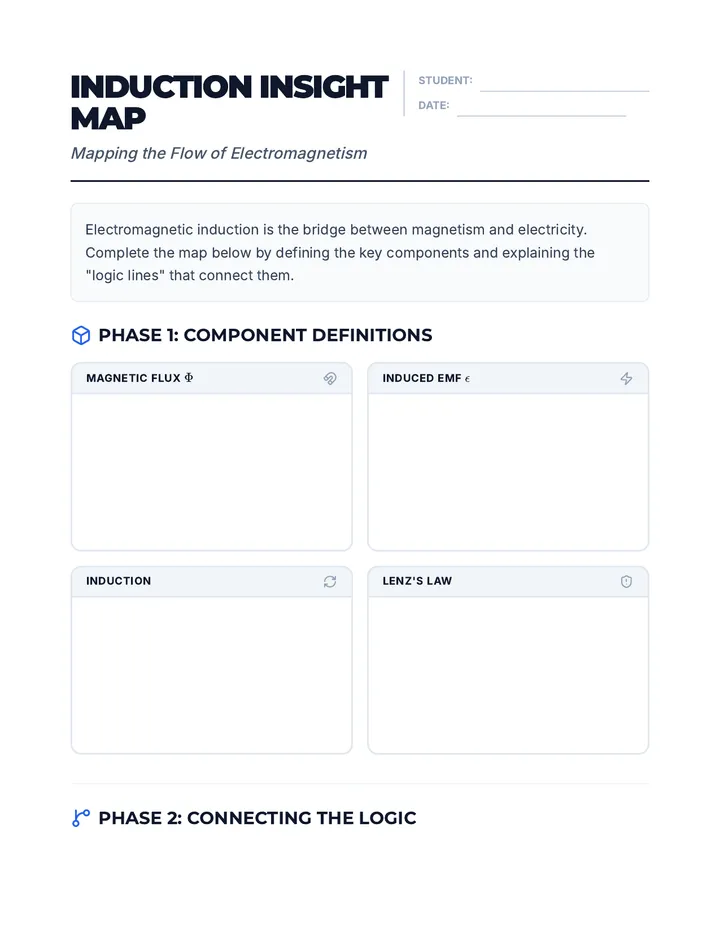
Induction Insight Map Handout

Magnetic Forces Investigation

A 5-day intensive exploration of magnetic forces and fields, focusing on atomic-level causes, field interactions, and mathematical modeling of forces on charged particles. Students progress from anchoring phenomena to complex mathematical applications and a comprehensive unit review.

OM

Olutoyin Makinde

68
Pressure Poster Workshop Handout

Pressure Power

A comprehensive 5-day chemistry unit investigating the relationships between gas pressure, volume, temperature, and moles using lab inquiries, mathematical modeling, and real-world applications.

OM

Olutoyin Makinde

69
KMT Field Manual Packet

Molecular Mayhem Gas Unit

A 10-day exploration of the Behavior of Gases using Kinetic Molecular Theory, various gas laws, and real-world phenomena to understand gas behavior at both molecular and macroscopic scales. Students will investigate compressibility, gas variables, ideal behavior, and mixtures.

OM

Olutoyin Makinde

26
TSIA2 Prep Tracker Handout

TSIA2 Science Daily Prep

A comprehensive 20-day daily practice sequence designed to prepare students for the TSIA2 Math and ELAR assessments. Each day features high school science-themed questions with detailed explanations, hints, and a robust tracking system.

P

psreed75

5
Atomic Architecture Lesson Plan

Particle Explorers

A two-day 7th grade physical science sequence aligned with McGraw Hill Inspire Science exploring how matter is composed of particles too small to see and how thermal energy dictates particle motion across states of matter.

DB

David Boone Jr

10
Heat Quest Review Packet

Thermal Energy Mastery Review

A comprehensive two-day review sequence covering thermal energy, heat transfer, temperature vs. thermal energy, and particle motion, culminating in a CER practice and exit ticket.

RM

Rae Mailly

3

Lessons

Heat Flow Teacher Guide

Particle Behavior Review

A lesson focusing on the states of matter (solid, liquid, gas) and the behavior of particles at the molecular level. Students will model particle motion and arrangement, as well as the energy changes that drive phase transitions.

EA

Erica Andre

54
Flow State Reading Guide Expanded

Flow State

This lesson explores the fundamental properties of fluids, including the molecular differences between solids, liquids, and gases, the concept of density, and the characteristics of ideal fluids. Students will learn to distinguish states of matter through atomic interactions and apply the density formula to various substances.

CM

Chuguna Murugesan

33
Molecular Lab Slides

Matter Lab Review

A comprehensive review of the states of matter and phase changes designed for diverse learners, featuring simplified text, visual aids, and structured graphic organizers.

CB

Chloe Brown

5
Matter Masters Frayer Packet

Matter Foundations Lab

An introductory physical science lesson exploring foundational matter concepts including atoms, elements, properties, and states of matter through multi-modal vocabulary organizers and differentiated supports.

PL

Patrick l

7
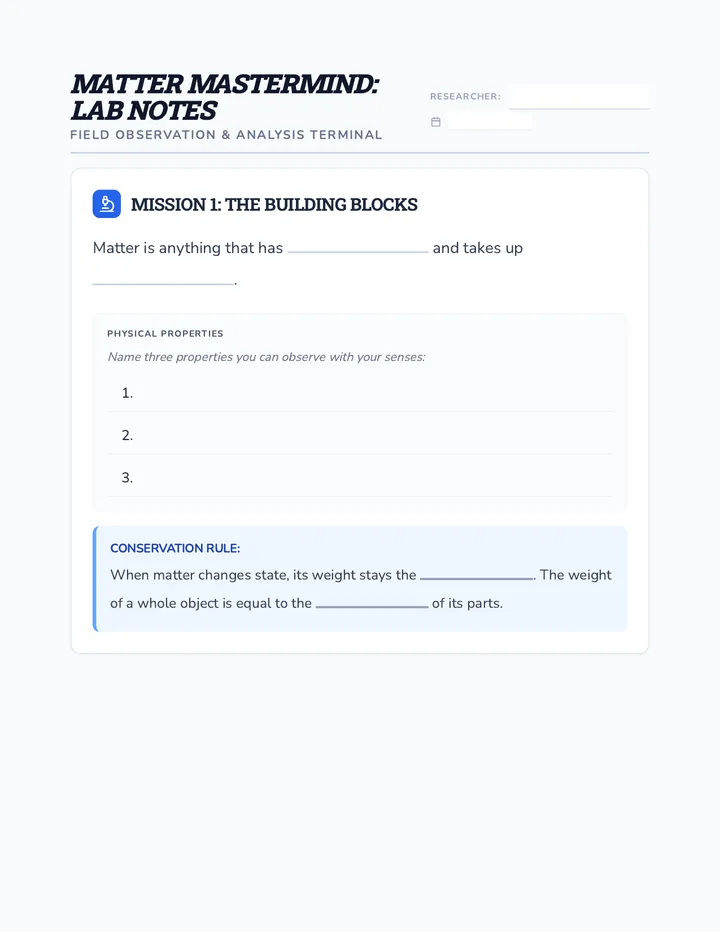
Matter Mastermind Lab Notes

Matter Mastermind

This integrated lesson explores the properties of matter and the forces of gravity. Students will analyze scientific claims by identifying the reasons and evidence used to support them, bridging physical science concepts with critical reading skills.

MW

Mr Whitfield

9
Curiosity Hacks Counselor Guide

Curiosity Hacks

A dynamic, curiosity-driven lesson designed to re-engage middle-of-the-pack students by transforming mundane everyday phenomena into deep, fascinating mysteries, boosting active questioning and self-motivation.

SH

Susan Henderson

4