Lenny.com
Explore
Create
ActivitiesNewMathEnglish Language ArtsScience & EngineeringSocial StudiesGlobal LanguagesHealth & Physical EducationSpecial EducationCounseling & Life SkillsArts & CreativityESL
Lenny.com
Lenny.com
Explore
Create
ActivitiesNewMathEnglish Language ArtsScience & EngineeringSocial StudiesGlobal LanguagesHealth & Physical EducationSpecial EducationCounseling & Life SkillsArts & CreativityESL
Lenny.com
Lenny.com

Solutions

Lenny for EducatorsLenny for SchoolsLenny for Districts

Product

ExploreSign inCreateSupportAbout

Resources

Getting startedMTSS Acceleration Program

© 2026 Lenny Learning Inc.

TermsPrivacyAccessibility
LinkedInInstagramX
Lenny

Nomenclature

Systematic rules for naming chemical compounds and biological organisms. Establishes standardized identification protocols to ensure consistent communication across scientific disciplines.

Science & EngineeringLife ScienceLiving ThingsAnimalsPlantsBody SystemsTraitsAdaptationsCellsEcosystemsHeredityGenes to TraitsCell DivisionPhysicsComparing MaterialsShapes and PropertiesMagnetsMagnetismLightSoundLight and SoundMatterStates of MatterChanges of StateMixturesPhysical and Chemical ChangeHeating and CoolingHeat and Thermal EnergyEnergyForce and MotionElectrical CircuitsAtoms and MoleculesPeriodic TableMotion in One DimensionMotion in Two DimensionsScalars and VectorsForces and Laws of MotionCircular Motion and GravityMomentum and ImpulseWork, Energy, and PowerWavesElectromagnetic WavesGeometric OpticsElectricity and MagnetismSimple Harmonic MotionThermodynamicsNuclear PhysicsEarth Science & AstronomyWeatherWater CycleRocks and MineralsFossilsEarth's FeaturesEarth's ResourcesEarth's StructureWeather and ClimateEarth EventsFossils and Geologic TimePlate TectonicsHuman ImpactsAstronomyChemistryUnits and MeasurementAtomic StructurePeriodic TrendsChemical BondingNomenclatureMolecular StructureIntermolecular ForcesThe MoleStoichiometryProperties of GasesSolutionsChemical ReactionsBalancing EquationsEnergy ChangesRates of ReactionsEquilibriumAcids and BasesQuantum ModelBiologyClassificationCell StructureThe Chemistry of LifeBiomoleculesCellular TransportCell EnergyCell Growth and DivisionDNAProtein SynthesisMeiosis and Sexual ReproductionPatterns of InheritanceMulticellular OrganismsEvolutionEcologyBiodiversityComputer ScienceAlgorithms and Computational ThinkingProgramming LanguagesComputing SystemsNetworks and InternetData AnalysisCybersecurityAI and Machine LearningSoftware Design and DevelopmentBlockchainEngineering & AIDesigning ExperimentsEngineering PracticesDesign ThinkingEngineering Design ProcessMechanical EngineeringElectrical EngineeringMaterials and StructuresCAD and 3D DesignRoboticsArtificial Intelligence BasicsVibe CodingMachine LearningAI Ethics and SocietySystems ThinkingEntrepreneurship & InnovationEntrepreneurial MindsetBusiness Idea DevelopmentBusiness Plan BasicsMarketing & Customer DiscoveryFinancial Management for Startups

Materials

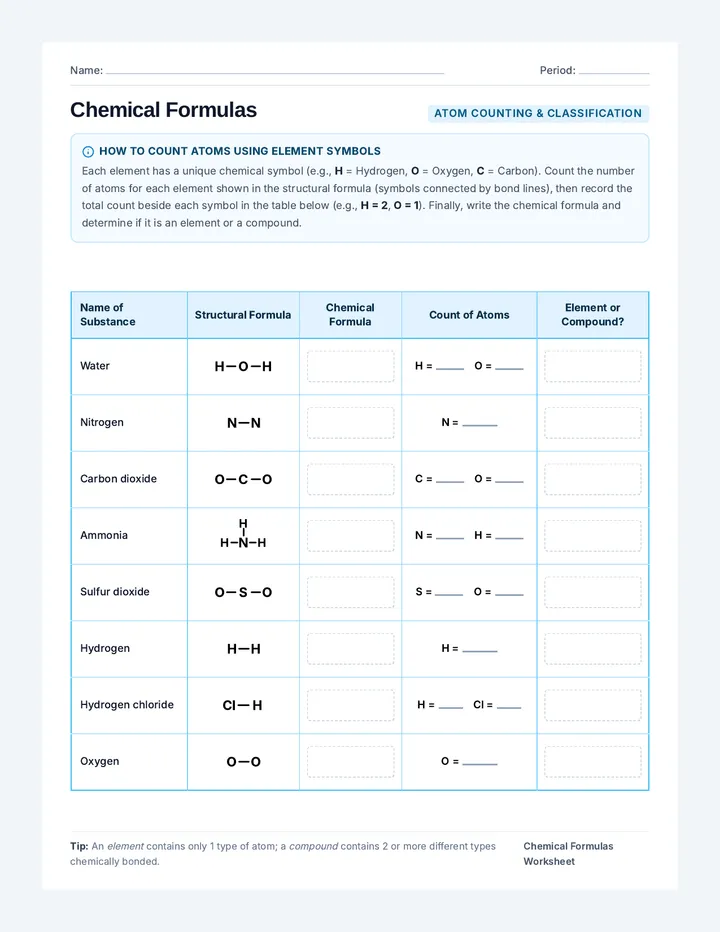
Chemical Formulas Worksheet

Chemical Formulas Worksheet

A chemistry worksheet for identifying chemical formulas, counting atoms beside element symbols using structural formulas with bond lines, and classifying substances as elements or compounds.

SH

Sarah Hale

Atomic Blueprint Anchor Chart

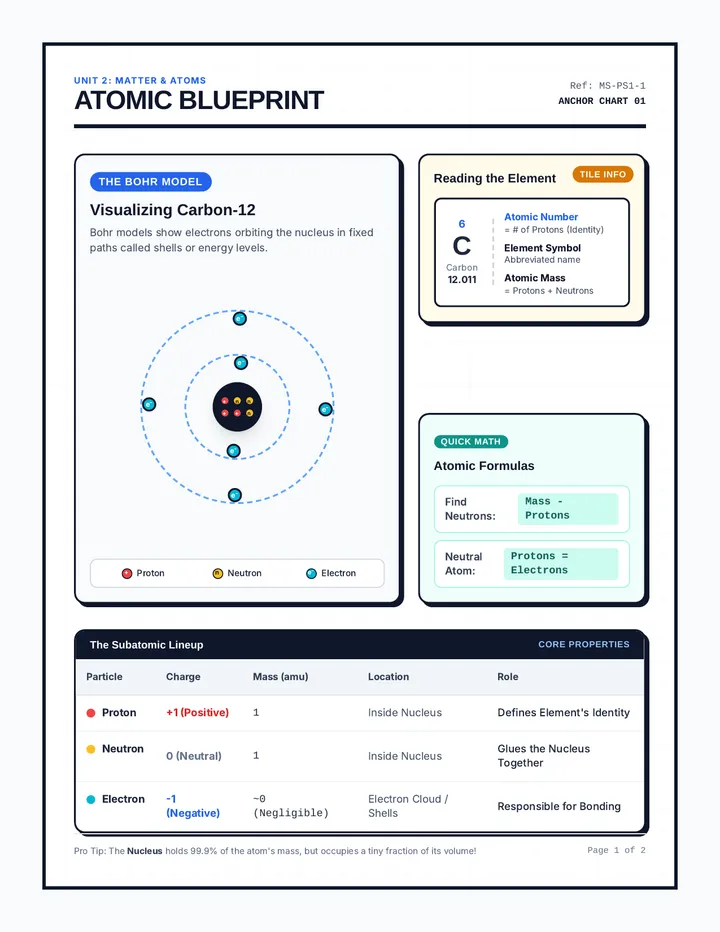
Atomic Blueprint Anchor Chart

A visually stunning, high-contrast 2-page anchor chart designed as a classroom poster and student reference sheet. Page 1 breaks down the atomic structure and subatomic particles using an interactive-style Bohr model of Carbon. Page 2 illustrates the differences between elements, diatomic molecules, and compounds, complete with a visual anatomy of a chemical formula.

DS

Dawn Stump

Videos

Identifying and Classifying Minerals, Crystals, and Gemstones

Identifying and Classifying Minerals, Crystals, and Gemstones

This comprehensive science video provides a detailed exploration of the geological building blocks of our planet: minerals, crystals, and gemstones. Hosted by Kylie, the lesson begins by distinguishing between these three often-confused terms, explaining that rocks are mixtures of minerals, while minerals are the building blocks that form crystals. The video establishes the five strict scientific criteria for a substance to be considered a mineral: it must be naturally occurring, solid, inorganic, have a fixed chemical formula, and possess an ordered crystalline structure. Viewers are guided through specific examples, such as why wood and sugar are not minerals (organic) while salt and quartz are. The content delves deep into mineral classification, introducing the eight major mineral groups: native elements, sulfides, oxides, phosphates, sulfates, carbonates, halides, and silicates. For each group, the video provides clear definitions, chemical compositions, and real-world examples like pyrite (fool's gold), turquoise, and quartz. The lesson also explores how crystals form through cooling lava, hardening liquids, or evaporation, and categorizes them by their geometric shapes, such as cubic, hexagonal, and triclinic structures. Ideal for Earth Science curriculums, this video serves as an excellent foundation for geology units. It bridges the gap between basic rock identification and introductory chemistry by explaining atoms, molecules, and chemical formulas in an accessible way. Teachers can use this resource to explain complex classification systems, discuss the difference between organic and inorganic matter, or introduce the geometry of natural structures. The video concludes with a look at gemstones and a demonstration of raw vs. polished specimens, encouraging students to start their own collections.
Miacademy & MiaPrep Learning ChannelMiacademy & MiaPrep Learning Channel

12mins 23s

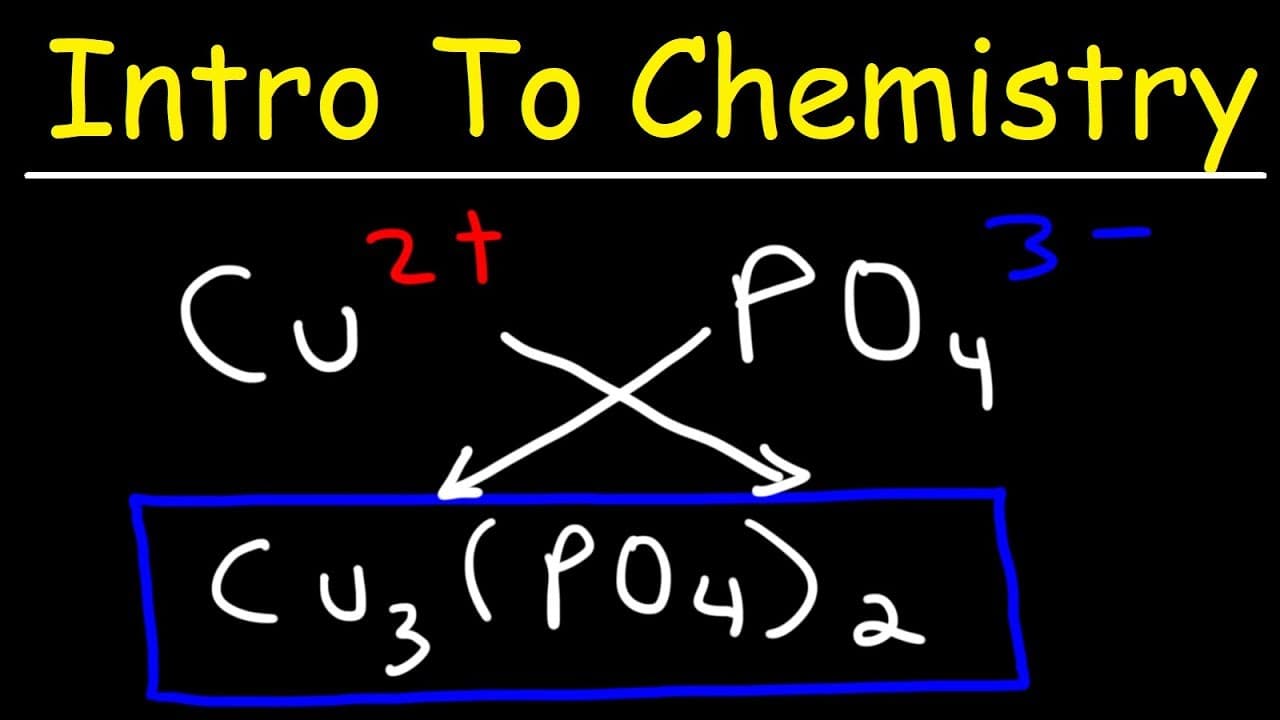
Chemistry Basics: Periodic Table, Naming Compounds, and Atomic Structure

Chemistry Basics: Periodic Table, Naming Compounds, and Atomic Structure

This comprehensive 52-minute video serves as an extensive introduction to K-12 chemistry, covering the fundamental building blocks of the subject. The video begins by touring the periodic table, identifying key groups like alkali metals and halogens, and explaining the charges associated with different columns. It distinguishes between atoms, molecules, elements, and compounds before diving into the crucial skill of nomenclature—teaching viewers how to name ionic and molecular compounds using prefixes and Roman numerals.

The Organic Chemistry TutorThe Organic Chemistry Tutor

52mins 9s

Why Water Is Essential for Life: A Molecular Look

Why Water Is Essential for Life: A Molecular Look

This video provides a comprehensive exploration of the biological importance of water, bridging the gap between molecular chemistry and macroscopic biological functions. It begins by contrasting the diverse life of the Amazon Rainforest with the sparse life of the Sahara Desert to illustrate water's critical role in ecosystems. The narrator then zooms in to the molecular level, explaining the chemical structure of water ($H_2O$), the difference between elements and compounds, and the concept of polarity, using magnets as an analogy for how positive hydrogen and negative oxygen atoms interact.

Miacademy & MiaPrep Learning ChannelMiacademy & MiaPrep Learning Channel

15mins 32s

How Nature Recycles Nitrogen and Phosphorus

How Nature Recycles Nitrogen and Phosphorus

This fast-paced and humorous educational video explores the biogeochemical cycles of two essential nutrients: Nitrogen and Phosphorus. Hosted by Hank Green, the video breaks down how these elements move through the biosphere, lithosphere, and hydrosphere, explaining why they are critical for life despite often being difficult for organisms to access. The content contrasts the atmospheric abundance of nitrogen with its biological scarcity due to strong chemical bonds, while highlighting phosphorus's unique cycle that notably lacks an atmospheric component. Key themes include the vital role of bacteria in nitrogen fixation, the chemical structure of nutrients (like the triple bond of N2), and the symbiotic relationships between plants and microorganisms. The video also covers the geological timescales of the phosphorus cycle and introduces the significant impact humans have had on these cycles through the invention and overuse of synthetic fertilizers. It connects chemistry to biology by explaining how these elements build DNA, RNA, proteins, and ATP. For educators, this resource serves as an excellent anchor for units on ecology, biochemistry, or environmental science. It effectively bridges the gap between atomic chemistry and macroscopic ecosystems. The clear visual aids and analogies help demystify abstract processes like nitrification and sedimentation, making it a powerful tool for explaining limiting nutrients and preparing students for discussions on human environmental impact and eutrophication.

CrashCourseCrashCourse

9mins 22s

How Molecules and Chemical Reactions Power Life

How Molecules and Chemical Reactions Power Life

This educational video bridges the gap between basic chemistry and biology by explaining how the microscopic world of atoms and molecules powers living organisms. It begins with the familiar phrase "you are what you eat" to introduce the concept that our bodies are constructed from the atoms found in our food. The video uses clear visual models to explain fundamental concepts including atomic structure, the periodic table, chemical bonding, and the formation of molecules like oxygen, carbon dioxide, and water. The content progresses to explain chemical reactions as the mechanism that rearranges atoms—similar to reassembling LEGO bricks—transforming food molecules into body structures and energy. It distinguishes between reactants and products, demonstrates the conservation of atoms during reactions, and visually balances a chemical equation for the formation of water. The narrator emphasizes that while molecules change, the atoms themselves remain constant during biological processes. Finally, the video explores the role of energy in biological systems, explaining how breaking chemical bonds releases energy for life processes while other reactions, like photosynthesis, absorb energy. This resource is highly valuable for teachers introducing biochemistry or the flow of matter and energy in ecosystems, as it concretizes abstract concepts using relatable examples like apples, nutrition labels, and building blocks.

Miacademy & MiaPrep Learning ChannelMiacademy & MiaPrep Learning Channel

14mins 25s

Understanding and Improving Indoor Air Quality

Understanding and Improving Indoor Air Quality

This educational video explores the critical topic of indoor air pollution, revealing the surprising fact that indoor air quality is often significantly worse than outdoor air. The video breaks down the primary sources of indoor pollutants, categorization them into visible particles like dust and smoke, chemical compounds like Volatile Organic Compounds (VOCs), and hidden hazards such as mold, carbon monoxide, lead, and asbestos. It explains the scientific composition of these pollutants and how they become airborne and affect our respiratory systems. The content delves into the health implications of poor indoor air quality, noting that humans spend approximately 90% of their time indoors. It provides a historical case study on lead paint regulations to illustrate how scientific evidence leads to public health protections. The video connects these concepts to human biology, specifically how pollutants trigger asthma, allergies, and other health issues over long periods of exposure. Designed for students, the video emphasizes practical application by offering actionable strategies to improve air quality. It covers ventilation techniques, smarter consumer choices regarding cleaning products and paints, and preventative habits like removing shoes and using exhaust fans. The host encourages students to become "scientists" in their own homes by identifying potential hazards and making simple changes to create a healthier living environment.

Miacademy & MiaPrep Learning ChannelMiacademy & MiaPrep Learning Channel

9mins 10s

Sequences

KMT Field Manual Packet

Molecular Mayhem Gas Unit

A 10-day exploration of the Behavior of Gases using Kinetic Molecular Theory, various gas laws, and real-world phenomena to understand gas behavior at both molecular and macroscopic scales. Students will investigate compressibility, gas variables, ideal behavior, and mixtures.

OM

Olutoyin Makinde

26
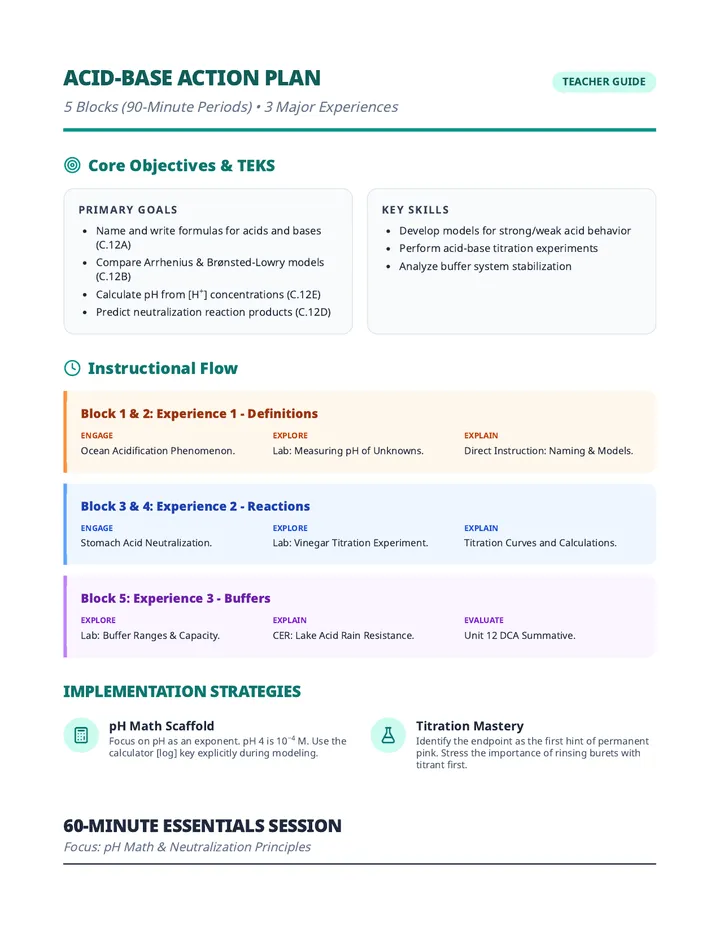
Acid Base Action Plan

Acid Base Investigation

A comprehensive unit exploring the properties, reactions, and mathematical relationships of acids and bases, featuring pH calculations, titrations, and buffer systems.

OM

Olutoyin Makinde

34
CHEM 1406 Study Guide

CHEM 1406 Lab Midterm Review

A comprehensive review of CHEM 1406 introductory chemistry lab concepts, including safety, measurement, atomic structure, bonding, and chemical reactions.

OM

Olutoyin Makinde

4
Lab Success Study Guide

Lab Chemistry Mastery

A specialized curriculum designed to prepare students for introductory chemistry laboratory examinations, focusing on practical applications, quantitative calculations, and organic structure identification.

OM

Olutoyin Makinde

3
Stoichiometry Master Slides Plus Practice

Stoichiometry Mastery

A unit focused on the quantitative relationships in chemical reactions, covering everything from basic molar mass to complex limiting reactant and percent yield calculations.

OM

Olutoyin Makinde

27
Foundations Starters Slides

Forensic Starters Collection

A comprehensive 42-day collection of class starters for an 8th-grade forensics course, covering foundations, physical evidence, biological evidence, and forensic reasoning.

S

schrauthb

4

Lessons

Atomic Blueprint Slides

Atomic Blueprint

A comprehensive introduction to the Periodic Table, exploring how elements are organized by atomic number, the significance of groups and periods, and the distinct properties of metals, non-metals, and metalloids through real-world examples.

CB

Chloe Brown

7
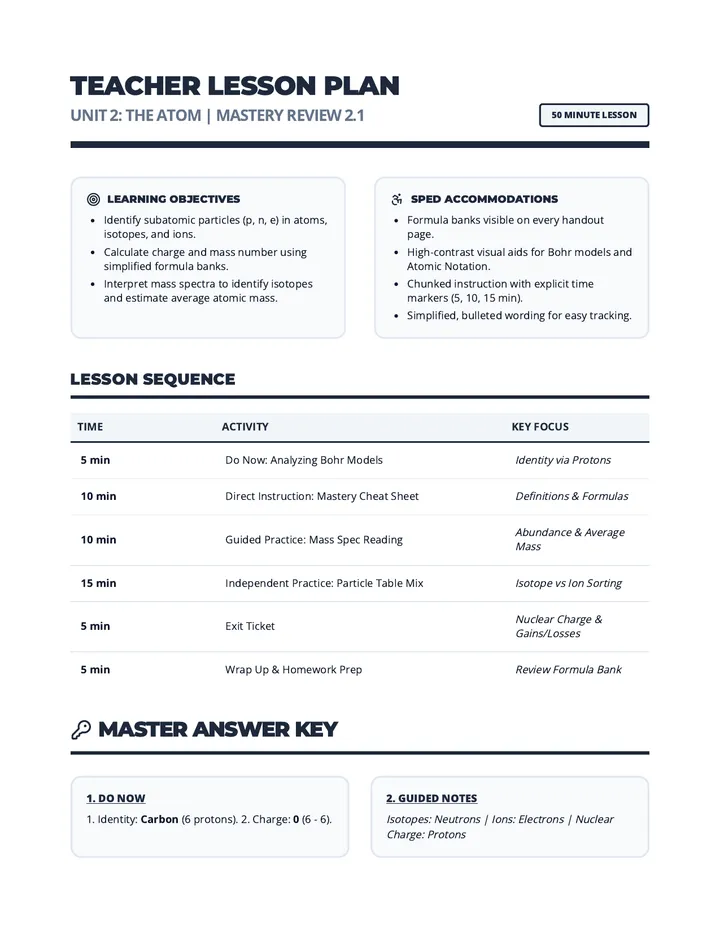
Atom Academy Lesson Plan Teacher Guide

Atom Academy Review

A comprehensive review lesson designed for high school special education students to master the concepts of atoms, isotopes, ions, and average atomic mass calculation using mass spectra. The lesson includes structured pacing from Do Now to Exit Ticket with heavy visual support and formula banks.

D

david.marques

6
Bio Roots Relay Cards

Bio Roots Relay

A high-energy, kinetic biology relay activity where students race to match biological prefixes, roots, and suffixes with their meanings and real-world scientific examples, followed by word-building challenges and formative assessment.

M

MELANIE.ROBERTS

5
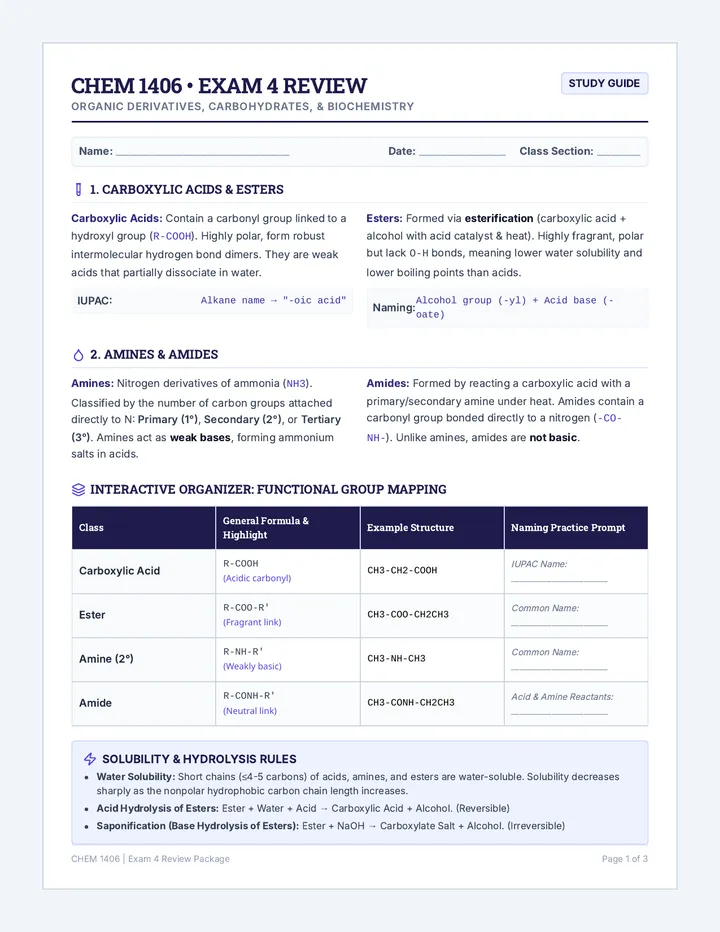
Concept Review Study Guide

Exam Review Package

A comprehensive review package designed for CHEM 1406 Exam 4. It covers organic chemistry (carboxylic acids, esters, amines, amides), carbohydrates, stereochemistry, amino acids, proteins, and basic metabolic pathways through high-impact study summaries, a full practice test, and detailed explanations.

OM

Olutoyin Makinde

3
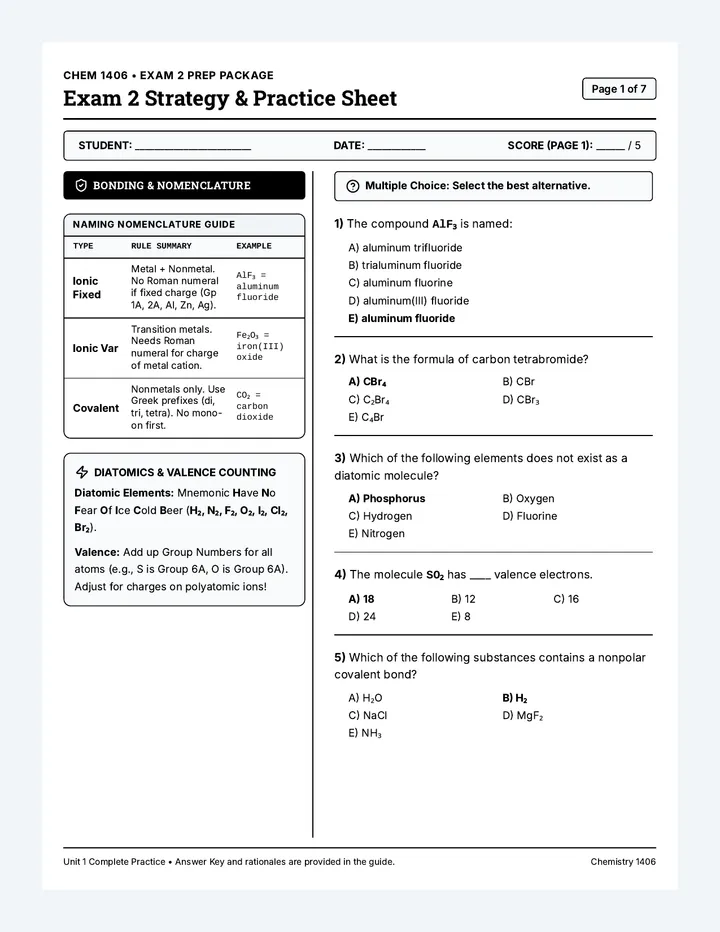
Exam 2 Strategy and Practice Sheet

Exam Prep Package

A comprehensive study and practice package for Chemistry 1406 Exam 2. It contains a highly structured, side-by-side strategy guide paired with a 30-question practice exam, and a matching detailed answer key with step-by-step rationales.

OM

Olutoyin Makinde

2
Matter Decoded Slides

Matter Decoded

An introductory lesson on the classification of matter, covering atoms, elements, compounds, and mixtures (homogeneous and heterogeneous). Students will learn to distinguish between pure substances and mixtures through visual models and real-world examples.

LB

Laurel Bartos

4