Lenny.com
Explore
Create
ActivitiesNewMathEnglish Language ArtsScience & EngineeringSocial StudiesGlobal LanguagesHealth & Physical EducationSpecial EducationCounseling & Life SkillsArts & CreativityESL
Lenny.com
Lenny.com
Explore
Create
ActivitiesNewMathEnglish Language ArtsScience & EngineeringSocial StudiesGlobal LanguagesHealth & Physical EducationSpecial EducationCounseling & Life SkillsArts & CreativityESL
Lenny.com
Science & EngineeringLife ScienceLiving ThingsAnimalsPlantsBody SystemsTraitsAdaptationsCellsEcosystemsHeredityGenes to TraitsCell DivisionPhysicsComparing MaterialsShapes and PropertiesMagnetsMagnetismLightSoundLight and SoundMatterStates of MatterChanges of StateMixturesPhysical and Chemical ChangeHeating and CoolingHeat and Thermal EnergyEnergyForce and MotionElectrical CircuitsAtoms and MoleculesPeriodic TableMotion in One DimensionMotion in Two DimensionsScalars and VectorsForces and Laws of MotionCircular Motion and GravityMomentum and ImpulseWork, Energy, and PowerWavesElectromagnetic WavesGeometric OpticsElectricity and MagnetismSimple Harmonic MotionThermodynamicsNuclear PhysicsEarth Science & AstronomyWeatherWater CycleRocks and MineralsFossilsEarth's FeaturesEarth's ResourcesEarth's StructureWeather and ClimateEarth EventsFossils and Geologic TimePlate TectonicsHuman ImpactsAstronomyChemistryUnits and MeasurementAtomic StructurePeriodic TrendsChemical BondingNomenclatureMolecular StructureIntermolecular ForcesThe MoleStoichiometryProperties of GasesSolutionsChemical ReactionsBalancing EquationsEnergy ChangesRates of ReactionsEquilibriumAcids and BasesQuantum ModelBiologyClassificationCell StructureThe Chemistry of LifeBiomoleculesCellular TransportCell EnergyCell Growth and DivisionDNAProtein SynthesisMeiosis and Sexual ReproductionPatterns of InheritanceMulticellular OrganismsEvolutionEcologyBiodiversityComputer ScienceAlgorithms and Computational ThinkingProgramming LanguagesComputing SystemsNetworks and InternetData AnalysisCybersecurityAI and Machine LearningSoftware Design and DevelopmentBlockchainEngineering & AIDesigning ExperimentsEngineering PracticesDesign ThinkingEngineering Design ProcessMechanical EngineeringElectrical EngineeringMaterials and StructuresCAD and 3D DesignRoboticsArtificial Intelligence BasicsVibe CodingMachine LearningAI Ethics and SocietySystems ThinkingEntrepreneurship & InnovationEntrepreneurial MindsetBusiness Idea DevelopmentBusiness Plan BasicsMarketing & Customer DiscoveryFinancial Management for Startups

Acids and Bases

Properties of pH levels, hydrogen ion concentrations, and neutralization reactions. Examines chemical indicators, titration methods, and Bronsted-Lowry theory.

Lenny.com

Solutions

Lenny for EducatorsLenny for SchoolsLenny for Districts

Product

ExploreSign inCreateSupportAbout

Resources

Getting startedMTSS Acceleration Program

© 2026 Lenny Learning Inc.

TermsPrivacyAccessibility
LinkedInInstagramX
Lenny

Videos

How Pollution Disrupts Earth's Natural Balance

How Pollution Disrupts Earth's Natural Balance

This episode of Crash Course Ecology dives deep into the complex nature of pollution, challenging the common misconception that it is simply trash or synthetic chemicals. Hank Green explains that pollution is fundamentally about substances—whether natural or synthetic—existing in the wrong place or at the wrong concentrations. The video explores how human activities disrupt Earth's natural biogeochemical cycles, specifically looking at how overloading the carbon, nitrogen, and phosphorus cycles leads to climate change and massive aquatic dead zones.

CrashCourseCrashCourse

9mins 22s

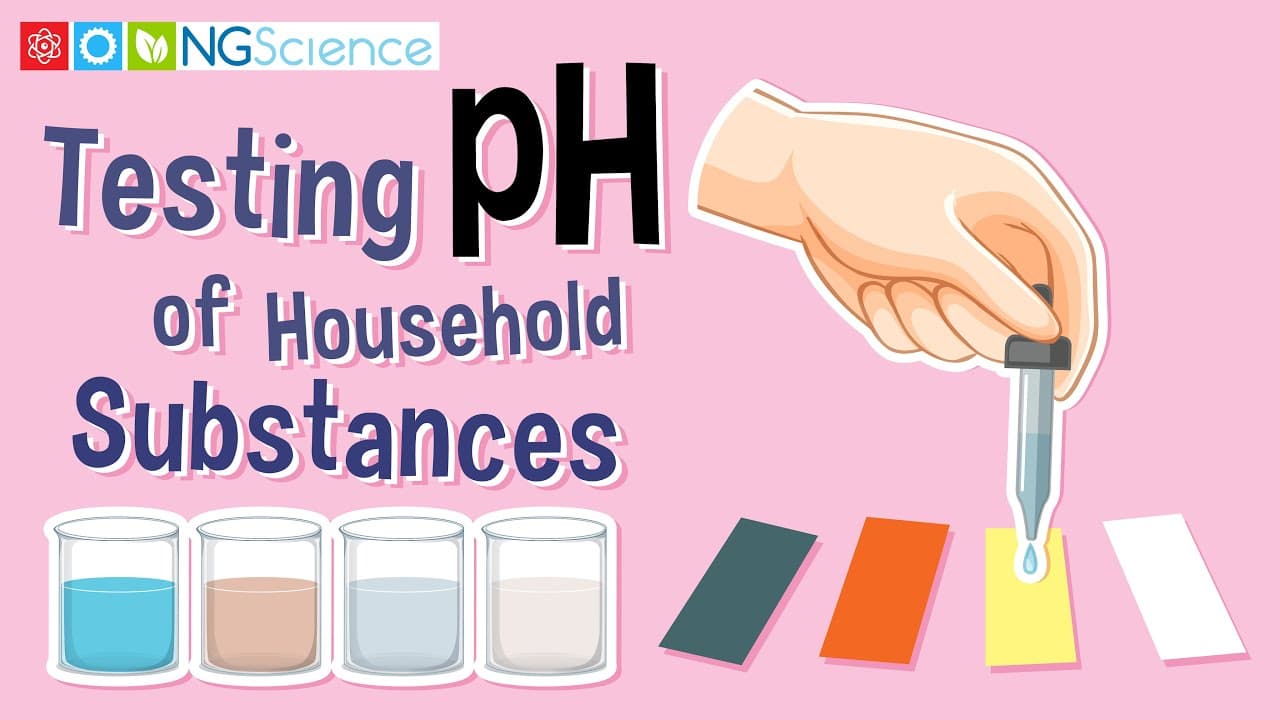
Is It an Acid or a Base? Testing Household Items

Is It an Acid or a Base? Testing Household Items

This educational video demonstrates a classic science experiment suitable for elementary and middle school students: testing the pH levels of common household substances to determine if they are acids or bases. Using litmus paper as an indicator, the presenter tests four distinct liquids—window cleaner, lemon juice, vinegar, and a baking soda solution—providing a clear visual representation of chemical properties. The video explores key themes of chemical classification, observation, and data recording. It introduces the concept of litmus paper as a tool that changes color in reaction to pH levels, establishing the rule that acids turn the paper red while bases turn it blue or green. The segment concludes by synthesizing the findings into a clear data table, modeling how scientists organize their results. For educators, this video serves as an excellent hook or demonstration for units on matter, chemistry, or the scientific method. It provides a safe, replicable experiment that allows students to see abstract chemical properties manifested through observable color changes. The clear pacing and visual reinforcement make it ideal for introducing the vocabulary of "acid" and "base" before students conduct their own hands-on investigations.

Next Generation ScienceNext Generation Science

2mins 51s

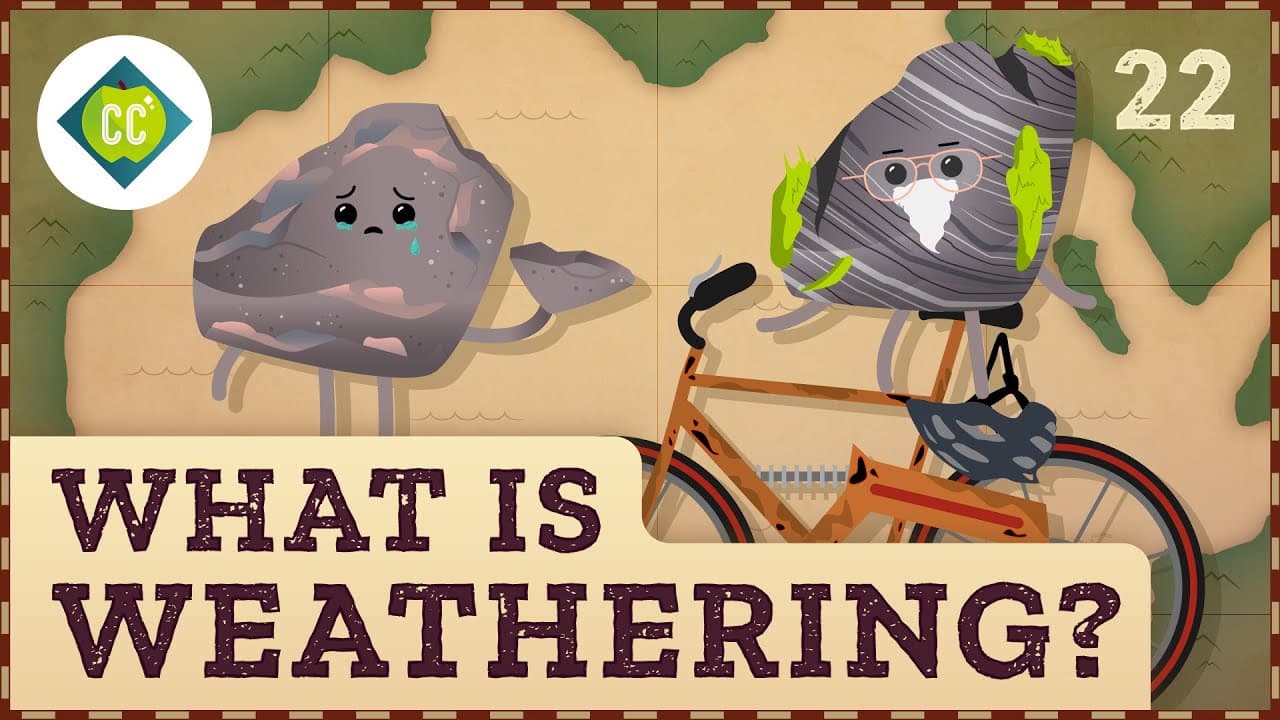
How Weathering and Erosion Shape the Earth

How Weathering and Erosion Shape the Earth

In this dynamic episode of Crash Course Geography, host Alizé Carrère explores the powerful forces that break down the Earth's surface: weathering and erosion. The video distinguishes between these two critical processes, explaining that weathering is the breakdown of rock in situ, while erosion is the transport of that material. Viewers are taken on a journey from the towering Himalayas to the microscopic interactions of atoms, illustrating how mountains are leveled over millions of years through mechanical, chemical, and biological means. The content dives deep into specific mechanisms of weathering. It covers mechanical processes like frost action (freeze-thaw cycles) and salt crystal growth, which physically pry rocks apart. It then transitions to chemical weathering, explaining oxidation (rusting) and carbonation, detailing how acidic water dissolves limestone to create vast cave systems and karst topography. The video concludes by examining biological weathering and the unique ecosystems found within caves. For educators, this video serves as an excellent bridge between chemistry and geography. It visually demonstrates abstract concepts like acid-base reactions in a real-world geological context. The clear analogies—such as a rusting bicycle representing oxidation or bursting pipes representing frost wedging—make complex geological processes accessible. Teachers can use this resource to explain the rock cycle, soil formation, and the interconnectivity of Earth's spheres (lithosphere, hydrosphere, atmosphere, and biosphere).

CrashCourseCrashCourse

11mins 25s

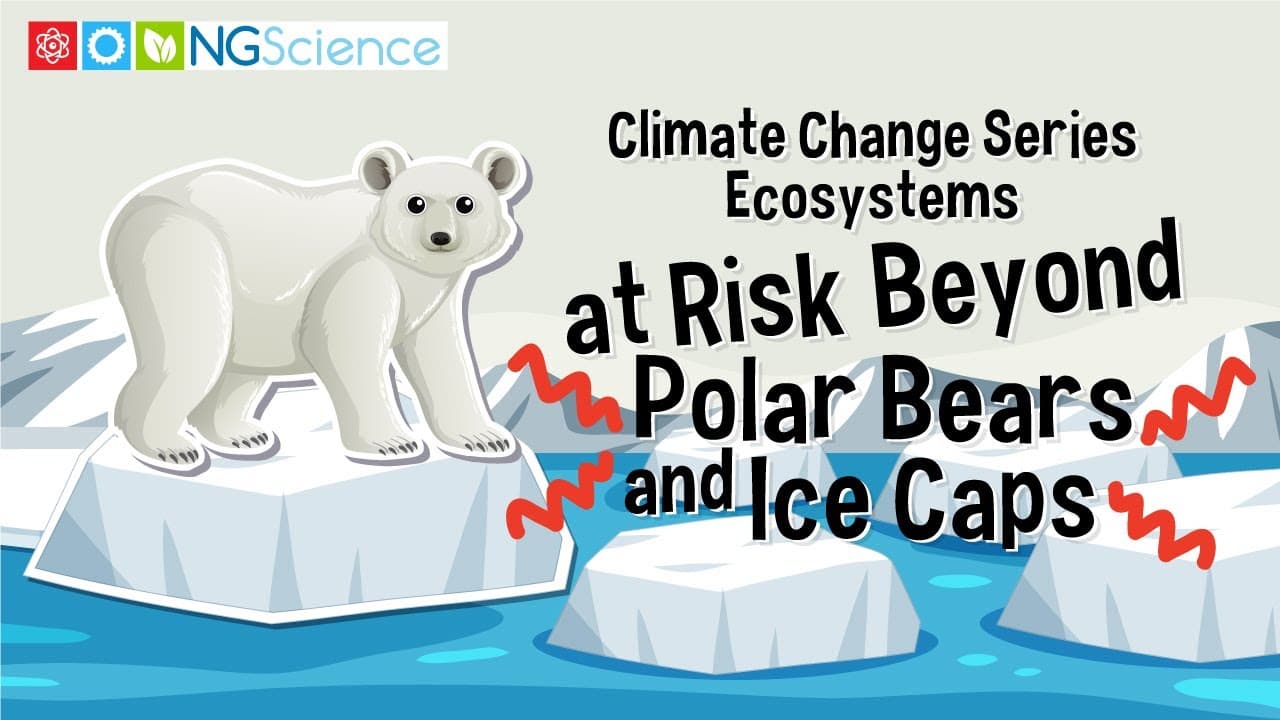
Beyond Polar Bears: How Climate Change Impacts Global Ecosystems

Beyond Polar Bears: How Climate Change Impacts Global Ecosystems

This educational video provides a comprehensive look at the ripple effects of climate change beyond the common imagery of melting ice caps and polar bears. It explores how rising temperatures and atmospheric changes are devastating diverse ecosystems, from the chemical structure of our oceans to the stability of forests and the survival of specific species like koalas. The narrative connects human activity, such as deforestation and carbon emissions, to the breakdown of essential natural systems. Key themes include ocean acidification and its impact on coral reefs, the role of forests as carbon sinks (and how drought and fire compromise this), and the specific biological threats to wildlife. The video details how koalas suffer from dehydration due to drying eucalyptus leaves and heat stress, while also touching on the decline of amphibians, birds, and pollinators. It emphasizes the concept of a "domino effect" where the loss of one species disrupts entire food webs. For educators, this resource serves as a powerful tool to teach systems thinking and environmental science. It moves beyond general awareness to explain specific mechanisms of harm, such as how CO2 prevents coral from building calcium carbonate structures. It provides excellent visual evidence for discussions on biodiversity, conservation, and the interconnectedness of life on Earth, making it suitable for biology, ecology, and environmental studies units.

Next Generation ScienceNext Generation Science

4mins 30s

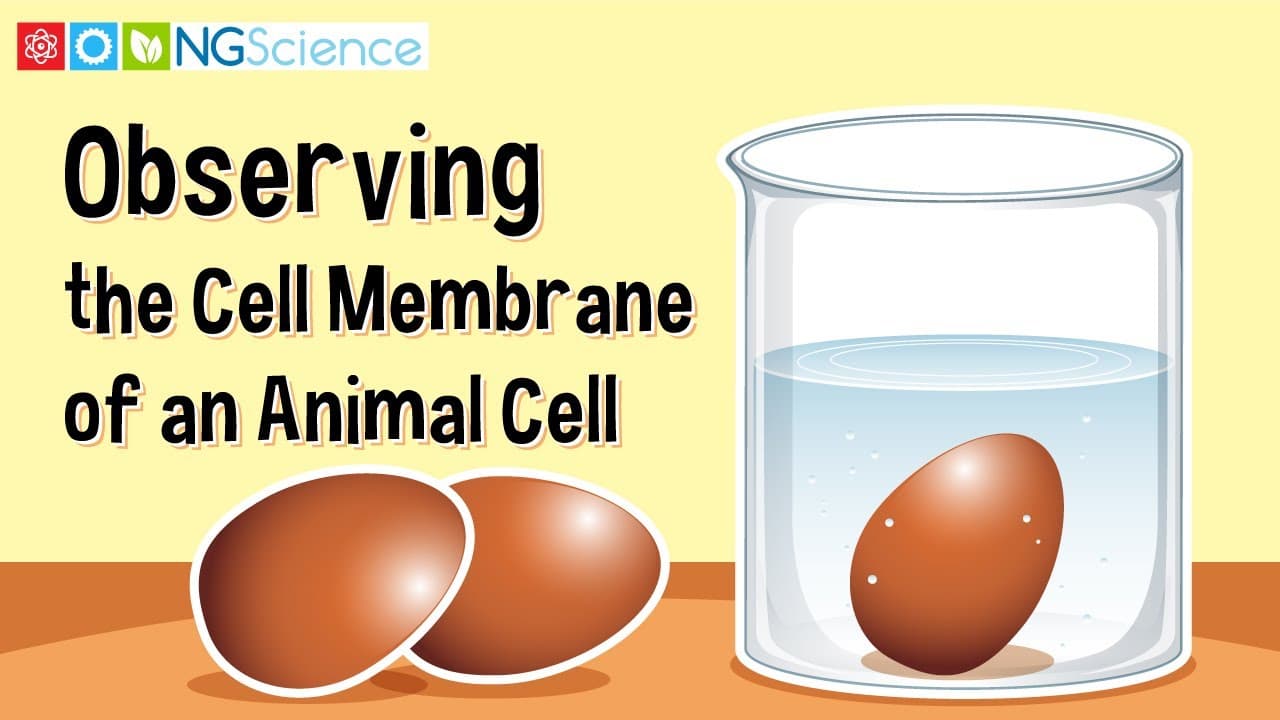
Observing a Giant Cell: The Naked Egg Experiment

Observing a Giant Cell: The Naked Egg Experiment

This concise science demonstration uses a common chicken egg to visualize and understand the properties of a cell membrane. By dissolving the hard outer shell of the egg using vinegar, the video reveals the flexible, semi-permeable membrane underneath, providing a rare macroscopic view of a biological structure usually only visible through a microscope. The video guides viewers through the chemical process of removing the calcium carbonate shell and then examines the physical properties of the exposed membrane. The video explores key biological and chemical themes, specifically the structure of animal cells and the reaction between acids and bases. It highlights that bird eggs are essentially giant single cells, making them perfect models for classroom study. The interaction between the vinegar (acetic acid) and the eggshell (calcium carbonate) serves as a dual lesson in cell biology and chemical reactions, demonstrating how distinct substances interact to alter physical properties. For educators, this video is an excellent hook or demonstration tool for units on cell biology or introductory chemistry. It transforms the abstract concept of a "cell membrane" into a tangible, observable object. Teachers can use this video to introduce the differences between plant and animal cells (specifically the lack of a cell wall in animal cells), discuss the protective functions of biological structures, or set up a hands-on "Naked Egg" experiment in the classroom to further study osmosis and diffusion.

Next Generation ScienceNext Generation Science

1min 54s

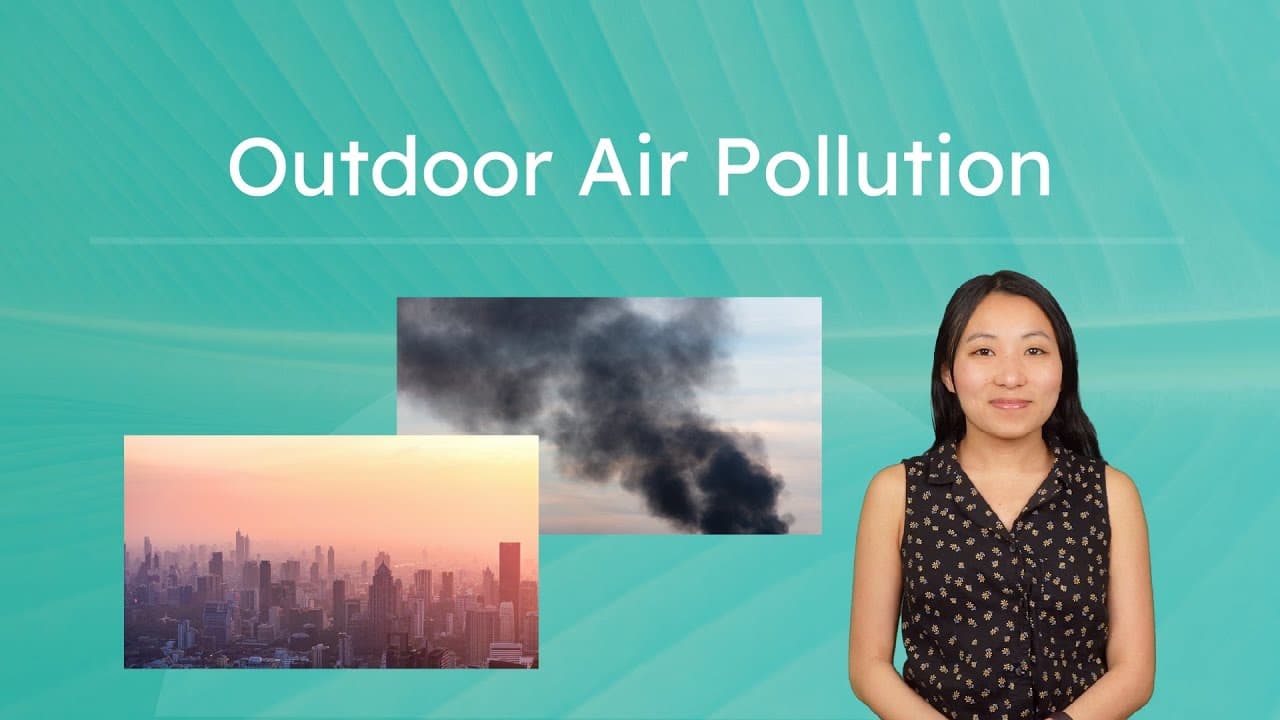
Understanding Outdoor Air Pollution: Primary and Secondary Types

Understanding Outdoor Air Pollution: Primary and Secondary Types

This educational video explores the complex topic of outdoor air pollution, breaking it down into two main categories: primary and secondary pollutants. The narrator, Caroline, uses a personal anecdote about receiving an air quality alert to frame the lesson, guiding viewers through the scientific reasons behind such alerts. The video defines and provides examples of primary pollutants like particulate matter, harmful gases, and volatile organic compounds (VOCs), before explaining how secondary pollutants like acid rain and ground-level ozone are formed through chemical reactions in the atmosphere. The content covers key environmental science themes including atmospheric chemistry, the sources of pollution (such as fossil fuels, wildfires, and consumer products), and the distinction between beneficial stratospheric ozone and harmful ground-level ozone. It also touches on the Air Quality Index (AQI) and the health impacts of smog and particulate matter, making abstract environmental concepts concrete and relatable. For educators, this video serves as an excellent core resource for units on ecology, human impact, or environmental chemistry. It uses clear visual metaphors—like the "pollution cake"—to explain complex chemical processes, making it accessible for middle and high school students. The built-in pause points for reflection and prediction allow teachers to easily incorporate active learning, checking for understanding as the lesson progresses.
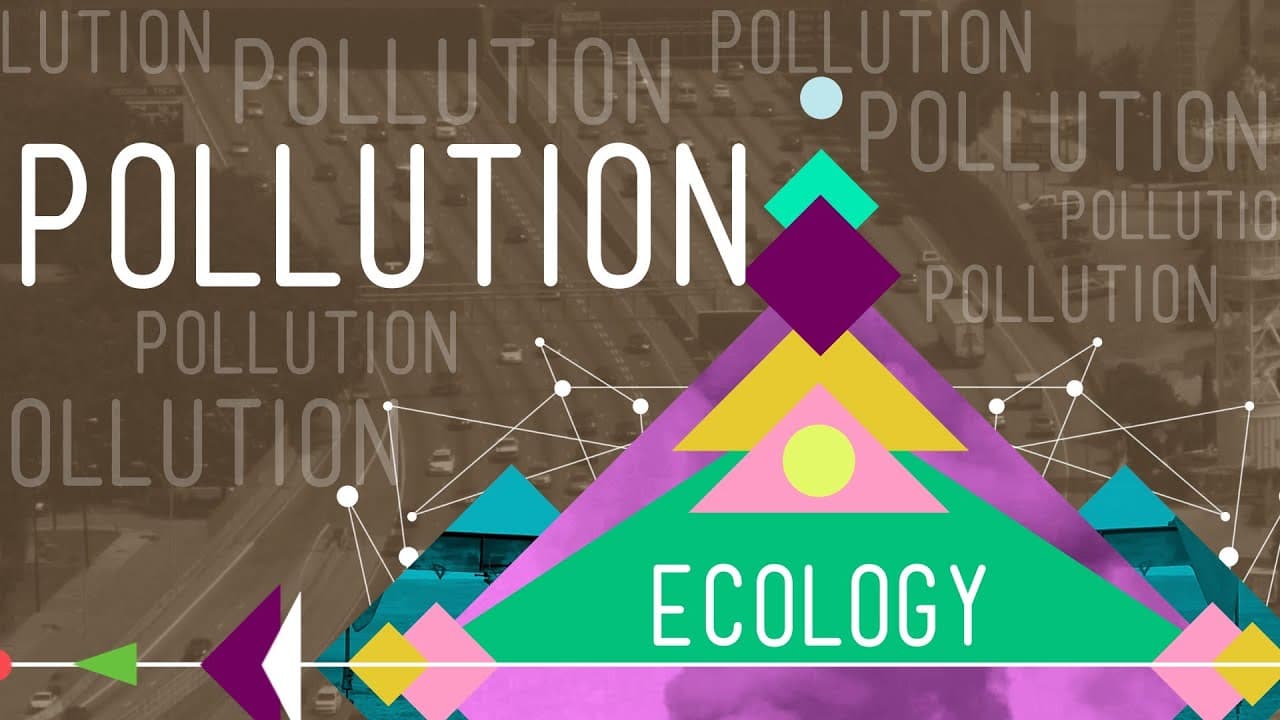
Miacademy & MiaPrep Learning ChannelMiacademy & MiaPrep Learning Channel

8mins 32s

Materials

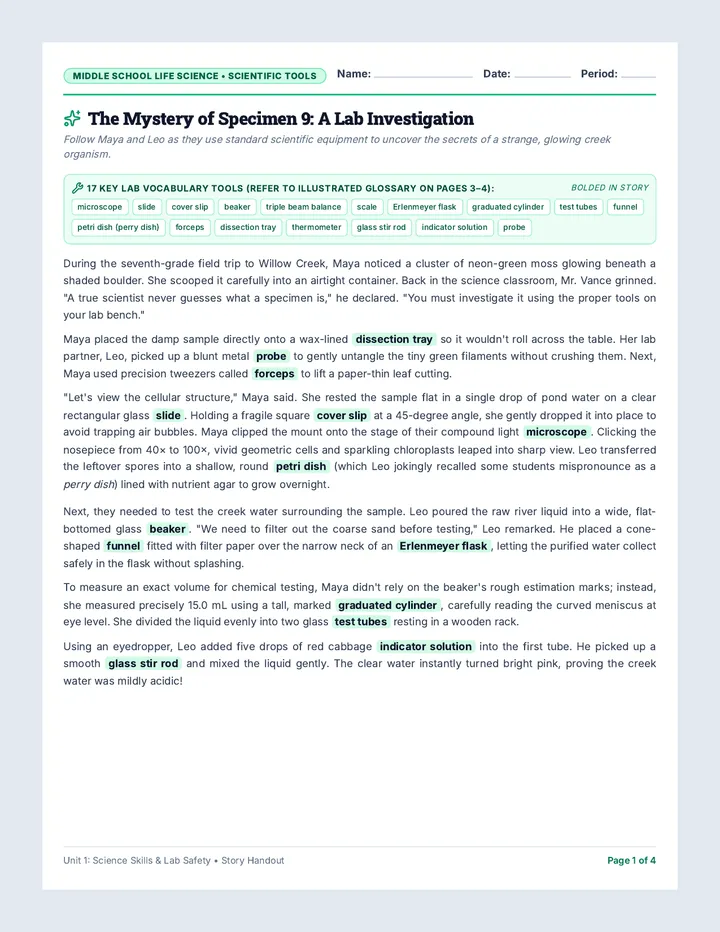
Mystery Specimen Story Handout

Mystery Specimen Story Handout

A comprehensive four-page middle school science packet containing the 'Mystery of Specimen 9' reading story, comprehension questions, and a complete two-page illustrated visual glossary featuring diagrams and definitions for all 17 laboratory tools.

S

stewart

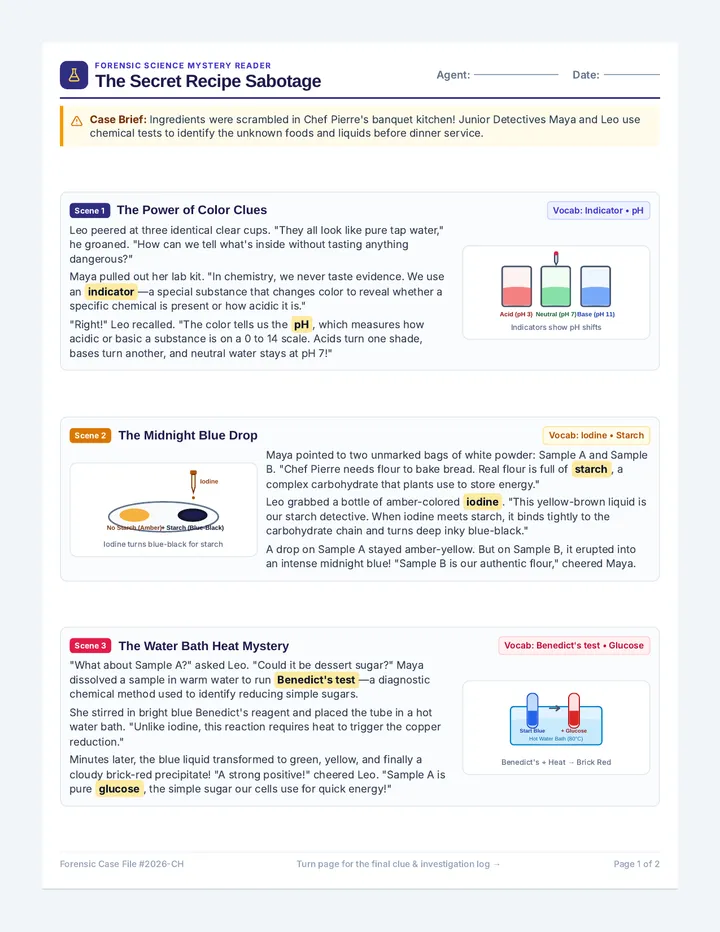
Chemical Clue Mystery Story

Chemical Clue Mystery Story

A two-page illustrated science mystery story featuring chemical indicators, food tests, and lab color changes to teach vocabulary terms including iodine, Benedict's test, glucose, starch, pH, indicator, and phenolphthalein.

S

stewart

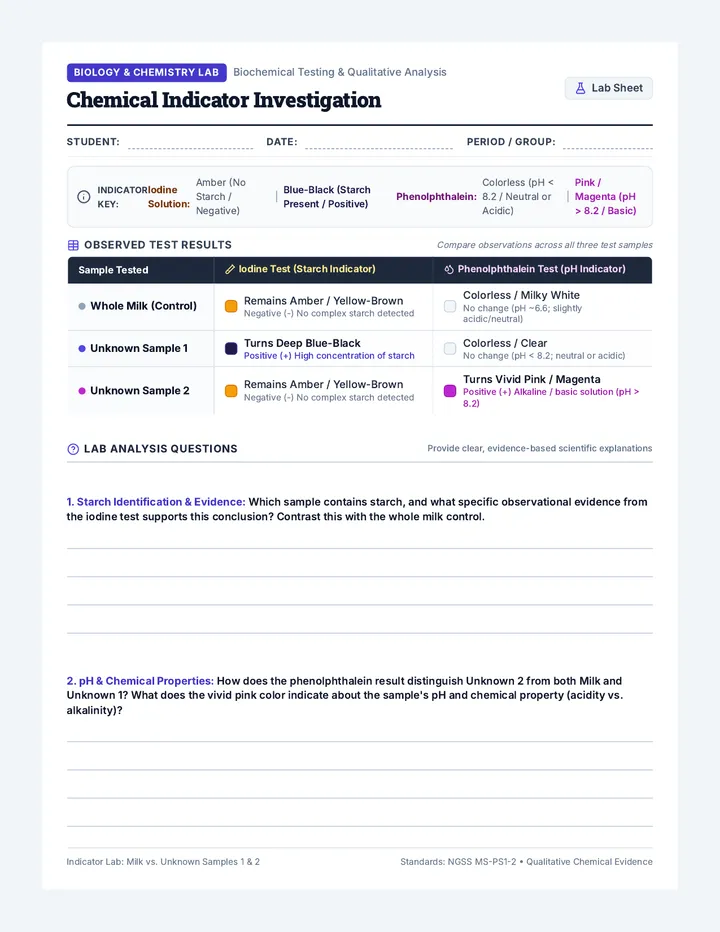
Mystery Milk Lab Worksheet

Mystery Milk Lab Worksheet

A laboratory analysis worksheet featuring an observation chart comparing milk, Unknown 1, and Unknown 2 tested with iodine and phenolphthalein. Includes an indicator reference key and two comprehensive analysis questions with ample student response lines.

S

stewart

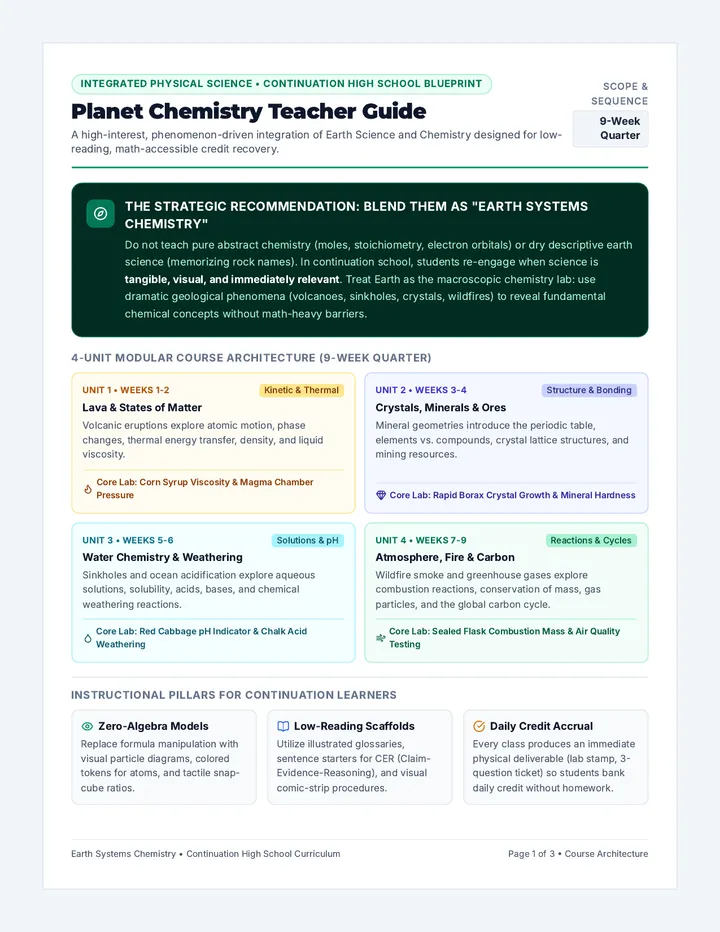
Planet Chemistry Teacher Guide

Planet Chemistry Teacher Guide

A comprehensive curriculum blueprint integrating chemistry and earth science specifically tailored for continuation high school students. Features four accessible, hands-on units, low-math lab investigations, and structured literacy supports for credit recovery.

MH

Meagan Hudson

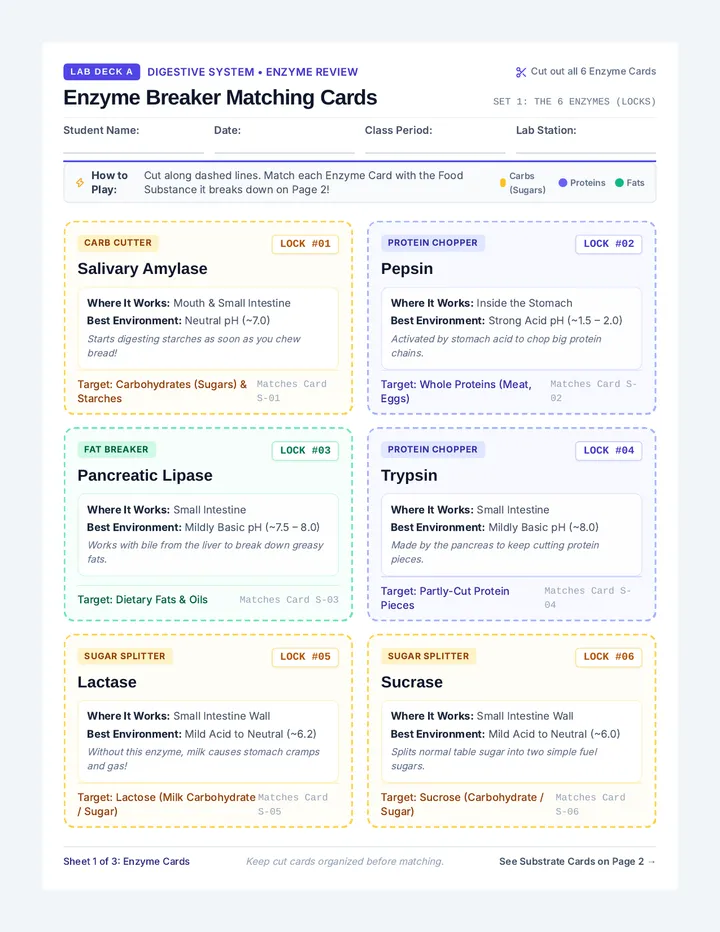
Enzyme Breaker Matching Cards

Enzyme Breaker Matching Cards

A streamlined 3-page matching card game and worksheet with 6 key digestive enzymes (amylase, pepsin, lipase, trypsin, lactase, and sucrase). Features large format cut-out cards, matching food substrates, and a synthesis lab mat.

M

MELANIE.ROBERTS

Sour Science Lab Worksheet

Sour Science Lab Worksheet

A polished single-page science worksheet for testing candy pH, featuring pre-lab hypothesis sections, a data collection table, and post-lab analysis questions with a vibrant, candy-themed design.

TM

Teri Minami

Sequences

Steady State Slides

Reaction Dynamics

This unit explores how chemical reactions occur and how they reach a state of balance. Students investigate reaction kinetics, energy changes, and the principles of dynamic equilibrium through modeling and laboratory investigation.

OM

Olutoyin Makinde

34
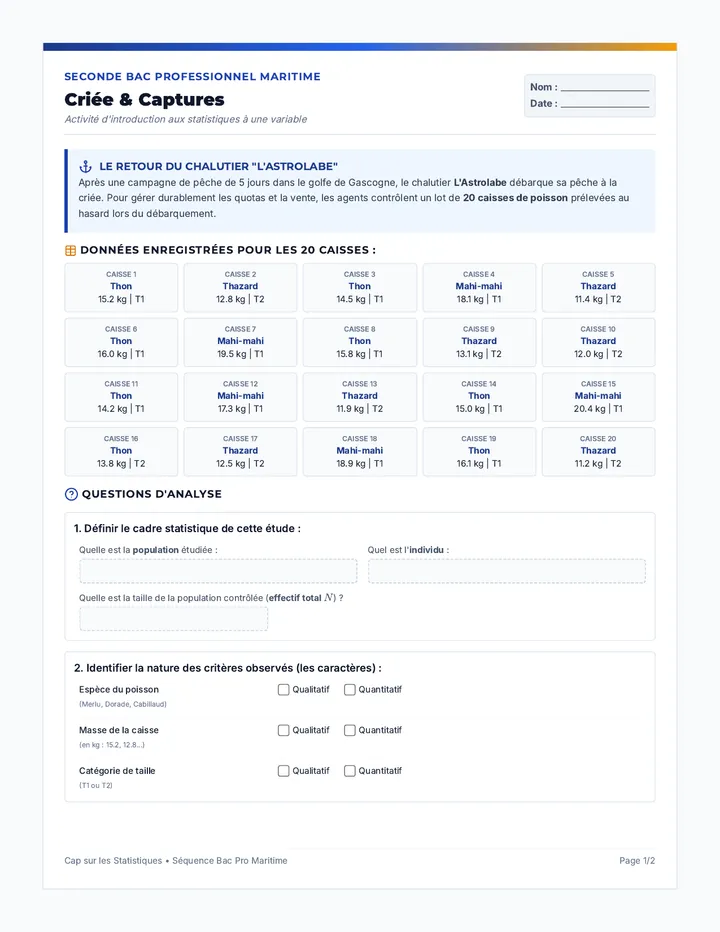
Positionnement Diagnostic Test

Cap sur les Automatismes

Séquence d'accueil et de consolidation des automatismes numériques (nombres, fractions, priorités opératoires) comprenant un test de positionnement et des fiches d'exercices contextualisées.

EK

Emmanuelle Klaus-Baron

7
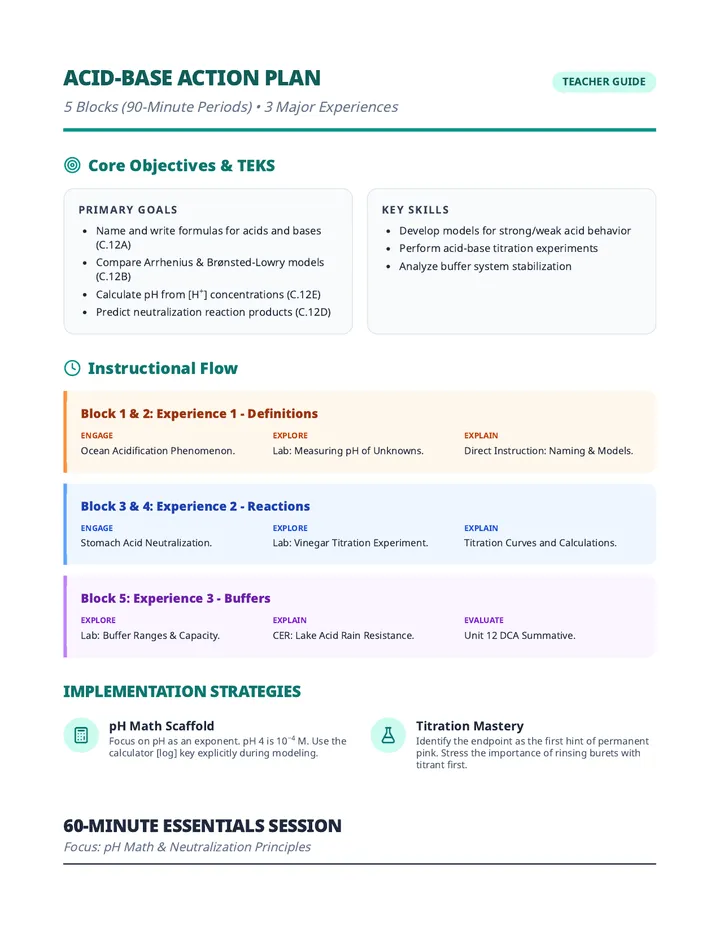
Acid Base Action Plan

Acid Base Investigation

A comprehensive unit exploring the properties, reactions, and mathematical relationships of acids and bases, featuring pH calculations, titrations, and buffer systems.

OM

Olutoyin Makinde

34
Lab Success Study Guide

Lab Chemistry Mastery

A specialized curriculum designed to prepare students for introductory chemistry laboratory examinations, focusing on practical applications, quantitative calculations, and organic structure identification.

OM

Olutoyin Makinde

3
Stoichiometry Master Slides Plus Practice

Stoichiometry Mastery

A unit focused on the quantitative relationships in chemical reactions, covering everything from basic molar mass to complex limiting reactant and percent yield calculations.

OM

Olutoyin Makinde

27
Chemistry Finals Study Booklet

Molecular Mastery Finals Prep

A comprehensive review package for CHEM 1406, featuring in-depth study guides for key topics and a full practice exam with detailed solutions.

OM

Olutoyin Makinde

3

Lessons

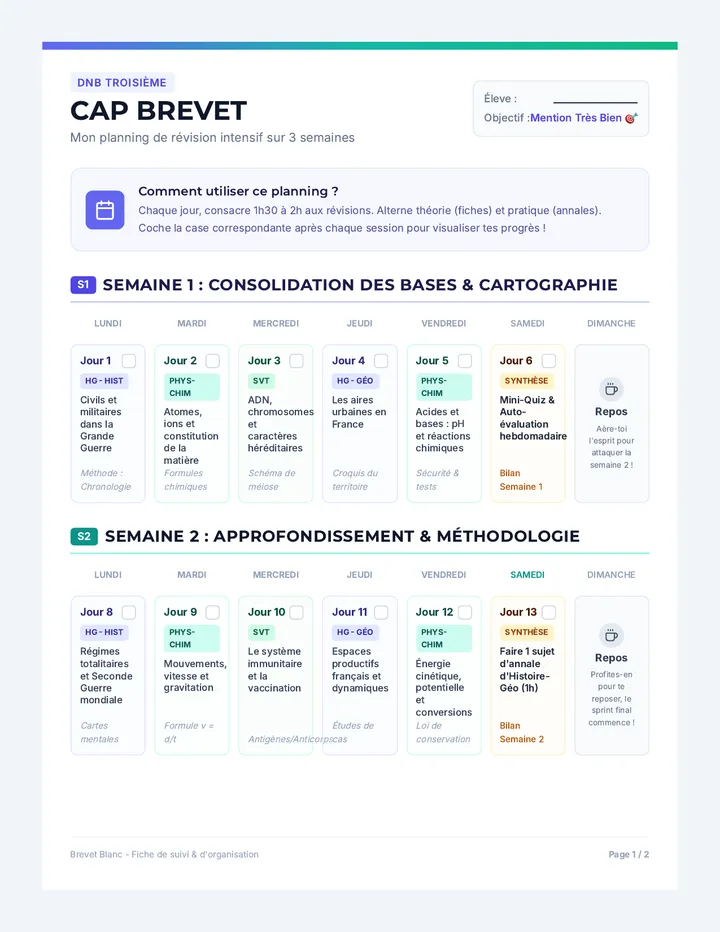
Planning Brevet Calendrier

Objectif Brevet

Un programme de révision intensif et structuré sur 3 semaines pour préparer sereinement les épreuves de SVT, Physique-Chimie et Histoire-Géographie du Diplôme National du Brevet.

MW

Myriam Wb

6
Reaction Review Slides

Reaction Mastery

A comprehensive lesson on chemical reactions covering conservation of mass, balancing equations, evidence of reactions, and energy changes. Students will engage with visual slides, practice worksheets, and a summative assessment.

MB

Marsha Bolden

6
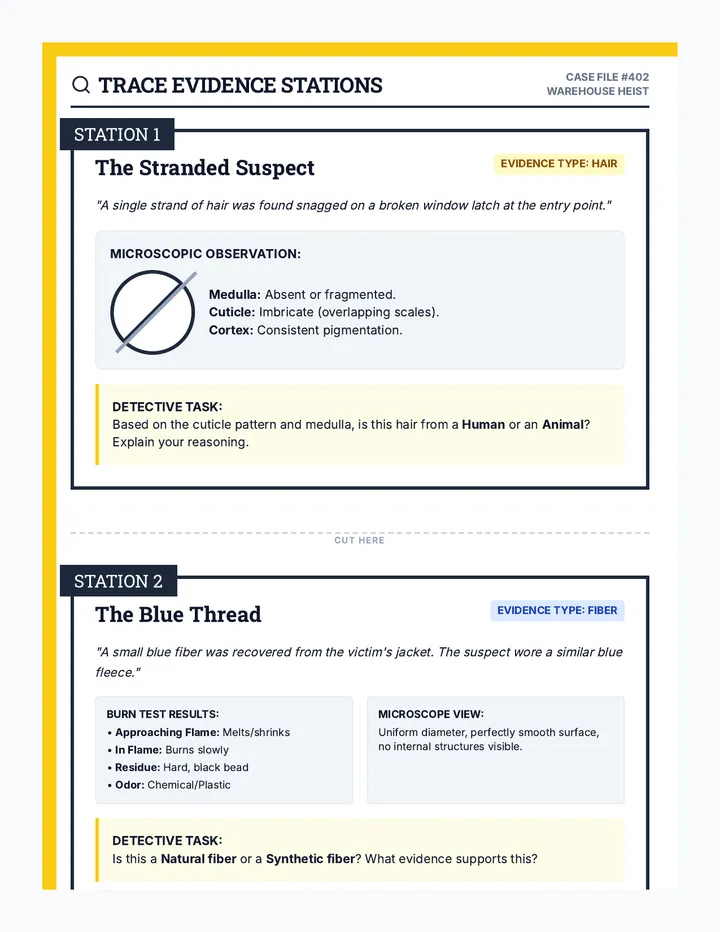
Trace Evidence Stations Cards

Trace Evidence Detectives

A hands-on forensic science lesson where students rotate through stations to analyze various types of trace evidence (hair, fiber, glass, soil, etc.) to solve a warehouse heist.

SW

Shelley Wright

3
Kitchen Print Lesson Plan

Kitchen Print Lab

A chemistry-meets-art lesson where students use aluminum foil and cola to explore hydrophobia and surface tension through lithographic printmaking. Students create their own hand-drawn designs and produce multiple editions while learning the molecular science behind the process.

RC

Rita Collins

5
Molecular Mashup Booklet

Molecular Mashup

A comprehensive review of mixtures and solutions for 5th grade students, focusing on solubility, concentration, and chemical vs. physical reactions through a series of independent lab challenges.

M

mfraser

3
Student Tracking Booklet

ACT Science Daily Sparks

A comprehensive 20-day ACT prep warm-up curriculum designed for science classrooms. Features daily pairings of science-themed English and Math ACT questions, complete with student tracking worksheets and a detailed teacher reference guide.

PR

Penne Reed

3