Bottoms Up Slides Bottoms Up
Unlocking Earth's Oldest Secrets
Lesson 1: The Law of Superposition
The Sandwich Problem
Imagine you are making a giant sandwich.
First, you put down the Bread .
Then, the Cheese .
Finally, the Tomato .
"Which part did you touch first? Which part is at the very bottom?"
TOP: TOMATO
CHEESE
BOTTOM: BREAD
The Law of Superposition
"In any sequence of undisturbed rock layers, the oldest layer is at the bottom and the youngest layer is at the top."
Oldest
Deposited first.
Youngest
Deposited last.
Dusty Diaries
Earth builds itself layer by layer over millions of years.
Sediments like sand, mud, and pebbles settle at the bottom of oceans or lakes.
Think about it:
If you drop a coin in the mud, and then more mud covers it... where will the coin be?
Youngest Layer (Newest)
Middle Layer
Oldest Layer (First)
Relative Age Practice
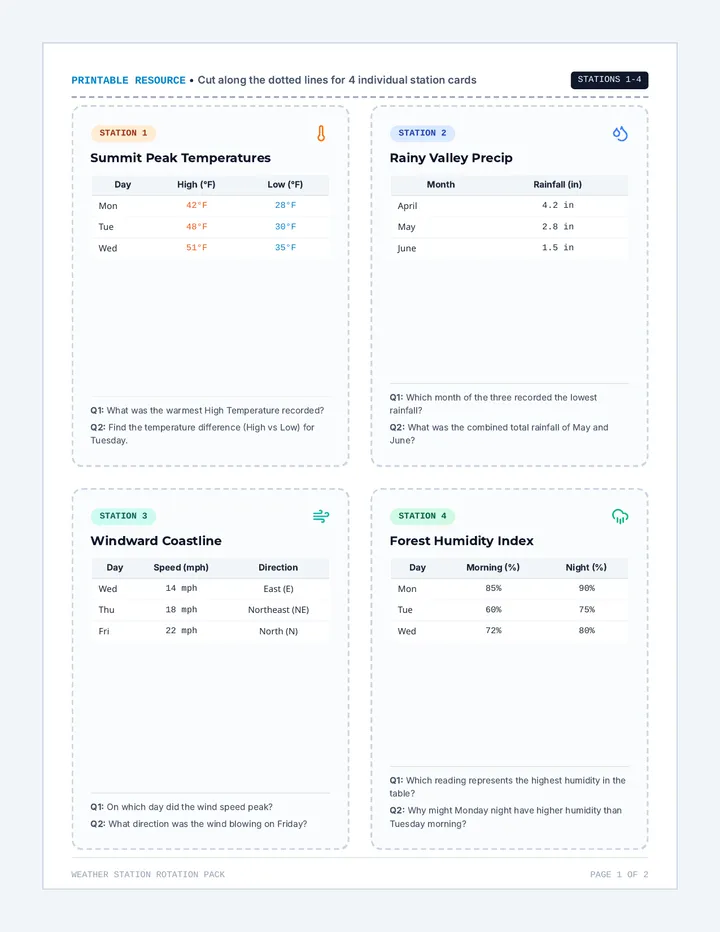
Look at this Laundry Hamper:
Monday Socks
Tuesday Shirt
Wednesday Pants
Thursday Hat
1
Which item was worn first ?
2
Which item is the newest ?
3
This is called Relative Dating !
Keep in Mind...
If a rock layer is at the bottom, it had to be there before the layer on top could land on it.
Younger
Older
Laundry Layer Log Worksheet Laundry Layer Log
Investigation: The Law of Superposition
Name:
Date:
Background Knowledge
In geology, the Law of Superposition tells us that in undisturbed rock layers, the oldest layer is at the bottom and the youngest layer is at the top . We can use this same logic to figure out the "relative age" of items in a pile, like a laundry hamper!
1
Part 1: Analyze the Hamper
MONDAY:
Soccer Socks
TUESDAY:
Red T-Shirt
WEDNESDAY:
Blue Jeans
THURSDAY:
Striped Hat
The "Relative Dating" Hamper
A. Which item was worn first and put at the bottom of the hamper?
B. Which item is the "youngest" or most recently worn?
C. How do you know the Blue Jeans are older than the Striped Hat?
2
Part 2: Applying it to Rocks
Scientists use this same logic to date fossils. Look at the rock layers below:
Layer D
Layer C
Layer B
Layer A
Relative Age Challenge:
Rank the layers from 1 (Oldest) to 4 (Youngest):
Layer A:
Layer B:
Layer C:
Layer D:
Critical Thinking:
If you found a dinosaur fossil in Layer B and a leaf fossil in Layer D, which fossil is older? Explain your reasoning using the Law of Superposition .
Geology Field Notes • Earth's Dusty Diary • Unit 1
Layer Lab Slides Layer Lab
Modeling Earth's Stratigraphic Columns
Lesson 2: Constructing Columns
Grand Canyon Stripes
When you look at the Grand Canyon, you see massive stripes of color.
Each stripe is a rock layer formed at a different time.
"If you were a geologist, where would you find the oldest fossils? At the top or the bottom?"
OLDEST
The Modeling Mission
Build
Use sand, soil, and gravel to create your own rock layers.
Embed
Hide "fossils" (beads/shells) inside different layers.
Map
Draw your column and record which fossils are the oldest.
How to build a Column
1
Choose your materials for the first layer (Oldest!).
2
Place one "fossil" in that layer.
3
Repeat for 3-4 more layers.
4
DO NOT SHAKE THE BOTTLE!
Vocabulary Alert!
Stratigraphic Column
"A diagram showing the vertical sequence of rock layers in a specific area."
Think of it as a vertical timeline of the Earth's history!
Layer Maker Lab Activity Layer Maker Lab
Geological Modeling Report
Geologist:
Station:
Mission Objective
Construct a physical model of a stratigraphic column . You will use different materials to represent sedimentary rock layers and embed objects to represent fossils.
Fossil Key
Star Bead
Round Bead
Square Bead
Triangle Bead
My Stratigraphic Column
Sketch your finished model below. Color each layer to match your materials and draw the fossils where you placed them.
TOP • • • • • • BOTTOM
Data Log
Layer Pos. Material Used Fossil Found Top (Youngest) Middle Top Middle Bottom Bottom (Oldest)
1. Which material represents your oldest rock layer?
2. If you swapped your Bottom and Top materials, would the fossils' relative ages change? Why?
Geologist Challenge
Identify a fossil in your model that is older than the round bead, but younger than the oldest layer. Which one is it?
Field Lab 02 • Stratigraphic Modeling Earth's Dusty Diary • Sequence Unit
Fossil Match Slides Fossil Match
Correlating Rock Layers Across the World
Lesson 3: Index Fossils & Correlation
Connecting the Pieces
Imagine you find two halves of a torn treasure map.
How do you know which way they fit together?
"You look for a pattern that continues across the rip!"
Geologists do the same with rock layers in different locations.
The Index Fossil
Nature's Time Markers
Widespread
Lived all over the world, not just in one small spot.
Short-Lived
Only existed for a short time in Earth's history.
"If we find the same Index Fossil in two different places, we know those rock layers are the same age !"
Fossil Superstar: The Trilobite
Trilobites are perfect index fossils. They lived millions of years ago in every ocean, but then they went extinct.
Because they were everywhere for a specific time, they act like a time stamp in the rocks.
Easy to recognize
Found globally
Defined time period
How to Correlate
Location A
Match the Fossils!
Location B
Geologist Clue:
Even though the rock colors are different, the Blue Trilobite tells us the second layer from the bottom in Location A is the SAME AGE as the third layer from the bottom in Location B.
Fossil Finder Activity Fossil Finder
Data Correlation Challenge
Investigator:
Earth's Dusty Diary • Lesson 3
Index Fossil Identification Key
Trilobite Paleozoic
Ammonite Mesozoic
Placoderm Devonian
Glossopteris Permian
Correlation Challenge
Three different rock outcrops have been discovered across the state. Match the layers by finding the same index fossils in each location. Draw lines connecting the same fossils across the sites.
SITE A
SITE B
SITE C
Correlation Log
1. Which fossil is found in ALL three sites?
2. Based on Site B, which fossil is the OLDEST?
3. Why can we say the bottom of Site A is the same age as the second layer from the bottom of Site B?
Master Geologist Question
Imagine you find a Glossopteris fossil way below Site B. Would that be younger or older than everything else on this page? Explain.
Field Task 03 • Stratigraphy & Correlation • Fossil Finder Worksheet
Earth Breaks Slides Earth Breaks
When the Rock Record Gets Messy
Lesson 4: Disturbances in the Record
The Cut Rule
Think about a piece of paper.
If you cut the paper with scissors, what came first? The paper or the cut?
"The thing being cut must be OLDER than the thing doing the cutting!"
In geology, we call this Cross-Cutting Relationships .
PAPER
The Cut is Younger!
What is a Fault?
Earth's Major Shifts
A fault is a crack in the Earth's crust where rock layers have moved.
Earthquakes cause these breaks, shifting entire mountains of rock up, down, or sideways.
"If a fault cuts through 5 layers of rock, the fault is younger than all 5 of those layers!"
The Eraser: Erosion
Sometimes, Earth's history isn't just broken—it's erased .
Wind, rain, and ice wear down rock layers, creating a gap in the timeline called an Unconformity .
It's like a history book with pages 50 through 75 ripped out. We know something is missing!
ERODED!
Today's Mission
You will simulate a fault line and use your detective skills to determine the relative order of events.
Event A:
The layers are formed (Superposition).
Event B:
The layers are broken (Faulting).
Which must happen first? Why?
Cracked Earth Investigation Cracked Earth
Investigation: Geological Faults
Field Agent:
Earth's Dusty Diary • Lesson 4
Part 1: Before the Break
Draw your "undisturbed" rock layers. Make sure to draw at least 3 distinct layers and label them A (Oldest) to C (Youngest) .
Stable Earth
Part 2: Simulate the Fault
Follow your teacher's instructions to cut and shift your model. Draw what it looks like now. Make sure to show where the fault line (the break) is!
Fault Zone
Event Sequence Log
List the events in your model from Oldest (first) to Youngest (last):
1
2
3
4
FAULT LINE
1. How do you know the Fault is the youngest part of your model?
2. What would happen to the fossils inside the layers when the fault moved?
The Eraser Challenge
Suppose a river flows over your faulted layers for 1,000 years and wears the top of them smooth. Which event is younger: the Fault or the Erosion ? Why?
Investigation 04 • Earth Breaks • Geological Disturbances Lab
Time Tape Slides Time Tape
Mapping Earth's Incredible History
Lesson 5: The Geological Timescale
If Earth's History was 24 Hours...
12:00 AM Earth is formed.
4:00 AM First simple life appears.
10:56 PM Dinosaurs arrive!
11:59:58 PM Humans appear.
12
3
6
9
Earth's Major Chapters
Precambrian
The longest era! Only simple life like bacteria lived here for billions of years.
4.6 Billion - 541 Million
Paleozoic
"Ancient Life." Fish, plants, and those famous trilobites ruled the world.
541 - 252 Million
Mesozoic
"Middle Life." The Age of Dinosaurs! Huge reptiles and first small mammals.
252 - 66 Million
Cenozoic
"Recent Life." The Age of Mammals. Humans finally make our entrance!
66 Million - Today
Making it to Scale
Billions of years is a lot to imagine. Today, we will use a 5-meter long piece of paper tape to represent all of Earth's history.
On this scale:
1 centimeter = 10 Million Years!
EARTH FORMS DINOSAURS ARRIVE (Last Tiny Slice!)
Your Mission
Construct a Geological Time Tape that stretches across your classroom.
Measure & Mark
Find the exact spots for the start of each Era.
Illustrate
Draw the creatures that lived in each time period.
Compare
Stand back and see how much time passed before life began!
Time Tape Project Guide Time Tape Project
Mapping Deep Time
Time Traveler:
Earth's Dusty Diary • Final Project
The Mission
You will create a physical timeline of Earth's 4.6 billion-year history. Using a scale of 1 cm = 10 million years , you will mark the major Eras and key events. Your tape will be approximately 460 cm (4.6 meters) long!
The Measurement Log
Start your measurement from the "Earth Forms" end of your tape (0 cm).
Event / Era Start Time (Years Ago) Tape Measurement Earth Forms 4.6 Billion Years 0 cm First Bacteria 3.5 Billion Years 110 cm Paleozoic Era Starts 541 Million Years 406 cm Mesozoic Era Starts 252 Million Years 435 cm Cenozoic Era Starts 66 Million Years 453 cm Humans Appear 200,000 Years 459.98 cm TODAY Present Day 460 cm
Deep Time Reflections
1. Looking at your tape, which Era took up the MOST space? Why do you think geologists group the first 4 billion years into just one era (the Precambrian)?
2. Dinosaurs lived for about 186 million years. Humans have lived for about 200,000 years. Compare their "length" on your tape. What did you notice?
The Big Connection
How does knowing the relative age of rock layers (from the bottom up) help scientists build a timeline like the one you just made?
Unit Finale • Earth's Dusty Diary • Scale & Proportion Project