Climate Clues Presentation Day 1
Storm Squad PBL
Mission Launch
Welcome to the Storm Squad!
Our community faces severe weather events that can cause disruptions and hazards. As severe weather experts, we need to help our friends and families stay safe!
Our Driving Question:
How can we, as severe weather experts, design an informational Weather Survival Guide to help our community prepare for extreme weather events?
Unit Objective: Research, Design, and Share! Slide 1 of 3
Day 1
Climate Clues
Weather vs. Climate
What's the Difference?
Daily Weather
What is happening in the atmosphere right now or over a few days.
Examples:
"It is 72°F and sunny today."
"A thunderstorm is coming tonight."
"It snowed three inches yesterday."
Long-Term Climate
The average weather patterns of an area over many years (usually 30+ years).
Examples:
"Florida has warm, wet summers."
"The Sahara desert is hot and dry."
"The Arctic is consistently freezing."
🔑 Shortcut: "Climate is what you expect, weather is what you get!"
Discussion: Look out the window. Is that weather or climate? Slide 2 of 3
Day 1
Hazard Squad
Choose Your Hazard
Select Your Research Focus
You will become an expert in one of these four extreme weather events:
Tornadoes
Violent spinning columns of air with destructive winds that touch down suddenly.
Hurricanes
Massive swirling tropical storms with torrential rains and storm-surge flooding.
Blizzards
Severe winter storms combining subfreezing temperatures, heavy snow, and blinding winds.
Severe Floods
Overflow of massive volumes of water onto dry land, caused by heavy rains or storm surges.
Open your Storm Squad Field Journal to Page 1. Complete the Weather vs. Climate sort and mark your hazard choice!
Activity Time: 15 min
Tip: Choose a storm you want to understand deeply! Slide 3 of 3
Climate Clues Journal Storm Squad Field Journal
DAY 1: Climate Clues
Mission: Weather PBL
Grade 3 Science & ELA
Name: ____________________________________
Date: ________________________
Our Project Driving Question
"How can we, as severe weather experts, design an informational Weather Survival Guide to help our community prepare for extreme weather events?"
Activity: Sort the Observations
Read each scientific observation below. Write the correct letter in the box for either W (Daily Weather) or C (Long-Term Climate).
A. "The temperature in Seattle is 45°F and rainy today." Classify: [____]
B. "Sahara Deserts are extremely hot and dry year after year." Classify: [____]
C. "A sudden tornado warning was issued for Lincoln, Nebraska this afternoon." Classify: [____]
D. "New England states usually have cold, snowy winters over many decades." Classify: [____]
Select Your Squad Focus
Check the box of the severe weather hazard you will research and design your Weather Survival Guide around:
Tornado
Hurricane
Blizzard
Severe Flood
Explain: Why did you choose this hazard? What do you already know about it?
Storm Squad PBL Portfolio Page 1
Teacher Field Guide
DAY 1: Lesson Plan & Key
Pacing: 60 Mins
Standards: 3-ESS2-1, RI.3.1
Learning Objectives
Differentiate between daily weather conditions and long-term regional climate.
Identify the driving question of the Project-Based Learning unit.
Select a severe weather hazard and state reasons for interest.
Lesson Materials
Slide Deck: "Day 1 - Climate Clues"
Day 1 Journal worksheet (Page 1)
Pencil, clipboard, storm hazard sign-up sheet
Facilitation Pacing Guide
10 MIN
The Launch & Driving Question: Project Slide 1. Hook students with a discussion about severe storms they have witnessed. Read the driving question together and explain their role as "Severe Weather Experts."
20 MIN
Instruction (Weather vs. Climate): Use Slide 2. Discuss the difference. Weather = immediate/short term ("clothing you wear today"). Climate = long-term pattern over 30+ years ("clothing inside your closet"). Do quick oral checks.
20 MIN
Active Work & Hazard Selection: Hand out Page 1. Students complete the classification sort. Review Slide 3, explaining the four major hazards. Give students 5-10 minutes to choose their storm and write down why.
10 MIN
Wrap-Up & Sign-Up: Have students share their choices. Record hazard assignments to balance research groups (aim for roughly equal numbers of Tornado, Hurricane, Blizzard, and Flood experts).
Answer Key & Teacher Tips
Observation Sort Answers:
A: Weather (W) - "today"
B: Climate (C) - "year after year"
C: Weather (W) - "this afternoon"
D: Climate (C) - "many decades"
Instructional Tip:
"For third graders, focus on temporal clue words. Clues like 'today,' 'tonight,' or 'yesterday' always mean weather. Clues like 'usually,' 'always,' or 'decades' signal climate patterns."
Storm Squad Teacher Resources Page 2
Hazard Hunters Slides Presentation Day 2
Storm Squad PBL
Fact Finding
Becoming Hazard Hunters
To design a Weather Survival Guide, we must first read like scientists! Today, we will hunt for text evidence to understand how our severe storms form, how they are measured, and why they are hazardous.
Today's Mission:
Read informational text, define key weather vocabulary, and record scientific facts about your hazard!
Reading Standard: Refer to details and examples in text (RI.3.1) Slide 1 of 3
Day 2
Science Vocabulary
Meteorology Terms
Vocabulary for Weather Experts
Atmosphere
The thick blanket of air that surrounds Earth. This is where all of our weather takes place!
Air Pressure
The weight of air pressing down on Earth. Low pressure usually brings clouds and stormy weather!
Precipitation
Water that falls from clouds to the ground. This can be rain, snow, sleet, or hail.
🔍 Look for these words as you read your informational passages today!
Key Idea: Understanding these terms helps us explain HOW storms form. Slide 2 of 3
Day 2
Evidence Hunt
Reading Like a Scientist
How to Gather Scientific Evidence
1
Scan & Annotate
Read your storm's informational text carefully. Underline key details, statistics, and weather conditions (such as wind speed or freezing temperatures).
2
Record Facts
Fill out your Hazard Hunters Research Table. Write down exactly where the storm forms, what makes it dangerous, and what conditions are present.
Open your Storm Squad Field Journal to Page 2. Read the passage and list your text evidence!
Activity Time: 25 min
Active Reading: Use details from the text to support your answers. Slide 3 of 3
Hazard Hunters Journal Storm Squad Field Journal
DAY 2: Hazard Research
Hazard Hunt Profile
Grade 3 Science & ELA
Name: ____________________________________
My Hazard: ________________________
Severe Storm Dossiers (Read your storm's profile!)
🌪️ Tornadoes (Spinning Danger) Tornadoes form when warm, wet air collides with cold, dry air, creating a rapidly spinning funnel. They have extremely high wind speeds, often exceeding 150 miles per hour! These violent funnels can lift cars, rip roofs off houses, and occur in seconds. Meteorologists issue a Tornado Warning when a funnel cloud is spotted by radar.
🌀 Hurricanes (Tropical Giants) Hurricanes are massive swirling storms that form over warm ocean waters. They carry sustained wind speeds of 74 to over 150 miles per hour and dump heavy, torrential precipitation. Their biggest hazard is a "storm surge"—huge ocean waves that flood coastal cities. They form slowly and are tracked by satellites days in advance.
❄️ Blizzards (Frozen Blinds) Blizzards are severe winter storms with subfreezing temperatures below 32°F. To be a blizzard, there must be sustained blowing snow, winds of at least 35 miles per hour, and low visibility (less than a quarter-mile) for 3 or more hours. These storms can create high snowdrifts, freeze water pipes, and shut down entire cities.
🌊 Severe Floods (Rising Waters) Floods occur when excessive precipitation (heavy rain) or melting snow overflows dry land. Slow-moving storms can drop inches of rain in hours, overwhelming rivers and soils. A "flash flood" is a sudden, fast-moving wall of water that can sweep away roads. Warning signs include rapidly rising water and overflowing storm drains.
My Hazard Research Findings
Read your hazard profile above. Search for text evidence to answer these critical questions about your storm:
1. Formation Clues: How or where does this severe storm form?
2. Storm Conditions: What are the wind speeds, temperatures, or rain levels?
3. Damaging Impacts: What are the major dangers to buildings or communities?
4. Scientific Warnings: What are the warning signs or how do meteorologists track it?
Storm Squad PBL Portfolio Page 2
Teacher Field Guide
DAY 2: Lesson Plan & Key
Pacing: 60 Mins
Standards: RI.3.1, RI.3.2, 3-ESS3-1
Learning Objectives
Extract text-based evidence from informational science texts.
Define weather conditions such as atmosphere, air pressure, and wind speed.
Summarize the causes and impacts of a specific extreme hazard.
Teacher Materials Checklist
Adaptation Allies Slides Presentation Day 3
Storm Squad PBL
Engineering & Safety
Becoming Adaptation Allies
We can't stop severe weather, but we CAN protect ourselves and our communities! Today we research how engineers design special structures to reduce storm impacts and keep us safe.
Today's Mission:
Explore structural designs, learn safety rules, and plan an Emergency Kit for your storm!
Science Standard: Design a solution to reduce hazard impacts (3-ESS3-1) Slide 1 of 3
Day 3
Storm Adaptations
Structural Engineering
How Engineers Outsmart Storms
Tornado Shelter
Reinforced concrete safe rooms built underground or in school centers to resist extremely high tornado winds.
Elevated Stilts
Building houses on elevated concrete pillars to allow hurricane ocean storm surges to pass safely underneath.
Heating backups
Backup wood stoves or gas generators to keep homes warm and pipes unfrozen during severe winter blizzards.
Levees & Walls
Massive earthen walls and concrete barriers built along rivers to contain rising water and prevent heavy rain floods.
Question: Which of these designs matches your squad's storm hazard? Slide 2 of 3
Day 3
Emergency Readiness
Survival Kits
What Goes in an Emergency Kit?
Essential Gear
Every storm kit needs: fresh water (one gallon per person per day), non-perishable canned food, a battery-powered radio for weather alerts, flashlights, and a first aid kit.
Smart Safety Plans
Families should practice a "Storm Plan": where to meet inside the house, when to evacuate (leave the area), and how to communicate if cellular networks go down.
Open your Storm Squad Field Journal to Page 3. Sketch your adaptation design and check off your kit!
Activity Time: 25 min
Survival Guide Prep: These safety steps will go directly into your guide! Slide 3 of 3
Adaptation Allies Journal Storm Squad Field Journal
DAY 3: Adaptation Allies
Design & Safety
Grade 3 Science & Engineering
Name: ____________________________________
My Storm Focus: ________________________
Activity 1: Engineering Design Challenge
Think about your severe weather hazard. How can structural engineering reduce its impact? Sketch an engineered solution (such as a tornado bunker, home on stilts, flood walls, or storm shutters) in the box below. Label at least two key protective features!
Activity 2: Survival Supply List
Check the items that are essential to place inside a household Emergency Kit to survive your chosen hazard:
Fresh Water
Canned Food
Flashlight & Batteries
First Aid Kit
Weather Radio
Warm Blankets
Why is one of your checked items absolutely critical for your specific storm?
Storm Squad PBL Portfolio Page 3
Teacher Field Guide
DAY 3: Lesson Plan & Key
Pacing: 60 Mins
Standards: 3-ESS3-1, 3-5-ETS1-2
Learning Objectives
Analyze physical structures built to reduce storm damage on homes and regions.
Sketch and label an original engineering solution responding to weather hazards.
Evaluate and select emergency supply items required for household storm kits.
Teacher Checklist
Slide Deck: "Day 3 - Adaptation Allies"
Day 3 Journal sheet (Page 1)
Colored markers or crayons for diagram labels
Facilitation Pacing Guide
10 MIN
Warm-Up & Concept Hook: Show Slide 1. Ask: "If a storm is coming, can we stop it?" Guide students to realize we adapt by changing how we build and how we act.
15 MIN
Exploring Engineering Models: Project Slide 2. Analyze the four engineering examples. Connect them directly to students' research groups (Tornadoes = bunkers, Hurricanes = stilts/shutters, Blizzards = generators, Floods = levees/walls).
25 MIN
Active Design & Checklisting: Distribute Page 1. Students sketch their hazard adaptation and write labels. Then, guide them through completing the Emergency Kit checkboxes and writing their rationale.
10 MIN
Engineering Pitch: Have students pair up with a partner researching a DIFFERENT hazard. Give each student 2 minutes to explain how their engineering design protects a home.
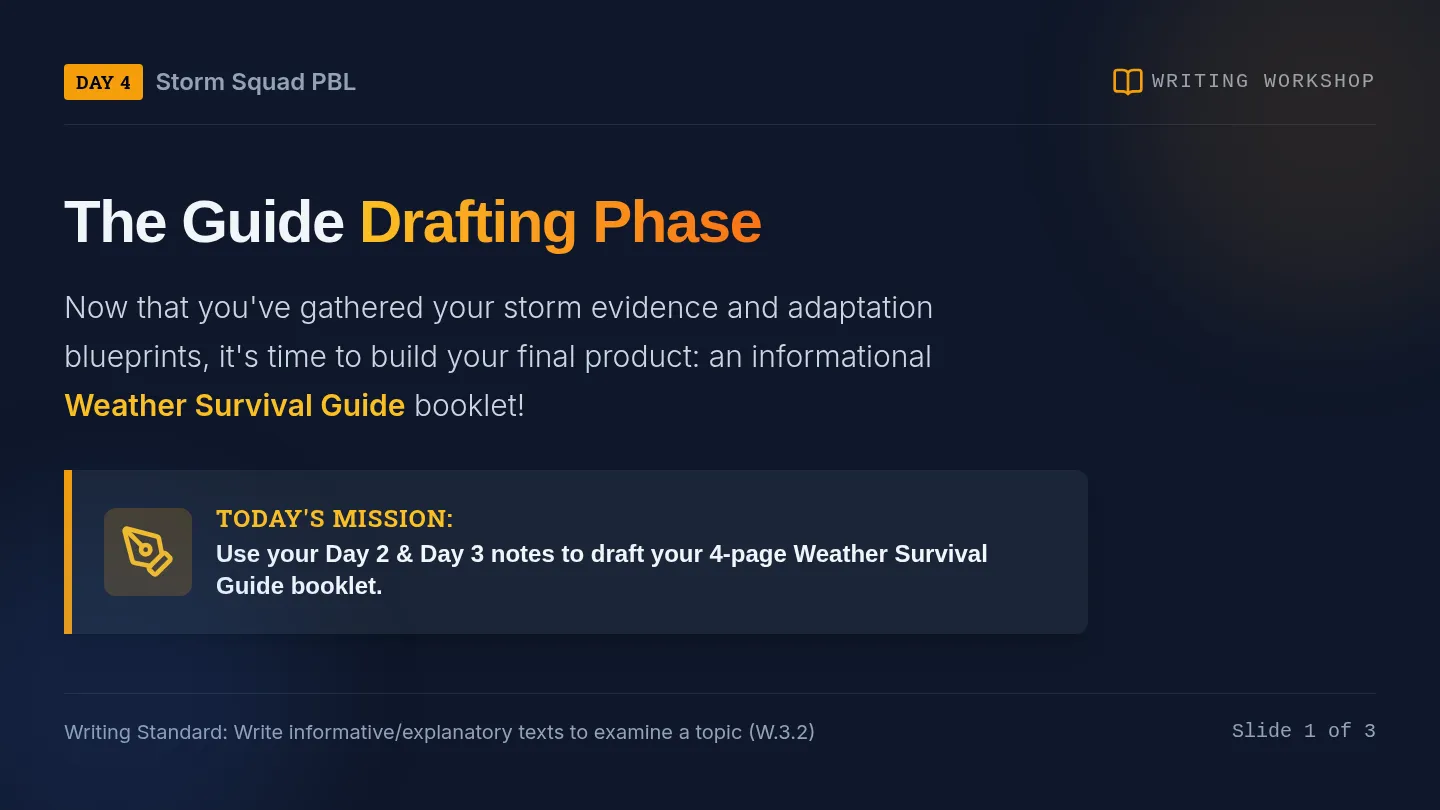
Guide Writers Presentation Day 4
Storm Squad PBL
Writing Workshop
The Guide Drafting Phase
Now that you've gathered your storm evidence and adaptation blueprints, it's time to build your final product: an informational Weather Survival Guide booklet!
Today's Mission:
Use your Day 2 & Day 3 notes to draft your 4-page Weather Survival Guide booklet.
Writing Standard: Write informative/explanatory texts to examine a topic (W.3.2) Slide 1 of 3
Day 4
Writing Craft
Text Features
Informational Text Features
Bold Headings
Separate your pages into clear sections using big, bold headers (e.g., "What is a Blizzard?" or "Emergency Action Plan").
Labeled Diagrams
Draw your storm's key parts or your engineering adaptation, adding lines and labels to explain the components clearly.
Bulleted Checklists
Organize action steps in simple bullet lists so readers can easily find safety instructions in a hurry!
🏆 Goal: Use at least THREE text features in your Survival Guide!
Key Idea: Text features help readers find and understand information quickly. Slide 2 of 3
Day 4
My Blueprint
Guide Structure
Booklet Layout Blueprint
PAGE 1
Cover Page
Write an eye-catching title, draw your storm, and add an introduction.
PAGE 2
Storm Science
Describe how the storm forms, its conditions, and why it is dangerous.
PAGE 3
Adaptations
Explain the engineering designs that help communities survive this storm.
PAGE 4
Family Safety
List the Emergency Supply Checklist and critical steps to take during warnings.
Open your Storm Squad Field Journal to Page 4. Map out your layout blueprint, then begin writing!
Activity Time: 35 min
Ready to Write: Keep your Day 2 & Day 3 sheets open for research data! Slide 3 of 3
Guide Writers Journal Storm Squad Field Journal
DAY 4: Guide Blueprint
Writing Workshop
Grade 3 ELA / Informational
Name: ____________________________________
Hazard: ________________________
1. Catchy Guide Title & Intro Planning
Every survival guide needs an engaging title to grab readers' attention! Brainstorm a catchy title (e.g., The Blizzard Battles or Tornado Tracker 101 ) and outline your main cover idea:
Catchy Title Idea:
Cover Picture Idea:
2. Text Feature Integration
Check off at least three text features you will incorporate in your final written booklet to assist your readers:
Bold Headings
Diagram + Labels
Bulleted Lists
Mini-Glossary
3. Map Out Your Sections
Write down the customized section subtitles you will write on Page 2 (Science) and Page 3 (Engineering) of your booklet:
Page 2: Science Subtitle Idea Example: "How Tornadoes Twist"
Page 3: Engineering Subtitle Idea Example: "Building Super Stilts"
Ready to Construct?
Once your blueprint is approved, fold a blank sheet of paper in half to make a 4-page booklet. Use your Day 2 & Day 3 research sheets to write the final copy!
Storm Squad PBL Portfolio Page 4
Teacher Field Guide
DAY 4: Lesson Plan & Key
Pacing: 60 Mins
Standards: W.3.2, W.3.7, RI.3.5
Learning Objectives
Synthesize severe weather research notes into a cohesive 4-page booklet format.
Select and integrate at least three informational text features (headings, diagrams, lists).
Apply descriptive titles and subtitles to structure factual writing.
Materials Needed
Slide Deck: "Day 4 - Guide Writers"
Day 4 Journal sheet (Page 1)
8.5" x 11" white construction paper (1 sheet per student)
Rulers, colored pencils, thin markers
Facilitation Pacing Guide
10 MIN
Warm-Up & Writing Hook: Show Slide 1. Explain that severe weather experts must write clearly so readers can understand rules quickly. Introduce the final booklet project.
15 MIN
Text Features Workshop: Display Slide 2. Discuss text features. Focus on how bold headings and bulleted lists assist readability, and explain how labeled diagrams visualize engineering.
30 MIN
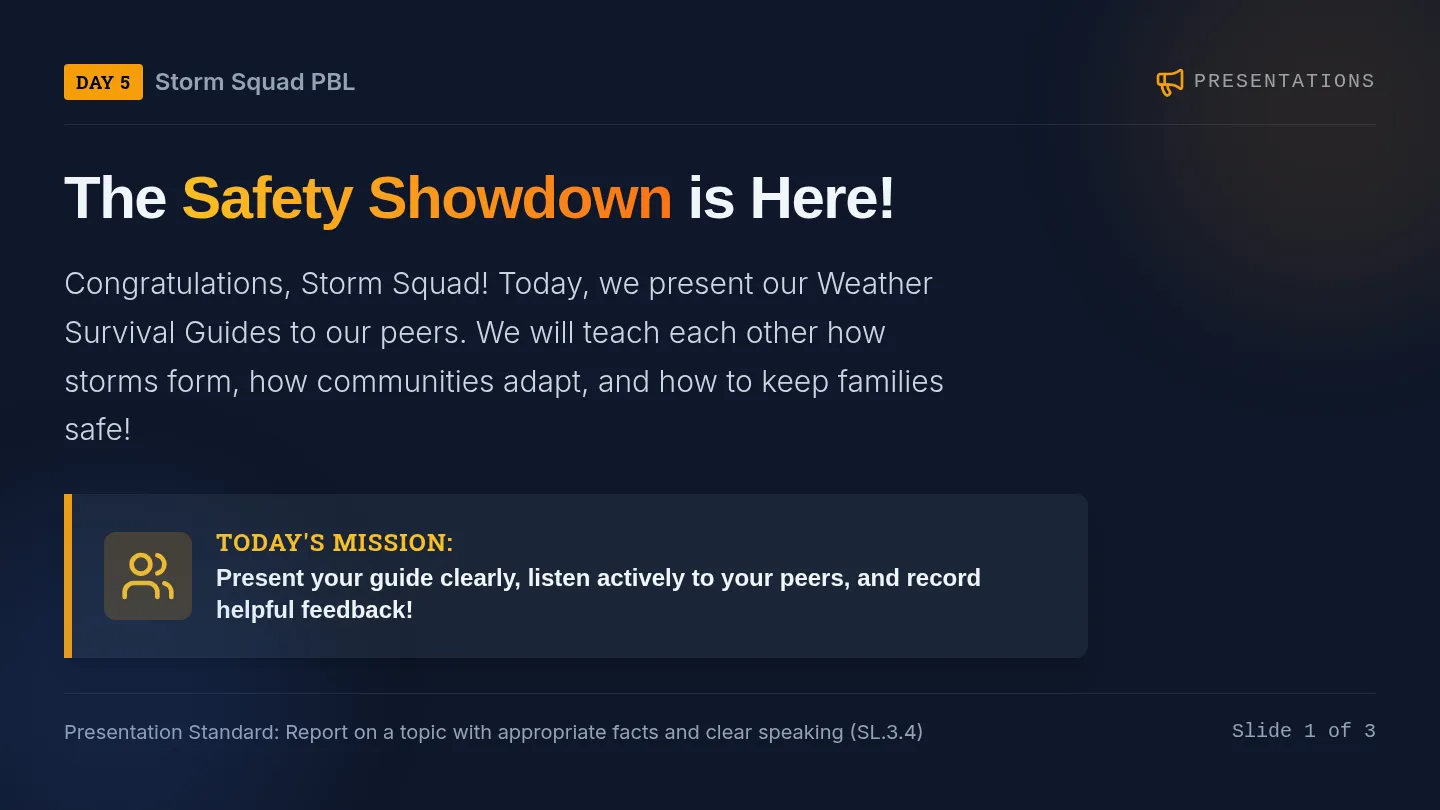
Safety Showdown Presentation Day 5
Storm Squad PBL
Presentations
The Safety Showdown is Here!
Congratulations, Storm Squad! Today, we present our Weather Survival Guides to our peers. We will teach each other how storms form, how communities adapt, and how to keep families safe!
Today's Mission:
Present your guide clearly, listen actively to your peers, and record helpful feedback!
Presentation Standard: Report on a topic with appropriate facts and clear speaking (SL.3.4) Slide 1 of 3
Day 5
Active Listening
Feedback Rules
How to Be an Active Listener
The Presenter
Stand tall, look at your audience, and smile!
Speak slowly, clearly, and at a strong volume.
Point out your diagram and read your safety list!
The Audience
Keep your eyes on the speaker and nod to show interest.
Ask a polite question when they finish.
Write down one positive star and one new fact!
💬 "Your presentation was excellent because of ________!"
Praise: Always start feedback with something they did exceptionally well! Slide 2 of 3
Day 5
Mission Accomplished
Official Induction
Storm Squad Graduation
Now that you have analyzed weather, researched climate hazards, sketched engineering designs, and authored survival manuals, let's take the official Safety Expert Pledge!
THE STORM SQUAD SAFETY PLEDGE
"I promise to use my severe weather knowledge to keep my family and community safe, to stay alert during storm warnings, and to share safety tips with others!"
👉 Open your Field Journal to Page 5. Complete your peer reviews and sign your safety pledge!
Congratulations, Storm Squad Weather Experts! 🌪️🌀❄️🌊 Slide 3 of 3
Safety Showdown Journal Storm Squad Field Journal
DAY 5: Safety Showdown
PBL Presentation
Grade 3 Speaking & Listening
Name: ____________________________________
Date: ________________________
Activity 1: Peer Presentation Tracker
As you listen to your classmates present their Weather Survival Guides, fill out this expert checklist for three different presenters:
1. Classmate Name: _________________
Storm Hazard: _________________
🌟 One thing that was awesome (Star):
💡 One cool storm fact I learned:
2. Classmate Name: _________________
Storm Hazard: _________________
🌟 One thing that was awesome (Star):
💡 One cool storm fact I learned:
Activity 2: Personal Safety Expert Goal
The Storm Squad Safety Pledge
"I promise to use my severe weather knowledge to keep my family and community safe, to stay alert during storm warnings, and to share safety tips with others!"
Signed: _______________________________ Date: _______________
My Safety Goal: Write one concrete action you will take to help your family prepare at home.
Storm Squad PBL Portfolio Page 5
Teacher Field Guide
DAY 5: Lesson Plan & Rubric
Pacing: 60 Mins
Standards: SL.3.4, SL.3.6
Learning Objectives
Deliver a clear informational report on a severe weather hazard.
Incorporate active listening rules while peer group presentations occur.
Establish a concrete personal safety goal and take the safety pledge.
PBL Materials Checklist
Slide Deck: "Day 5 - Safety Showdown"
Day 5 Journal sheets (Page 1)
Completed Student booklets (Weather Survival Guides)
Graduate ribbons or sticker badges (Optional)
Facilitation Pacing Guide
10 MIN
Speaking & Listening Warm-Up: Show Slide 1 & 2. Detail what an active listener does (eye contact, polite nodding) and set expectations for respectful applause.
35 MIN
The Safety Showdown: Organize students into small, mixed hazard circles (4-5 students, balancing Tornado, Hurricane, Blizzard, and Flood experts). Each student gets 4-5 minutes to present their survival guide. Peer group members take notes on Page 1.
15 MIN
Reflection, Pledge & Graduation: Project Slide 3. Students read the Storm Squad Safety Pledge together, sign Page 1, and write their home safety goal. Issue teacher certificates or expert ribbons!