Skyward Bound Slides MISSION 1 Aqua Quest Series
SKYWARD BOUND
Skyward Bound: The Journey Begins
How does water escape the Earth and travel into the sky? Today we explore the invisible forces driving the water cycle: solar energy and phase changes.
Grade 3-5 Earth Science Driven by Solar Energy
THE ENGINE Powering the Cycle
SOLAR POWER
The Sun: Our Engine in the Sky
Without the Sun, the water cycle would completely freeze! The Sun radiates solar energy (thermal energy) down to Earth's oceans, lakes, and rivers.
Energy Transfer
Thermal energy warms up the surface water molecules, causing them to move faster and faster until they break free!
1. Thermal Energy Warms the Liquid Molecules speed up!
How thermal energy drives the cycle Slide 2 of 6
PHASE CHANGE 1 Liquid to Gas
EVAPORATION
Liquid → Gas
Water vapor is completely invisible to our eyes!
What is Evaporation?
As liquid water absorbs thermal energy, molecules break their surface bonds and float up as an invisible gas called water vapor.
Puddles Dry Up Heat from solar radiation turns wet ground into dry air.
Ocean Escape Salt stays behind; only pure water evaporates into the atmosphere!
Invisible water vapor ascends into the atmosphere Slide 3 of 6
PHASE CHANGE 2 Gas to Liquid
CONDENSATION
What is Condensation?
As warm water vapor rises higher, the atmosphere grows colder. Water vapor loses its thermal energy, slows down, and clusters back into tiny water droplets.
Cloud Formation
Millions of microscopic condensed droplets cling to dust particles in the air, gathering together to create the clouds we see in the sky.
Gas → Liquid
Cooling down causes molecules to pack tightly again.
Cooler temperatures in the upper atmosphere transform water vapor into clouds Slide 4 of 6
CHECKPOINT Concept Review
BRAIN SQUEEZE
Quick Check: Can you solve this flow?
1
Solar Heat Absorption
Surface water gains energy. What process happens next?
Answer: Evaporation!
2
Atmospheric Cooling
Invisible vapor loses thermal energy. What does it form?
Answer: Condensation (Clouds)!
Discuss these processes as a class before starting the lab! Slide 5 of 6
LAB TIME Hands-On Science
EXPERIMENT PREP
Cloud in a Jar Experiment
We are going to trap water vapor and force it to condense right in front of our eyes! We will create a miniature microclimate to witness evaporation and condensation.
Hot Water (Heat Source) Ice (Cooling Layer) Aerosol/Match (Dust Particles)
Active Lab Tasks
Formulate your hypothesis first
Draw the model under the ice cap
Explain how solar energy compares
Get your lab sheets ready and begin instructions! Slide 6 of 6
Cloud in Jar Lab Aqua Quest Unit • Lab Sheet Name: ______________________ Date: ________
LAB: Cloud in a Jar
Investigating thermal energy, evaporation, and condensation in a closed microclimate.
The Science Goal
How do cold air and warm air interact to create a cloud? By simulating thermal energy differences in a sealed jar, we will observe phase shifts right before our eyes.
Materials Needed
Glass Jar & Lid
Ice Cubes
Hot Water
Hairspray / Match
Think Like a Scientist (Hypothesis)
If we pour hot water into a jar, place cold ice on the top lid, and spray a small amount of aerosol (to act as dust particles), then a cloud will form in the jar because...
Draw Your Observation
[ Draw the jar, label: 1. Hot Water, 2. Ice Lid, 3. Cloud Vapor ]
Bottom: Warm Liquid Top: Cold Gas
Lab Observations
1. Minutes 1-2 (Evaporation phase):
Describe what you see rising from the hot water:
2. Minutes 3-5 (Condensation phase):
Describe what forms near the ice lid when hairspray is added:
Lab Reflection Questions
1. Thermal Energy Connection: What provides the thermal energy in our real atmosphere to start evaporation?
2. Condensation Catalyst: Why did we need to spray hairspray (or light a match) inside the jar to get a visible cloud?
3. Energy Flow: Did the water vapor GAIN or LOSE thermal energy when it hit the ice at the top of the jar?
Unit: Aqua Quest • Lesson 1 Lab Page 1 of 1
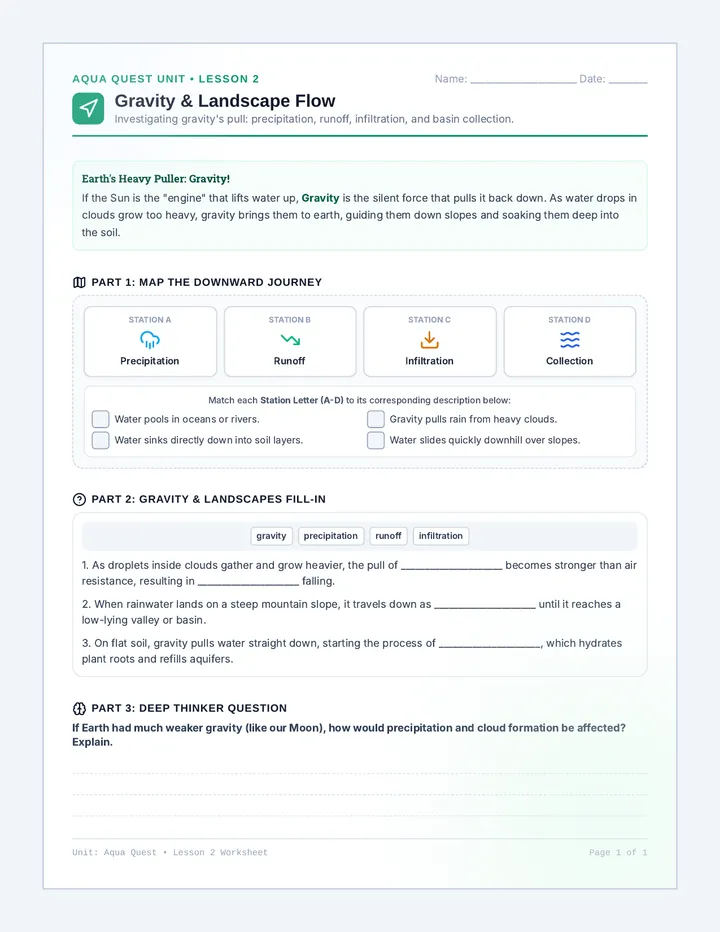
Gravity and Flow Worksheet Aqua Quest Unit • Lesson 2 Name: ______________________ Date: ________
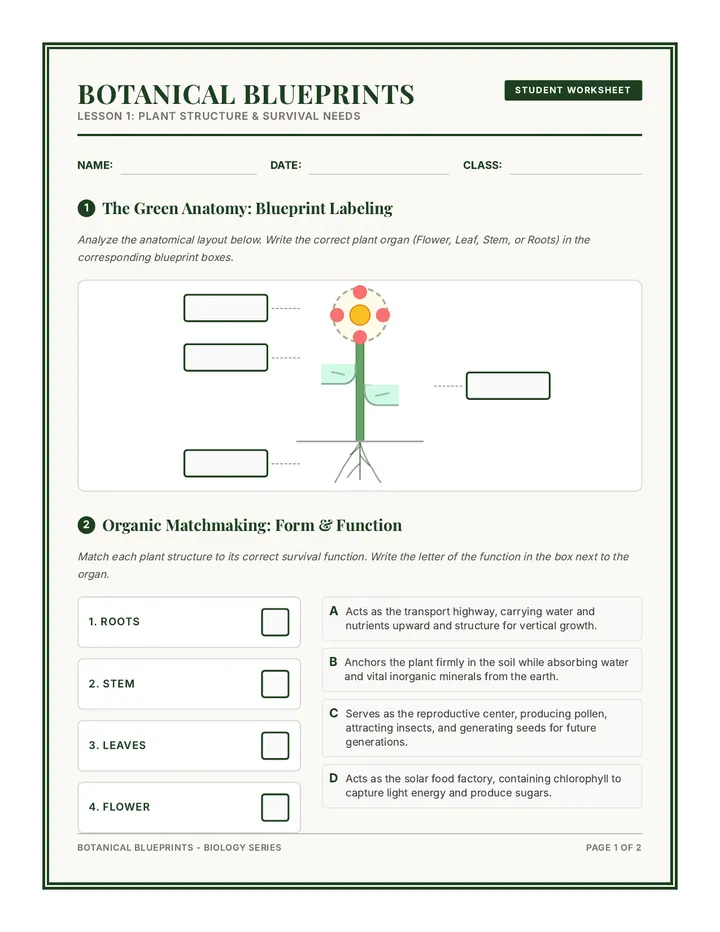
Gravity & Landscape Flow
Investigating gravity's pull: precipitation, runoff, infiltration, and basin collection.
Earth's Heavy Puller: Gravity! If the Sun is the "engine" that lifts water up, Gravity is the silent force that pulls it back down. As water drops in clouds grow too heavy, gravity brings them to earth, guiding them down slopes and soaking them deep into the soil.
Part 1: Map the Downward Journey
Station A
Precipitation
Station B
Runoff
Station C
Infiltration
Station D
Collection
Match each Station Letter (A-D) to its corresponding description below:
Water pools in oceans or rivers.
Gravity pulls rain from heavy clouds.
Water sinks directly down into soil layers.
Water slides quickly downhill over slopes.
Part 2: Gravity & Landscapes Fill-in
gravity precipitation runoff infiltration
1. As droplets inside clouds gather and grow heavier, the pull of _____________________ becomes stronger than air resistance, resulting in _____________________ falling.
2. When rainwater lands on a steep mountain slope, it travels down as _____________________ until it reaches a low-lying valley or basin.
3. On flat soil, gravity pulls water straight down, starting the process of _____________________, which hydrates plant roots and refills aquifers.
Part 3: Deep Thinker Question
If Earth had much weaker gravity (like our Moon), how would precipitation and cloud formation be affected? Explain.
Unit: Aqua Quest • Lesson 2 Worksheet Page 1 of 1
Water Journey Game Aqua Quest Unit • Lesson 2 Activity Droplet Name: ______________________
H2O Quest: The Water Cycle Game
Roll a single die and follow your droplet's path. Track your state changes on your score sheet!
How to Play: Use a coin or eraser as your game token. Start at 1. Ocean . Roll to advance. If you land on a shortcut/change space, follow the arrow immediately. Record every state you visit (Liquid, Solid, Gas) in your tracker below.
Forces at Play:
Sun Heat (Lifts) Gravity (Pulls)
1
The Vast Ocean Liquid State
Sun heats you! Roll 4-6 to Evaporate to Space 2.
2
Upper Atmosphere Gas (Vapor)
Cools down rapidly. Roll 1-3 to Condense to Space 3.
3
Storm Cloud Heavy Liquid
Gravity pulls! Roll any number to Precipitate to Space 4.
4
Mountain Glacier Solid (Ice)
Sun melts you! Roll 1-3 Runoff to Space 5, or 4-6 Infiltrate to Space 6.
5
Soil & Roots Infiltration
Gravity pulls underground! Roll 1-3 to seep into Space 6.
6
Deep Aquifer Groundwater
Slow flow! Roll 5 or 6 to seep back to Ocean (Space 1).
My Water Droplet Travel Journal
Record your state (Solid, Liquid, Gas) and what force moved you at each turn. Can you complete 5 rolls?
Roll # Current Space State (S / L / G) Force (Sun Heat or Gravity?) Start 1. Vast Ocean Liquid Sun Warmth (Preparing to rise) Roll 1 __________________ __________________ ____________________________ Roll 2 __________________ __________________ ____________________________ Roll 3 __________________ __________________ ____________________________ Roll 4 __________________ __________________ ____________________________
Did you ever get "stuck" in a specific state? How does gravity pull you out of the atmosphere?
Unit: Aqua Quest • Lesson 2 Board Game Page 1 of 1
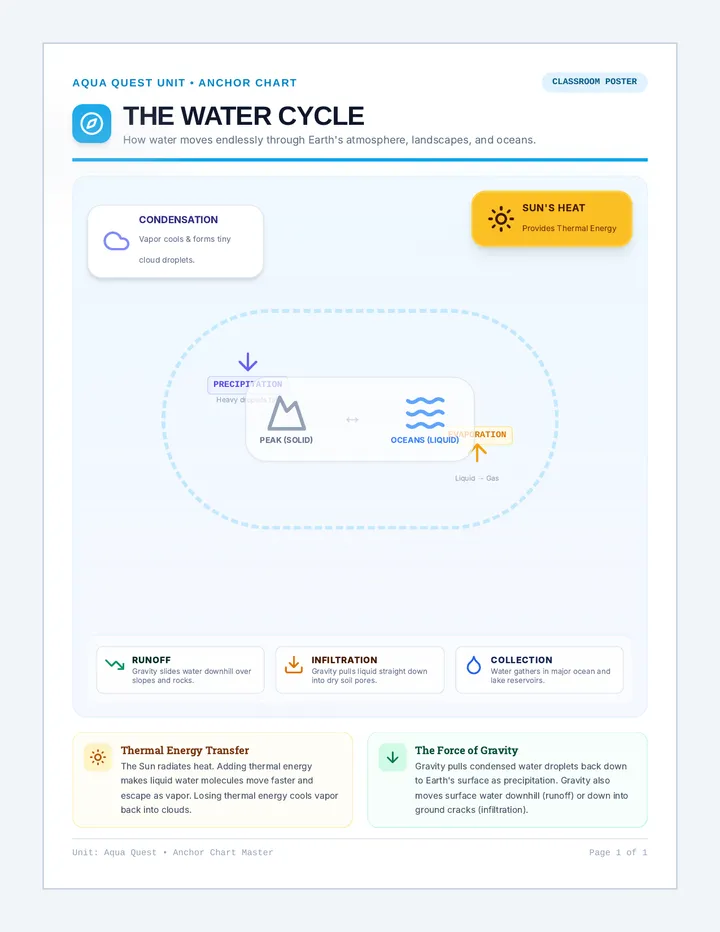
Water Cycle Anchor Chart Aqua Quest Unit • Anchor Chart CLASSROOM POSTER
The Water Cycle
How water moves endlessly through Earth's atmosphere, landscapes, and oceans.
Sun's Heat Provides Thermal Energy
Condensation Vapor cools & forms tiny cloud droplets.
Evaporation Liquid → Gas
Precipitation Heavy droplets fall
Peak (Solid)
↔
Oceans (Liquid)
Runoff
Gravity slides water downhill over slopes and rocks.
Infiltration
Gravity pulls liquid straight down into dry soil pores.
Collection
Water gathers in major ocean and lake reservoirs.
Thermal Energy Transfer
The Sun radiates heat. Adding thermal energy makes liquid water molecules move faster and escape as vapor. Losing thermal energy cools vapor back into clouds.
The Force of Gravity
Gravity pulls condensed water droplets back down to Earth's surface as precipitation. Gravity also moves surface water downhill (runoff) or down into ground cracks (infiltration).
Unit: Aqua Quest • Anchor Chart Master Page 1 of 1
Water Cycle Vocab Cards H2O Explorer Vocab Cards
Cut along the dotted lines. Use for flashcard practice, concept mapping, or memory games!
Interactive Printables
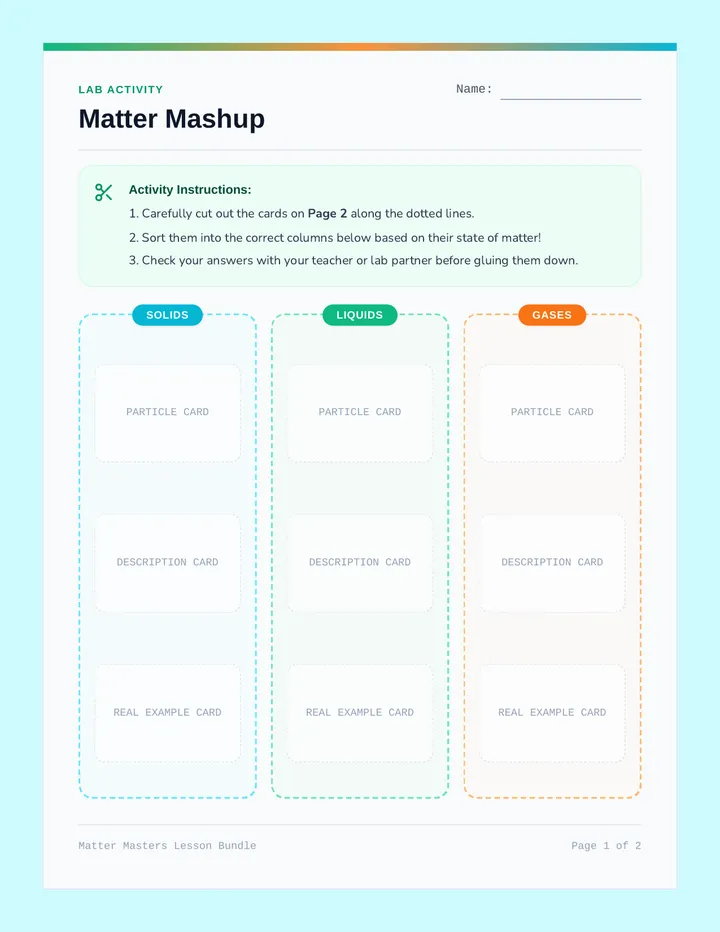
Phase Change
Evaporation
The process where liquid water gains thermal energy from the Sun and transforms into invisible water vapor gas, rising into the sky.
State: Liquid → Gas Absorbs Energy
Phase Change
Condensation
The process where rising water vapor loses its thermal energy, cools down in the upper atmosphere, and clusters together to form liquid clouds.
State: Gas → Liquid Releases Energy
Downward Force
Precipitation
Water that falls back to Earth's surface as rain, snow, sleet, or hail when tiny cloud droplets become too heavy for the atmosphere to support.
State: Liquid or Solid Driven by Gravity
Downward Force
Infiltration
The process where precipitation hits loose, permeable ground, and gravity pulls it straight down to flow into subterranean soils and rock aquifers.
Path: Ground Seepage Driven by Gravity
Downward Force
Runoff
Excess precipitation water that flows downhill over impermeable solid land surfaces (like mountain rock or clay) into rivers and basins.
Path: Slope Flow Driven by Gravity
Storage
Collection
The accumulation of fallen precipitation in Earth's natural reservoirs, primarily in the oceans, lakes, glaciers, and groundwater basins.
Storage: Earth Reservoirs Precipitation End
Thermal Engine
Solar Energy
Electromagnetic radiation from the Sun. It transfers vital heat energy to Earth, acting as the prime engine driving phase changes and lifting water molecules.
Source: The Sun Thermal Transfer
Physical Force
Gravity
The invisible physical force that pulls all objects toward the center of the Earth. It governs precipitation, runoff, collection, and infiltration pathways.
Source: Earth's Mass Downward Pull
Unit: Aqua Quest • Vocabulary Mastery Cards Page 1 of 1
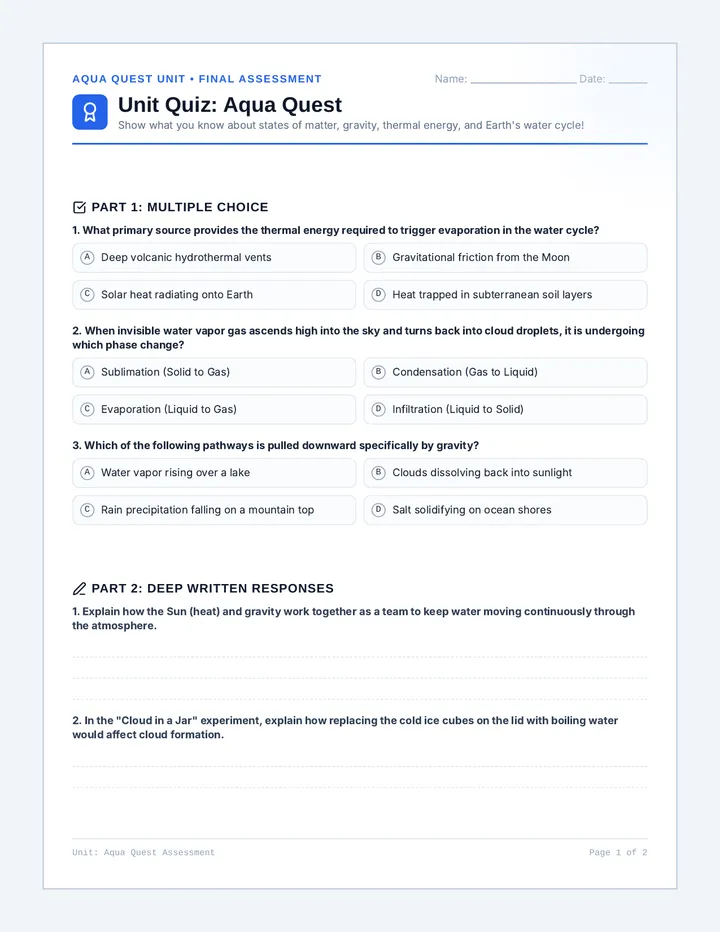
Water Cycle Assessment Aqua Quest Unit • Final Assessment Name: ______________________ Date: ________
Unit Quiz: Aqua Quest
Show what you know about states of matter, gravity, thermal energy, and Earth's water cycle!
Part 1: Multiple Choice
1. What primary source provides the thermal energy required to trigger evaporation in the water cycle?
A Deep volcanic hydrothermal vents B Gravitational friction from the Moon C Solar heat radiating onto Earth D Heat trapped in subterranean soil layers
2. When invisible water vapor gas ascends high into the sky and turns back into cloud droplets, it is undergoing which phase change?
A Sublimation (Solid to Gas) B Condensation (Gas to Liquid) C Evaporation (Liquid to Gas) D Infiltration (Liquid to Solid)
3. Which of the following pathways is pulled downward specifically by gravity?
A Water vapor rising over a lake B Clouds dissolving back into sunlight C Rain precipitation falling on a mountain top D Salt solidifying on ocean shores
Part 2: Deep Written Responses
1. Explain how the Sun (heat) and gravity work together as a team to keep water moving continuously through the atmosphere.
2. In the "Cloud in a Jar" experiment, explain how replacing the cold ice cubes on the lid with boiling water would affect cloud formation.
Unit: Aqua Quest Assessment Page 1 of 2
Aqua Quest Unit • Facilitator Tool Teacher Notes & Scoring Guide
Assessment Rubric & Answer Key
Grading rubric for student self-evaluation and key criteria for full scientific understanding.
H2O Explorer Scoring Rubric
Criteria Beginning (1 pt) Developing (2 pts) Proficient (3 pts) Core Vocabulary Confuses basic definitions (e.g., evaporation vs condensation). Can define core terms but struggles to explain soil infiltration/runoff. Accurately defines all 6 key cycle terms with real-world examples. Force & Energy Connect Does not identify how gravity or the Sun impacts the water cycle. Identifies that the Sun heats water, but misses the role of gravity. Clearly explains how Sun drives lift (evaporation) and gravity pulls down (precipitation). Experimental Evidence Draws basic diagram but lacks scientific labeling or notes. Records lab steps correctly but struggles to synthesize conclusions. Uses visual labeling, detail, and answers lab questions with scientific facts.