Sea Explorers Teacher Guide
Wit & Wisdom Alignment
Sea Explorers
Grade 3, Module 1: The Sea | Lesson 1 of 32
Teacher Lesson Guide
Core Text: Ocean by Seymour Simon
Essential Question
"How do artists and writers capture the power and beauty of the sea?"
Focusing Question
"What does a first look at the ocean reveal?"
Learning Objectives
- • Establish initial impressions and list elements of a visual text using the Notice & Wonder protocol.
- • Define key marine terms: viscosity (optional), ocean, horizon, and ebb.
- • Collaborate to create a class-wide Wonder Board to capture student-led inquiry questions.
Required Materials
- Ocean by Seymour Simon
- Class Anchor Chart paper
- Student Response Journals
- "Sea Explorers" Worksheet
Lesson Procedure
1 Welcome & Launch (10 Minutes)
ESTABLISH FOCUS
Begin the module by playing sounds of crashing ocean waves. Display the module's Essential Question prominently. Ask students: "When you think of the ocean, what feelings, colors, or memories come to mind?" Allow 2 minutes for a brief partner turn-and-talk, then invite 3 students to share. Explain that this unit will explore how authors and painters help us see, taste, and feel the wonders of the sea.
2 Learn - First Look & Notice Protocol (15 Minutes)
CLOSE VIEWING
Present the cover of Seymour Simon's Ocean. Tell students to look closely at the details of the photograph (the cresting wave, the color transitions, the white spray). Introduce the Notice & Wonder Protocol. Direct students to the "Sea Explorers Notice Worksheet" Part 1. Give them 3 minutes of silent observation to record at least 3 things they directly observe on the cover ("I Notice").
Teacher Scaffolding Prompt: "Focus strictly on what your eyes can prove. Instead of saying 'it is dangerous,' say 'I notice sharp white foam at the top of the wave.'"
Page 1 of 2
Wit & Wisdom Alignment
Sea Explorers
Facilitation Guide & Lesson Procedures
Teacher Lesson Guide
Core Text: Ocean by Seymour Simon
Lesson Procedure (Continued)
3 Learn - Wonder Phase & Inquiry (15 Minutes)
STUDENT INQUIRY
Transition students to formulating questions ("I Wonder"). Have students complete the right side of the chart on their worksheets. Remind them: "A wonder is a question you cannot answer immediately from the cover, but want to discover as we read." Have students do a Mix and Mingle. For 3 minutes, they walk around, share their wonders, and record a partner's wonder that interests them.
4 Land - Building the Wonder Board (15 Minutes)
SYNTHESIS
Gather the class on the rug. Introduce the class Anchor Chart: Wonder Board. Have each student write one specific wonder on a sticky note. Invite students to come forward and stick their notes to the board. Group similar wonders (e.g., deep sea animals, wave movement, ocean size) into columns together. Summarize: "We are launching an expedition. These questions will guide our research over the next few weeks!"
5 Wrap - Vocabulary & Check-In (5 Minutes)
ASSESSMENT
Formally define the word horizon (the line where the ocean surface meets the sky). Introduce the Exit Ticket to assess basic vocabulary retention and their primary focus observation from today's lesson.
Text-Dependent Questions
- "Look closely at the cover of Ocean. How does Seymour Simon use colors to convey depth?"
- "What words would you use to describe the texture of the foam on the wave?"
Instruction Tips
- Notice Trap: Students often jump straight to inferences (e.g., "The water is cold"). Redirect them immediately to concrete observations ("I notice white foam").
- Vocabulary Support: Use physical hand motions to describe horizon (straight flat hand across the body).
Page 2 of 2
Sea Explorers Notice Worksheet
Name: ___________________________ Date: _______________
Class: ___________________
Response Journal Sheet
Voyage 1: Notice and Wonder
First reflections on Seymour Simon's "Ocean"
Unpacking our Essential Question
Our big question is: "How do artists and writers capture the power and beauty of the sea?" What is one word that comes to your mind when you think of the sea? Why?
My Word: _______________________ because _________________________________________________
The Notice and Wonder Protocol
Observe the cover of Seymour Simon's book, Ocean. Fill out at least three observations in the "I Notice" column, and three questions in the "I Wonder" column.
I Notice... (Things I directly see)
Observation 1:
Observation 2:
Observation 3:
I Wonder... (Questions I want to explore)
Question 1:
Question 2:
Question 3:
Page 1 of 2
Name: ___________________________
Class: ___________________
Part 3: Deep Sea Vocabulary
Write down the definition we discovered together in class. Then, draw a tiny sketch of each word.
1. Horizon
Definition:
Sketch Box
2. Observe
Definition:
Sketch Box
Part 4: Focusing Question Deep Dive
Prompt: Based on your first close observations of the book cover, what is one feeling or lesson that you think the sea can teach humans? Use at least one evidence statement (e.g., "On the cover, I noticed...") to support your thinking.
I believe the sea teaches us ___________________________________________________________________
because on the cover I noticed ________________________________________________________________
Page 2 of 2
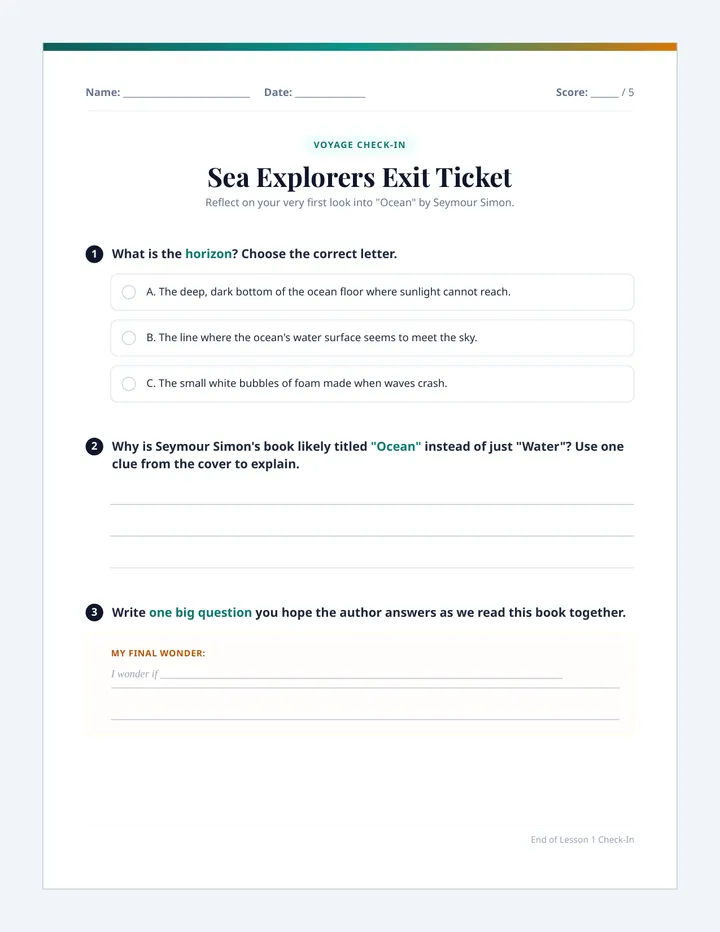
Sea Explorers Exit Ticket
Name: ___________________________ Date: _______________
Score: ______ / 5
Voyage Check-in
Sea Explorers Exit Ticket
Reflect on your very first look into "Ocean" by Seymour Simon.
1
What is the horizon? Choose the correct letter.
A. The deep, dark bottom of the ocean floor where sunlight cannot reach.
B. The line where the ocean's water surface seems to meet the sky.
C. The small white bubbles of foam made when waves crash.
2
Why is Seymour Simon's book likely titled "Ocean" instead of just "Water"? Use one clue from the cover to explain.
3
Write one big question you hope the author answers as we read this book together.
My Final Wonder:
I wonder if ____________________________________________________________________________
End of Lesson 1 Check-In