Mystery Powder Slides The Mystery of the
Disappearing Powder
Investigating Mixtures & Solubility
2nd Grade Science
Lesson 1
A Magic Trick?
Watch closely as I add a spoonful of white powder to this warm tea.
"Where did it go? Did it vanish into thin air?"
Discuss with a partner:
Is the powder still in the cup?
How can we prove it's still there?
The Great Showdown
Sand + Water
We stir and stir...
"I can still see it!"
The sand settles at the bottom. It is NOT soluble.
Salt + Water
We stir and stir...
"It's gone!"
The salt breaks into tiny pieces we can't see. It IS soluble.
Science Word Alert
DISSOLVE
When a solid breaks apart and mixes completely into a liquid.
It doesn't disappear from the world... it just becomes part of the solution!
Think Like a Scientist
01
If the salt "disappeared," why does the water taste salty?
What does this tell us about the salt?
02
Can we get the salt back?
Brainstorm ideas on how to separate the mixture.
Time to start our Lab Observations!
Vanishing Act Worksheet The Vanishing Act
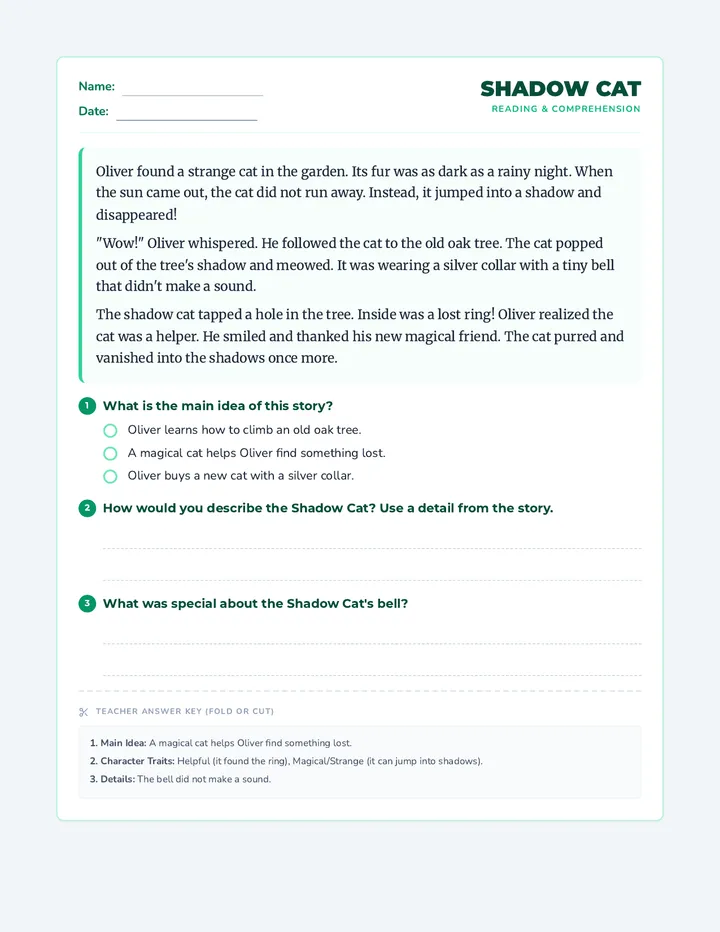
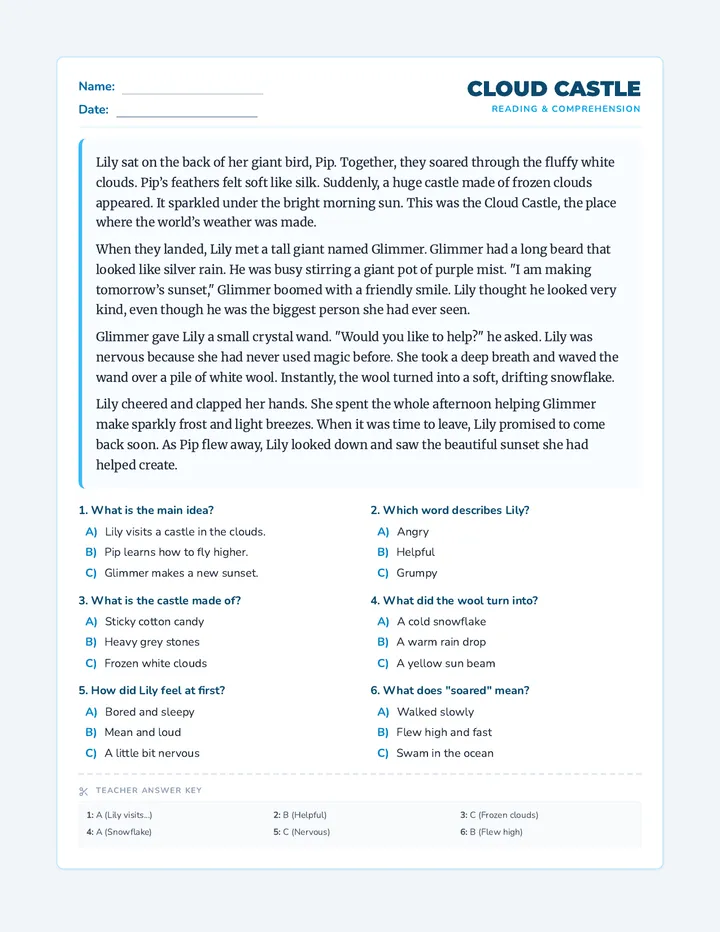
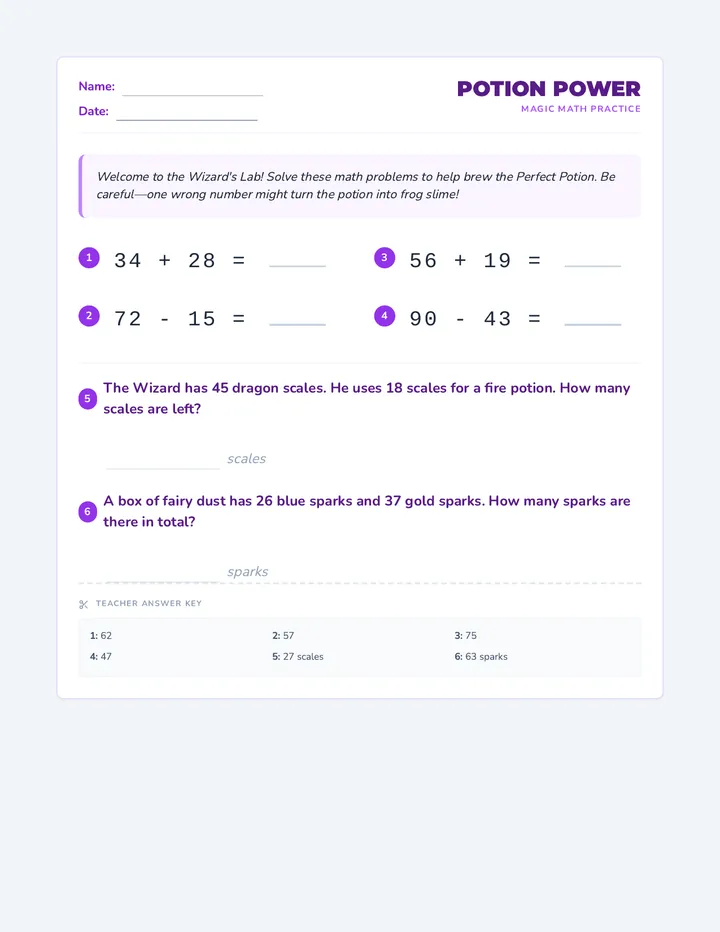
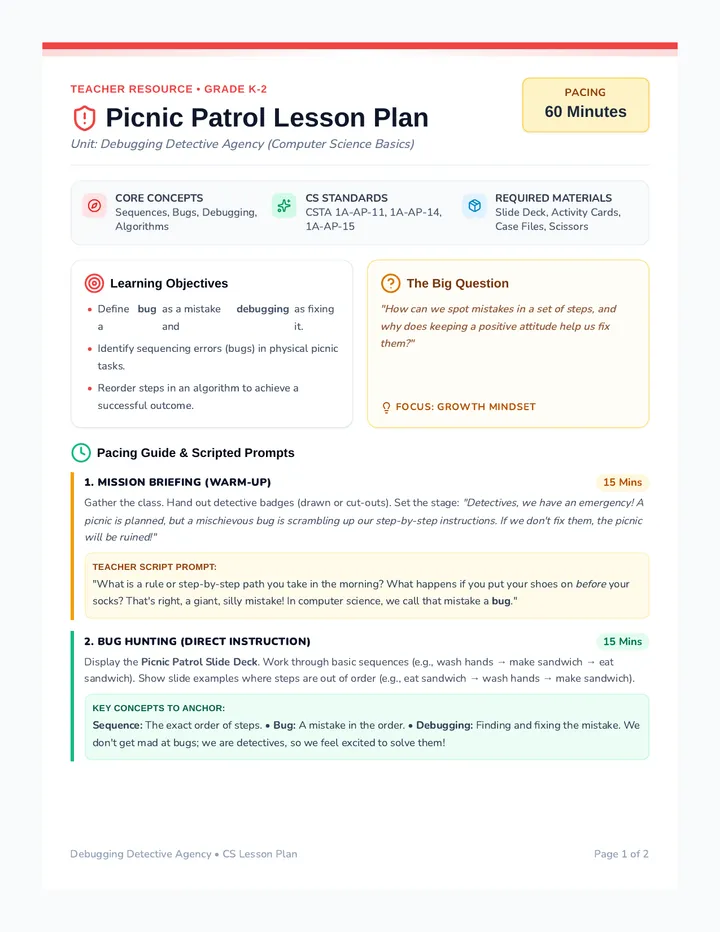
Lab Observation Log
Scientist:
Date:
The Mystery
What happens when we mix sand and salt into water?
Sand Prediction
Will it dissolve? (Circle one)
YES
NO
Salt Prediction
Will it dissolve? (Circle one)
YES
NO
Observations
Beaker A: Sand
Beaker B: Salt
Draw what you see:
Draw what you see:
Describe the mixture:
What I Learned
1. Which powder was soluble?
2. Where did the "disappearing" powder go?
Disappearing Powder Teacher Guide Teacher Guide
Mystery Disappearing Powder
Lesson 1: Intro to Solutions
Objectives
Define dissolve as a solid mixing completely into a liquid.
Distinguish between soluble and insoluble substances.
Materials
• Clear cups or beakers
• Sand
• Table Salt
• Sugar (for the "Magic Trick")
• Warm water / Tea
• Stirring rods or spoons
Misconceptions
Students often think the salt has "gone away" or vanished. Use the taste test (dipping a finger or using a drop) to prove the salt is still present. Remind them that dissolving is not disappearing.
Lesson Flow
1
The Magic Trick (Hook)
Prepare a cup of warm tea or tinted water. Show a spoonful of sugar. Ask: "What will happen if I put this in?" Stir it in until it's gone. Ham it up! Is it magic? Or science?
"Wait, did I just delete the sugar? Where is it hiding?"
2
Sand vs. Salt Demonstration
Give each group two cups of water. Have them add sand to one and salt to the other. Instruct them to stir for 1 minute. Students record observations on the Vanishing Act Worksheet .
3
Direct Instruction: Solubility
Introduce the vocabulary using the slides. Focus on dissolve . Explain that salt is soluble (it can dissolve) and sand is insoluble (it cannot dissolve).
4
Discussion & Conclusion
Ask: "If we let the water sit for 100 years, will the salt ever come back out?" Answer: Only if the water evaporates! This sets the stage for future physical change lessons.
Key Questions to Ask
• "Can you still see the salt? Why do you think that is?"
• "If I give you a glass of water that had salt dissolved in it, how could you prove the salt is there without drinking it?" (Weight/Mass comparison, evaporation)
• "Why did the sand fall to the bottom but the salt didn't?"
Lab Stations Slides Lab Day:
Solubility Test
Testing 4 Mystery Substances
Are they Soluble or Insoluble?
Our Contestants
Flour
Soft and white powder used for baking.
Drink Mix
Sweet, colored powder for yummy drinks.
Dirt
Dark bits from the garden soil.
Sugar
Sparkly crystals from the kitchen.
Lab Safety & Rules
1
No TASTING the science experiments!
2
Stir gently! We don't want a "tidal wave" on the table.
3
Clean up spills immediately with a paper towel.
Eyes On!
Scientists are best at watching for tiny changes. Look for bubbles, colors, or sinking bits!
The Lab Report
Step 1: Predict
Write what you THINK will happen before you add the water.
Step 2: Observe
Stir and watch! Does the water get cloudy? Clear? Or stay chunky?
Step 3: Decide
Is it Soluble (it dissolves) or Insoluble (it doesn't)?
Classifying Matter
SOLUBLE
INSOLUBLE
"Sorting things helps us understand how they behave in our world!"
Ready, Set,
Test!
Head to your first station!
Solubility Lab Report Worksheet Solubility Lab Report
Junior Scientist Division
Name:
Date:
Lab Procedure
1. Observe the substance.
2. Predict: Do you think it will dissolve?
3. Add water and stir gently.
4. Observe: What happened to the mixture?
Key Terms
SOLUBLE = Dissolves
INSOLUBLE = Stays Visible
Substance Prediction Observations Result FLOUR YES
NO
|
|
SOLUBLE
INSOLUBLE
|
| DRINK MIX |
YES
NO
|
|
SOLUBLE
INSOLUBLE
|
| DIRT |
YES
NO
|
|
SOLUBLE
INSOLUBLE
|
| SUGAR |
YES
NO
|
|
SOLUBLE
INSOLUBLE
|
Thinking Deeper
Which of these substances would be the hardest to clean out of water? Why?
Soluble Sorting Activity Cards Worksheet Solubility Sorting Activity
Cut & Categorize Matter
Teacher Resource • Prep Material
SOLUBLE
"It dissolves and disappears into the liquid!"
INSOLUBLE
"It stays visible or sinks to the bottom!"
Cut along the dotted lines for student sorting:
SALT
SAND
SUGAR
DIRT
FLOUR
DRINK MIX
ROCKS
HONEY
Teacher Tip:
Use these cards for a quick whole-class sorting activity on the whiteboard or as a small-group rotation task after the lab. Challenge students: "Can you think of one more thing for each category?"
Speed of Heat Slides Presentation The Great
Speed Race
Temperature vs. Dissolving
Hot vs. Cold
A "Fair Test"
A Morning Dilemma
You want a mug of delicious hot chocolate.
"Why do we always use hot water or warm milk?"
Predict:
Which dissolves sugar FASTER?
☕️
TEAM HOT vs TEAM COLD
The "Fair Test" Rules
Same Amount
Use the exact same amount of sugar and water in each cup.
Start Together
Add the sugar to both cups at the exact same time.
Equal Stirring
Stir both cups at the same speed (like a robot!)
If we change too many things, we won't know WHY one was faster!
Why does heat help?
Heat gives water ENERGY.
Hot water particles move very fast. They bump into the sugar crystals harder and more often, breaking them apart quickly!
The Race is On!
HOT
vs
COLD
Open your Lab Notebooks to page 3!
Temperature Race Lab Sheet Worksheet The Temperature Race
Dissolving Speed Lab
Scientist:
Team Name:
My Prediction
I predict that the sugar in the HOT WATER will dissolve:
Faster
Slower
Fair Test Checklist
Same amount of water (1/2 cup)
Same amount of sugar (1 tsp)
Same stirring speed
Added sugar at the same time
⏱️
Observation Focus:
Watch for the "Shadow" to vanish!
Results Table
Hot Water
Time (estimate):
Describe what happened:
Cold Water
Time (estimate):
Describe what happened:
Scientist Conclusion
The hot water was faster because hot water particles move ____________________ and hit the sugar ____________________.
Fair Test Teacher Facilitation Guide Teacher Resource Teacher's Fair Test Guide
Temperature & Speed
Lesson 3: Variables
Setup (Prep)
Hot Water: Not boiling, but definitely steaming (approx. 50-60°C).
Cold Water: Use ice water if possible for the biggest contrast.
Portioning: Pre-measure 1 tsp of sugar into small cups to ensure simultaneous adding.
Safety Tips
Students should not handle the hot water container. The teacher should pour the water into clear plastic or tempered glass cups at each station just before the race starts.
The Fair Test Procedure
1
Defining the Variable
Ask: "If we use a tiny bit of hot water and a big bucket of cold water, is it a fair race?" Explain that in science, we only change one thing at a time. Here, that thing is temperature.
2
The Sync-Stir
Have one student be the "Hot Water Adder" and another the "Cold Water Adder." On your count of three, they add the sugar. Have a third student stir both (one in each hand) to ensure the speed is equal.
3
The "Micro-Observation"
Encourage students to look at the bottom of the cup. The sugar often forms a tiny mound before dissolving. When that mound is gone, the race is over!
The "Energy" Explanation
For 2nd graders, describe water particles like tiny bumper cars. In cold water, the cars are moving slowly and barely bumping into the sugar. In hot water, the cars are zooming and crashing into the sugar, breaking it into invisible pieces much faster!
Cold Water
Sleepy Particles
Hot Water
Hyper Particles
Full To The Brim Slides Presentation Lesson 4 Full To The
Brim
The Limit of Solubility
How much can one cup hold?
Think of a Sponge...
A sponge can soak up water... but only SO MUCH.
"Once it's full, the extra water just spills out. Water works the same way with solids!"
Saturation = Fullness
DRIP DRIP
"I can't hold any more!"
The Big Salt Test
1 Spoon at a time
Add salt, stir, and wait. Did it disappear?
The Stop Point
The moment salt stays at the bottom... the water is Saturated!
"Can we fit 5 spoons? 10? Let's find out!"
Science Word Alert
SATURATED
When a liquid has dissolved as much solid as it possibly can.
"The parking lot is full! No more salt cars can come in."
What's your
Number?
3
5
7
10?
Grab your scoops and tally sheets!
Spoon By Spoon Saturation Tracker Worksheet The Saturation Tracker
Spoon by Spoon Data Log
Scientist:
Lesson 4: Limits
THE BIG CHALLENGE
How many spoons of salt can this water hold before it stops dissolving?
My Prediction
Spoons
Spoon Count & Observations
Spoon #
Stir Result
Invisible?
Bottom View
1
I stirred and...
2
I stirred and...
3
I stirred and...
4
I stirred and...
5
I stirred and...
6
I stirred and...
Final Result
The water became SATURATED after
spoons of salt.
"I know it's saturated because I can see ____________________________________________________________________"
Saturation Point Teacher Facilitation Guide Teacher Resource Saturation Teacher Guide
Finding the Dissolving Limit
Lesson 4 Facilitation
Materials List
• Clear plastic cups (8-10 oz)
• Room temperature water
• Table salt (large container)
• Leveling spoons (tsp)
• Stirring sticks
• Magnifying glasses (optional)
Critical Thinking
What happens if we add MORE water to a saturated solution? (It becomes unsaturated again). What happens if we HEAT it? (It might hold more). This is a great extension for gifted learners!
Lesson Sequence
1
The "Full" Classroom Hook
Ask: "Can 100 people fit in this classroom? Why not?" Lead them to the idea of available space . Water molecules have tiny spaces between them where salt "parks." When all spots are taken, it's saturated.
2
Controlled Scooping
Emphasize leveled spoons . Students must stir for at least 30 seconds between spoons. If they stir for only 5 seconds, they might think it's saturated when it just hasn't had time to dissolve yet.
3
Spotting the Saturation
Instruct students to look at the cup from the side and bottom . Saturated solutions will have distinct, undissolved crystals sitting clearly at the bottom no matter how much they stir.
Common Misconceptions
• MELTING vs DISSOLVING: Remind students that melting requires heat and only one substance (ice to water). Dissolving requires two substances (salt and water).
• LOSING MASS: Students often think the salt is "gone" and therefore weighs nothing. If you have a scale, weighing before and after is a powerful "aha" moment.
Solution Spotters Hunt Slides Presentation Lesson 5 Solution
Spotters
Finding Mixtures in the Real World
Scavenger Hunt
Mystery Solved!
Quick Recap
A
DISSOLVE
To break apart and mix completely in a liquid.
B
SOLUBLE
A substance that can dissolve (like sugar).
C
SOLUTION
The invisible mixture of liquid and solid!
Your Secret Mission
Solutions are EVERYWHERE!
You will hunt for items that are solutions. Look in your lunchbox, under the sink, and in the classroom!
HINT:
If you can see through it, but it's not plain water... it's probably a solution!
Juice Box
Window Cleaner
Liquid Soap
Cough Syrup
Is it a
Solution?
YES
It is clear and mixed perfectly. You can't see the parts.
NO
It is chunky or has parts you can see (like chicken soup).
Happy Hunting!
Grab your Scavenger Hunt Log
Solution Spotter Log Scavenger Hunt Worksheet Lesson 5 The Solution Spotter Log
Field Investigator Division
Investigator:
Lesson 5: Real World
🕵️♂️
Mission Briefing
Find 5 solutions in your environment. Remember: A solution must be a perfect mixture where you can't see the different parts!
Item I Found Where I Found It Why it's a Solution Example: Apple Juice Lunchbox It's a mixture of water and sugar, but it's clear and mixed perfectly.
The "Invisible" Solid
Think about one of the solutions you found. If you could zoom in with a SUPER MICROSCOPE, what would the dissolved solid look like inside the water?
Draw or describe it here...
Microscopic View
Solubility Expert Exit Ticket Worksheet Lesson 5 Assessment Solubility Expert
Exit Ticket
Name: ____________________
Date: ____________________
1 The Matching Game
Draw a line to match the word with its meaning:
DISSOLVE
SATURATED
SOLUBLE
Something that CAN disappear in water.
When the water is "Full" and can't hold more.
When a solid breaks apart and mixes completely.
Quick Speed!
If you want to dissolve salt as FAST as possible, what should you do?
Use Hot Water
Use Cold Water
Invisible Art
You dissolved sugar in water. Now the sugar is invisible! Is the sugar still there?
YES
NO
The Final Question
What is the difference between SOLUBLE and INSOLUBLE? Give one example of each!
SOLUBLE:
INSOLUBLE:
Official Solubility Expert Certification Exam • Physical Science