Living Earth Curriculum Plan
Middle School Science • Grade Band 6–8
36 Instructional Weeks
Living Earth Curriculum Plan Academic Year 2026–2027
Sequenced year-long instructional roadmap integrating Life, Physical, and Earth Systems through phenomenon-based inquiry, NGSS 3D learning progressions, authentic lab practices, and performance assessments.
Phenomenon Inquiry
Every unit anchors to an observable natural anomaly driving student modeling and inquiry.
CER Argumentation
Iterative Claim-Evidence-Reasoning embedded across weekly lab notebooks and investigations.
STEM Design Cycles
Students iterate physical prototypes, test constraints, and defend community solutions.
Year-at-a-Glance Sequencing Dashboard
6 Modular Units • Trimester & Quarter Mapped
| Pacing | Unit Title & Scope | Driving Question & Core Standards | Signature Milestone |
|---|
| Weeks 1–6 | | | |
| Term 1 (Q1) | | | |
| Unit 1: Cellular Foundations & Microscopic Life | How do microscopic factories sustain complex living systems?
MS-LS1-1, MS-LS1-2, MS-LS1-3
| Clinical Cell Diagnostic Dossier |
| Weeks 7–12
Term 1 (Q1)
| Unit 2: Dynamic Ecosystems & Energy Webs | What happens when a keystone species vanishes from a biome?
MS-LS2-1, MS-LS2-2, MS-LS2-3, MS-LS2-4
| Trophic Cascade Ecosystem Defense |
| Weeks 13–18
Term 2 (Q2)
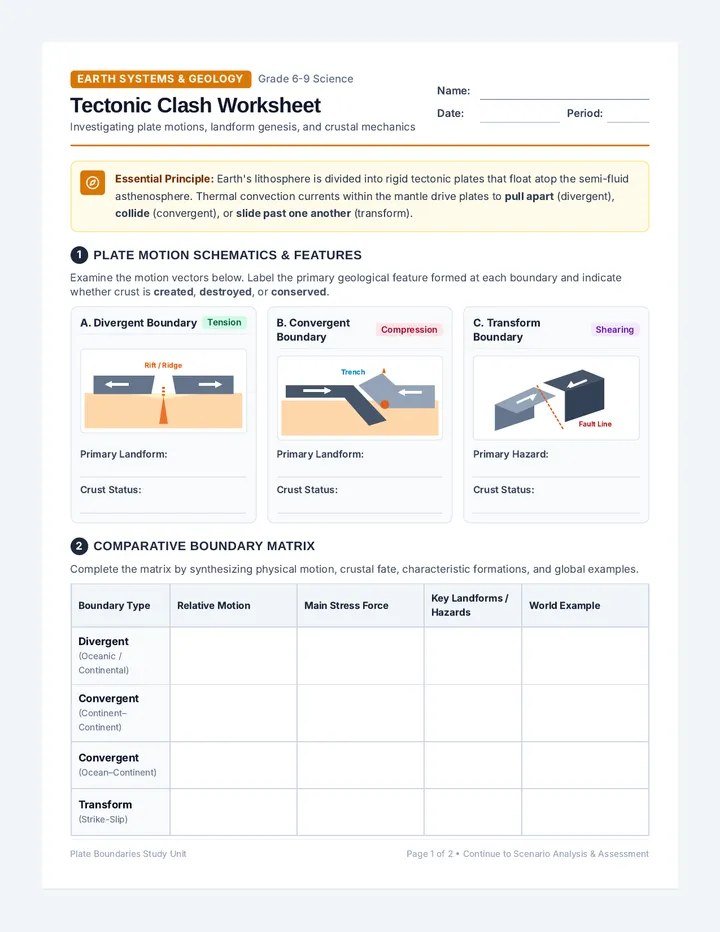
| Unit 3: Dynamic Earth & Plate Tectonics | Why do continents migrate and trigger catastrophic seismic events?
MS-ESS1-4, MS-ESS2-1, MS-ESS2-2, MS-ESS2-3
| Seismic Hazard Resilient Structure Build |
| Weeks 19–24
Term 2 (Q3)
| Unit 4: Thermal Energy & Material Systems | How does kinetic thermal transfer govern planetary & mechanical states?
MS-PS3-3, MS-PS3-4, MS-PS3-5, MS-ETS1-2
| Passive Solar Insulative Capsule Lab |
| Weeks 25–30
Term 3 (Q3)
| Unit 5: Heredity, Traits & Natural Selection | How do genetic scripts propagate diversity across generations?
MS-LS3-1, MS-LS3-2, MS-LS4-4, MS-LS4-6
| Population Genetics Simulation Dossier |
| Weeks 31–36
Term 3 (Q4)
| Unit 6: Climate Resilience & STEM Capstone | How can urban communities engineer resilience against climate pressures?
MS-ESS3-3, MS-ESS3-4, MS-ETS1-1 to ETS1-4
| Urban Microclimate Mitigation Expo |
Course Evaluation & Grading Weights
Summative Performance Tasks & Projects 40%
Lab Practicums, Data Portfolios & Notebooks 25%
Formative Checks, Quizzes & CER Reflections 25%
Peer Collaboration & Safety Protocol Defense 10%
Year-Long Skill Progression Framework
- • Q1: Controlled lab variables, metric precision, qualitative vs. quantitative logs.
- • Q2: Multi-variable scatter plots, trendline analysis, rate of change calculations.
- • Q3: Multi-paragraph CER syntheses citing empirical trial data and literature.
- • Q4: Iterative engineering design briefs, constraints analysis, and public defense.
Middle School Integrated Science • Course Pacing Guide Page 1 of 4 • Master Blueprint NGSS Aligned • Grades 6–8
Semester 1 Curriculum Modules
Biological Systems & Energy Dynamics
Weeks 1–12 • Quarters 1 & 2
1
Cellular Foundations & Microscopic Life
6 Weeks (Weeks 1–6) • Focus Standards: MS-LS1-1, MS-LS1-2, MS-LS1-3
Life Science
Anchoring Phenomenon
A single-celled amoeba hunts and captures prey, while human specialized immune cells engulf pathogens using identical cellular machinery.
Essential Question
How do microscopic organelles interact to maintain homeostatic equilibrium and fuel macroscopic organism survival?
Target Objectives (SWBAT):
- •Operate compound light microscopes safely to resolve plant (elodea) and animal (cheek epithelial) cellular structures.
- •Construct a functional analogy model comparing cellular organelles (nucleus, mitochondria, membrane, ribosome) to a municipal city system.
- •Differentiate single-celled vs. multi-celled organization: cell → tissue → organ → organ system → organism.
Core Hands-On Labs & Activities:
- • Cytology Lab: Staining & calibrating cheek cell vs. onion epidermal fields of view.
- • Dialysis Bag Diffusion Inquiry: Modeling selective permeability using iodine and starch solution.
- • Interactive Organelle Speed-Dating: Roleplay peer critique of organelle interdependency.
Assessment Suite:
- • Formative: Microscope slide drawing rubric, daily organelle check-ins, CER exit slip.
- • Summative Performance Task: "Medical Examiner Case File"—diagnose cellular organelle failure from patient pathology reports with evidence.
2
Dynamic Ecosystems & Energy Webs
6 Weeks (Weeks 7–12) • Focus Standards: MS-LS2-1, MS-LS2-2, MS-LS2-3, MS-LS2-4
Ecology & Systems
Anchoring Phenomenon
The reintroduction of 14 gray wolves to Yellowstone National Park dramatically changed the physical course of rivers over two decades.
Essential Question
How does energy dissipate through trophic tiers, and what mechanisms stabilize ecosystems against disruption?
Target Objectives (SWBAT):
- •Calculate caloric efficiency across trophic levels applying the 10% ecological energy rule.
- •Construct food webs delineating competitive, predatory, and mutualistic symbiotic relationships within local biomes.
- •Analyze empirical census data to evaluate the impact of invasive species (e.g., zebra mussels or kudzu) on native biodiversity.
Core Hands-On Labs & Activities:
- • Barn Owl Pellet Dissection: Bone identification and biomass trophic pyramid reconstruction.
- • Closed Bottle Mesocosm Build: Sealed aquatic/terrestrial eco-column monitoring cycling over 21 days.
- • Carrying Capacity Tag Simulation: Graphing boom-and-bust predator-prey cyclical oscillations.
Assessment Suite:
- • Formative: Trophic calculation check, food web connection rubrics, daily data logs.
- • Summative Performance Task: "Keystone Species Intervention Defense"—formal presentation and policy brief on stabilizing a disrupted regional biosphere.
Mid-Year Checkpoint (Week 12): Laboratory Safety Practicum Review & Quantitative Data Literacy Audit.
Benchmark 1 Complete
Middle School Integrated Science • Course Pacing Guide Page 2 of 4 • Fall Semester Units NGSS Aligned • Grades 6–8
Semester 2 Curriculum Modules
Earth Dynamics & Thermodynamic Systems
Weeks 13–24 • Quarters 2 & 3
3
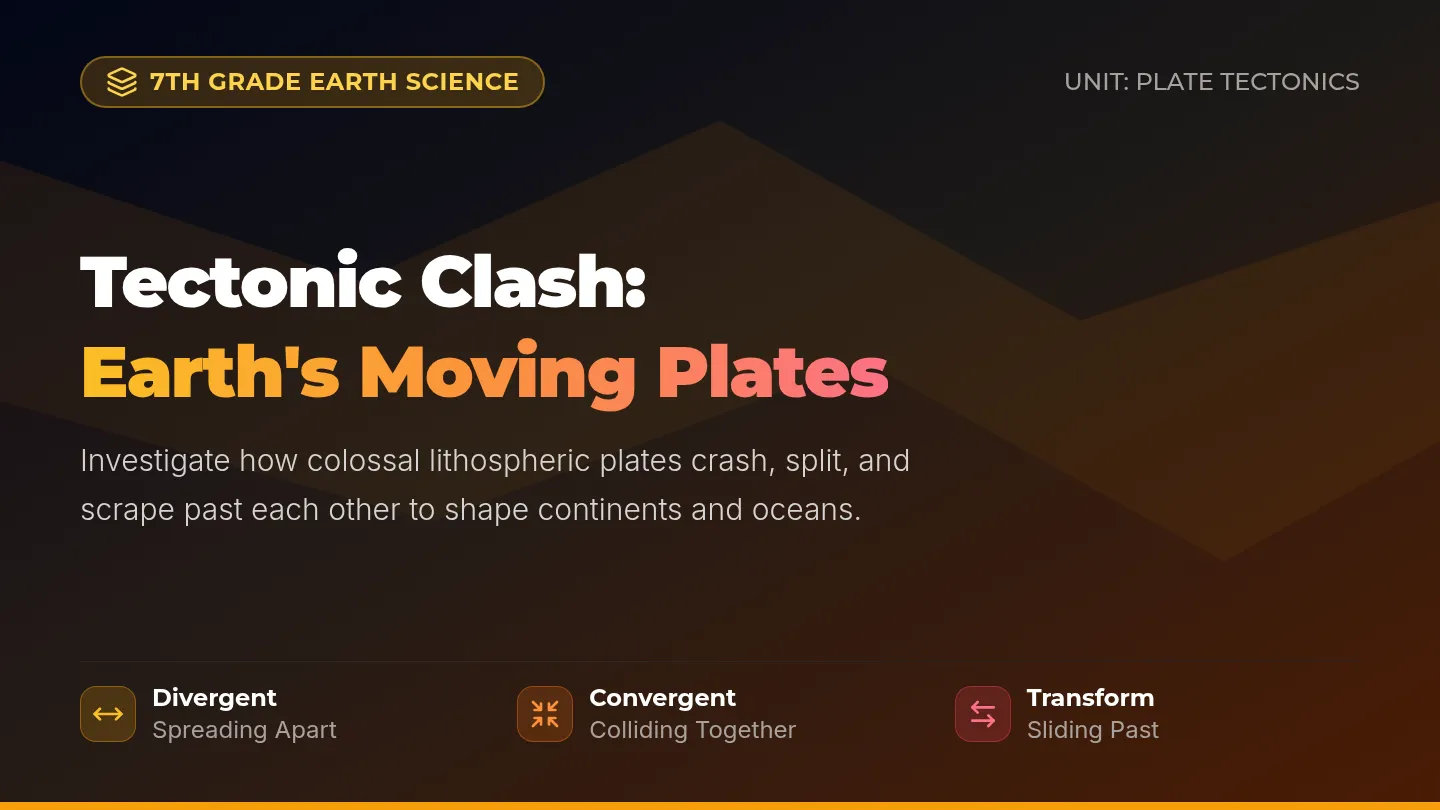
Dynamic Earth & Plate Tectonics
6 Weeks (Weeks 13–18) • Focus Standards: MS-ESS1-4, MS-ESS2-1, MS-ESS2-2, MS-ESS2-3
Earth & Space
Anchoring Phenomenon
Identical fossilized Glossopteris flora and Mesosaurus reptiles are discovered on coastlines separated by thousands of miles of Atlantic ocean.
Essential Question
How do interior thermal convection currents continuously remodel Earth's crust and generate destructive surface events?
Target Objectives (SWBAT):
- •Correlate plate boundary dynamics (convergent, divergent, transform) to landforms using seafloor magnetic striping data.
- •Synthesize mineral cycling and rock metamorphosis via igneous, sedimentary, and metamorphic geochemical pathways.
- •Triangulate earthquake epicenters using seismic S-P wave time-distance arrival graphs.
Core Hands-On Labs & Activities:
- • Convection Tank Visualization: Mapping fluid thermal currents with potassium permanganate dye.
- • Seafloor Spreading Cardboard Model: Recreating paleomagnetic reversals and subduction zones.
- • Earthquake Triangulation Practicum: Plotting compass circles from three seismograph stations.
Assessment Suite:
- • Formative: Tectonic boundary sketching checks, rock cycle diagram sorting, CER fossil exit tickets.
- • Summative Performance Task: "Seismic Engineering Challenge"—design, test on shake table, and defend an earthquake-resistant multi-story municipal tower.
4
Thermal Energy & Material Systems
6 Weeks (Weeks 19–24) • Focus Standards: MS-PS3-3, MS-PS3-4, MS-PS3-5, MS-ETS1-2
Physical Science
Anchoring Phenomenon
An ice cube melts significantly faster on an ambient-temperature aluminum block than on a plastic block of the exact same temperature.
Essential Question
How does molecular kinetic motion govern thermal equilibrium, and how can material selection control thermal transfer?
Target Objectives (SWBAT):
- •Differentiate conduction, convection, and radiation at atomic/molecular particle motion scales.
- •Measure and calculate specific heat absorption rates comparing metals, water, and soil substrates.
- •Construct and iterate a thermal insulating device minimizing thermal leakage over a 30-minute interval.
Core Hands-On Labs & Activities:
- • Calorimetry Inquiry: Measuring thermal transfer between boiling water and mystery metal cylinders.
- • PhET Kinetic Simulation: Modeling state phase changes as energy is introduced or extracted.
- • Insulative Thermos Design Lab: Engineering double-walled vacuum canisters with eco-materials.
Assessment Suite:
- • Formative: LOL energy transfer diagrams, cooling rate slope calculations, temperature probe check.
- • Summative Performance Task: "Thermal Preservation Engineering Brief"—build, test, and write a technical patent application for a vaccine cooling storage vessel.
Mid-Year Milestone Check (Week 24): Engineering Design Process Matrix & Multi-Variable Graphing Certification.
Benchmark 2 Complete
Middle School Integrated Science • Course Pacing Guide Page 3 of 4 • Spring Semester Units NGSS Aligned • Grades 6–8
Culminating Modules & Universal Design
Evolution, Climate Action & Scaffolding
Weeks 25–36 • Quarter 4 & Capstone
5
Heredity & Natural Selection
Weeks 25–30
Phenomenon: Rock pocket mice populations shifted from sandy-buff to black coats within 1,000 years after volcanic basalt flows.
Standards: MS-LS3-1, MS-LS3-2, MS-LS4-4, MS-LS4-6
Core Objectives: Model Punnett square probabilities, analyze mutation advantages, examine anatomical fossil homology.
Signature Labs: Strawberry DNA isolation; Natural selection simulation with varied beak tools & seeds; Pedigree analysis.
Summative Milestone:
Evolutionary Adaptation Lab Dossier & Speciation CER defense.
6
Climate Resilience & Capstone
Weeks 31–36
Phenomenon: Urban areas register surface temperatures up to 10°F higher than surrounding rural green spaces on the same afternoon.
Standards: MS-ESS3-3, MS-ESS3-4, MS-ETS1-1 to ETS1-4
Core Objectives: Quantify carbon flux, evaluate atmospheric greenhouse data, engineer local environmental solutions.
Signature Labs: Campus thermal imaging survey; Bioswale runoff filtration build; Greenhouse chamber gas probe testing.
Summative Capstone:
STEM Community Climate Expo & Policy Presentation to stakeholders.
Multi-Tiered System of Supports (MTSS) & Differentiation Matrix
Tier 1: Universal Access (All)
- • Structured sentence stems for all CER writing prompts.
- • Dual-coded visual vocabulary glossaries with diagrams.
- • Multi-modal representations (simulations, audio, tactile manipulatives).
- • Explicit lab role rotations (Director, Materials, Recorder, Safety).
Tier 2: Targeted Scaffolding
- • Pre-scaled coordinate axes for data graphing challenges.
- • Chunked procedural lab checklists with pictorial cues.
- • Weekly small-group guided inquiry reteach workshops.
- • Word banks with morphological breakdown (e.g., endo/exo).
Tier 3 / Honors Extension
- • Self-directed student-designed independent variable tests.
- • Statistical analysis incorporating standard deviation & error bars.
- • Peer lab coaching and primary scientific literature synthesis.
- • Open-ended CAD / 3D printing engineering challenges.
Year-End Mastery Expectations (Grades 6–8 Performance Continuum)
Scientific Modeling
Progresses from descriptive physical drawings to dynamic, predictive computational and mathematical system models.
Data Analysis
Calculates measures of central tendency, resolves anomalous data points, and interpolates multi-variable curves.
Argumentation (CER)
Synthesizes empirical data with scientific principles to evaluate rival claims and critique flawed methodology.
Engineering Design
Defines constraints rigorously, models trade-offs between cost/efficacy, and validates prototypes with quantitative tests.
Middle School Integrated Science • Course Pacing Guide Page 4 of 4 • Culmination & MTSS Scaffolding NGSS Aligned • Grades 6–8