A collaborative Earth Day lesson where students create a class book inspired by Louis Armstrong's 'What a Wonderful World'. Includes a detailed teacher guide and presentation slides with a video embed.
In this fifth and final lesson of the Spine Squad unit, students explore fish, focusing on gills, fins, scales, and underwater survival, with a final cumulative review of the five vertebrate groups.
In this fourth lesson of the Spine Squad unit, students study amphibians, understanding how they live on water and land, lay soft eggs, and have smooth, wet skin, with scaffolded reading and tracing.
In this third lesson of the Spine Squad unit, students identify reptiles, exploring characteristics such as scales, cold-blooded regulation, and laying leathery eggs on land, supported by guided tracing.
In this second lesson of the Spine Squad unit, students examine the key characteristics of birds, including feathers, wings, and laying hard-shelled eggs, using scaffolded comprehension prompts and tracing.
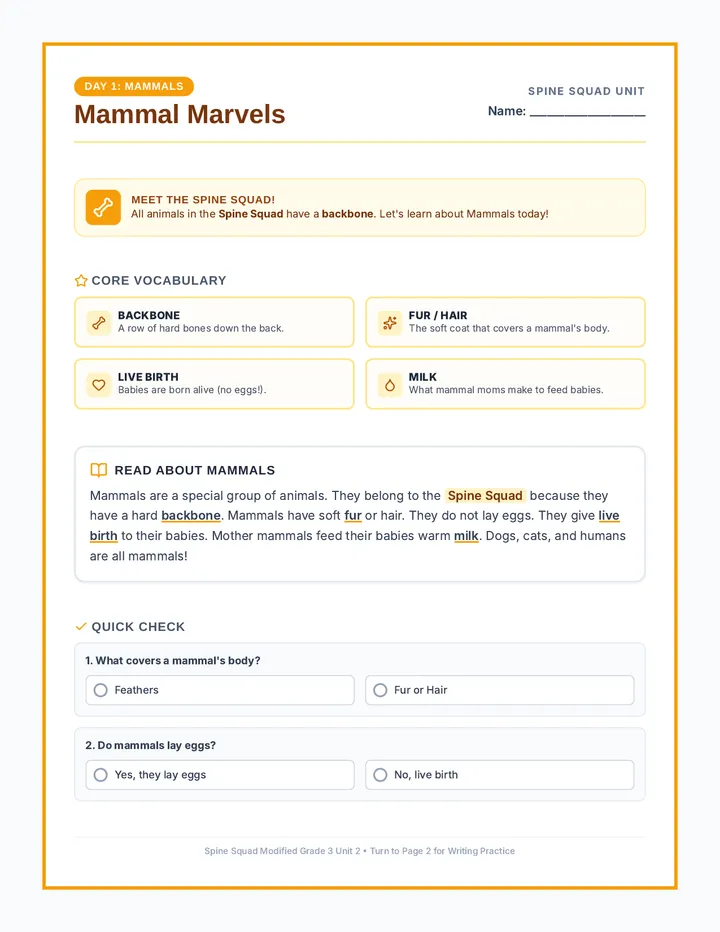
In this first lesson of the Spine Squad unit, students explore the unique traits of mammals, focusing on fur/hair, live birth, and milk production with heavy visual support and tracing activities.
A hands-on science lesson designed for second-grade students to explore seed dispersal methods. Students learn about wind, water, animals, gravity, and propulsion through visual modeling, discussion, and a structured field journal.
An interactive, visually rich lesson preparing Florida students for severe storms and hurricanes. Covers emergency kit building, weather alerts, home action plans, and sensory coping strategies to reduce storm anxiety.
An interactive, visual-heavy lesson where students investigate ecosystem roles (producers, consumers, and decomposers) through an engaging 'Guess Who' style game. Includes visual-support clue cards, a detective tracking sheet, and a comprehensive teacher guide.
An interactive Kindergarten lesson where students explore ocean zones, compare marine animal sizes, and collaborate on a classroom ocean depth mural while practicing foundational counting and size comparison skills.
A lesson on oceanography covering shorelines, coastal features, and the deep seafloor, adapted with a friendly My Little Pony decorative theme and chunked, accessible text for Standard Modified Special Education students.
A foundational biology lesson exploring the simple life cycle of a plant from seed to sprout to adult. Includes interactive slides, a comprehensive teacher guide, and three tiers of differentiated worksheets to support early writers, matchers, and independent sentence-builders.
Join Twilight Sparkle, Pinkie Pie, Fluttershy, and Rainbow Dash as they explore the origin, composition, and structure of Earth's oceans. This lesson is highly visual, simplified, and carefully structured with guided practice, word banks, and sentence starters.
A friendly, hands-on kindergarten lesson exploring the four stages of a butterfly's life cycle: egg, caterpillar, chrysalis, and butterfly. Students learn through sequencing, labeling, coloring, and reading a foldable mini-booklet.
A bilingual kindergarten lesson exploring the magical life cycle of butterflies. Students practice sequencing, labeling, and reading simple bilingual English/Portuguese sentences.
A playful, cooperative drawing game designed for toddlers to explore self-expression, fine motor skills, and collaborative creation. Guided by interactive presentation slides, children turn simple scribbles and basic shapes into hilarious, unique monster friends on a step-by-step activity canvas.
A premium, cohesive collection of beautifully designed spiritual and religious reminders for daily, weekly, and seasonal practices, featuring high-contrast connected Arabic typography, elegant arches, and glowing celestial themes.
Express new expertise through a multi-page layered flipbook template and structured cooperative writing prompts.
Sing and chant about ocean adaptations, fill out a collaborative Process Grid of focus animals, and use differentiated sentence frames for group writing.
Build vocabulary and deep comprehension using a interactive Cognitive Content Dictionary (CCD) and the story of Ollie the Octopus's Deep Sea Adventure.
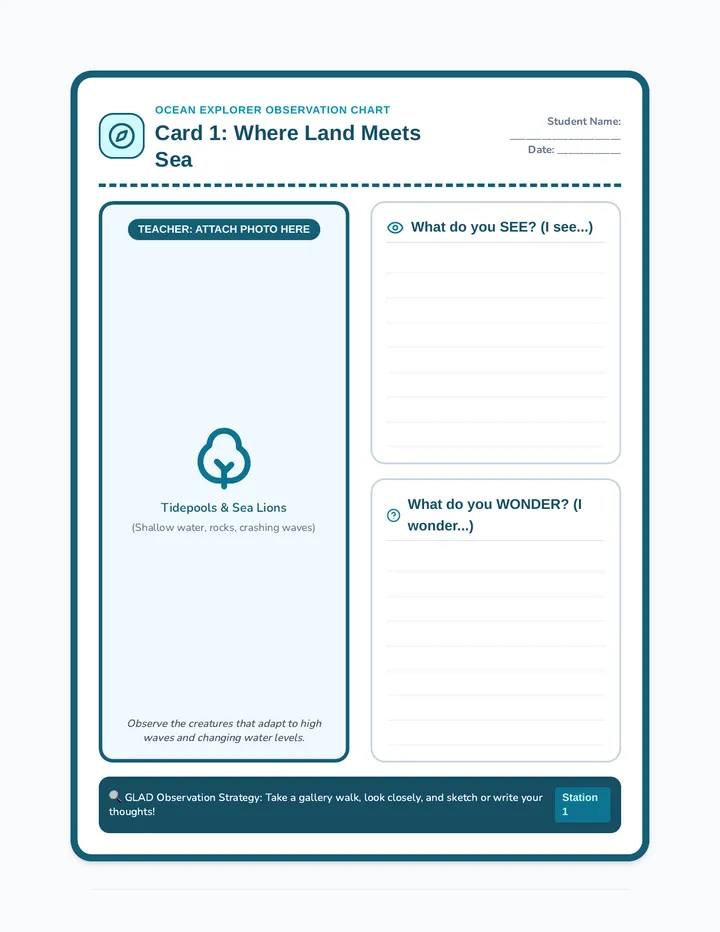
Spark curiosity with high-interest Observation Charts, positive-behavior Literacy Awards, and a large-scale visual blueprint for the multi-zone ocean chart.
A Disney-inspired interdisciplinary choice board and support materials for 2nd grade. Students explore math, language arts, art, music, and science through engaging, magical challenges that promote agency and creativity.
A highly differentiated 30-minute lesson where students act as 'Placement Officers' for the Pup Placement Agency. They analyze physical and behavioral traits of dog candidates and match them with appropriate service dog jobs, aligning with the OpenSciEd Grade 3 Trait Variation unit.
An engaging, kid-friendly lesson introducing 2nd graders to the wonders of electricity, exploring its discovery, how it works through simple circuits, and how it is generated safely.
A 30-minute introductory lesson on container capacity for Kindergarten students, using hands-on exploration with water and jars to understand 'more', 'less', and 'full'.
A fun set of kindergarten activities to celebrate the end of the school year and the start of summer, featuring drawing prompts and basic skill practice.
A pair of engaging, hands-on activities for kindergarten students to celebrate the start of summer while practicing fine motor skills, number recognition, and categorization.
A hands-on follow-up lesson for first graders focusing on the vocabulary of pollination, specifically the roles of bees and butterflies as they move pollen between flowers.
Students will learn how bees move pollen from flower to flower to help plants grow seeds and fruit.
Applying 'au' and 'aw' knowledge to sentence reading and a collaborative board game review.
Building fluency with 'au' and 'aw' words and phrases through repetitive practice and blending routines.