Winter Wonder Lab Lesson Plan Teacher Facilitation Guide
Winter Wonder Lab
Target Grade: 1st – 2nd Grade
Duration: 60–75 Minutes
Subject: Science & ELA Integration
Lesson Rationale: This lesson bridges physical science (freezing point, ice/snow properties, seasonal weather adaptation) with creative literary arts (imaginative perspective writing, sensory descriptive language, and geometric snowflake symmetry art).
Learning Objectives
Identify physical properties of ice and snow (cold, solid, melting at room temperature).
Categorize seasonal winter clothing items that trap body warmth.
Write a 3-part descriptive micro-narrative from a snowflake's point of view.
Target Standards
NGSS 2-ESS2-1: Patterns in seasonal changes and weather phenomena.NGSS 2-PS1-4: Heating and cooling can cause reversible changes.CCSS.ELA W.2.3: Narratives describing actions, thoughts, and feelings.
Materials & Advance Preparation
Physical Station Items:
Ice cubes in plastic trays, small flashlights, magnifying lenses, wool mittens, cotton swatches, plastic wrap, and paper towels.
Printed & Media Resources:
Winter Explorer Activity Sheets (1 per student), Frosty Discoveries Slide Deck, Snowy Tales Station Cards (laminated or mounted).
Instructional Sequence (Part 1)
Phase 1: Mystery Frost Sound & Hook
10 Min
Display Slide 2 ("Mystery Sound: Crunch!"). Ask students to close their eyes and listen to boots crunching on fresh powder. Guide inquiry: "What makes that sound? Why does snow crunch in cold temperatures but squish when warm?" Introduce the Winter Explorer badges and central mission question.
Phase 2: Ice & Snow Thermal Investigation
20 Min
Distribute ice cubes in transparent cups. Students observe with magnifying lenses and record on Page 1 of their Activity Sheet: Is it hard or soft? Wet or dry? Clear or cloudy? Conduct the Winter Wardrobe Insulation Test : Wrap one ice cube in a wool sock/mitten, one in bare foil, and leave one open to the room air. Students predict which will melt fastest.
Winter Wonder Lab • Grade 1–2 STEM & Literacy Integration Page 1 of 2
2
Instructional Sequence (Part 2) & Differentiation
Winter Creativity, Writing Integration & Assessment
Classroom Implementation
Phase 3: Creative Narrative – "A Day in the Life of a Snowflake"
20 Min
Introduce the imaginative shift using Slide 5. Students personify a single snowflake forming in high frosty clouds, floating over pine trees and rooftops, and landing on an explorer's woolen glove. Model sensory vocabulary: whisper, crystalline, swirling, shimmering, chilly . Students draft their 3-sentence adventure on Activity Sheet Page 2.
Phase 4: Winter Wonder Stations (Choice Centers)
15 Min
Station 1: Snowflake Symmetry Studio Design a 6-sided geometric snowflake drawing using radial symmetry guide points.
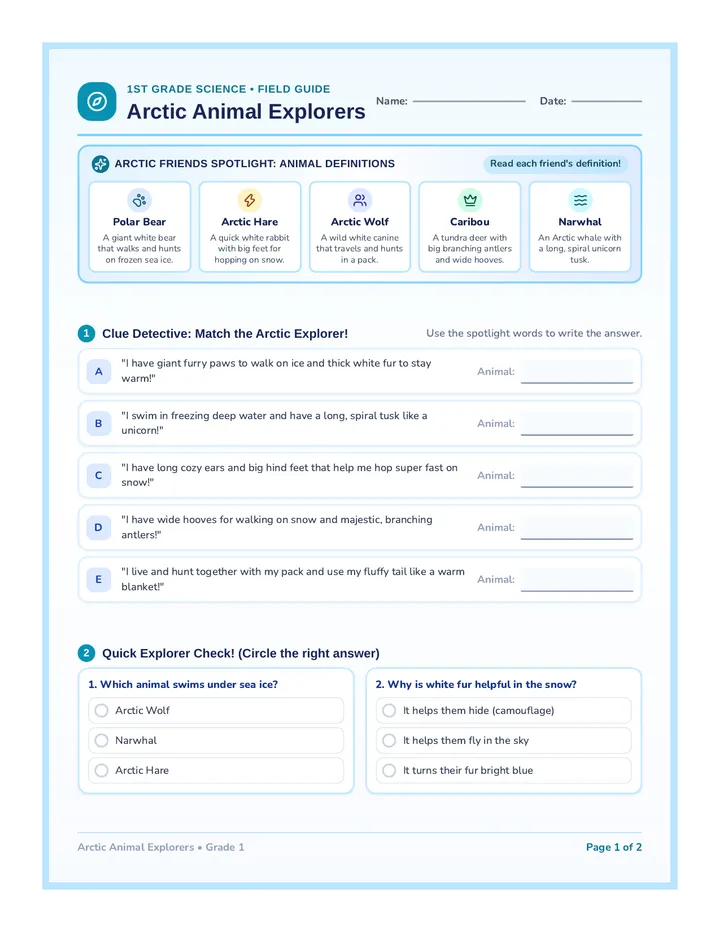
Station 2: Arctic Animal Shelter Lab Match animals (polar bear, hare, walrus) to winter adaptations (blubber, white fur).
Phase 5: Reflection & Frost Gallery Walk
10 Min
Pairs display their completed snowflake sketches and read their favorite narrative line. Wrap-up prompt: "If you were caught in a winter blizzard, which item in your explorer pack would keep your core warm, and why?" Collect completed explorer sheets as formative evidence.
Key Facilitation & Discussion Prompts
Observation: "Look closely at the ice cube with your lens. What happens along the edges when warmth touches it?"
Connection: "Why do we wear mittens made of wool instead of thin plastic grocery bags?"
Imagination: "What sound does your snowflake hear when it dances through a snowy pine forest?"
Inference: "What does the word 'insulator' mean in our wool mitten experiment?"
Support & Scaffolding
Provide word banks with picture icons for clothing (mittens, scarf, parka) and sensory adjectives (crisp, frosty, icy). Offer sentence frames: "I began high in the... Then I floated past... Finally, I melted on..."
Extension & Challenge
Have advanced learners measure ice melt water with a graduated dropper or write a rhyming couplet about winter temperature changes. Compare snow crystals to frost formed on a freezer window.
Winter Wonder Lab • Grade 1–2 STEM & Literacy Integration Page 2 of 2
Frosty Discoveries Slides Winter Wonder Lab
Grade 1–2 STEM & Creativity
Frosty Discoveries:
The Science & Wonder of Winter
Put on your explorer boots! Today we explore ice, snow, cold weather mysteries, and the secret story of a snowflake.
Explore Freezing Weather
Uncover Ice Secrets
Write a Snowflake Story
Mystery Warm-Up
Listen & Wonder
"CRUNCH! SQUEAK!"
Close your eyes. Imagine heavy boots stepping into fresh, deep snow on a freezing morning.
Why does snow make that special crunching sound?
Billions of tiny ice crystals press and break together!
When it is extra cold, the crystals are harder and crunch louder!
Discussion Question: What other sounds do you hear in winter?
Science Check
Temperature Matters!
The Magic Freezing Point: 32°F / 0°C
Above 32°F (Warm)
Water is a flowing liquid . Raindrops fall, puddles splash, and snow turns to water!
Below 32°F (Freezing)
Water molecules lock into place! It turns into a hard solid : ice cubes, icicles, and snowflakes!
Key Fact: Every single snowflake has 6 sides or arms because of how water freezes!
Winter Survival
Clothing as Insulators
How Does Winter Clothing Keep Us Warm?
1. Your Body Heat
Clothes do not make heat—YOU make the heat!
2. Trapping Air
Fluffy wool and down feathers trap warm air next to your skin.
3. Blocking Cold
Windproof coats stop chilly winter breezes from blowing warm air away.
Scientist Word of the Day: INSULATOR (keeps warm in and cold out!)
Creative Story Spark
Use Your Imagination
Imagine You Are a Tiny Snowflake...
Beginning:
Where were you born? High inside a fluffy gray cloud over a frozen mountain?
Middle:
How do you travel? Swirling with the chilly wind past cozy chimney smoke?
Ending:
Where do you land? On a child's mitten, a sleeping bear's nose, or a tall pine tree?
Sensory Word Bank: dancing • whisper • freezing • crystalline • shimmering • gentle
Explorer Mission
Time for Action!
Ready for Your Winter Explorer Stations?
1
Science Explorer Log
Observe real ice cubes, test wool insulation, and sort warm winter clothing gear.
2
Snowflake Story & Art
Draft your snowflake adventure and draw a symmetrical 6-pointed ice crystal!
Grab your pencils and explorer sheets—let's discover!
Winter Explorer Activity Sheet Official Field Log
Winter Explorer Journal
Name:
Date:
1 Ice Cube Sensory Check
Observe with Magnifier
Examine your ice cube carefully. Circle one word in each pair that best describes what you observe:
State of Matter
Solid Liquid
Temperature
Freezing Warm
Texture
Slippery Rough
Light
Clear Dark
2 The Melting Mystery Experiment
Insulator Test
We placed 3 equal ice cubes in different conditions. Which cube do you predict will stay frozen the longest? Check your hypothesis:
Cube A: Open Air
Sitting on a plain plastic tray
Cube B: Wool Mitten
Wrapped tightly in cozy wool
Cube C: Metal Foil
Wrapped in shiny aluminum foil
What happened after 10 minutes? Write or sketch your scientific observation:
3 Winter Wardrobe Gear Sort
Body Warmth Protection
Read the clothing items below. Put a CHECK (✓) next to items that protect your body heat in freezing snow, and an X next to items for hot summer weather:
Thick Wool Mittens
Insulated Winter Parka
Beach Sandals / Flip-Flops
Knitted Beanie Hat
Short Sleeve Cotton T-Shirt
Waterproof Snow Boots
Winter Wonder Lab • Science Exploration Log Page 1 of 2
Creative Writing & Art
A Day in the Life of a Snowflake
Imagination & Geometry Studio
Part A: My Snowflake's Secret Journey
3-Sentence Story
Pretend you are a crystalline snowflake. Use describing words from our sensory bank (chilly, swirling, whispering, dancing, shimmering ) to tell your tale:
1. The Beginning (Where were you born?):
2. The Middle (How did you dance through the winter sky?):
3. The Ending (Where did you land and what did you see?):
Part B: Snowflake Symmetry Art Studio
6-Pointed Symmetry
Every snowflake has 6 symmetrical points. Draw your own unique ice crystal inside the circular studio below:
My Snowflake's Name:
Special Superpower:
"Did you know? In real snow, no two crystals are shaped completely identical!"
Winter Wonder Lab • Creative Writing & Art Journal Page 2 of 2
Snowy Tales Station Cards Print & Cut Center Cards
Snowy Tales Station Cards
Winter Learning Centers • Part 1
1
Physical Science Center
The Ice Sculptor Lab
10–12 Min
Your Scientist Mission:
Place two ice cubes side-by-side in your tray.
Sprinkle a tiny pinch of coarse salt on only one cube.
Shine your mini flashlight through both cubes. What do you see?
Touch each cube gently with one finger. Which cube feels slippery first?
Explorer Talk Question:
"Why do winter road crews spray salt on snowy streets before a big freeze?"
Station Kit:
Ice cubes & tray
Mini flashlight
Table salt pinch-pot
Hand magnifier
Safety: Wipe wet spills immediately!
2
Literacy & Sensory Art
Frosty Poet Corner
10–12 Min
Your Poet Mission:
Build a 4-line winter feeling poem using this special sensory formula. Write your draft on scratch paper and recite it to your partner:
Line 1: Winter looks like __________.
Line 2: Winter sounds like __________.
Line 3: Winter feels like __________.
Line 4: Winter makes me want to __________.
Spark Words: crystalline, muffled, crackling, cozy, powdered, whispering
Station Kit:
Winter sensory word cards
Colored writing markers
Snowflake craft stickers
Goal: Use at least 2 sensory adjectives!
Winter Wonder Lab • Cut along dashed borders to mount at center tables Page 1 of 2
Print & Cut Center Cards
Snowy Tales Station Cards
Winter Learning Centers • Part 2
3
Life Science & Engineering
Arctic Animal Architects
10–12 Min
Your Design Challenge:
Arctic animals have extraordinary natural adaptations to survive sub-zero winds. Choose one creature and engineer a cozy winter den:
Polar Bear Deep snow den to protect cubs
Arctic Fox Tucks nose inside fluffy tail
Snowy Owl Feathered feet for snowy ground
Build Prompt:
"Use building blocks or cotton to create a winter wind-shelter for your animal toy!"
Station Kit:
Small toy winter animals
Cotton balls / white felt
Wooden building blocks
Test: Blow on the den! Does it block wind?
4
Problem Solving & Health
Winter Wardrobe Stylist
10–12 Min
Your Styling Scenario:
Explorer Jordan is about to step outside in a fierce winter blizzard: 15°F with freezing winds and heavy snow . Jordan has 3 outfit layers to assemble in the correct order:
Layer 1 (Base): Thermal long underwear to wick moisture.
Layer 2 (Middle Insulator): Fleece sweater to trap warm air.
Layer 3 (Outer Shell): Waterproof snowsuit to block wind & wet snow.
Bonus Check: Don't forget extremities! Why do fingers get cold first without mittens?
Station Kit:
Cardboard explorer paper doll
Magnetic clothing cutouts
Thermometer challenge card
Think: Which layer stops the wind?
Winter Wonder Lab • Cut along dashed borders to mount at center tables Page 2 of 2