Matter Explorers Lesson Plan Special Ed Science Guide NGSS 2-PS1-1 • Grades K–5 Support
Matter Explorers: Physical Properties
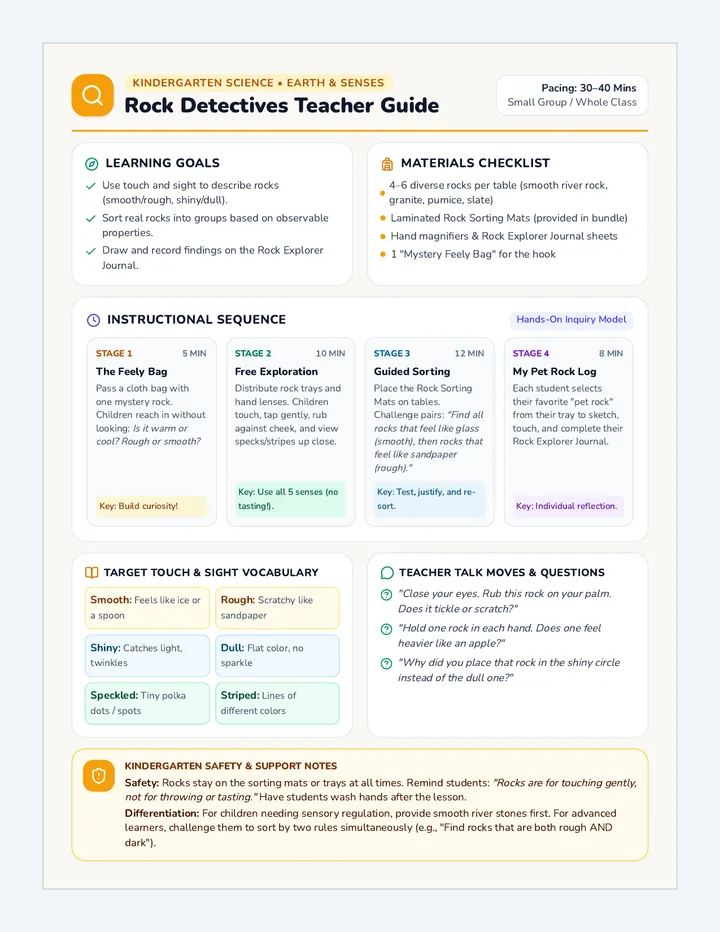
Suggested Duration
45–60 Minutes
Essential Question
"How can we use our senses to observe, touch, and describe what objects are like?"
Key Learning Targets (I Can...)
Observe: Name or point to an object's color, shape, and size.Feel & Compare: Identify texture (rough/smooth, soft/hard).Test: Check if an item is bendy (flexible) or stiff (rigid).
Multisensory Classroom Materials Needed
Tactile Realia Sponges, rocks, pom-poms, sandpaper, plastic spoons, pipe cleaners, erasers.
Sensory Tools 1 "Mystery Touch Bag" (opaque fabric), magnifying glasses, color sorting cups.
Visual Supports Picture communication cards, slide deck, Detective Worksheet, Exit Ticket.
Instructional Delivery: Step-by-Step
Phase 1: Sensory Mystery Hook (10 Mins) Engage
Introduce the "Mystery Feely Bag" containing one soft item (cotton ball) and one hard item (wooden block). Invite a student volunteer to reach in without peeking.
Teacher Script: "Reach in! Don't look with your eyes—look with your fingertips. Does it feel bumpy or smooth? Is it squishy or hard?"
Phase 2: Visual & Explicit Model (15 Mins) Slides 1–5
Display the Matter Mystery Slides . Walk through the core physical properties one at a time using high-contrast icons:
👀 Color Red, Blue, Green
📐 Shape Round, Square, Flat
✋ Texture Rough, Smooth, Soft
🌀 Flex Bendy vs. Stiff
Sensory Note: For students with tactile defensiveness, allow object exploration inside clear sealed zipper bags or offer tongs/chopsticks before direct skin contact.
Activity Stations, Differentiation & Scaffolds
Part 2 of 2
Phase 3: Hands-On Exploration Stations (15 Mins) Worksheet
Students receive the Matter Detective Worksheet . Pairs rotate or choose 2 real objects from their sensory table (e.g., a bumpy rock and a bendy pipe cleaner). Students test, feel, and record findings using icon checkboxes.
Phase 4: Synthesis & Exit Quick-Check (10 Mins) Exit Ticket
Review with the Slide Deck "Mystery Reveal" game. Distribute the visual 3-question Exit Ticket. Support students with read-aloud and pointing options.
3-Tiered Differentiation & Universal Design for Learning (UDL)
Tier 1: Emerging High Support
Non-verbal learners, AAC communicators, or students needing maximum tactile modeling.
• Pointing to 2-choice picture cards (e.g., "Is this soft or hard?")
• Hand-under-hand sensory guidance
• Use AAC switch / core board icon for "feel"
Tier 2: Developing Moderate Support
Students who circle visual choices and express 1–2 word descriptions with verbal prompts.
• Circling icon checkboxes on worksheet
• Sentence strip: "The rock is [hard]."
• 1-to-1 tactile sorting with visual anchor cards
Tier 3: Expanding Low Support
Students who write simple property words and compare two contrasting materials.
• Copy or spell descriptive words from bank
• Compare: "The sponge is soft, but rock is hard."
• Complete sorting challenge independently
Visual Communication Sentence Frames
1
Observation Frame "This object is [color / shape]."
2
Tactile Frame "When I touch it, it feels [soft / hard / rough]."
Common Student Misconceptions: Students often confuse "heavy" with "hard" or think all flexible items must be soft. Emphasize bending without breaking (e.g., an aluminum ruler or plastic spoon bends even though it is hard).
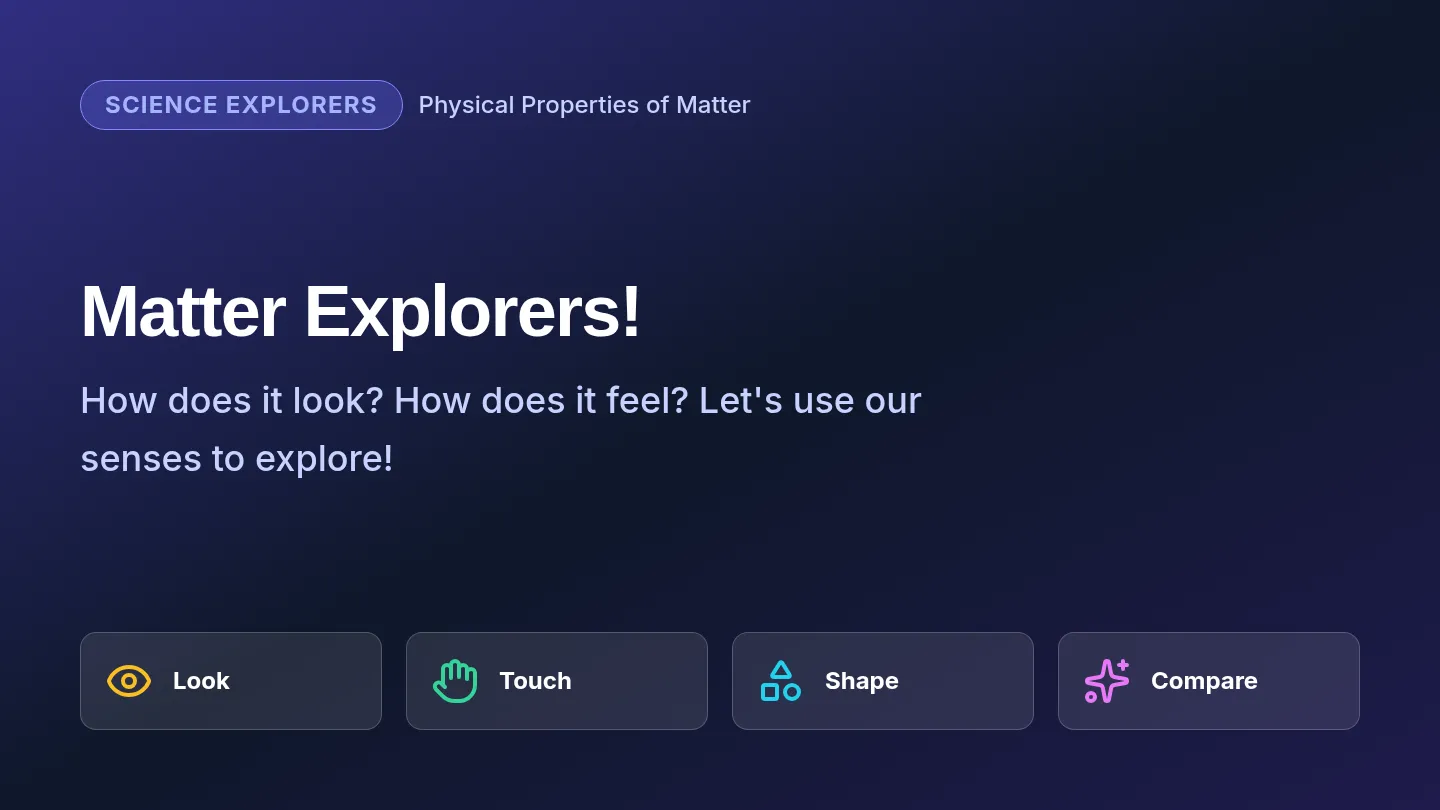
Matter Mystery Slides Science Explorers Physical Properties of Matter
Matter Explorers!
How does it look? How does it feel? Let's use our senses to explore!
Look
Touch
Shape
Compare
What is Matter?
Big Idea
Matter is everything around us that takes up space!
A Heavy Rock Solid and Hard
A Fluffy Feather Light and Soft
A Bounce Ball Round and Bendy
Look: Color and Shape
Sight Clues
Property 1
Color
What color do your eyes see?
Red
Blue
Yellow
Green
Property 2
Shape
What shape is the object?
Round
Square
Flat
Touch: Texture and Hardness
Touch Clues
Property 3
Texture
How does the surface feel to touch?
Smooth Like glass or plastic
Rough Like sandpaper or rock
Property 4
Hardness
Can you squish it with your fingers?
Soft Squishes easily (sponge)
Hard Holds shape (wooden block)
Can It Bend? Flexibility
Action Clue
Test gently with two hands! Does it change shape without breaking?
Bendy (Flexible)
It bends, curves, or twists and does not break!
Examples: Pipe cleaner, rubber band
Stiff (Rigid)
It stays straight and resists bending!
Examples: Wooden ruler, metal spoon
Mystery Object Detective!
Guessing Game
Listen to the Clues:
Color: Bright Yellow
Shape: Round or Rectangle
Texture: Squishy and Soft
Flex: Very Bendy!
What object is this?
A Cleaning Sponge!
It holds water, squishes in your hand, and springs right back!
We Are Matter Explorers!
Review
Color Eyes see it
Shape Round or flat
Texture Rough / smooth
Hardness Soft or hard
Flexibility Bendy or stiff
Ready for hands-on detective work with your real objects?
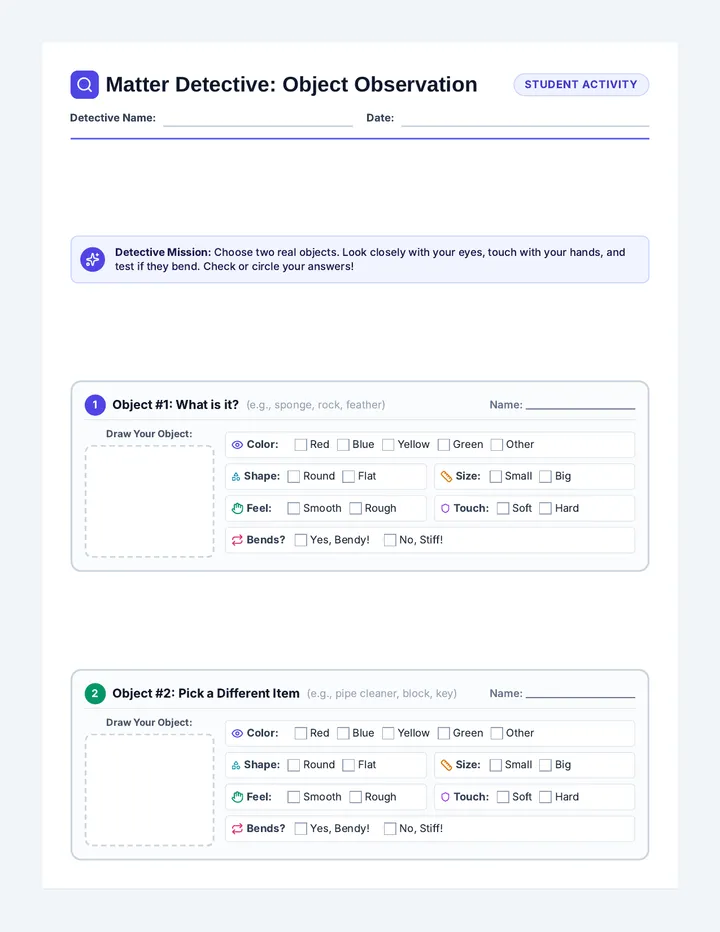
Matter Detective Worksheet Matter Detective: Object Observation
Student Activity
Detective Name:
Date:
Detective Mission: Choose two real objects. Look closely with your eyes, touch with your hands, and test if they bend. Check or circle your answers!
1
Object #1: What is it?
(e.g., sponge, rock, feather)
Name: ______________________
Draw Your Object:
Color:
Red Blue Yellow Green Other
Shape:
Round Flat
Size:
Small Big
Feel:
Smooth Rough
Touch:
Soft Hard
Bends?
Yes, Bendy! No, Stiff!
2
Object #2: Pick a Different Item
(e.g., pipe cleaner, block, key)
Name: ______________________
Draw Your Object:
Color:
Red Blue Yellow Green Other
Shape:
Round Flat
Size:
Small Big
Feel:
Smooth Rough
Touch:
Soft Hard
Bends?
Yes, Bendy! No, Stiff!
Property Sort & Match Challenge
Page 2 of 2
A
Texture Sort: Draw a line from each object to its box!
SOFT (Squishy)
Pillow, cotton, sponge
HARD (Solid)
Rock, brick, key
🪨 Hard Rock
🧸 Plush Bear
🔑 Metal Key
☁️ Cotton Ball
B
Flexibility Sort: Draw a line from each object to its box!
BENDY (Can curve)
Pipe cleaner, rubber band
STIFF (Stays straight)
Wood ruler, glass cup
🥢 Wood Stick
〰️ Rubber Band
📏 Metal Spoon
🧶 Pipe Cleaner
Detective Sentence Share
"My favorite object was the because it feels !"
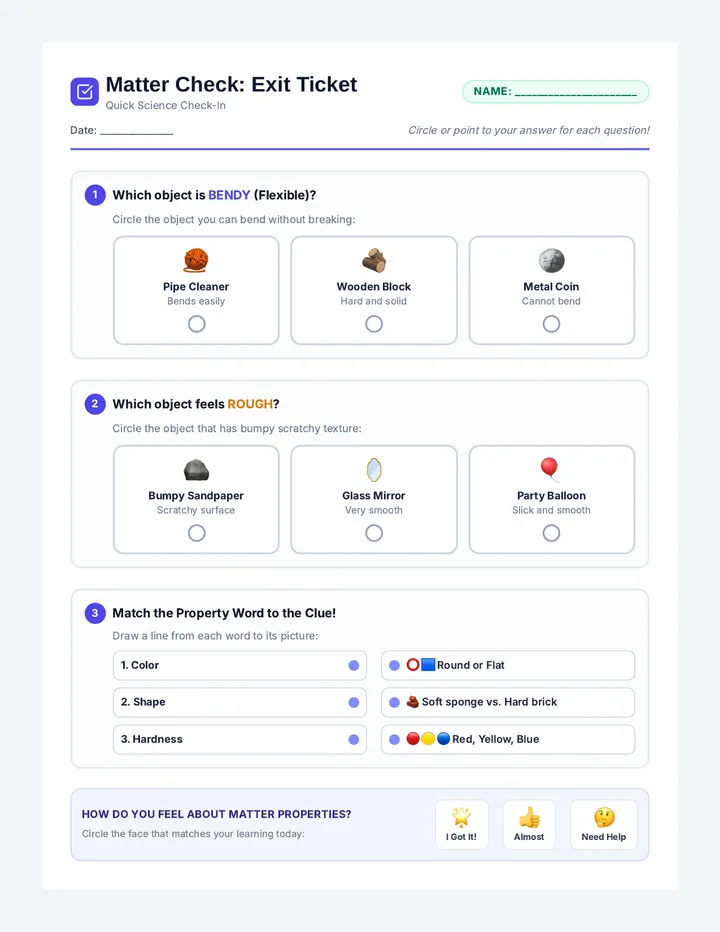
Matter Check Exit Ticket Matter Check: Exit Ticket
Quick Science Check-In
Name: ______________________
Date: _______________ Circle or point to your answer for each question!
1
Which object is Bendy (Flexible)?
Circle the object you can bend without breaking:
🧶 Pipe Cleaner Bends easily
🪵 Wooden Block Hard and solid
🪙 Metal Coin Cannot bend
2
Which object feels Rough?
Circle the object that has bumpy scratchy texture:
🪨 Bumpy Sandpaper Scratchy surface
🪞 Glass Mirror Very smooth
🎈 Party Balloon Slick and smooth
3
Match the Property Word to the Clue!
Draw a line from each word to its picture:
1. Color
2. Shape
3. Hardness
⭕ 🟦 Round or Flat
🧱 Soft sponge vs. Hard brick
🔴 🟡 🔵 Red, Yellow, Blue
How do you feel about Matter Properties? Circle the face that matches your learning today:
🌟 I Got It!
👍 Almost
🤔 Need Help