Float or Sink Slides
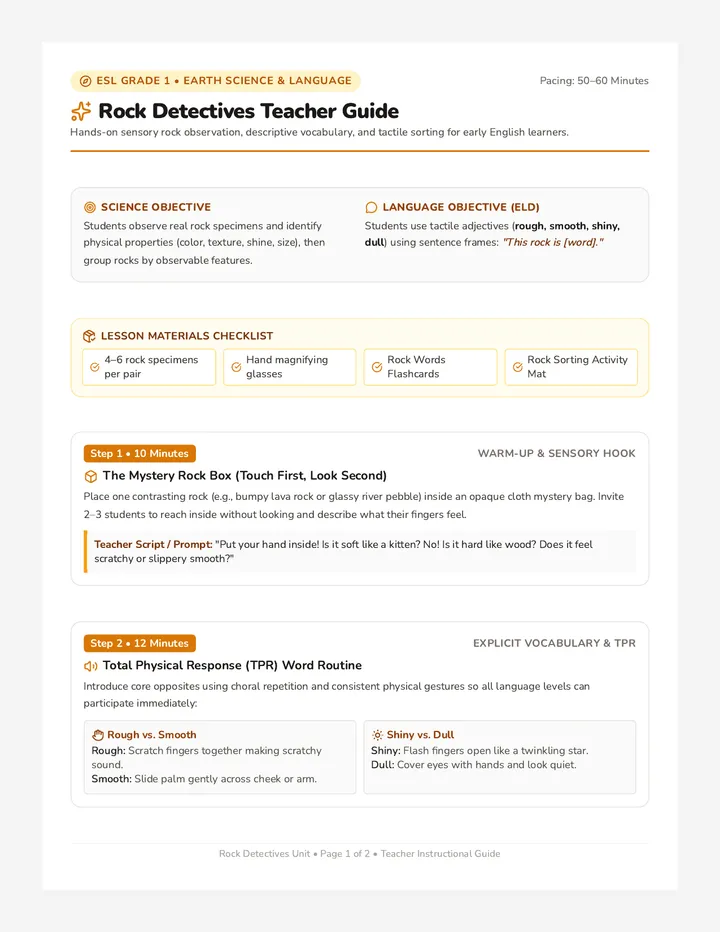
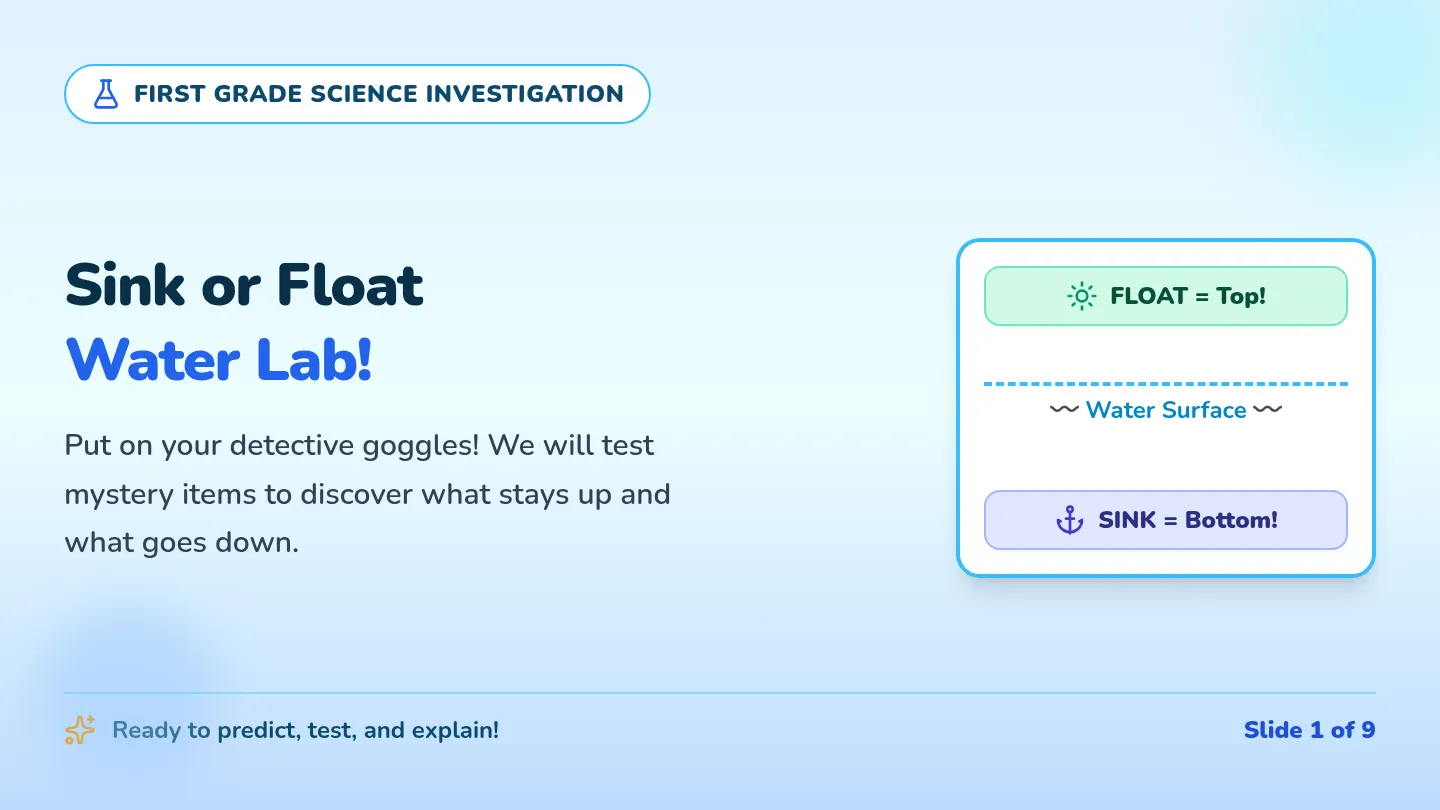
First Grade Science Investigation
Sink or Float
Water Lab!
Put on your detective goggles! We will test mystery items to discover what stays up and what goes down.
FLOAT = Top!
〰️ Water Surface 〰️
SINK = Bottom!
Ready to predict, test, and explain!
Slide 1 of 9
Our Two Science Words
Vocabulary
FLOAT
Stays on top of the water!
Rests at the surface
SINK
Drops to the bottom of the water!
Rests at the bottom
Thumbs up for FLOAT! Thumbs down for SINK!
Slide 2 of 9
How Scientists Investigate
4 Lab Steps
1
Look & Feel
Observe the object with your hands and eyes.
2
Predict
Make your smart guess before testing!
3
Test
Gently place it on the water surface.
4
Record
Mark your log and see if it matched!
We repeat these 4 steps for every item we test!
Slide 3 of 9
Making Predictions for Any Object
Before Testing
Detective Clues to Check
Does it feel heavy or light?
What material is it made of?
Is it solid or hollow inside?
Use all your clues to make your guess!
Lock In Your Vote!
Circle your guess on your recording sheet before the object enters the water.
☀️ FLOAT or ⚓ SINK
Scientists love surprises! A wrong guess helps us learn something new!
Slide 4 of 9
Testing Time: The Water Drop
Lab Rules
Gentle Hands
Place the object right on top of the water. Do not throw or splash!
No Splash Zone 💧
Watch & Wait
Count to 3! Let the water become calm so you can see where it rests.
Count: 1... 2... 3!
Record Result
Circle the final answer on your log right away. Did your prediction match?
Mark Your Sheet 📝
Keep paper towels ready for wet fingers and test items! Slide 5 of 9
Why Do Some Things Float?
The Science Why #1
1. Trapped Air
Many things that float have tiny, invisible pockets of air trapped inside them.
💨 Air is very light and always wants to rise up to the surface!
2. Water Pushes Up!
Water is strong! It pushes upward against anything placed on it. This upward push holds floating objects up.
🌊 Scientists call this upward push buoyancy!
If an item is light for its size, water can hold it up! Slide 6 of 9
Why Do Some Things Sink?
The Science Why #2
1. Heavy for Its Size
Items made of materials like metal, stone, and glass are packed tightly together with no room for air.
📦 Scientists call this being dense!
2. Gravity Wins
Because the object is heavier than the water pushing up against it, gravity pulls it straight down to the bottom!
⬇️ Down, down, down to the tank floor!
Solid, tightly packed things drop right through the water. Slide 7 of 9
The Great Science Myth: Does Size Matter?
Big vs Small
BIG Things Can Float!
A giant tree trunk or a huge cruise ship is enormous and heavy, but both float on top of the water!
🪵 They have trapped air or are shaped to spread out on the water!
TINY Things Can Sink!
A tiny metal pin or a small pebble is very small and light in your hand, but both sink to the bottom!
🪙 They have no air inside and are heavy for their small size!
Secret: It is not about how BIG something is, but WHAT it is made of!
Slide 8 of 9
Investigation Wrap-Up
Lab Debrief
Share with Your Partner:
1 Which item was your favorite to test?
2 Did any test result surprise you today?
3 Why did your floating items stay on top?
Official Water Scientist!
You made thoughtful predictions, tested carefully, and cracked the Sink or Float mystery!
⭐ Great Job Investigators! ⭐
Towel off your test items and hands to finish the lab! Slide 9 of 9
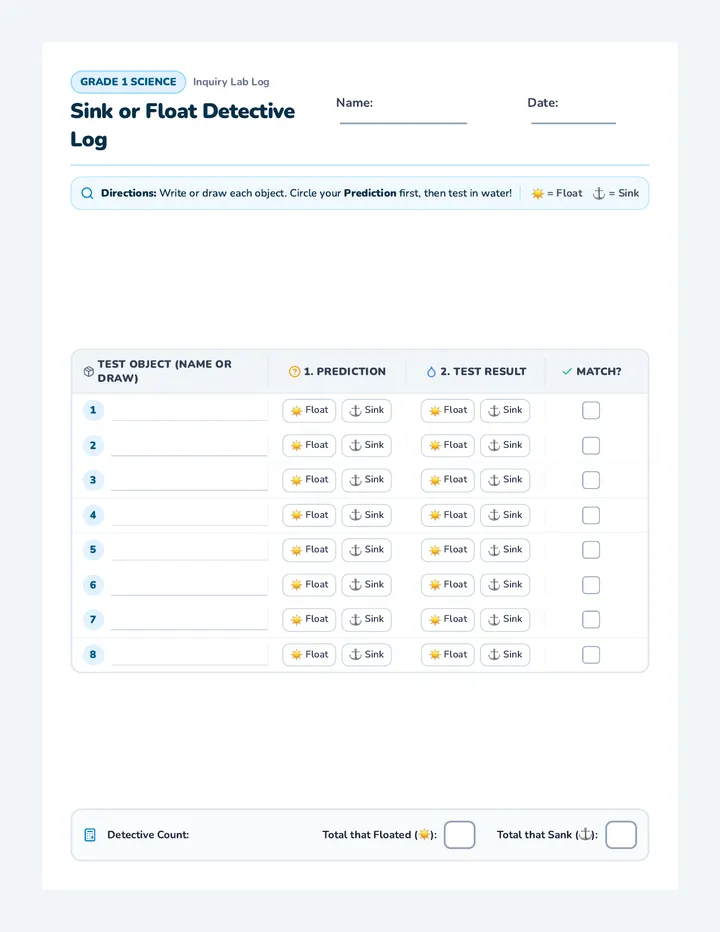
Water Detective Worksheet
Grade 1 Science Inquiry Lab Log
Sink or Float Detective Log
Name:
Date:
Directions: Write or draw each object. Circle your Prediction first, then test in water!
☀️ = Float ⚓ = Sink
Test Object (Name or Draw)
1. Prediction
2. Test Result
Match?
1
☀️ Float ⚓ Sink
☀️ Float ⚓ Sink
2
☀️ Float ⚓ Sink
☀️ Float ⚓ Sink
3
☀️ Float ⚓ Sink
☀️ Float ⚓ Sink
4
☀️ Float ⚓ Sink
☀️ Float ⚓ Sink
5
☀️ Float ⚓ Sink
☀️ Float ⚓ Sink
6
☀️ Float ⚓ Sink
☀️ Float ⚓ Sink
7
☀️ Float ⚓ Sink
☀️ Float ⚓ Sink
8
☀️ Float ⚓ Sink
☀️ Float ⚓ Sink
Detective Count:
Total that Floated (☀️):
Total that Sank (⚓):
Lab Part 2 Draw & Explain
The Water Tank Science Lab
Page 2 of 2
Draw 2 items floating at the top and 2 items resting at the bottom:
Label your drawings!
☀️ SURFACE (FLOAT ZONE) Draw floating items here ⬆️
⚓ TANK FLOOR (SINK ZONE) Draw sunken items here ⬇️
Science Reflection
1. One object that floated on top of the water was the:
2. One object that surprised me was the:
Official Water Detective Badge Teacher Stamp or Star Sticker goes here!
STAMP
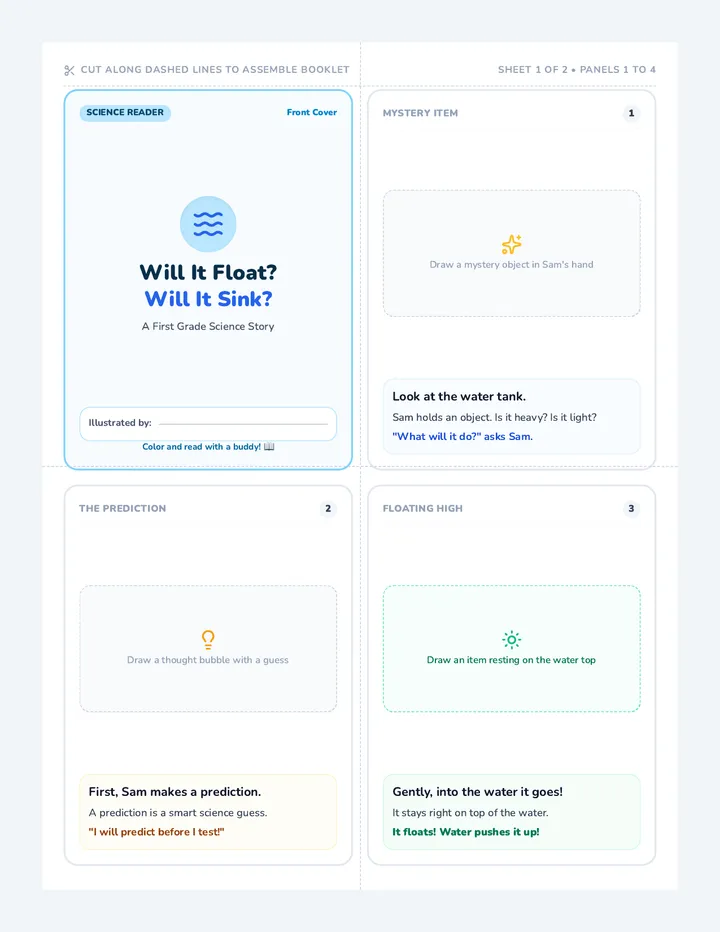
Water Mystery Mini Book
Cut along dashed lines to assemble booklet Sheet 1 of 2 • Panels 1 to 4
Science Reader Front Cover
Will It Float?
Will It Sink?
A First Grade Science Story
Illustrated by:
Color and read with a buddy! 📖
Mystery Item 1
Draw a mystery object in Sam's hand
Look at the water tank.
Sam holds an object. Is it heavy? Is it light?
"What will it do?" asks Sam.
The Prediction 2
Draw a thought bubble with a guess
First, Sam makes a prediction.
A prediction is a smart science guess.
"I will predict before I test!"
Floating High 3
Draw an item resting on the water top
Gently, into the water it goes!
It stays right on top of the water.
It floats! Water pushes it up!
Cut along dashed lines to assemble booklet Sheet 2 of 2 • Panels 5 to 8
Sinking Down 4
Draw an item sitting at the bottom floor
Down, down, down!
This item falls to the very bottom.
It sinks! Gravity pulls it down!
The Floating Secret 5
Draw tiny bubbles of trapped air
Why does it float?
It has trapped air inside.
Air is light. Air loves to stay on top!
The Sinking Secret 6
Draw a heavy solid stone or metal coin
Why does it sink?
It is packed tight with no room for air.
It is heavy for its size!
ELA Word Hunt Back Cover
Read and check each story word:
look
water
float
sink
Does a floating object stay at the top or the bottom?
TOP BOTTOM
⭐ I read this book to: