Meltdown Mission Lesson Plan
NGSS K-PS3-1 • K-PS3-2 Grades K–2 Earth Science
Meltdown Mission Lesson Plan
How Sunlight and Shade Affect Earth's Surface and Temperature
Estimated Pacing
45–50 MIN
Phenomenon
Ice melts rapidly under sunshine, but lasts much longer under shade.
Grouping
Partners (pairs) or small teams of 3 students for active outdoor work.
Location
Sunny schoolyard/blacktop with nearby natural or built shade.
Key Skill
Observing, drawing before-and-after evidence, comparing rates.
Essential Questions
- What happens to objects when sunlight shines directly on them?
- How does shade change the amount of warmth an object receives?
- How can we protect surfaces on Earth from getting too hot?
Learning Targets
- I can observe that sunlight warms surfaces and makes ice melt faster.
- I can draw before-and-after pictures showing changes in ice cubes.
- I can explain that shade blocks sunlight and keeps surfaces cooler.
Materials & Preparation
Per Pair: 2 identical ice cubes (keep in cooler until ready), 2 paper/plastic plates, 1 timer or clock access, 2 recording sheets, crayons/colored pencils.
Shade Options: Natural tree shade, building wall shadow, or student-held umbrella/cardboard tent.
Teacher Tip: Use uniform ice cubes (from ice trays) so melted liquid volumes can be fairly compared!
Core Science Vocabulary
Sunlight: Energy and light that travels from the Sun to Earth.
Solar Energy: The warmth and light that warms outdoor surfaces.
Shade: A dark or cooler space sheltered from direct sunlight.
Melt: When solid ice warms up and turns into liquid water.
Lesson Walkthrough • Part 1
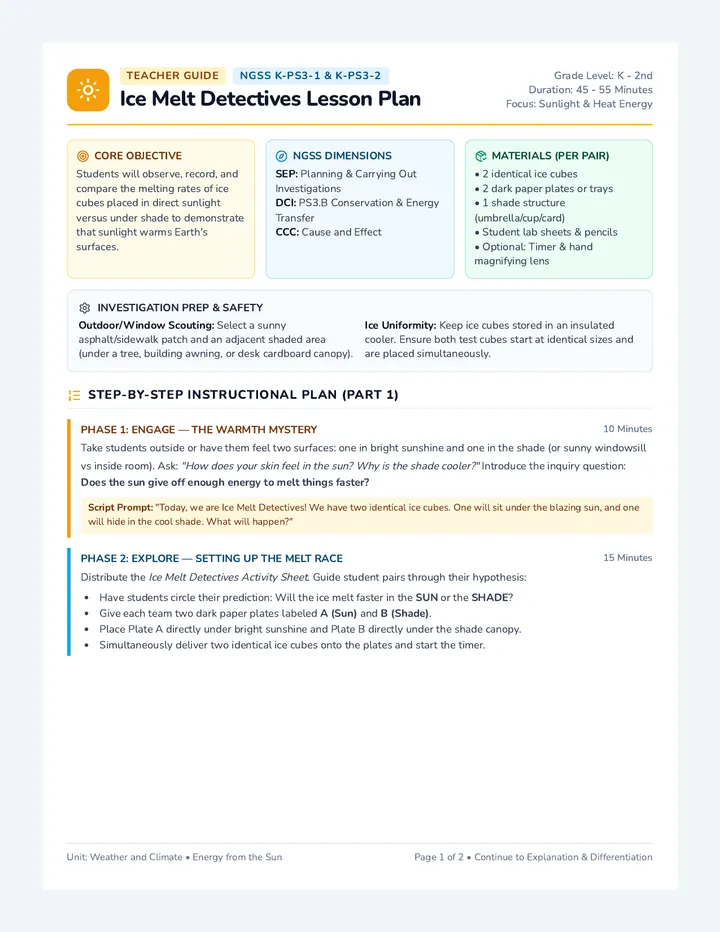
Phase 1: Engage & Touch the Ground (10 Min) Whole Group
Take students outside to a spot with both direct sun and deep shade. Ask them to place one palm on the asphalt in the sun, and the other palm on the asphalt in the shade. "What does your hand feel? Why is the sunny ground warmer?" Introduce the inquiry: What will happen if we place an icy cube in each spot?
Phase 2: Hypothesis & Before-Drawing (10 Min) Pairs
Hand out the Sunlight Ice Meltdown Activity Sheet. Guide students to record their prediction: Will the sunny ice or shady ice melt into water first? Have students draw the starting solid ice cube in both "Before" boxes before taking the cubes out into position.
Sun and Shade Meltdown • Teacher Guide Page 1 of 2
Procedures • Debrief • Supports
Facilitation & Assessment Guide
Part 2 of 2
Lesson Walkthrough • Part 2
Phase 3: Outdoor Investigation & Observation (15 Min) Active Lab
Place Plate A in bright, direct sunshine and Plate B under full shade (tree canopy, cardboard tent, or playground awning). Set a timer. Instruct students to watch closely:
- Minute 3: Notice the first drops forming around the edges of the sunny cube.
- Minute 8: Compare the size of both cubes. Is one shrinking faster?
- Minute 12–15: Students draw the "After" view in both boxes, showing remaining ice vs. pool of water.
Phase 4: Class Debrief & Evidence Discussion (10 Min) Class Discussion
Regroup indoors and facilitate student talk with these prompt stems:
• "What caused the ice in the sun to turn into a puddle so quickly?" (Sunlight radiates heat energy directly onto the ice and plate).
• "What did the shade do for the second ice cube?" (Shade blocked the direct rays of the Sun, keeping the surface cooler).
Phase 5: Formative Check & Exit Ticket (5 Min) Individual Check
Distribute the half-page Solar Warming Exit Ticket. Students demonstrate their understanding by identifying where ice melts faster and how structures provide protective shade.
Teacher Watch-Outs & Common Misconceptions
What Students Might Think Scientific Reality • How to Redirect
"The shade made the ice colder, like a freezer." Shade doesn't make things colder; it prevents the Sun from warming them up as fast!
"Ice melts because of wind blowing on it." Direct radiant heat from sunlight warms the dark plate and ice directly, causing faster melting.
Differentiation Strategies
- Support: Provide sentence frames: "The sun is _____. The shade made the ice stay _____."
- Visual: Use blue crayon for water puddle and white/gray outline for solid ice cube.
- ELL: Anchor with gestures for "Hot Sun" (arms overhead) and "Cool Shade" (hands sheltering brow).
NGSS K-PS3-2 Design Extension
"Save the Snowman" Challenge: Challenge students to use index cards, foil, craft sticks, and tape to engineer a mini umbrella or tent that keeps a third ice cube from melting in direct sunshine!
Sun and Shade Meltdown • Teacher Guide Page 2 of 2
Sunlight Ice Meltdown Activity
Science Lab Sheet Earth & Solar Energy
Sunlight and Shade Meltdown
Name:
Date:
1
My Prediction: Which ice cube will melt faster into water?
Look at your two test locations. Check the box you think will melt first:
The cube in direct sunlight
The cube under the shade
2
My Observations: Draw What You See
Location A: Direct Sunlight (Plate in the Sun)
Warm Surface
BEFORE: Start (0 min) Solid cube
AFTER: End (15 min) Puddle or ice
Location B: Shade Structure (Tree, Tent, or Awning)
Sheltered Surface
BEFORE: Start (0 min) Solid cube
AFTER: End (15 min) Puddle or ice
3
Scientist Findings: What Did the Evidence Show?
1. Which ice cube melted faster?
The Sunny Ice Cube
The Shady Ice Cube
2. Complete the science statement:
Sunlight warms Earth's surface and makes ice melt . Shade blocks sunlight to keep things .
Sunlight and Shade: Melting Ice Experiment NGSS Earth Science • K-PS3-1
Solar Warming Exit Ticket
ET
Solar Warming Exit Ticket
Check for Understanding • Sun & Shade
Name:
Date:
1. Where does ice melt FASTER?
In bright, direct sunlight
Under a cool shade tree
2. What does sunlight give to Earth?
Light and warmth (heat energy)
Freezing winds and cold snow
3. Engineer a Shade Shield!
Your popsicle is melting in the hot sun. Draw what you could build or find to make shade and save it!
How do you feel about today's lesson?
😊 Got it! 🤔 Need a little help
Cut Along Dashed Line (2 Copies Per Sheet)
ET
Solar Warming Exit Ticket
Check for Understanding • Sun & Shade
Name:
Date:
1. Where does ice melt FASTER?
In bright, direct sunlight
Under a cool shade tree
2. What does sunlight give to Earth?
Light and warmth (heat energy)
Freezing winds and cold snow
3. Engineer a Shade Shield!
Your popsicle is melting in the hot sun. Draw what you could build or find to make shade and save it!
How do you feel about today's lesson?
😊 Got it! 🤔 Need a little help