Lenny.com
Explore
Create
ActivitiesNewMathEnglish Language ArtsScience & EngineeringSocial StudiesGlobal LanguagesHealth & Physical EducationSpecial EducationCounseling & Life SkillsArts & CreativityESL
Lenny.com
Lenny.com
Explore
Create
ActivitiesNewMathEnglish Language ArtsScience & EngineeringSocial StudiesGlobal LanguagesHealth & Physical EducationSpecial EducationCounseling & Life SkillsArts & CreativityESL
Lenny.com
Lenny.com

Solutions

Lenny for EducatorsLenny for SchoolsLenny for Districts

Product

ExploreSign inCreateSupportAbout

Resources

Getting startedMTSS Acceleration Program

Newsletters

School Funding Newsletter

© 2026 Lenny Learning Inc.

TermsPrivacyAccessibility
LinkedInInstagramX
Lenny
Science & EngineeringLife ScienceLiving ThingsAnimalsPlantsBody SystemsTraitsAdaptationsCellsEcosystemsHeredityGenes to TraitsCell DivisionPhysicsComparing MaterialsShapes and PropertiesMagnetsMagnetismLightSoundLight and SoundMatterStates of MatterChanges of StateMixturesPhysical and Chemical ChangeHeating and CoolingHeat and Thermal EnergyEnergyForce and MotionElectrical CircuitsAtoms and MoleculesPeriodic TableMotion in One DimensionMotion in Two DimensionsScalars and VectorsForces and Laws of MotionCircular Motion and GravityMomentum and ImpulseWork, Energy, and PowerWavesElectromagnetic WavesGeometric OpticsElectricity and MagnetismSimple Harmonic MotionThermodynamicsNuclear PhysicsEarth Science & AstronomyWeatherWater CycleRocks and MineralsFossilsEarth's FeaturesEarth's ResourcesEarth's StructureWeather and ClimateEarth EventsFossils and Geologic TimePlate TectonicsHuman ImpactsAstronomyChemistryUnits and MeasurementAtomic StructurePeriodic TrendsChemical BondingNomenclatureMolecular StructureIntermolecular ForcesThe MoleStoichiometryProperties of GasesSolutionsChemical ReactionsBalancing EquationsEnergy ChangesRates of ReactionsEquilibriumAcids and BasesQuantum ModelBiologyClassificationCell StructureThe Chemistry of LifeBiomoleculesCellular TransportCell EnergyCell Growth and DivisionDNAProtein SynthesisMeiosis and Sexual ReproductionPatterns of InheritanceMulticellular OrganismsEvolutionEcologyBiodiversityComputer ScienceAlgorithms and Computational ThinkingProgramming LanguagesComputing SystemsNetworks and InternetData AnalysisCybersecurityAI and Machine LearningSoftware Design and DevelopmentBlockchainEngineering & AIDesigning ExperimentsEngineering PracticesDesign ThinkingEngineering Design ProcessMechanical EngineeringElectrical EngineeringMaterials and StructuresCAD and 3D DesignRoboticsArtificial Intelligence BasicsVibe CodingMachine LearningAI Ethics and SocietySystems ThinkingEntrepreneurship & InnovationEntrepreneurial MindsetBusiness Idea DevelopmentBusiness Plan BasicsMarketing & Customer DiscoveryFinancial Management for Startups

Sky Detectives

A comprehensive fifth-grade weather science and reading integration lesson aligned to NC Essential Standards (5.E.1.1, 5.E.1.2, 5.E.1.3) and CCSS RI.5.1. Students read an atmospheric science passage incorporating 22 key weather vocabulary terms and complete text-dependent quote-and-inference questions with a meteorological forecasting challenge.

MWMr Whitfield
16. Gulf Stream [¶3]:

17. Water Cycle [¶3]: Continuous movement of water through evaporation, condensation, and precipitation.

18. Evaporation [¶3]: Thermal process where liquid water heats and transforms into water vapor gas.

19. Precipitation [¶3]: Moisture falling from clouds to Earth's surface (rain, snow, sleet, hail).

20. Thunderstorm [¶3]: Severe localized storm created by rapidly rising warm, moist air colliding with cool air.

21. Meteorologist [¶4]: Scientist who analyzes atmospheric data to monitor and predict weather.

22. Forecast [¶4]: A science-based prediction of future atmospheric conditions based on data.

Common Student Misconceptions to Address

  • Confusing Weather vs. Climate: Emphasize that weather is a snapshot (daily conditions), while climate is the regional pattern over 30+ years.
  • Barometer Trends: Clarify that a falling barometer signals low pressure, rising air, and incoming clouds or thunderstorms.
  • Sea Breeze Mechanics: Land heats faster than water during the day, producing rising air and pulling cool ocean air inland.

Sky Detectives Teacher Reference • Page 2 contains Model Answers & RI.5.1 Rubric

Teacher Answer Key & Scoring Guide

Exemplar Text-Dependent Responses (RI.5.1)

Exemplar Model Responses

1. Explicit Cause of Wind (Paragraph 2): 3 Points

Exemplar Quote: "Nature constantly balances these differences: when high-pressure air rushes horizontally toward low pressure, it generates wind."
Scoring Note: Full credit requires direct quotation with quotation marks showing movement from high to low pressure.

2. Gulf Stream & Coastal Moisture (Paragraph 3): 3 Points

Exemplar Quote: "This warmth supercharges the water cycle: heated water undergoes rapid evaporation, converting liquid moisture into water vapor."
Scoring Note: Must cite the Gulf Stream's heat accelerating evaporation, cloud formation, or precipitation.

3. Weather vs. Climate Inference (Paragraph 1): 3 Points

Exemplar Response: The student is incorrect because snow on Tuesday is only daily weather. Paragraph 1 states that weather is "the day-to-day conditions of the air at a specific time and location," whereas climate describes "long-term patterns of temperature and precipitation established over decades across a region." A single day's event cannot change a multi-decade climate.

4. Barometer Drop & Storm Warning Inference (Paragraphs 1 & 2): 3 Points

Exemplar Response: A falling barometer indicates dropping air pressure. In Paragraph 1, warm air in a "convection current" expands and rises. As rising moist air cools, water vapor condenses into clouds and precipitation. Furthermore, Paragraph 2 notes air rushes toward low pressure, which pulls in strong winds and stormy air masses.

5. Station Observation & Forecast Challenge (NC 5.E.1.2): 3 Points

Exemplar Forecast: I forecast a severe thunderstorm with heavy downpours and gusty winds. The table shows the barometer plunging from 30.12 to 29.41 inHg, wind speed spiking from 5 mph to 28 mph, and dark clouds building. Paragraph 3 notes that when warm, moist air clashes with plunging pressure, the air "can erupt into a severe thunderstorm."

RI.5.1 Text Evidence 4-Point Analytic Rubric

LevelQuoting AccuracyInferential ReasoningScience Data Application
4 - AdvancedQuotes text word-for-word with exact quotation marks and paragraph citations.Draws nuanced inferences seamlessly tied to text evidence and physical mechanisms.Interprets all station data trends accurately to formulate a justified weather forecast.
3 - ProficientAccurately quotes text with quotation marks; minor mechanical punctuation omissions.Draws logical inferences supported by relevant quotes or explicit text facts.Correctly identifies storm conditions and links at least two weather data points.
2 - DevelopingParaphrases text instead of quoting or omits quotation marks; citations missing.Inferences are partially supported but rely mostly on prior knowledge without citations.Makes a basic prediction but does not clearly explain barometric or wind data.
1 - BeginningDoes not quote from text or copies inaccurate/irrelevant excerpts.Inferences are inaccurate or unsupported by text evidence.Prediction is missing, illogical, or contradicts provided weather observations.

Sky Detectives Instructional Package • Aligned to North Carolina Science Essential Standards & CCSS ELA

Reading Clue: 3 Golden Rules for RI.5.1

1. Locate paragraph: Check the ¶ symbol in each question.

2. Copy word-for-word: Do not change or summarize the author's words.

3. Add quotes: Put quotation marks " " before and after.

Part II: Scaffolded Text Evidence & Forecasting

RI.5.1 Evidence Hunt with Sentence Frames

Use the sentence frames to write complete answers!

A

Explicit Evidence (Direct Quotes)

1. What causes wind to form? [Look in Paragraph 2]

Sentence Starter: According to Paragraph 2, "Nature constantly balances these differences:

2. How does the warm Gulf Stream current create precipitation? [Look in Paragraph 3]

Sentence Starter: In Paragraph 3, the text states, "This warmth supercharges the water cycle:

B

Drawing Inferences with Text Evidence

3. A student says: "A single snowy day proves our climate is arctic." Why is this claim incorrect? [Compare Paragraph 1 terms]

Sentence Starter: This claim is incorrect because weather is only day-to-day, while climate is "

4. Why does a dropping barometer warn a meteorologist of an incoming storm? [Look at Paragraph 1 & 2]

Sentence Starter: A dropping barometer indicates falling air pressure, which means warm air is rising in a

C

Guided Meteorologist Lab: Forecast Challenge (NC 5.E.1.2)

TimeThermometerBarometer (Air Pressure)Wind SpeedSky Conditions
9:00 AM72°F30.12 inHg (Normal)5 mph (Calm)Clear sunny skies
1:00 PM86°F (Hot)29.80 inHg (Dropping)14 mph (Breezy)Cumulus clouds building
3:30 PM81°F29.41 inHg (Plunging!)28 mph (High gusts)Dark towering clouds

5. As the meteorologist, write your forecast for 4:30 PM by completing the guided frame below:

Forecaster Report: For 4:30 PM, I forecast an approaching thunderstorm because the barometer plunged to and wind speed reached . According to Paragraph 3, when these conditions clash, the atmosphere can erupt into:

Scaffolded Success Checklist: Used sentence starter? [ ] • Copied words directly into quotes? [ ] • Included numbers from table? [ ]

Grade 5 Supported Tier
You might also like

Cell Foundations Slides

Cell City Quest

A two-part life science sequence exploring cell theory, cellular architecture, and organelle functions through the lens of a bustling microscopic city. Students progress from fundamental cell characteristics to intricate organelle operations across two interactive class sessions.

CP

Carmen Pavlovsky

7
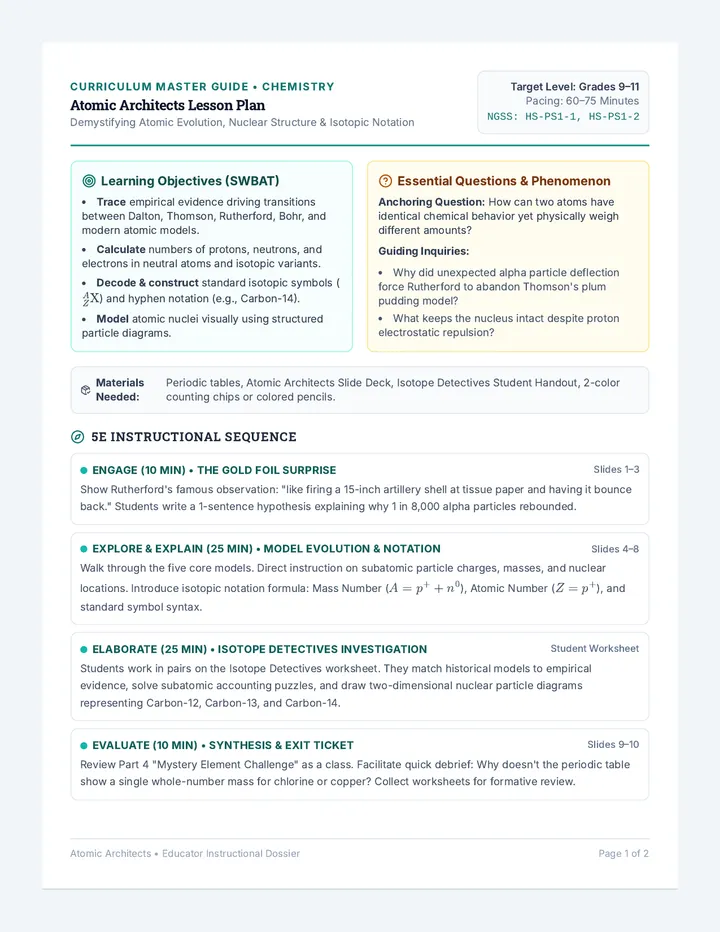
Atomic Architects Lesson Plan

Atomic Architects

A comprehensive chemistry lesson exploring the evolution of atomic models, subatomic particle accounting, isotope notation, and nuclear diagrams. Students investigate historical experiments from Thomson to Rutherford, master isotope notation drills, and solve quantitative atomic mass problems.

CB

Chloe Brown

13
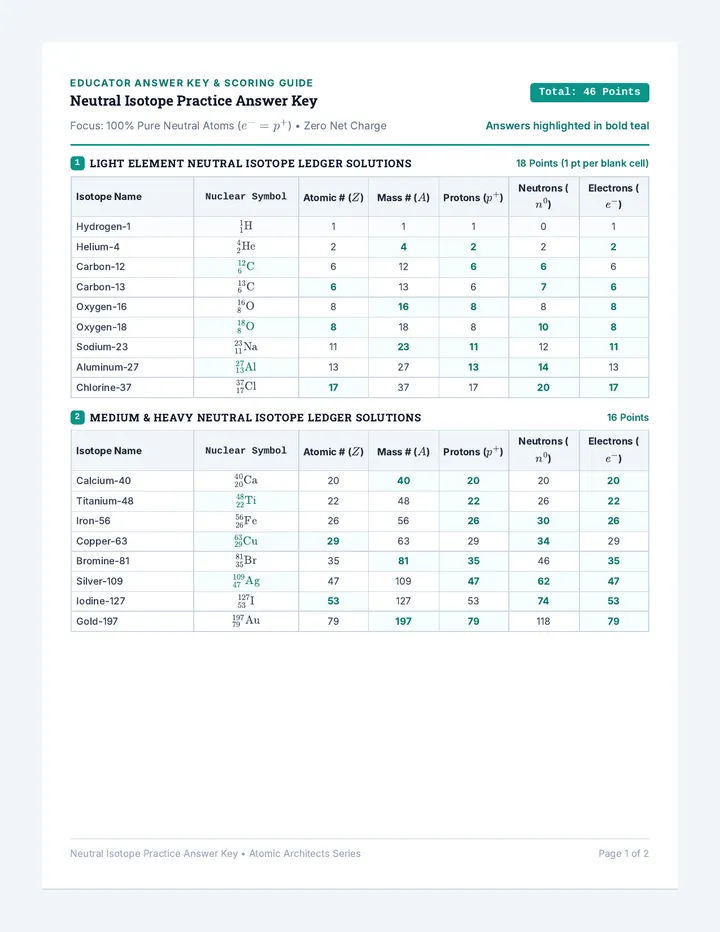
Neutral Isotope Practice Answer Key

Neutral Isotope Practice Answer Key

Comprehensive educator answer key for the Neutral Isotope Practice Worksheet, featuring fully filled subatomic tables, bold teal answer callouts, and scoring guidance.

CB

Chloe Brown

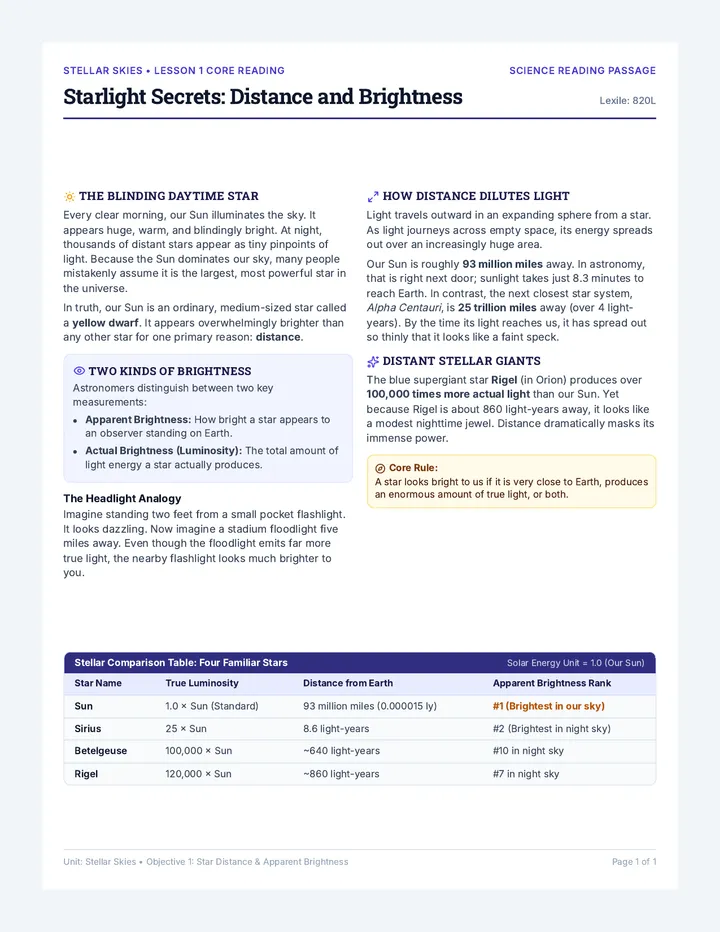
Starlight Secrets Reading Passage

Stellar Skies

A two-lesson science sequence investigating star brightness, apparent versus absolute luminosity, nightly sky rotation, and yearly seasonal constellations.

DB

Danny Brooks

8
Organelle Powerhouse Slides

Organelle Powerhouse

Dives deep into internal cell machinery using the cell factory analogy to investigate energy release, protein synthesis, transport, and waste breakdown. Students master mitochondria, ribosomes, rough ER, smooth ER, Golgi bodies, lysosomes, vacuoles, and chloroplasts.

CP

Carmen Pavlovsky

4
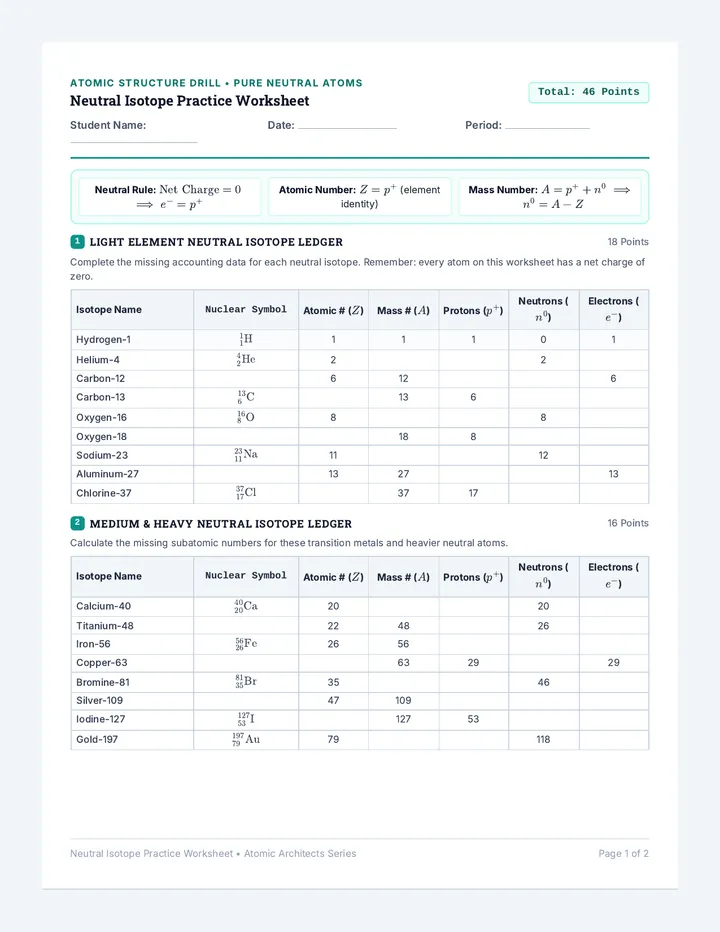
Neutral Isotope Practice Worksheet

Neutral Isotope Practice Worksheet

A 2-page practice worksheet dedicated exclusively to neutral isotope accounting, featuring extensive subatomic accounting tables for light, medium, and heavy neutral isotopes, mystery clues, and comparative isotopic sets.

CB

Chloe Brown

Helix Studio Slides

Candy Code Sequence

A multi-day competency-based biology sequence exploring DNA architecture, complementary base pairing, and semi-conservative replication through tactile candy modeling and evidence-based assessment.

TM

Teri Minami

6
Cell Foundations Slides

Cell Foundations

Explores the definition of life at the cellular level, the three tenets of cell theory, unicellular versus multicellular organisms, and key boundary structures including the cell membrane, cell wall, cytoplasm, and nucleus. Students analyze microscopic scale and fundamental cell structure.

CP

Carmen Pavlovsky

3
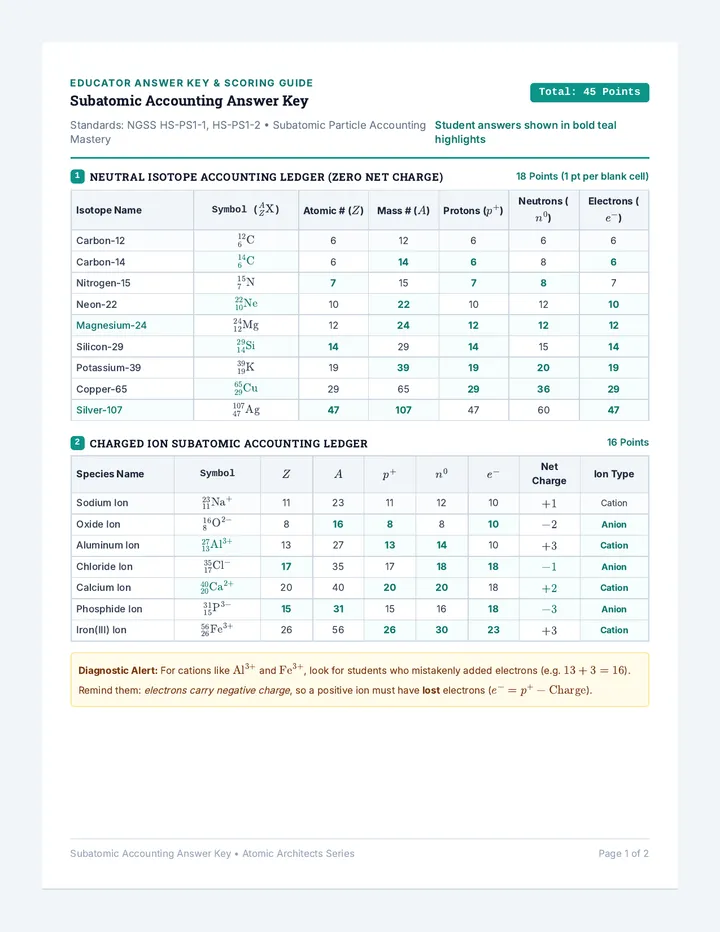
Subatomic Accounting Answer Key

Subatomic Accounting Answer Key

Complete educator answer key for the Subatomic Accounting Worksheet, featuring fully populated data tables, bold solution keys, point distributions, and diagnostic grading notes.

CB

Chloe Brown

Pest Spotters Slides

Bug Busters

A hands-on, highly visual science sequence designed for lower-literacy 5th grade learners to identify common nuisance insects, master foundational vocabulary, and discover pest habitats and attractants.

A

amy_oshea

9
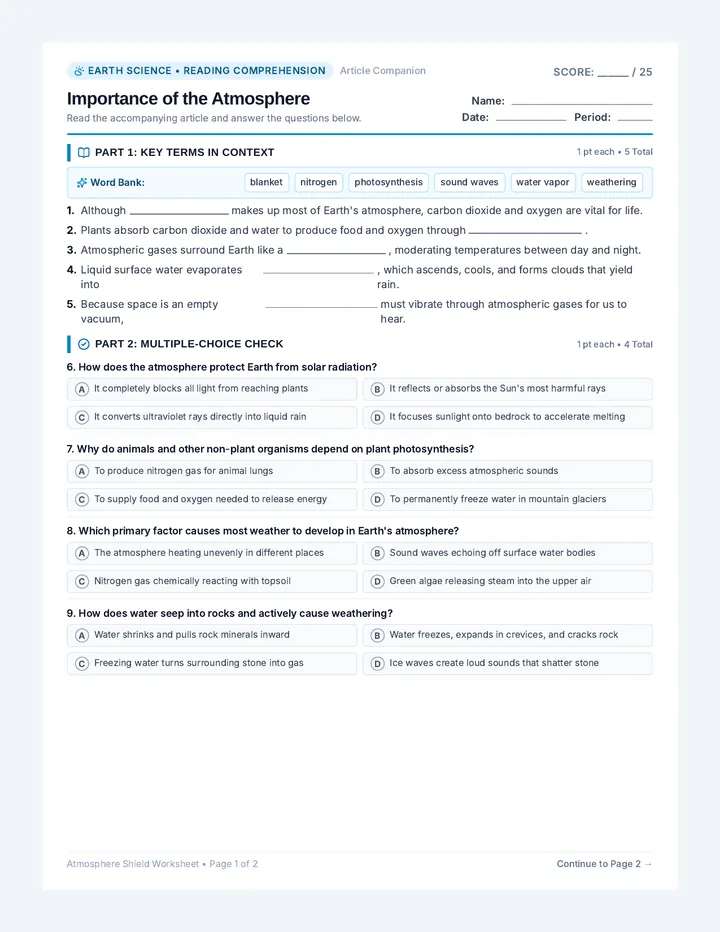
Atmosphere Shield Worksheet

Atmosphere Essentials

A comprehensive Earth science lesson exploring the protective functions, water cycle interactions, and ecological importance of Earth's atmosphere.

S

Shelby.Toll

2
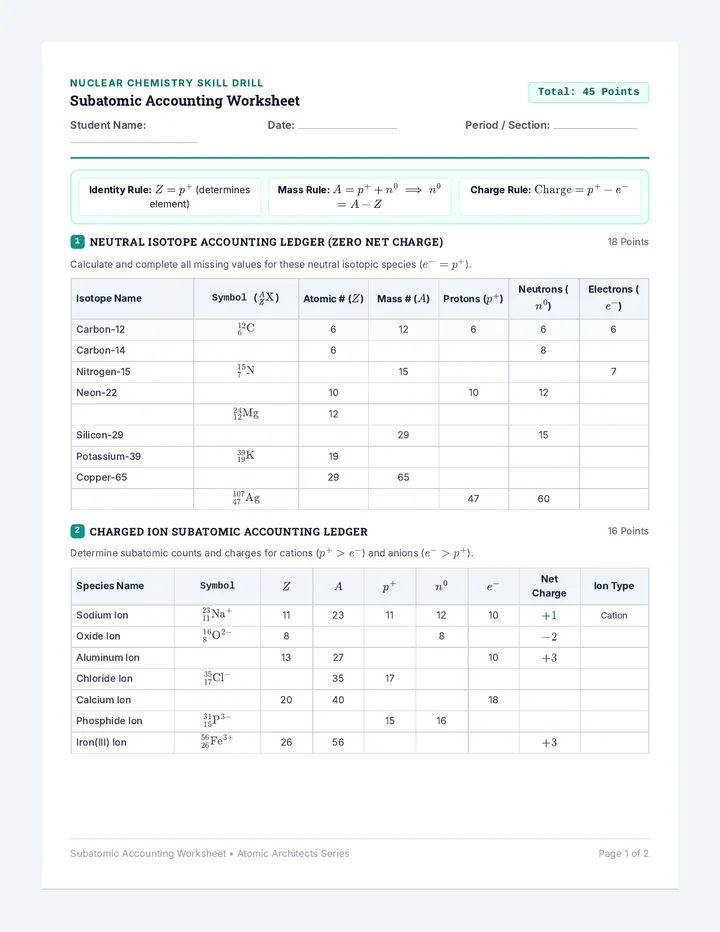
Subatomic Accounting Worksheet

Subatomic Accounting Worksheet

A comprehensive 2-page practice worksheet dedicated entirely to subatomic particle accounting drills, featuring neutral isotope tables, ion charge matrices, reverse-engineering puzzle ledgers, and comparative isotopic families.

CB

Chloe Brown