Hangar Notes Sheet Aerospace Test Lab
HANGAR NOTES SHEET
Topic: The Scientific Method & Flight Dynamics
NAME:
DATE:
PERIOD:
What is the Scientific Method?
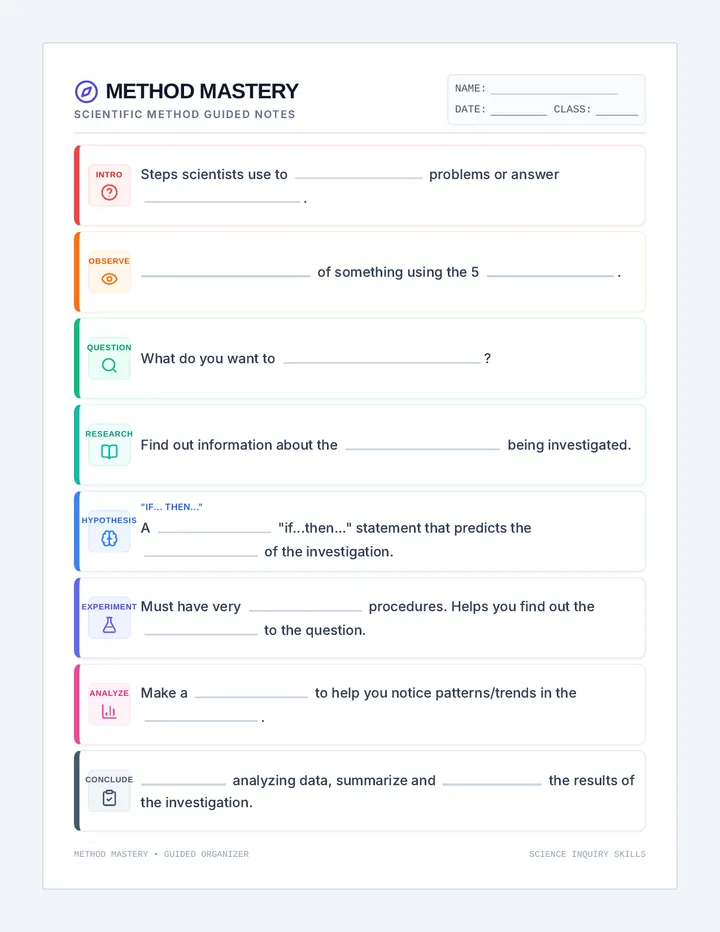
A systematic, logical approach that scientists and engineers use to solve problems, discover new knowledge, and test hypotheses through careful experimentation.
1 Observation & Question
An observation is gathered using your five senses.
We ask a testable question: How does wing shape affect how far a plane flies?
2 The Hypothesis
An educated guess or testable proposed explanation.
Format: IF X, THEN Y will happen, BECAUSE of reasoning.
3 Identifying Flight Variables
Variables are conditions or factors that can change during an experiment.
INDEPENDENT VARIABLE (IV)
The factor that the scientist changes. In our lab, this is the wing shape.
DEPENDENT VARIABLE (DV)
The factor that is measured; it changes in response to the IV. In our lab, this is flight distance.
CONTROLLED VARIABLES
The factors kept the same so the test is fair. Examples: paper type, launch height.
4 Experiment & Data
We must perform multiple trials for reliable data.
We record findings in a data table and make a graph.
5 Analysis & Conclusion
We look for trends in the results.
Our conclusion states if the hypothesis is supported or refuted.
Concept Verification
Why can we only change ONE independent variable at a time in a scientific experiment?
UNIT 1: METRIC SYSTEM & SCIENTIFIC INQUIRY PAGE 1 OF 1
Wing Shape Showdown Worksheet Aerospace Engineering Lab
WING SHAPE SHOWDOWN LAB
Topic: Investigating Variables & Aerodynamics
NAME:
DATE:
PERIOD:
Lab Objective
In this lab, you will act as aerospace flight test engineers. You will test how modifying a paper airplane's wing design (adding 1-inch upward-folded winglets ) impacts its total flight distance. You will practice identifying variables, recording data, and graphing.
Equipment
Blank Paper
Measuring Tape
Ruler & Pencil
The Flight Question
"How does folding 1-inch winglets on the wing tips of a paper airplane affect its average flight distance?"
1 Develop Your Hypothesis
Predict what will happen to the flight distance of the plane once winglets are folded.
IF we add 1-inch upward-folded winglets to the paper airplane,
THEN the average flight distance will (circle one: INCREASE / DECREASE / STAY THE SAME),
BECAUSE
2 Identify the Flight Variables
Identify variables carefully. We made these boxes extra large for your technical explanations!
Independent (IV)
The one design element that you deliberately alter.
Dependent (DV)
The outcome flight performance being measured.
Constants (CV)
List 2-3 factors you must keep identical.
FLIGHT PHYSICS SCIENTIFIC METHOD LAB PAGE 1 OF 2
Aerospace Engineering Lab FLIGHT DATA SHEET
3 Flight Procedure & Folding Guide
FOLDING REFERENCE: Construct the standard Basic Dart plane following instructions at foldnfly.com/1.html#Basic-Dart
Get one sheet of standard paper. Carefully construct your standard **Basic Dart** plane.
Mark a launch baseline on the ground. Do not step past this line when throwing.
Throw your plane 3 times (Control ). Measure and write down each distance in centimeters.
Modify your plane by folding the outer 1-inch of both wingtips straight up to create **winglets**.
Throw your modified plane 3 times (Experimental ) using identical force. Measure and record.
4 Engineering Flight Log
Plane Wing Style Trial 1 (cm) Trial 2 (cm) Trial 3 (cm) Average (cm) Control (Flat Wings) Experimental (1" Winglets)
5 Visualizing Flight Performance
Draw a high-contrast bar graph to compare both wing types.
150 cm 100 cm 50 cm 0 cm
DRAW BAR
Flat Wings
DRAW BAR
1" Winglets
FLIGHT DISTANCE →
6 Engineering Post-Flight Analysis
1. Based on your averages, did adding winglets increase or decrease the flight distance? Use data numbers!
2. Was your hypothesis supported or refuted? Summarize your evidence and flight learnings below.
FLIGHT PHYSICS SCIENTIFIC METHOD LAB PAGE 2 OF 2
Flight Physics Slides Aerospace Test Lab
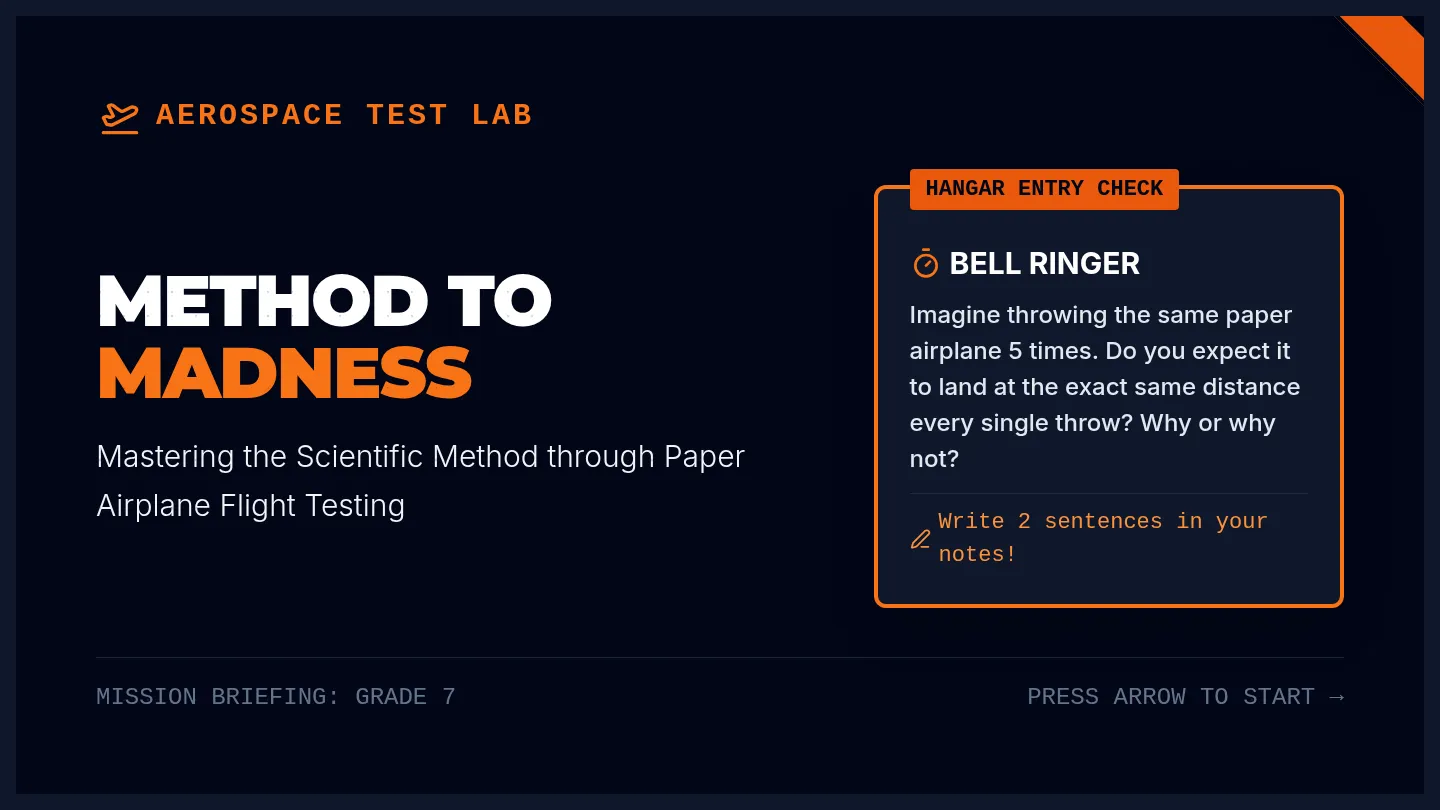
METHOD TO MADNESS
Mastering the Scientific Method through Paper Airplane Flight Testing
Hangar Entry Check
BELL RINGER
Imagine throwing the same paper airplane 5 times. Do you expect it to land at the exact same distance every single throw? Why or why not?
Write 2 sentences on your bell ringer sheet!
MISSION BRIEFING: GRADE 7
PRESS ARROW TO START →
Scientific Process
01 / 08
Systematic
Problem Solving
A structured, logical loop that engineers and researchers use to make discoveries, fix glitches, and optimize physical systems.
1. Question
Identify a problem through physical observation.
2. Test
Isolate variables and run controlled experiments.
3. Analyze
Review experimental facts to adjust conclusions.
FLIGHT CENTER PROTOCOL
Step 1: Focus
02 / 08
Observations vs. Inferences
Observe with Your Senses.
Question with Math.
Observations
Factual statements gathered strictly using your 5 senses.
Inferences
Logical explanations based on your observations.
Today's Test Question: "How does folding 1-inch winglets on the wing tips of a paper airplane affect its average flight distance?"
FLIGHT CENTER PROTOCOL
Step 2: Predict
03 / 08
The Engineering Hypothesis
A hypothesis is not a random guess. It is a precise prediction of cause-and-effect written in our strict scientific format:
CAUSE (IV)
IF...
"If we add 1-inch upward-folded winglets to the plane..."
MEASUREMENT (DV)
THEN...
"...then the average flight distance will increase..."
REASONING
BECAUSE...
"...because winglets reduce tip drag and improve lift stability."
FLIGHT CENTER PROTOCOL
Step 3: Variables
04 / 08
Control Your System
A fair experiment only tests ONE independent variable at a time.
CAUSE
Independent (IV)
The factor you change .
Hangar Notes Sheet Key Aerospace Test Lab — TEACHER KEY
HANGAR NOTES SHEET KEY
Topic: The Scientific Method & Flight Dynamics
TEACHER ANSWER KEY
DATE:
PERIOD:
What is the Scientific Method?
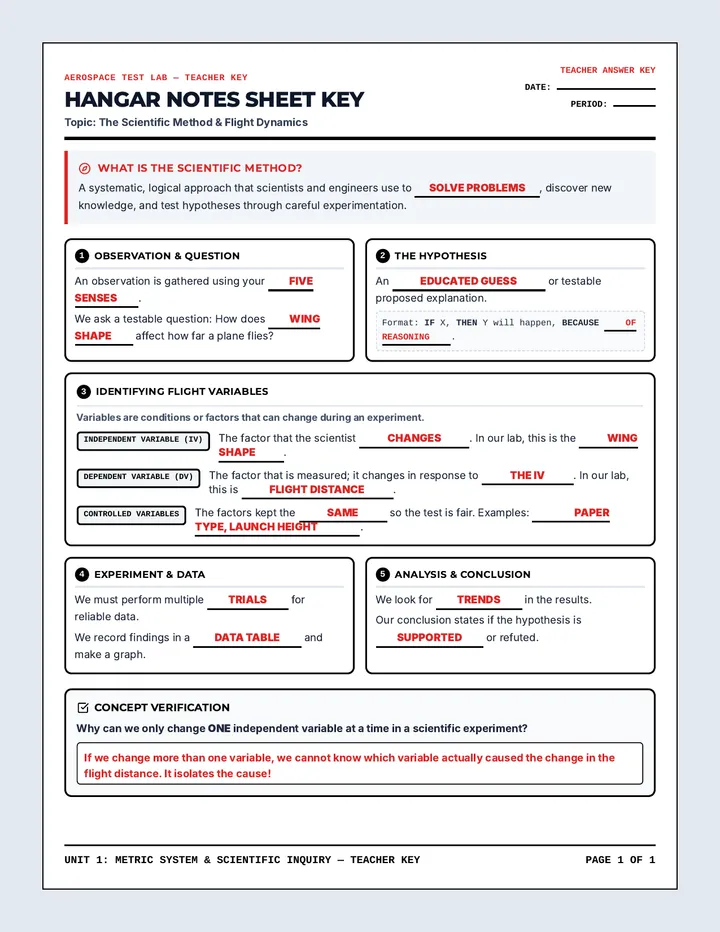
A systematic, logical approach that scientists and engineers use to SOLVE PROBLEMS, discover new knowledge, and test hypotheses through careful experimentation.
1 Observation & Question
An observation is gathered using your FIVE SENSES.
We ask a testable question: How does WING SHAPE affect how far a plane flies?
2 The Hypothesis
An EDUCATED GUESS or testable proposed explanation.
Format: IF X, THEN Y will happen, BECAUSE OF REASONING.
3 Identifying Flight Variables
Variables are conditions or factors that can change during an experiment.
INDEPENDENT VARIABLE (IV)
The factor that the scientist CHANGES. In our lab, this is the WING SHAPE.
DEPENDENT VARIABLE (DV)
The factor that is measured; it changes in response to THE IV. In our lab, this is FLIGHT DISTANCE.
CONTROLLED VARIABLES
The factors kept the SAME so the test is fair. Examples: PAPER TYPE, LAUNCH HEIGHT.
4 Experiment & Data
We must perform multiple TRIALS for reliable data.
We record findings in a DATA TABLE and make a graph.
5 Analysis & Conclusion
We look for TRENDS in the results.
Our conclusion states if the hypothesis is SUPPORTED or refuted.
Concept Verification
Why can we only change ONE independent variable at a time in a scientific experiment?
If we change more than one variable, we cannot know which variable actually caused the change in the flight distance. It isolates the cause!
UNIT 1: METRIC SYSTEM & SCIENTIFIC INQUIRY — TEACHER KEY PAGE 1 OF 1
Wing Shape Showdown Worksheet Key Aerospace Engineering Lab — TEACHER KEY
WING SHAPE SHOWDOWN LAB KEY
Topic: Investigating Variables & Aerodynamics
TEACHER ANSWER KEY
DATE:
PERIOD:
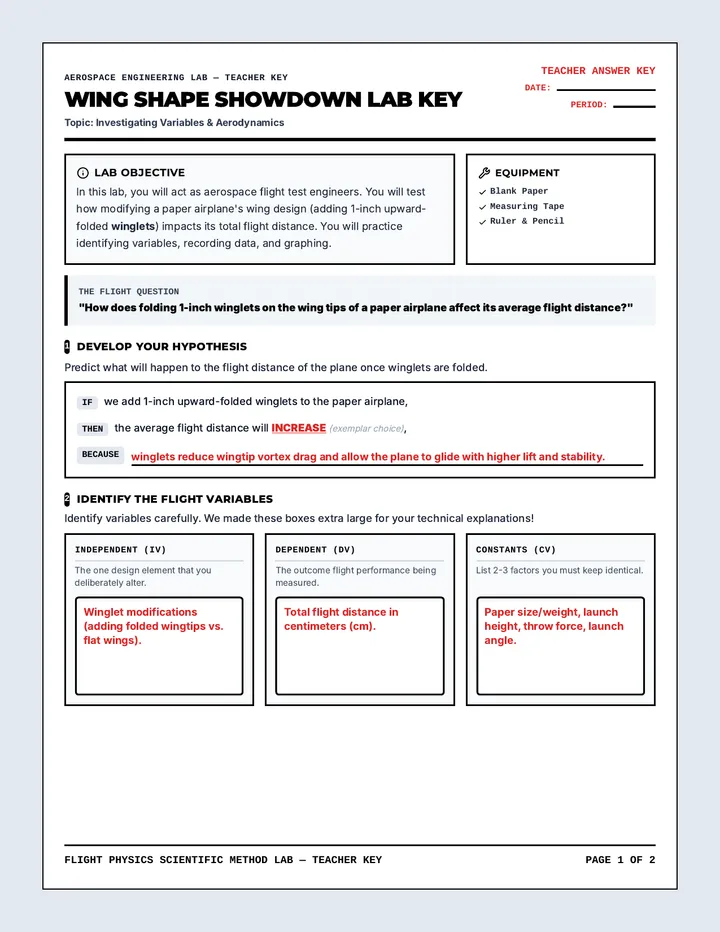
Lab Objective
In this lab, you will act as aerospace flight test engineers. You will test how modifying a paper airplane's wing design (adding 1-inch upward-folded winglets ) impacts its total flight distance. You will practice identifying variables, recording data, and graphing.
Equipment
Blank Paper
Measuring Tape
Ruler & Pencil
The Flight Question
"How does folding 1-inch winglets on the wing tips of a paper airplane affect its average flight distance?"
1 Develop Your Hypothesis
Predict what will happen to the flight distance of the plane once winglets are folded.
IF we add 1-inch upward-folded winglets to the paper airplane,
THEN the average flight distance will INCREASE (exemplar choice),
BECAUSE
winglets reduce wingtip vortex drag and allow the plane to glide with higher lift and stability.
2 Identify the Flight Variables
Identify variables carefully. We made these boxes extra large for your technical explanations!
Independent (IV)
The one design element that you deliberately alter.
Winglet modifications (adding folded wingtips vs. flat wings).
Dependent (DV)
The outcome flight performance being measured.
Total flight distance in centimeters (cm).
Constants (CV)
List 2-3 factors you must keep identical.
Paper size/weight, launch height, throw force, launch angle.
FLIGHT PHYSICS SCIENTIFIC METHOD LAB — TEACHER KEY PAGE 1 OF 2
Aerospace Engineering Lab — TEACHER KEY FLIGHT DATA SHEET
3 Flight Procedure & Folding Guide
FOLDING REFERENCE: Construct the standard Basic Dart plane following instructions at foldnfly.com/1.html#Basic-Dart
Get one sheet of standard paper. Carefully construct your standard **Basic Dart** plane.
Mark a launch baseline on the ground. Do not step past this line when throwing.
Throw your plane 3 times (Control ). Measure and write down each distance in centimeters.
Modify your plane by folding the outer 1-inch of both wingtips straight up to create **winglets**.