Matter Masters Teacher Guide Case File: #4-MATTER-01
Matter Masters
Teacher Facilitation Guide & Lesson Plan
Mission Briefing
Students act as "Matter Detectives" to investigate the observable properties of solids, liquids, and gases. Through hands-on inquiry, they test shape, volume, and compressibility, culminating in an analysis of tricky substances like sand (flowing solid), slime (non-Newtonian fluid), and steam (invisible gas).
Focus Standards: NGSS 5-PS1-1 / 2-PS1-1 (Adapted for Grade 4 mastery of observable properties and classification)
Lab Quick Stats
Grade Level: 4th GradeDuration: 60 MinutesGrouping: Teams of 3-4Format: Hands-on Lab & Slides
Updated: August 2026
Evidence Kit (Materials Needed)
Blocks/rocks (solid test)
Measuring cups & water (liquid test)
Plastic syringes (no needles!) or balloons
Tricky samples: Sand, Slime, hot water (steam)
Timeline of Investigation
10 MIN
Phase 1: The Hook — The Slime Mystery
Present a jar of slime to the class. Let it pour out, then slap it with a hand. Ask: "Is this a solid or a liquid? It flows like water, but breaks like a cookie if pulled quickly!" Define the goal: We must discover the official rules of matter to solve this.
20 MIN
Phase 2: Explore — Hands-On Evidence Gathering
Distribute the Matter Mission Worksheet . Have students work in groups to test three known substances: a wooden block (solid), water (liquid), and trapped air in a sealed syringe (gas). They test if each can change shape, change volume, or be squished (compressed).
15 MIN
Phase 3: Explain — Defining the Rules
Use the Matter Masters Slides to codify observations. Define: Solids (fixed shape/volume), Liquids (variable shape, fixed volume), and Gases (variable shape/volume, highly compressible). Explain particle movement (tightly packed, sliding, wildly bouncing).
MATTER DETECTIVE AGENCY • TEACHER GUIDE PAGE 1 OF 2
Case File: #4-MATTER-01
Mission Execution & Debrief
Phase 4: Elaborate, Evaluate, and Common Misconceptions
10 MIN
Phase 4: Elaborate — Tricky State Investigation
Challenge teams with the "Tricky Trio":Sand: It pours like a liquid! Detective truth: Each individual sand grain is solid, keeping its shape. Sand only pours because millions of tiny solids roll over each other. Slime: Non-Newtonian liquid. It flows slowly, but acts as a solid under force.Steam: Water vapor (gas) mixed with tiny droplets of condensed liquid water. Real water vapor is actually invisible!
05 MIN
Phase 5: Evaluate — Exit Ticket Check
Administer the State Shifter Exit Ticket to quickly gauge individual student mastery. Focus on whether they can transfer their knowledge of shape, volume, and compressibility to categorize a novel substance.
Critical Detective Misconceptions
"If it pours, it's a liquid." (e.g., Sand, sugar, salt). Emphasize scale. Zoom in on a single grain. It has a rigid, fixed shape!"Gases have no weight or mass." Prove this by weighing an empty balloon vs. an inflated balloon, or explaining air pressure."Steam is the white stuff you see." Visible steam is actually water droplets that have re-condensed into tiny liquid droplets in the cold air. True water vapor (gas) is 100% invisible!
Case Closed: Answer Key Cheat Sheet
State Shape Volume Compressible? Particle Action Solid Fixed / Rigid Fixed No Tightly packed, vibrating in place Liquid Takes container shape Fixed No (mostly) Close together, sliding past each other Gas Takes container shape Fills container Yes (High) Far apart, moving very fast and randomly
Tricky Classified: Sand = Solid (grains keep shape), Slime = Liquid/Non-Newtonian (flows but has strange properties), Steam/Vapor = Gas.
Supporting All Detectives
Scaffolding (ELL/IEP): Provide matching sentence stems for discussions ("I know this block is a solid because its shape..." ). Use kinesthetic model: have students stand in a tight group and vibrate (solid), slide around (liquid), or run safely around the room (gas).Extension (Gifted): Ask students to explain how thermal energy (adding heat) causes a solid block of ice to transform into liquid water, and then into water vapor.
MATTER DETECTIVE AGENCY • TEACHER GUIDE PAGE 2 OF 2
Matter Masters Slides CLASSIFIED
MISSION: STATES OF MATTER
CASE FILE: #4-MATTER-01
Matter Masters
Welcome, Matter Detectives! Today we investigate the secret behaviors of solids, liquids, and gases.
MATTER DETECTIVE ACADEMY SLIDE 1/6
Detective Case Rule #1 CASE FILE: #4-MATTER-01
The Solid Rule
Solids keep their own shape and own volume, no matter what container you put them in!
"A wooden block is still a block, whether it is in your hand, a cup, or a backpack!"
The Liquid Rule
Liquids change their shape to match the container, but keep their volume the same.
"100 mL of juice is still 100 mL, whether in a tall glass or spilled flat on the table."
MATTER DETECTIVE ACADEMY SLIDE 2/6
Detective Case Rule #2 CASE FILE: #4-MATTER-01
Squeezing Gas (Compressibility)
Unlike solids and liquids, Gases change both shape and volume. They will expand to fill any container or compress to squeeze into tiny spaces!
Why? Gas particles are super far apart! There is plenty of space to squish them closer together when you apply force.
Compressibility Test
Try to push down a syringe plugged at the end:
Water (Liquid) Saves its size - No Squish!
Air (Gas) Squishes easily!
Test this at Station 3 on your Worksheet!
MATTER DETECTIVE ACADEMY SLIDE 3/6
Classifying Tricky Matters CASE FILE: #4-MATTER-01
MYSTERY A: SAND
Does Sand Pour?
Sand pours like liquid, but it is a Solid ! Why? Each microscopic grain has a fixed, rigid shape.
Grains don't change shape!
MYSTERY B: SLIME
Solid or Liquid?
Slime flows slowly but breaks when snapped! It's a Non-Newtonian Fluid . It acts liquid normally, but solid under force!
Squeeze it to solidfy it!
MYSTERY C: STEAM
Can You See Gas?
True water vapor (gas) is invisible . The white wisps you see are actually micro droplets of liquid water condensing in air!
Real steam is 100% hidden!
MATTER DETECTIVE ACADEMY SLIDE 4/6
Investigation Brief CASE FILE: #4-MATTER-01
Your Mission
Grab your Matter Mission Worksheet and visit each lab station with your group.
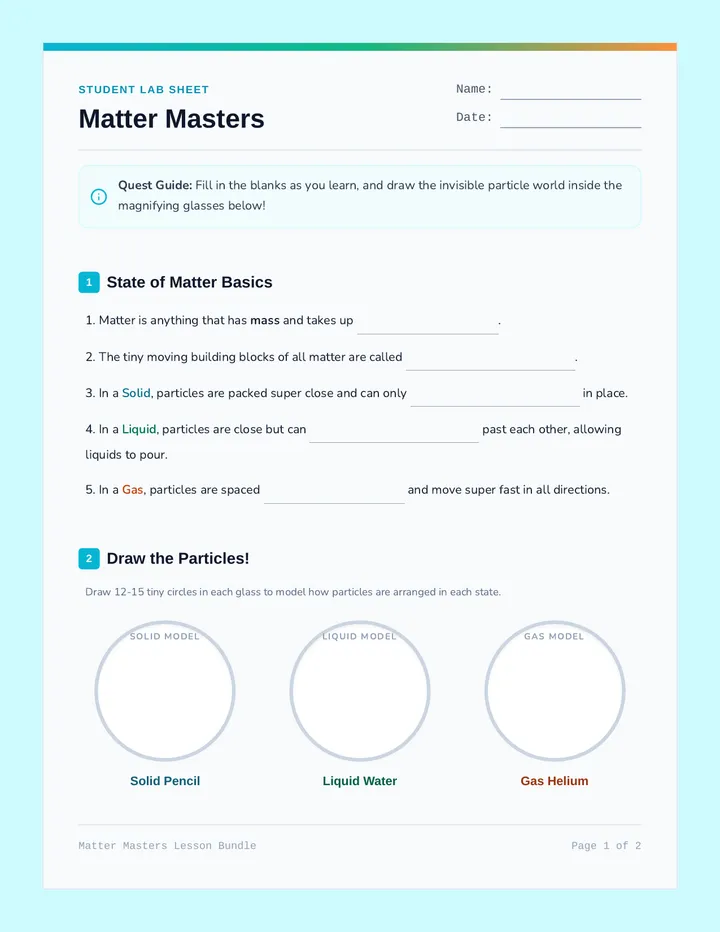
Matter Mission Worksheet Case File: #4-MATTER-01
Matter Detective Agency
OFFICIAL LAB RECORD
Agent Name:
Date:
Squad ID:
Active Case Objective
To discover the official laws of the States of Matter. Use physical tests at each lab station to fill out your diagnostic evidence chart below. Treat all materials with respect!
Part 1: Physical Evidence Chart
Test each test substance. In each column, write down your direct observations of its properties.
| Test Material | Shape Test
Preliminary Diagnostics
Based on your chart above, answer these detective check-ins:
1. Which state of matter was the only one that allowed you to visibly compress (squish) its volume? Why?
2. Describe what water does when poured from a cylinder container to a wide plate. Does it change shape, volume, or both?
MATTER DETECTIVE AGENCY • LAB WORKSHEET PAGE 1 OF 2
Case File: #4-MATTER-01
Part 2: The Tricky State Cases
Investigating Sand, Slime, and Steam
Mystery Case A: Sand Storm
The Clue: Sand can pour out of a bucket just like water! It seems to take the exact shape of its container. Because of this, some claim sand is a liquid.
Detective Analysis: Zoom in on a single, isolated grain of sand. Does it actually change shape? Explain whether sand is a solid or liquid.
Mystery Case B: The Slime Hazard
The Clue: Slime oozes and flows over tables. But if you hit it hard or pull it very quickly, it tears like paper or shatters!
Detective Analysis: What happens when you apply a quick, strong force to slime vs. when you let it rest? Write down your observations.
Mystery Case C: Ghostly Steam
The Clue: When a kettle boils, white wispy clouds form above the nozzle. Your teacher says water vapor (gas) is invisible.
Detective Analysis: If water vapor is an invisible gas, what is that white cloud you can actually see in the air? (Hint: Think about cold air chilling the hot vapor).
Final Check: State Definition Match
Write down the correct state of matter next to its microscopic rule:
Rule 1 Tightly packed particles vibrating in place.
State Shifter Exit Ticket Case File: #4-MATTER-01-EXIT
Case Closed Exit Ticket
CONFIDENTIAL
Detective Name:
Date:
Final Case Clearance Instruction
To complete your official investigation of matter and earn your Matter Master badge, answer the diagnostic questions below. Think carefully about shape, volume, and particle movement!
Case 1 The Spreading Gas
The Discovery: In a hidden storage vault, you locate a sealed metal tube. When unscrewed slightly, the substance inside instantly bursts out, spreads to fill the entire classroom volume, and can be squished back down into a tiny empty box.
Based on these properties, which state of matter is inside the tube? (Check exactly one)
A) Solid
B) Liquid
C) Gas
Case 2 Particle Positioning
A solid wooden block holds its rectangular shape forever when placed on a desk. A cup of liquid water immediately spreads flat across that same desk.
Explain what the tiny particles of a solid are doing compared to the tiny particles of a liquid to cause this difference.
Agent Self-Reflection: How confident are you with classifying tricky substances?
Not Sure Getting There Solved!
MATTER DETECTIVE AGENCY • EXIT TICKET PAGE 1 OF 1