Water Broadcast Planner
ON-AIR TELEPROMPTER
My Water News Script
Reporter: Complete the lines below. This is your exact script to read on camera!
Production Script
PAGE-1-ON-AIR
Anchor Name:
Air Date:
My Water Topic:
The Water Cycle 🌧️
Freshwater 💧
Water Pollution ⚠️
SCENE 1: THE OPENING
Camera Lens Focus
"Hello, water watchers! This is Reporter [My Name] reporting live from the amazing [My Location]!"
"Today, we are witnessing a very important water event! The big story here is all about [What is happening with the water?]."
"Right now, the water we are focusing on is in the form of a [liquid, solid ice, or gas vapor]!"
Smile and look up at the camera at the end of each sentence!
Turn the page to write the science details! Page 1 of 2
SCIENCE CORE
My Water News Script
Reporter: Complete the final science facts and sign off with energy!
Production Script
PAGE-2-ON-AIR
SCENE 2: THE WATER SCIENCE
Scroll Speed: Slow
"How does this water science event work? According to our research, this is happening because [Explain why or how this water event happens]."
"This water change is super important because it impacts [Which animals, plants, or people?] who depend on this water."
"But wait, here is a mind-blowing water fact! I discovered that [Write your cool, shocking water fact]!"
"As we watch this story, we should all remember to protect our water by [How can we help keep water clean or conserve it?]."
"This is Reporter [My Name] signing off for H2O Science News. Now, back to you in the studio!"
Speak with a loud, proud voice and hold up your props when you read!
Presenter's Rehearsal Checklist
Check off these skills as you practice with a partner before recording!
Eye Contact
Clear Voice
Props/Poster
Get ready for lights, camera, science! Page 2 of 2
News Anchor Slides
JUNIOR REPORTER BROADCAST ACADEMY LIVE FEED // SECTION: INTRO
On-Air Training
Lights, Camera,
Water Science!
How to design, write, and record an unforgettable news report on the water cycle, freshwater, or water pollution.
Signal Status
100% Water-Ready
Press Space or Arrow Keys to Advance
STEP 1: FINDING THE WATER SCOOP TOPIC SELECTION
Choose Your Water Beat
Water is everywhere, but it behaves in amazing ways. Which water theme will you report on?
The Water Cycle
Explore how water changes states: from clouds, to pouring rain, to invisible vapor rising in the sky!
Freshwater
Report on our planet's vital liquid: rushing rivers, deep clean lakes, or freezing glaciers where animals survive.
Water Pollution
Investigate real challenges like ocean plastics, chemicals in rivers, and active ways we can save our water!
Water Broadcast Toolkit Slide 2
STEP 2: THE BROADCAST STRUCTURE ANATOMY OF A NEWS STORY
Structure of a Water Report
Every broadcast on television follows three simple stages to keep viewers locked in!
PART 1
The Hook
Grab attention with an opening water line. Tell your audience where you are and why they must listen right now!
PART 2
The Water Science
Explain the facts clearly! Answer Who, What, Where, and Why. Detail how the water changes or supports life.
PART 3
The Sign-Off
End with a strong conservation takeaway or question. Sign off with your name and say, "Back to you in the studio!"
Water Broadcast Toolkit Slide 3
STEP 3: HOOKING VIEWERS EXPRESSIVE OPENERS
Hook Your Audience!
The first 10 seconds determine if people keep watching. Which opening hook fits your water theme?
Theme: Water Pollution
"Imagine taking a swim in your favorite local lake, only to find it completely covered in green slime and floating plastic!"
Theme: The Water Cycle
"Did you know that the exact drop of water landing on your tongue today might have been drunk by a Tyrannosaurus Rex?"
Water Broadcast Toolkit Slide 4
STEP 4: LIVE DELIVERIES PRESENTER PERFORMANCE
On-Camera Pro Tips
Behind every famous reporter is practice! Master these 3 camera habits to sound like a professional.
Focus on the Lens
Look directly at the camera lens! Think of the lens as your best friend sitting in the living room listening to your story.
Project Your Voice
Speak slowly and double your normal volume. Pretend you are speaking to the very back wall of the classroom!
Show and Tell
Hold up liquid jars, cycle charts, or animal toys when you speak. Point to them to guide your viewer's eyes!
Water Broadcast Toolkit Slide 5
MISSION BRIEFING YOUR NEXT STEPS
Your Water News Mission
Ready to make your television debut? Follow this action plan with your news crew!
1
Research & Plan
Complete Page 1 of your Water Broadcast Planner. Gather all your fluid science facts!
2
Fill Out Your Script
Write directly into your Page 2 script template. Read it out loud and use the rehearsal checklist.
3
Record & Present!
Turn on the camera, speak up, hold your water props high, and share your report with the class!
Water Broadcast Toolkit Slide 6
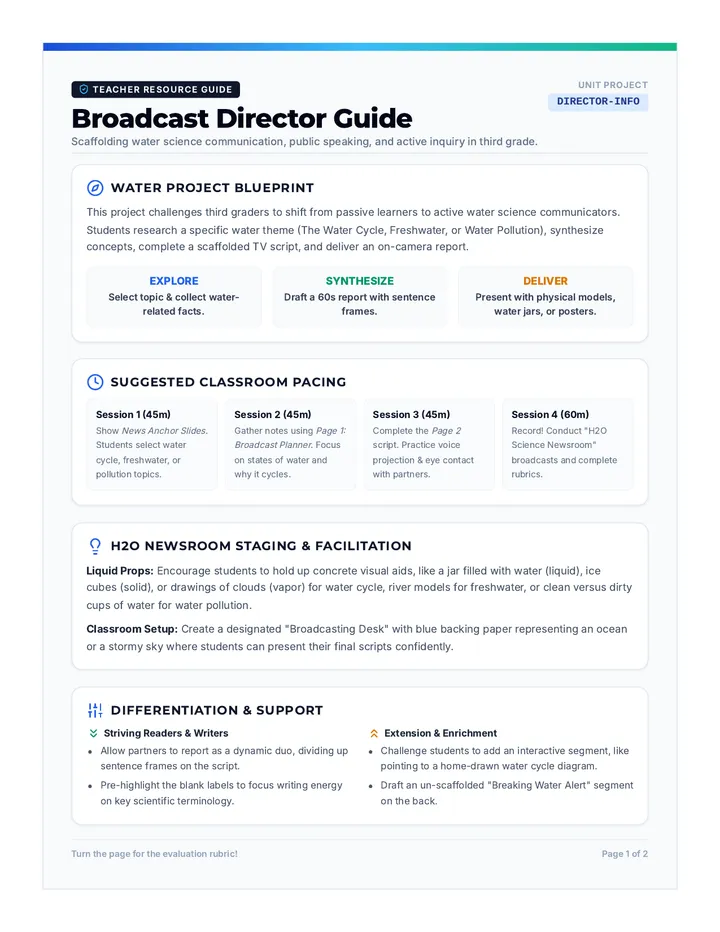
Broadcast Director Guide
Teacher Resource Guide
Broadcast Director Guide
Scaffolding water science communication, public speaking, and active inquiry in third grade.
Unit Project
DIRECTOR-INFO
Water Project Blueprint
This project challenges third graders to shift from passive learners to active water science communicators. Students research a specific water theme (The Water Cycle, Freshwater, or Water Pollution), synthesize concepts, complete a scaffolded TV script, and deliver an on-camera report.
Explore
Select topic & collect water-related facts.
Synthesize
Draft a 60s report with sentence frames.
Deliver
Present with physical models, water jars, or posters.
Suggested Classroom Pacing
Session 1 (45m)
Show News Anchor Slides. Students select water cycle, freshwater, or pollution topics.
Session 2 (45m)
Gather notes using Page 1: Broadcast Planner. Focus on states of water and why it cycles.
Session 3 (45m)
Complete the Page 2 script. Practice voice projection & eye contact with partners.
Session 4 (60m)
Record! Conduct "H2O Science Newsroom" broadcasts and complete rubrics.
H2O newsroom Staging & Facilitation
Liquid Props: Encourage students to hold up concrete visual aids, like a jar filled with water (liquid), ice cubes (solid), or drawings of clouds (vapor) for water cycle, river models for freshwater, or clean versus dirty cups of water for water pollution.
Classroom Setup: Create a designated "Broadcasting Desk" with blue backing paper representing an ocean or a stormy sky where students can present their final scripts confidently.
Differentiation & Support
Striving Readers & Writers
- Allow partners to report as a dynamic duo, dividing up sentence frames on the script.
- Pre-highlight the blank labels to focus writing energy on key scientific terminology.
Extension & Enrichment
- Challenge students to add an interactive segment, like pointing to a home-drawn water cycle diagram.
- Draft an un-scaffolded "Breaking Water Alert" segment on the back.
Turn the page for the evaluation rubric! Page 1 of 2
Grading & Feedback
Water Broadcast Rubric
Standards-aligned assessment criteria designed for third-grade speech and water science writing.
Assessment Tool