Rumble and Rupture Reading Passage USGS Field Log // Earth Sciences Division
Informational Text // Grade 8
Rumble and Rupture
The Mechanics, Measurement, and Dynamics of Earthquakes
Lexile Measure 1050L - 1100L
1 2 3 4 5 6 7 8 9 10 11 12 13 14 15 16 17 18 19 20 21 22 23 24 25 26 27 28 29 30 31 32 33
To human beings living on the surface of the Earth, the ground beneath our feet feels solid, unchanging, and permanent. However, beneath this deceptive calm lies a dynamic planet of immense, restless power. An earthquake is the sudden shaking of the Earth's surface caused by the rapid release of energy in the lithosphere—the crust and upper mantle. This release of energy generates waves that travel through the planet, rattling cities, reshaping landscapes, and revealing the violent forces that continuously sculpt our world.
The Mechanics of Stress: Plates and Faults
To understand what triggers these violent events, one must examine the theory of plate tectonics . The lithosphere is not a seamless shell; rather, it is fractured into roughly fifteen major and dozens of minor pieces called tectonic plates. Driven by convection currents circulating in the semi-fluid asthenosphere below, these massive slabs of rock drift at microscopic speeds—usually between two to ten centimeters per year, roughly the speed at which human fingernails grow.
As these plates jostle, they interact along their boundaries in three primary ways: they pull apart (divergent boundaries), collide (convergent boundaries), or slide past one another horizontally (transform boundaries). Because tectonic plates are composed of rough, jagged rock, they do not slide smoothly. Instead, friction causes them to lock together. While the boundaries remain jammed, the underlying tectonic forces continue to push the plates forward.
This state of immobility under pressure creates an immense accumulation of elastic strain . Like a rubber band being pulled tighter and tighter, the rocks store mechanical energy. When the accumulated stress finally overcomes the frictional resistance holding the rocks in place, a sudden, catastrophic failure occurs. The rocks rupture, and the plates snap forward. This point of initial rupture deep within the Earth is known as the hypocenter (or focus), while the point directly above it on the Earth's surface is designated as the epicenter .
Diagram 1: Anatomy of a Rupture
Stress builds up at the locked plate boundary (fault line). Once the threshold of friction is crossed, stored elastic strain is instantly released from the hypocenter , sending seismic waves outward. The most severe surface destruction typically radiates from the epicenter .
surface
Epicenter
Hypocenter
UNIT: DYNAMIC EARTH PAGE 1 OF 2 STUDENT RESOURCE
USGS Field Log // Earth Sciences Division
Part II: Waves, Scales, and Survival Class Reference Material
34 35 36 37 38 39 40 41 42 43 44 45 46 47 48 49 50 51 52 53 54 55 56 57 58 59 60 61 62 63 64 65 66
Measuring the Tremor: Waves and Scales
When a fault slips, the energy is radiated in the form of seismic waves . These are classified into two main categories: body waves (which travel through the Earth's interior) and surface waves (which roll along the Earth's surface). Body waves include fast-moving Primary (P) waves—longitudinal compression waves that squeeze and stretch rock—and Secondary (S) waves, which are transverse shear waves that move rock particles from side to side. Because S-waves cannot travel through liquids, they historically provided scientists with vital evidence that the Earth's outer core is entirely molten.
To record these vibrations, seismologists deploy ultra-sensitive instruments called seismographs . For decades, the public quantified earthquakes using the Richter Scale, developed in 1935. However, modern seismology has largely replaced it with the Moment Magnitude Scale (Mw) . Unlike the Richter Scale, which measures wave amplitude, the Moment Magnitude Scale calculates the absolute physical energy released by measuring the rock's rigidity, the fault's surface area, and the slip distance. Because it is logarithmic, each whole-number increase represents approximately 32 times more energy released.
While magnitude measures the energy source, the Modified Mercalli Intensity Scale assesses an earthquake’s local impact. Using Roman numerals from I (not felt) to XII (total destruction), the Mercalli scale is subjective, evaluating visible structural damage and human observations.
Global Geography and Human Safety
Earthquakes are not distributed randomly. Over ninety percent of seismic events take place along plate boundaries. The most infamous zone is the circum-Pacific belt, known colloquially as the Ring of Fire . This horseshoe-shaped path of active subduction zones and oceanic trenches generates both explosive volcanoes and devastating, deep-focus earthquakes.
Because humans cannot predict exactly when or where a fault will fail, survival depends on engineering and emergency preparedness. If caught in an earthquake, emergency services universally advocate for "Drop, Cover, and Hold On!" Dropping to the hands and knees prevents being thrown down; covering the head and neck under a sturdy table shields against falling debris (the primary cause of injury); and holding onto the shelter ensures it moves with you during violent shaking.
Magnitude vs. Intensity
Magnitude (Mw): Fixed number per earthquake. Measures exact mechanical energy at source.Intensity (Mercalli): Varies by location. Measures damage and shaking felt on the surface.
Critical Safety Measures
1. DROP Get low
2. COVER Cover head
3. HOLD Hold tight
UNIT: DYNAMIC EARTH PAGE 2 OF 2 STUDENT RESOURCE
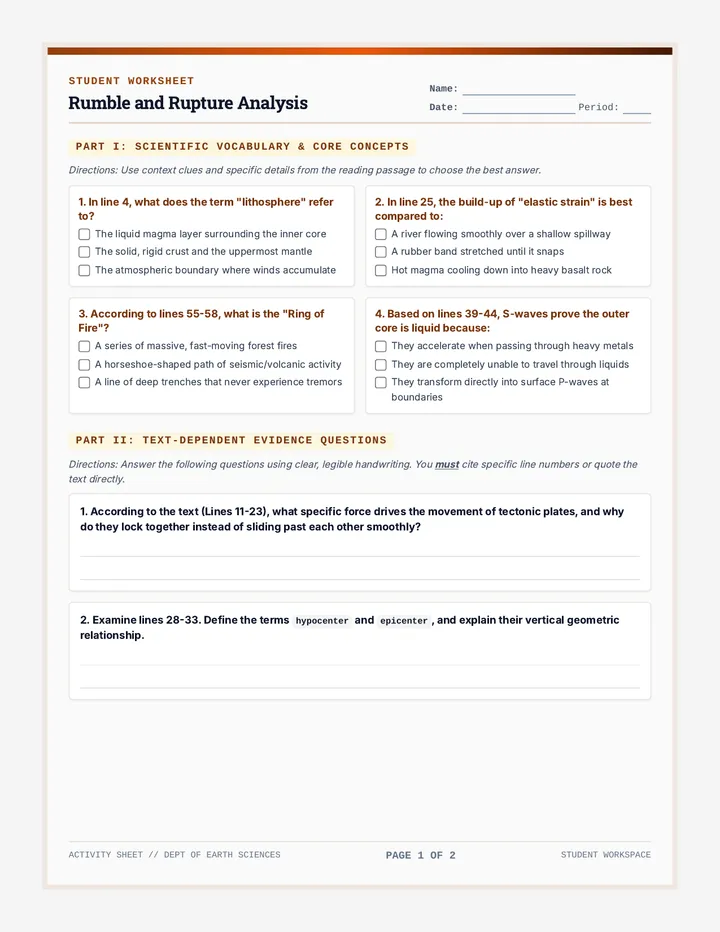
Rumble and Rupture Activity Sheet Student Worksheet
Rumble and Rupture Analysis
Name:
Date:
Period:
Part I: Scientific Vocabulary & Core Concepts
Directions: Use context clues and specific details from the reading passage to choose the best answer.
1. In line 4, what does the term "lithosphere" refer to?
The liquid magma layer surrounding the inner core The solid, rigid crust and the uppermost mantle The atmospheric boundary where winds accumulate
2. In line 25, the build-up of "elastic strain" is best compared to:
A river flowing smoothly over a shallow spillway A rubber band stretched until it snaps Hot magma cooling down into heavy basalt rock
3. According to lines 55-58, what is the "Ring of Fire"?
A series of massive, fast-moving forest fires A horseshoe-shaped path of seismic/volcanic activity A line of deep trenches that never experience tremors
4. Based on lines 39-44, S-waves prove the outer core is liquid because:
They accelerate when passing through heavy metals They are completely unable to travel through liquids They transform directly into surface P-waves at boundaries
Part II: Text-Dependent Evidence Questions
Directions: Answer the following questions using clear, legible handwriting. You must cite specific line numbers or quote the text directly.
1. According to the text (Lines 11-23), what specific force drives the movement of tectonic plates, and why do they lock together instead of sliding past each other smoothly?
2. Examine lines 28-33. Define the terms hypocenter and epicenter, and explain their vertical geometric relationship.
ACTIVITY SHEET // DEPT OF EARTH SCIENCES PAGE 1 OF 2 STUDENT WORKSPACE
Part III: Scale Comparison & Safety Analysis Name: ______________________
3. According to lines 44-52, how does the Moment Magnitude Scale (Mw) calculate an earthquake's strength differently than the older Richter Scale? Why do modern scientists prefer it?
Part III: Evaluative & Synthesis Writing
Directions: Read the scenario and prompt below. Synthesize information from across the entire text to build a well-reasoned argument.
Scenario: The Double Shaking Imagine a shallow, magnitude 6.2 earthquake strikes a highly prepared, modern city with strict building codes. Meanwhile, an identical magnitude 6.2 earthquake strikes a region with unreinforced brick buildings and poor infrastructure.
Prompt: Evaluate why a seismologist would report identical numbers on the Moment Magnitude Scale for both events, but an emergency manager would report vastly different Roman numerals on the Modified Mercalli Intensity Scale. Which scale is more valuable for deploying emergency rescue teams, and why? Support your claims with evidence.
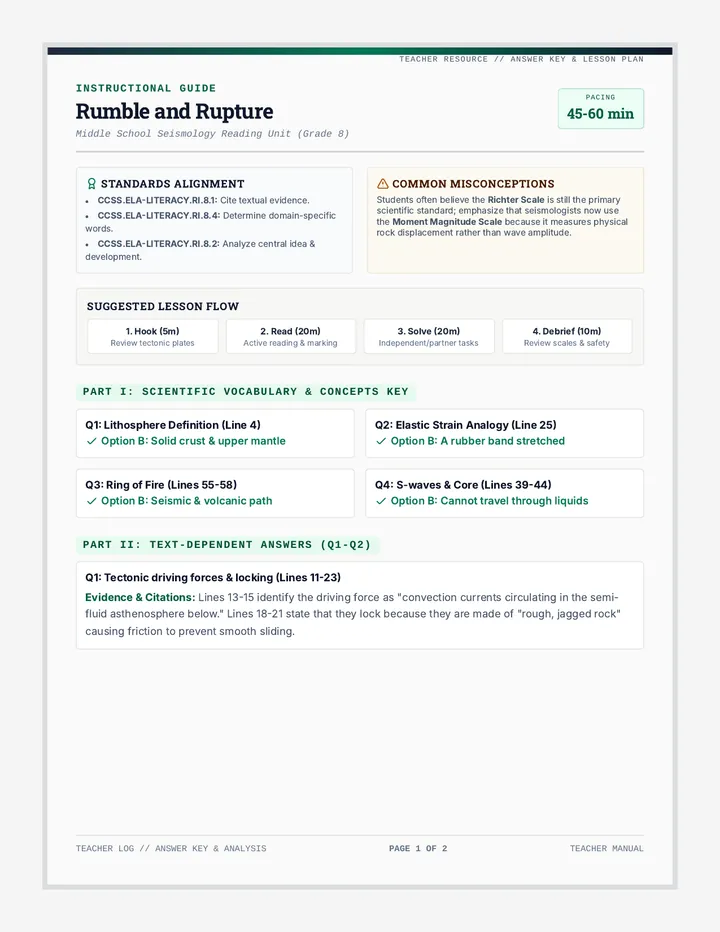
Rumble and Rupture Teacher Guide Teacher Resource // Answer Key & Lesson Plan
Instructional Guide
Rumble and Rupture
Middle School Seismology Reading Unit (Grade 8)
Pacing 45-60 min
Standards Alignment
CCSS.ELA-LITERACY.RI.8.1: Cite textual evidence.CCSS.ELA-LITERACY.RI.8.4: Determine domain-specific words.CCSS.ELA-LITERACY.RI.8.2: Analyze central idea & development.
Common Misconceptions
Students often believe the Richter Scale is still the primary scientific standard; emphasize that seismologists now use the Moment Magnitude Scale because it measures physical rock displacement rather than wave amplitude.
Suggested Lesson Flow
1. Hook (5m) Review tectonic plates
2. Read (20m) Active reading & marking
3. Solve (20m) Independent/partner tasks
4. Debrief (10m) Review scales & safety
Part I: Scientific Vocabulary & Concepts Key
Q1: Lithosphere Definition (Line 4)
Option B: Solid crust & upper mantle
Q2: Elastic Strain Analogy (Line 25)
Option B: A rubber band stretched
Q3: Ring of Fire (Lines 55-58)
Option B: Seismic & volcanic path
Q4: S-waves & Core (Lines 39-44)
Option B: Cannot travel through liquids
Part II: Text-Dependent Answers (Q1-Q2)
Q1: Tectonic driving forces & locking (Lines 11-23)
Evidence & Citations: Lines 13-15 identify the driving force as "convection currents circulating in the semi-fluid asthenosphere below." Lines 18-21 state that they lock because they are made of "rough, jagged rock" causing friction to prevent smooth sliding.
TEACHER LOG // ANSWER KEY & ANALYSIS PAGE 1 OF 2 TEACHER MANUAL
Part II (Continued) & Evaluative Task Classroom Management Guide
Q2: Hypocenter and epicenter geometry (Lines 28-33)
Evidence & Citations: The hypocenter (or focus) is the "initial rupture deep within the Earth" (lines 30-31). The epicenter is the "point directly above it on the Earth's surface" (lines 31-33). Geometrically, they are aligned along a vertical perpendicular line extending from the interior source up to the surface.
Q3: How does Moment Magnitude (Mw) differ from Richter, and why is it preferred?
Evidence & Citations: Lines 45-50 state that while the Richter Scale measures wave amplitude, the Moment Magnitude Scale (Mw) calculates "absolute physical energy released" by measuring rock rigidity, fault surface area, and slip distance. It is preferred because it is accurate for massive earthquakes.