Part 3 & 4: Antiparallel Modeling & Replication Mechanism Double Helix Decoders Lab
3
Competency: SCI.1.2 & SCI.1.3 Using Models
The two strands of DNA run antiparallel: one strand runs 5' to 3', while the opposing strand runs 3' to 5'. Complete the complementary strand below by filling in the correct base letters and the number of hydrogen bonds (2 between A-T; 3 between G-C).
Strand 1: 5' A T G C G A T C 3'
H-Bonds: (=) (=) (≡) (≡) (≡) (=) (=) (≡)
Strand 2: 3' [ ] [ ] [ ] [ ] [ ] [ ] [ ] [ ] 5'
Q5. Model Critique (SCI.1.2): What are two strengths and two limitations of using a flat, 2D "ladder" model to represent the 3D double helix structure of DNA?
4
Competency: SCI.3.1 Scientific Explanations
Enzyme 1: DNA Helicase
Unwinds the parent double helix and breaks the hydrogen bonds between base pairs, creating the Y-shaped replication fork.
Enzyme 2: DNA Polymerase
Synthesizes new daughter strands by matching free nucleotides to the exposed template strand and proofreads for base mismatches.
Q6. During DNA replication, why is each original parent strand able to serve as an exact template for the creation of a new daughter strand?
Q7. Scientific Explanation (Claim-Evidence-Reasoning • SCI.3.1): CER Format
Construct an explanation arguing why DNA replication is described as semi-conservative rather than conservative, and how this mechanism prevents genetic errors.
Competency Progress Check: SCI.1.2 (Model Development) • SCI.2.2 (Data Inference) • SCI.3.1 (CER Explanation) Target: Stage 8 / 10 Mastery
Biology 9 • Yellowhab Student Competency Framework Page 2 of 2
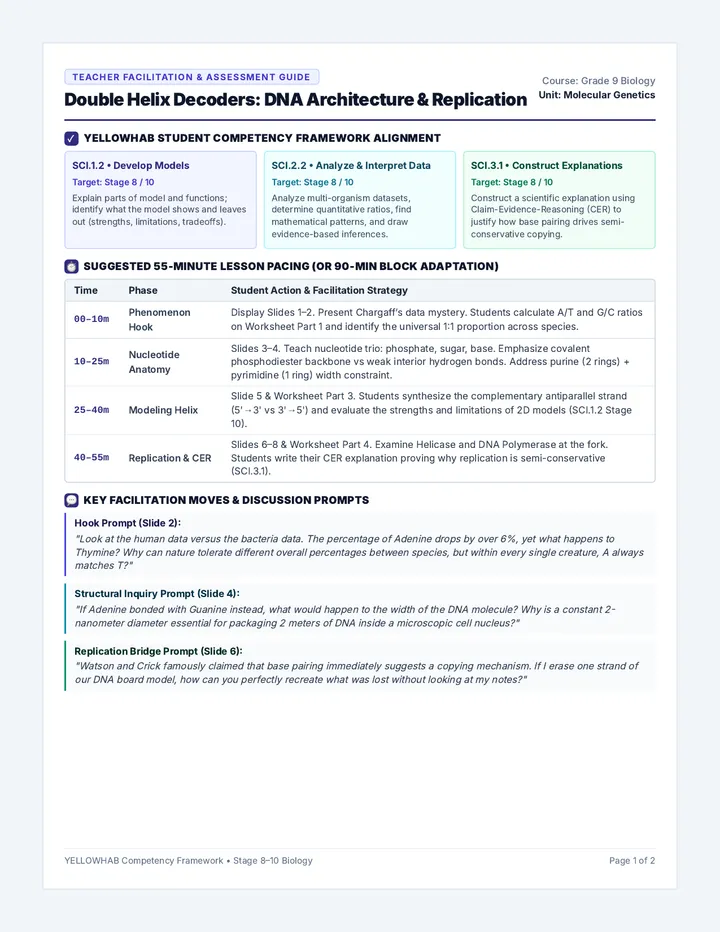
"Watson and Crick famously claimed that base pairing immediately suggests a copying mechanism. If I erase one strand of our DNA board model, how can you perfectly recreate what was lost without looking at my notes?"
YELLOWHAB Competency Framework • Stage 8–10 Biology Page 1 of 2
Complete Exemplar Answer Key & Differentiation Pathways Teacher Resource Key
Q1. Unknown Bacterium: Thymine = 15.2%; Guanine = 34.8%. Ratios: A/T = 1.00; G/C = 1.00. (Math: Total must sum to 100%: 15.2 + 15.2 + 34.8 + 34.8 = 100%).
Q2. Chargaff's Rule Claim (SCI.2.2): In double-stranded DNA, the percentage of Adenine is always approximately equal to Thymine (\(\%A = \%T\)), and Guanine is always equal to Cytosine (\(\%G = \%C\)). Total purines equal total pyrimidines (\(A+G = T+C\)).
Q3. Backbone vs Rung Bonds: Backbone is linked by strong covalent phosphodiester bonds that preserve sequence order. Interior base pairs are held by weak hydrogen bonds, allowing the strands to "unzip" easily during replication and transcription without tearing the structural backbone apart.
Q4. Purine + Pyrimidine Constraint: Purines have 2 rings; pyrimidines have 1 ring. To maintain a constant 2.0 nm width throughout the double helix, every rung must contain exactly 3 rings (2+1). Two purines (4 rings) would create bulges; two pyrimidines (2 rings) would pinch too narrow to form stable hydrogen bonds.
Strand 2 Complementary Sequence: 3' — T — A — C — G — C — T — A — G — 5'
Q5. Model Critique (SCI.1.2): Strengths: Clearly shows complementary base-pairing, antiparallel polarity (5' to 3'), and relative hydrogen bonding (2 vs 3). Limitations: Does not depict the 3D helical twist (10.5 bp/turn), minor/major grooves where proteins bind, or spatial bond angles.
Q6. Template Function: Because base-pairing is strictly complementary (A only with T; G only with C), the sequence on one strand unambiguously determines the sequence of the new opposite strand.
Q7. Exemplar CER Response (SCI.3.1):
Claim: DNA replication is semi-conservative because each newly formed double helix retains one intact original parent template strand and one newly assembled daughter strand.
Evidence: During replication, DNA Helicase separates the hydrogen bonds between parent strands, and DNA Polymerase synthesizes complementary daughter strands using free nucleotides.
Reasoning: By conserving one original parent strand in each daughter helix, the cell preserves the exact template sequence, drastically minimizing transcription and copying errors.
Misconception: Covalent Base Bonds
Students assume base pairs are glued by strong covalent bonds. Intervention: Explain that if bases were covalently linked, unzipping DNA would require massive thermal energy and destroy the cell.
Misconception: Conservative Copying
Students believe original DNA stays completely intact while a photocopied helix is made from scratch. Intervention: Reference the Meselson-Stahl isotope experiment where intermediate hybrid density proves semi-conservative splitting.
Support / Scaffolding (IEP / ELL)
Honors / Extension (Stage 10–12 Inquiry)
Double Helix Decoders • Yellowhab Competency-Based Biology Curriculum Page 2 of 2