Design Loop Study Guide
STEM Engineering Guide SPEC-EDP.01 // REV. 2026
Engineering Design Process
Core Concepts, Technical Vocabulary & Assessment Study Blueprint
Student:
Period:
Date:
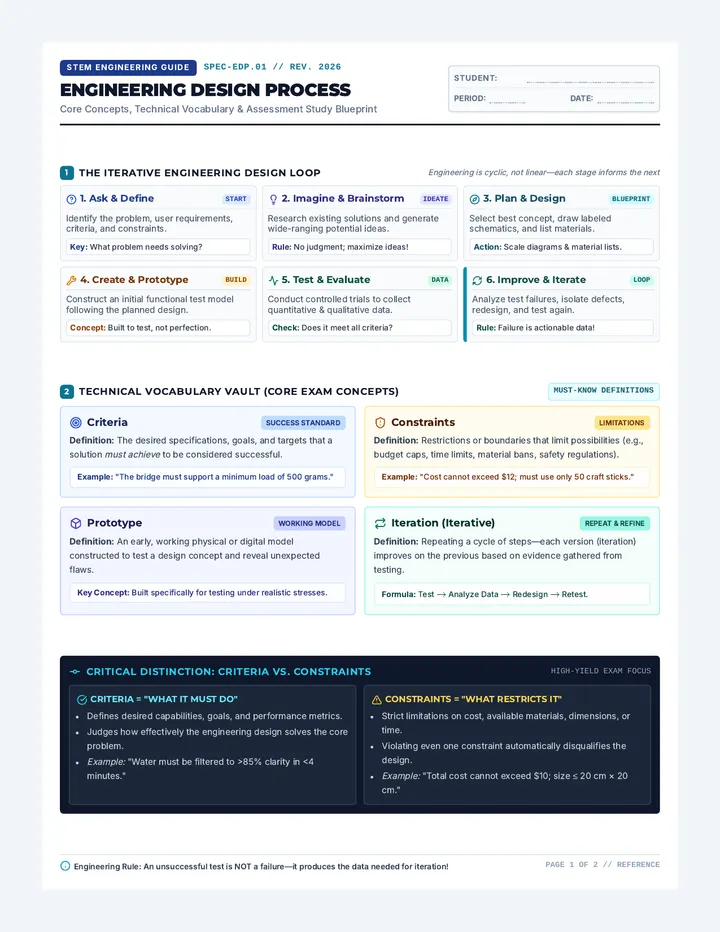
1 The Iterative Engineering Design Loop
Engineering is cyclic, not linear—each stage informs the next
1. Ask & Define START
Identify the problem, user requirements, criteria, and constraints.
Key: What problem needs solving?
2. Imagine & Brainstorm IDEATE
Research existing solutions and generate wide-ranging potential ideas.
Rule: No judgment; maximize ideas!
3. Plan & Design BLUEPRINT
Select best concept, draw labeled schematics, and list materials.
Action: Scale diagrams & material lists.
4. Create & Prototype BUILD
Construct an initial functional test model following the planned design.
Concept: Built to test, not perfection.
5. Test & Evaluate DATA
Conduct controlled trials to collect quantitative & qualitative data.
Check: Does it meet all criteria?
6. Improve & Iterate LOOP
Analyze test failures, isolate defects, redesign, and test again.
Rule: Failure is actionable data!
2 Technical Vocabulary Vault (Core Exam Concepts)
MUST-KNOW DEFINITIONS
Criteria Success Standard
Definition: The desired specifications, goals, and targets that a solution must achieve to be considered successful.
Example: "The bridge must support a minimum load of 500 grams."
Constraints Limitations
Definition: Restrictions or boundaries that limit possibilities (e.g., budget caps, time limits, material bans, safety regulations).
Example: "Cost cannot exceed $12; must use only 50 craft sticks."
Prototype Working Model
Definition: An early, working physical or digital model constructed to test a design concept and reveal unexpected flaws.
Key Concept: Built specifically for testing under realistic stresses.
Iteration (Iterative) Repeat & Refine
Definition: Repeating a cycle of steps—each version (iteration) improves on the previous based on evidence gathered from testing.
Formula: Test \(\rightarrow\) Analyze Data \(\rightarrow\) Redesign \(\rightarrow\) Retest.
Critical Distinction: Criteria vs. Constraints
HIGH-YIELD EXAM FOCUS
CRITERIA = "WHAT IT MUST DO"
- Defines desired capabilities, goals, and performance metrics.
- Judges how effectively the engineering design solves the core problem.
- Example: "Water must be filtered to >85% clarity in <4 minutes."
CONSTRAINTS = "WHAT RESTRICTS IT"
- Strict limitations on cost, available materials, dimensions, or time.
- Violating even one constraint automatically disqualifies the design.
- Example: "Total cost cannot exceed $10; size ≤ 20 cm × 20 cm."
Engineering Rule: An unsuccessful test is NOT a failure—it produces the data needed for iteration!
PAGE 1 OF 2 // REFERENCE
Assessment Prep & Practice
Engineering Design Process Review
Total Score _____ / 24 Pts
A Part 1: Vocabulary Match (4 Pts)
Write the letter of matching definition
1. Criteria
2. Constraint
3. Prototype
4. Iteration
A. An initial working model created to test out a solution concept.
B. Repeating a cycle of designing, testing, and revising to make improvements.
C. Specific performance standards or requirements a design must satisfy.
D. A limitation, boundary, or restriction placed on materials, time, or cost.
B Part 2: Criteria vs. Constraints Classification (6 Pts)
Mark [CR] for Criteria or [CO] for Constraint
Mission Scenario: Your team is designing a solar-powered lunar rover for a robotics competition.
Must travel at least 15 meters on loose sand.
Total rover mass must remain under 2.5 kg.
Must complete build before Friday at 3:00 PM.
Must transmit high-resolution surface video.
Total expenditure cannot exceed the $40 cap.
Must safely climb over an 8 cm rocky obstacle.
C Part 3: Scenario Analysis & Failure Iteration (8 Pts)
Analyze testing evidence and design next step
The Engineering Challenge: An eighth-grade team created a water filter (Prototype Alpha). Goal: Filter muddy water to reach at least 85% light clarity in under 4 minutes, with a budget cap of $10. During testing, Prototype Alpha filtered the sample in 2 minutes 15 seconds, but clarity reached only 52% because fine silt passed through the gravel filter layer. Total spent: $6.50.
1. What quantitative data did the team collect? Did Prototype Alpha meet all criteria? Explain.
2. Propose the team's next iteration (Prototype Beta). What specific adjustment should they make, and which EDP step are they returning to?
D Part 4: Concept Assessment (6 Pts)
Circle the best response
1. Why is the engineering design process represented as a cycle rather than a linear sequence?
A. Engineers must restart from step one whenever any component breaks.
B. Test results and failure data provide insight to redesign and refine solutions.
C. Products are never manufactured until twenty prototypes are completed.
D. Brainstorming can only occur after final evaluation has been completed.
2. During testing, a prototype robotic arm fails to grip objects securely. What is the team's best iterative next step?
A. Change the motor, claw shape, and code all at once before testing again.
B. Discard the robotic arm completely and pick a different project to build.
C. Adjust only the grip material or claw friction, then re-test to evaluate improvement.
D. Declare the prototype finished because failure means the project cannot work.
Engineering Design Process Study Guide © STEM Curriculum Series PAGE 2 OF 2 // ASSESSMENT PREPARATION
Design Loop Answer Key
Teacher Answer Key EDP-KEY.01 // DIAGNOSTIC GUIDE
Design Loop Study Guide: Answer Key
Complete Solutions, Item Rationales & Pedagogical Diagnostics
Master Point Breakdown
Part 1: 4 pts | Part 2: 6 pts
Part 3: 8 pts | Part 4: 6 pts
Total Available: 24 Pts
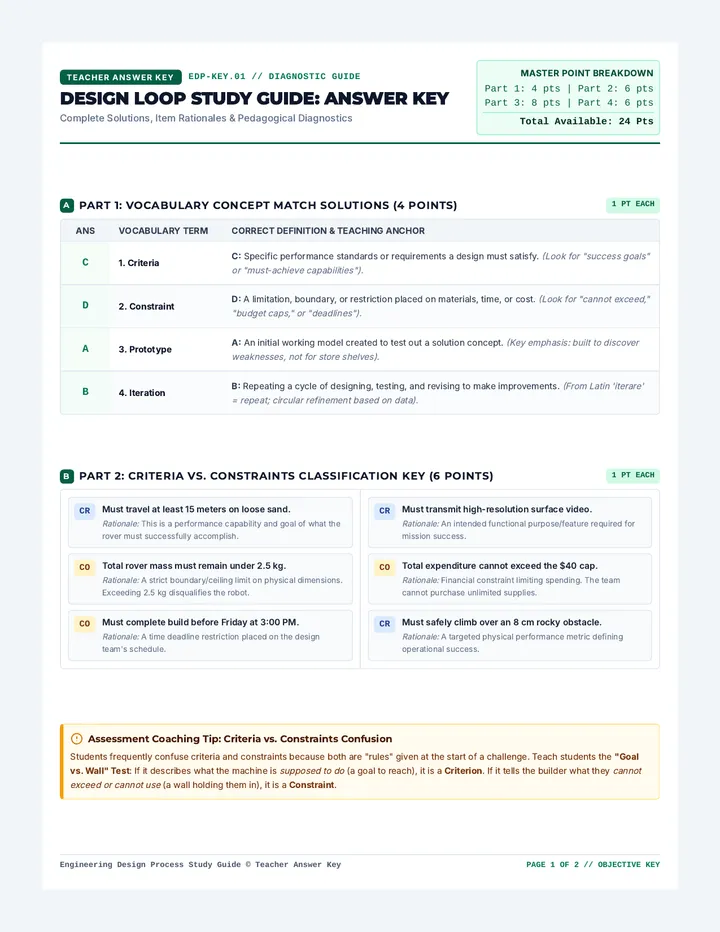
A Part 1: Vocabulary Concept Match Solutions (4 Points)
1 PT EACH
| Ans | Vocabulary Term | Correct Definition & Teaching Anchor |
|---|
| C | 1. Criteria | C: Specific performance standards or requirements a design must satisfy. (Look for "success goals" or "must-achieve capabilities"). |
| D | 2. Constraint | D: A limitation, boundary, or restriction placed on materials, time, or cost. (Look for "cannot exceed," "budget caps," or "deadlines"). |
| A | 3. Prototype | A: An initial working model created to test out a solution concept. (Key emphasis: built to discover weaknesses, not for store shelves). |
| B | 4. Iteration | B: Repeating a cycle of designing, testing, and revising to make improvements. (From Latin 'iterare' = repeat; circular refinement based on data). |
B Part 2: Criteria vs. Constraints Classification Key (6 Points)
1 PT EACH
CR
Must travel at least 15 meters on loose sand.
Rationale: This is a performance capability and goal of what the rover must successfully accomplish.
CO
Total rover mass must remain under 2.5 kg.
Rationale: A strict boundary/ceiling limit on physical dimensions. Exceeding 2.5 kg disqualifies the robot.
CO
Must complete build before Friday at 3:00 PM.
Rationale: A time deadline restriction placed on the design team's schedule.
CR
Must transmit high-resolution surface video.
Rationale: An intended functional purpose/feature required for mission success.
CO
Total expenditure cannot exceed the $40 cap.
Rationale: Financial constraint limiting spending. The team cannot purchase unlimited supplies.
CR
Must safely climb over an 8 cm rocky obstacle.
Rationale: A targeted physical performance metric defining operational success.