Circuit Breakdown Study GuideMCAT Physics • Circuits Circuit Breakdown Study Guide Node Potentials (\(V_1, V_A, V_2\)), Current Direction & AAMC Question Logic Name: _______________________ Date: ________________________ Uploaded Reference Problem \(V_1 = 8.0\text{ V},\; V_2 = 1.0\text{ V},\; R_1 = R_2 = R_3 = 1.0\text{ k}\Omega\) What Is a Node? A node is any continuous wire or junction connecting components with no resistor or battery in between. Every point on the same node has the exact same voltage (e.g., all of the purple wire at Point A is at \(3.0\text{ V}\)). Why Does Voltage Drop (Not Current)? Current (\(I\)) does NOT drop across a resistor—the same \(5.0\text{ mA}\) enters and exits \(R_1\). What drops is voltage (\(V\)): charges lose potential energy (as heat) pushing through resistance (\(\Delta V = IR\)). 1. Difference Between \(V_1\), \(V_A\), and \(V_2\) \(V_1\) (Main Battery = \(8.0\text{ V}\)) The stronger power source (discharging). It pumps current out of its \(+\) terminal and sets the top-left node to \(8.0\text{ V}\) above ground. \(V_A\) (Node A = \(3.0\text{ V}\)) Not a battery—it's the junction potential left after voltage drops across \(R_1\): \(V_A = 8.0 - (5.0\text{ mA})(1.0\text{ k}\Omega) = \mathbf{3.0\text{ V}}\). \(V_2\) (Battery 2 = \(1.0\text{ V}\)) A weaker battery pinning the top-right node at \(1.0\text{ V}\). Because \(V_A > V_2\), current enters its \(+\) terminal (charging). 2. How Do We Know \(V_A\) Is Higher Than \(V_2\)? 1 Conservation of Charge at Point A (KCL): \(5.0\text{ mA}\) flows into Point A from \(R_1\), and \(3.0\text{ mA}\) flows out downward through \(R_3\). Since current cannot vanish, the remaining \(5.0 - 3.0 = \mathbf{2.0\text{ mA}}\) must flow out of Point A to the right through \(R_2\). 2 Golden Rule of Resistors: Conventional current always flows from higher potential to lower potential through a resistor (like water flowing downhill). 3 Connect Direction to Voltage: Because current leaves Point A and travels toward \(V_2\) through \(R_2\), \(V_A\) must be higher than \(V_2\). Numerically: \(V_2 = V_A - I_{R_2}R_2 = 3.0\text{ V} - (2.0\text{ mA})(1.0\text{ k}\Omega) = 1.0\text{ V}\). Key Takeaway: \(\text{mA} \times \text{k}\Omega = \text{V}\) (milli and kilo cancel!) Page 1 of 3 3. Answer Choice Breakdown & Practice KCL & KVL Logic Use Kirchhoff's Current Law (\(\sum I_{\text{in}} = \sum I_{\text{out}}\)) at Point A to eliminate wrong choices in seconds: Choice A • CORRECT \(V_A > V_2\), \(2.0\text{ mA}\) Current leaves A through \(R_2\) (\(V_A > V_2\)). Total current in (\(5.0\text{ mA}\)) equals total current out (\(3.0\text{ mA} + 2.0\text{ mA} = 5.0\text{ mA}\)). Choice C • TRAP \(V_A > V_2\), \(8.0\text{ mA}\) Adds \(5.0 + 3.0 = 8.0\text{ mA}\) instead of subtracting. That would mean \(3.0 + 8.0 = 11.0\text{ mA}\) leaves a node fed by only \(5.0\text{ mA}\). Choice B • TRAP \(V_2 > V_A\), \(2.0\text{ mA}\) Reverses the voltage comparison. If \(V_2 > V_A\), \(2.0\text{ mA}\) would enter A from the right, so \(5.0 + 2.0 = 7.0\text{ mA}\) would have to leave via \(R_3\). Choice D • TRAP \(V_2 > V_A\), \(8.0\text{ mA}\) Wrong magnitude AND wrong direction. \(5.0 + 8.0 = 13.0\text{ mA}\) would arrive at Point A while only \(3.0\text{ mA}\) leaves—impossible! 4. Practice: Kirchhoff's Junction & Loop Rules Problem 1 (KCL Junction): At Junction P, \(6.0\text{ mA}\) enters from the left and \(2.5\text{ mA}\) leaves downward through a resistor. What is the magnitude and direction of the current in the right branch? Problem 2 (Current Direction & Potential): A current of \(4.0\text{ mA}\) flows from Node X (\(V_X = 10.0\text{ V}\)) through a \(1.5\text{ k}\Omega\) resistor to Node Y. Calculate \(V_Y\) and state which node has higher potential. Problem 3 (KVL Loop Check): In the uploaded circuit, trace the left loop clockwise starting at Ground (\(0\text{ V}\)): \(+8.0\text{ V}\) across \(V_1\), \(-5.0\text{ V}\) across \(R_1\). What must the voltage drop across \(R_3\) be for the loop to return to \(0\text{ V}\)? Tip: Always label node voltages relative to ground before solving branches. Page 2 of 3 5. High-Yield MCAT Circuit Cheat Sheet High-Yield Review Ohm's Law & Power Ohm's Law: \(\Delta V = I R\) (voltage drop across a resistor). Power: \(P = I V = I^2 R = \dfrac{V^2}{R}\) (units: Watts, \(\text{J/s}\)). Unit Shortcut: \(\text{mA} \times \text{k}\Omega = \text{V}\) and \(\text{mA} \times \text{V} = \text{mW}\). Brightness: Bulb brightness depends on Power (\(P\)), not just current or voltage alone. Series, Parallel & \(R_{\text{eq}}\) What is \(R_{\text{eq}}\)? Equivalent Resistance—the single combined resistance of multiple resistors acting together. Series (1 path): Same \(I\); \(R_{\text{eq}} = R_1 + R_2 + \dots\) (adding resistors increases \(R_{\text{eq}}\)). Parallel (split paths): Same \(\Delta V\); \(\dfrac{1}{R_{\text{eq}}} = \dfrac{1}{R_1} + \dfrac{1}{R_2} + \dots\) (adding branches decreases \(R_{\text{eq}}\)). Kirchhoff's Two Laws Junction Rule (KCL): \(\sum I = 0\) (algebraic sum of currents at a node is zero; \(\sum I_{\text{in}} = \sum I_{\text{out}}\), Conservation of Charge). Loop Rule (KVL): \(\sum \Delta V_{\text{loop}} = 0\) (Conservation of Energy). Walk any closed loop back to start—rises (\(+\)) and drops (\(-\)) sum to \(0\). Example (Left Loop): \(+8.0\text{ V}\,(V_1) - 5.0\text{ V}\,(R_1) - 3.0\text{ V}\,(R_3) = 0\). Batteries: Charging vs. Discharging Discharging (e.g., \(V_1\)): Current exits the \(+\) terminal. Terminal voltage \(V_{\text{term}} = \mathcal{E} - Ir_{\text{int}}\). Charging (e.g., \(V_2\)): Stronger battery forces current into the \(+\) terminal. \(V_{\text{term}} = \mathcal{E} + Ir_{\text{int}}\). Ideal Battery: Internal resistance \(r_{\text{int}} = 0\), so \(V_{\text{term}} = \mathcal{E}\). Universal Node Voltage Formula (Nodal Analysis) Assuming all currents leave the node (\(\sum I_{\text{out}} = 0\)), each branch gives \(\dfrac{V_{\text{node}} - V_i}{R_i}\) (any branch where current actually enters simply turns out negative): \(V_{\text{node}} = \dfrac{\sum (V_i / R_i)}{\sum (1 / R_i)}\) Equal-Resistor Shortcut: Whenever all connected resistors are equal (\(R_1 = R_2 = \dots = R_n\)), \(V_{\text{node}}\) is simply the average \(\dfrac{V_1 + V_2 + \dots + V_n}{n}\). Top 4 AAMC Circuit Traps to Avoid Trap 1: Node \(V\) vs. Drop \(\Delta V\) \(V_A = 3.0\text{ V}\) is the potential at Point A relative to ground—not the voltage drop across \(R_1\) (\(5.0\text{ V}\))! Trap 2: Current vs. Electrons Conventional current (\(I\)) flows from high \(V\) to low \(V\). Electrons flow the opposite way (low \(V\) to high \(V\)). Trap 3: Parallel Resistance Intuition Adding a resistor in parallel always lowers total \(R_{\text{eq}}\) and increases total current drawn from the battery. Trap 4: Meters in Circuits Ammeters go in series (near-zero \(R\)). Voltmeters go in parallel (near-infinite \(R\)). Quick Check: Practice Problem Answers — P1: \(3.5\text{ mA}\) right; P2: \(V_Y = 4.0\text{ V}\), \(V_X > V_Y\); P3: \(3.0\text{ V}\). Page 3 of 3
Circuit Fundamentals SlidesMCAT Physics • Circuits Mini-Lesson Circuit Fundamentals & Node Logic Decoding \(V_A\), \(V\), and \(V_2\), Kirchhoff's Laws, Current Direction, and High-Yield AAMC Traps Node Potentials Kirchhoff's Laws High-Yield Traps What Do \(V\), \(V_A\), and \(V_2\) Mean? 1 / 6 \(V\) (Potential) Electric potential at a node (connected wire) relative to Ground (\(0\text{ V}\)). \(V_1 = 8.0\text{ V}\) sets top-left wire to \(8.0\text{ V}\). \(V_A\) (Node A) Potential at Node A after voltage drops across \(R_1\) (current stays \(5.0\text{ mA}\)). \(V_A = 8.0 - 5.0 = 3.0\text{ V}\) \(V_2\) (Battery 2) Second battery pinning the top-right node at \(1.0\text{ V}\). Current enters \(+\) plate \(\Rightarrow\) Charging! Node: Any wire/junction at one constant voltage. Across a resistor, voltage drops (energy lost as heat), while current stays the same! Current Direction & Potential 2 / 6 The Golden Rule Conventional current (\(I\)) always flows through a resistor from: High \(V\) \(\longrightarrow\) Low \(V\) Ohm's Law Across a Resistor \[V_{\text{start}} - V_{\text{end}} = I \cdot R\] If current flows from A to B, then \(V_A > V_B\). MCAT Unit Shortcut \[\text{mA} \times \text{k}\Omega = \text{Volts (V)}\] Example: \(2.0\text{ mA} \times 1.0\text{ k}\Omega = 2.0\text{ V}\) Watch out: Electrons (\(e^-\)) move opposite to conventional current (from low \(V\) to high \(V\)). Kirchhoff's Two Laws 3 / 6 1. Junction Rule (KCL) \[\sum I_{\text{in}} = \sum I_{\text{out}}\] • Based on Conservation of Charge. • Charge cannot pile up or vanish at a node. • At Point A: \(5.0\text{ mA in} = 3.0 + 2.0\text{ mA out}\). 2. Loop Rule (KVL) \[\sum \Delta V_{\text{loop}} = 0\] • Based on Conservation of Energy. • Any closed path returns to the same potential. • Left loop: \(+8.0\text{ V} - 5.0\text{ V} - 3.0\text{ V} = 0\). Strategy: Always apply KCL at junctions first to find missing currents and directions! Diagram Walkthrough: Why \(V_A > V_2\) 4 / 6 Step 1: Check Junction A (KCL) \(5.0\text{ mA}\) enters from \(R_1\); \(3.0\text{ mA}\) exits down \(R_3\). Step 2: Find \(R_2\) Current \(5.0 - 3.0 = \mathbf{2.0\text{ mA}}\) must leave A through \(R_2\). Step 3: Compare \(V_A\) and \(V_2\) Current flows high \(\rightarrow\) low \(V\), so \(V_A\) (\(3.0\text{ V}\)) > \(V_2\) (\(1.0\text{ V}\)). Check with Ohm's Law: \(V_2 = V_A - (2.0\text{ mA})(1.0\text{ k}\Omega) = 3.0\text{ V} - 2.0\text{ V} = 1.0\text{ V}\). Cracking the Answer Choices 5 / 6 A: \(V_A > V_2\), \(2.0\text{ mA}\) ✓ \(5.0\text{ mA in} = 3.0\text{ mA} + 2.0\text{ mA out}\). Conserves charge and matches current direction! C: \(V_A > V_2\), \(8.0\text{ mA}\) ✗ \(3.0 + 8.0 = 11.0\text{ mA}\) would leave a node fed by only \(5.0\text{ mA}\). B: \(V_2 > V_A\), \(2.0\text{ mA}\) ✗ If \(2.0\text{ mA}\) entered A from \(R_2\), then \(7.0\text{ mA}\) (not \(3.0\text{ mA}\)) would leave via \(R_3\). D: \(V_2 > V_A\), \(8.0\text{ mA}\) ✗ \(5.0 + 8.0 = 13.0\text{ mA}\) would arrive at Point A with only \(3.0\text{ mA}\) leaving. 2-Step Elimination: 1) Find current magnitude (\(5 - 3 = 2\text{ mA}\)). 2) Confirm direction (out of A \(\Rightarrow V_A > V_2\)). High-Yield MCAT Circuit Review 6 / 6 Series vs. Parallel Series: Same \(I\); \(R_{\text{eq}} = \sum R_i\) (increases \(R_{\text{eq}}\)). Parallel: Same \(\Delta V\); \(\frac{1}{R_{\text{eq}}} = \sum \frac{1}{R_i}\) (decreases \(R_{\text{eq}}\)). Power: \(P = IV = I^2R = \frac{V^2}{R}\). Top Test Traps Charging Battery: Current forced into \(+\) terminal. Ammeter: In series (\(R \approx 0\)). Voltmeter: In parallel (\(R \approx \infty\)). Golden Rule Recap: Current flows High \(V\) \(\rightarrow\) Low \(V\), and \(\sum I_{\text{in}} = \sum I_{\text{out}}\) at every node!
Circuit Practice WorksheetMCAT Physics • Practice Circuit Practice Worksheet Node Potentials, Current Direction, Kirchhoff's Laws & \(R_{\text{eq}}\) Name: _______________________ Date: ________________________ 1. At Junction B, \(7.0\text{ mA}\) enters from the left and \(4.5\text{ mA}\) leaves downward through resistor \(R_3\). If the third branch connects Junction B through \(R_2 = 2.0\text{ k}\Omega\) to a node at potential \(V_2\), which statement is true? A) \(2.5\text{ mA}\) leaves B through \(R_2\), so \(V_B > V_2\) B) \(2.5\text{ mA}\) enters B through \(R_2\), so \(V_2 > V_B\) C) \(11.5\text{ mA}\) leaves B through \(R_2\), so \(V_B > V_2\) D) \(11.5\text{ mA}\) enters B through \(R_2\), so \(V_2 > V_B\) 2. Node Potential with Unequal Resistors: Point P connects to \(V_1 = 12.0\text{ V}\) via \(R_1 = 2.0\text{ k}\Omega\), to \(V_2 = 2.0\text{ V}\) via \(R_2 = 4.0\text{ k}\Omega\), and to Ground (\(0\text{ V}\)) via \(R_3 = 4.0\text{ k}\Omega\). Use the universal node voltage formula to find \(V_P\). 3. Loop Rule (KVL) & Battery Direction: In a closed single-loop circuit, a \(9.0\text{ V}\) battery (\(V_1\)) drives \(3.0\text{ mA}\) clockwise through a \(2.0\text{ k}\Omega\) resistor and into the \(+\) terminal of a second battery (\(V_2\)). Is \(V_2\) charging or discharging, and what is \(V_2\)'s voltage? 4. Equivalent Resistance (\(R_{\text{eq}}\)) & Power Trap: Two \(6.0\text{ }\Omega\) resistors are connected in parallel across a \(12.0\text{ V}\) ideal battery. Calculate \(R_{\text{eq}}\), total current \(I_{\text{tot}}\), and total power \(P_{\text{tot}}\). What happens to \(R_{\text{eq}}\) and \(I_{\text{tot}}\) if a third \(6.0\text{ }\Omega\) resistor is added in parallel? Reminder: \(\text{mA} \times \text{k}\Omega = \text{V}\) • Conventional current flows from high \(V\) to low \(V\). Page 1 of 1
Circuit Practice Answer KeyMCAT Physics • Solutions Circuit Practice Answer Key Step-by-Step Solutions & Reasoning for the Circuit Practice Worksheet 1. Correct Answer: A KCL + Current Direction By KCL at Junction B, \(\sum I_{\text{in}} = \sum I_{\text{out}}\). Since \(7.0\text{ mA}\) enters and \(4.5\text{ mA}\) leaves via \(R_3\), the remaining \(7.0 - 4.5 = \mathbf{2.5\text{ mA}}\) must leave Junction B through \(R_2\). Because conventional current flows from high potential to low potential, \(V_B > V_2\). 2. Answer: \(V_P = 6.5\text{ V}\) Universal Node Formula Apply \(V_P = \dfrac{\sum (V_i / R_i)}{\sum (1 / R_i)}\): Numerator: \(\dfrac{12.0\text{ V}}{2.0\text{ k}\Omega} + \dfrac{2.0\text{ V}}{4.0\text{ k}\Omega} + \dfrac{0\text{ V}}{4.0\text{ k}\Omega} = 6.0 + 0.5 + 0 = 6.5\text{ mA}\) Denominator: \(\dfrac{1}{2.0\text{ k}\Omega} + \dfrac{1}{4.0\text{ k}\Omega} + \dfrac{1}{4.0\text{ k}\Omega} = 0.5 + 0.25 + 0.25 = 1.0\text{ k}\Omega^{-1}\) Result: \(V_P = \dfrac{6.5}{1.0} = \mathbf{6.5\text{ V}}\) (pulled closest to \(12.0\text{ V}\) because \(R_1\) has the smallest resistance). 3. Answer: Charging; \(V_2 = 3.0\text{ V}\) KVL + Battery Polarity Because current is forced into the \(+\) terminal of \(V_2\), battery \(V_2\) is being charged. By Kirchhoff's Loop Rule (\(\sum \Delta V = 0\)) walking clockwise: \(+9.0\text{ V} - (3.0\text{ mA})(2.0\text{ k}\Omega) - V_2 = 0\). \(9.0\text{ V} - 6.0\text{ V} - V_2 = 0 \implies \mathbf{V_2 = 3.0\text{ V}}\). 4. Answer: \(R_{\text{eq}} = 3.0\text{ }\Omega\), \(I_{\text{tot}} = 4.0\text{ A}\), \(P_{\text{tot}} = 48\text{ W}\) Parallel \(R_{\text{eq}}\) & Power Parallel \(R_{\text{eq}}\): \(\dfrac{1}{R_{\text{eq}}} = \dfrac{1}{6.0} + \dfrac{1}{6.0} = \dfrac{2}{6.0} \implies R_{\text{eq}} = \mathbf{3.0\text{ }\Omega}\). Current & Power: \(I_{\text{tot}} = \dfrac{V}{R_{\text{eq}}} = \dfrac{12.0\text{ V}}{3.0\text{ }\Omega} = \mathbf{4.0\text{ A}}\). \(P_{\text{tot}} = I_{\text{tot}} V = (4.0\text{ A})(12.0\text{ V}) = \mathbf{48\text{ W}}\). Adding a 3rd Parallel Resistor: \(R_{\text{eq}}\) decreases (to \(2.0\text{ }\Omega\)), so \(I_{\text{tot}}\) increases (to \(6.0\text{ A}\)). Circuit Logic Breakdown • Answer Key Page 1 of 1
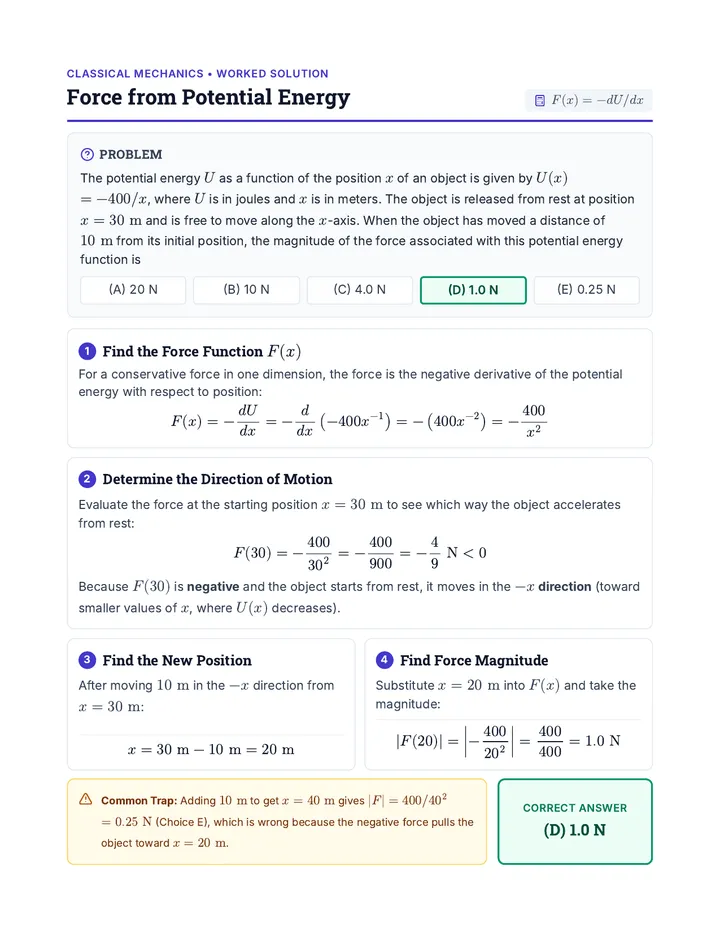
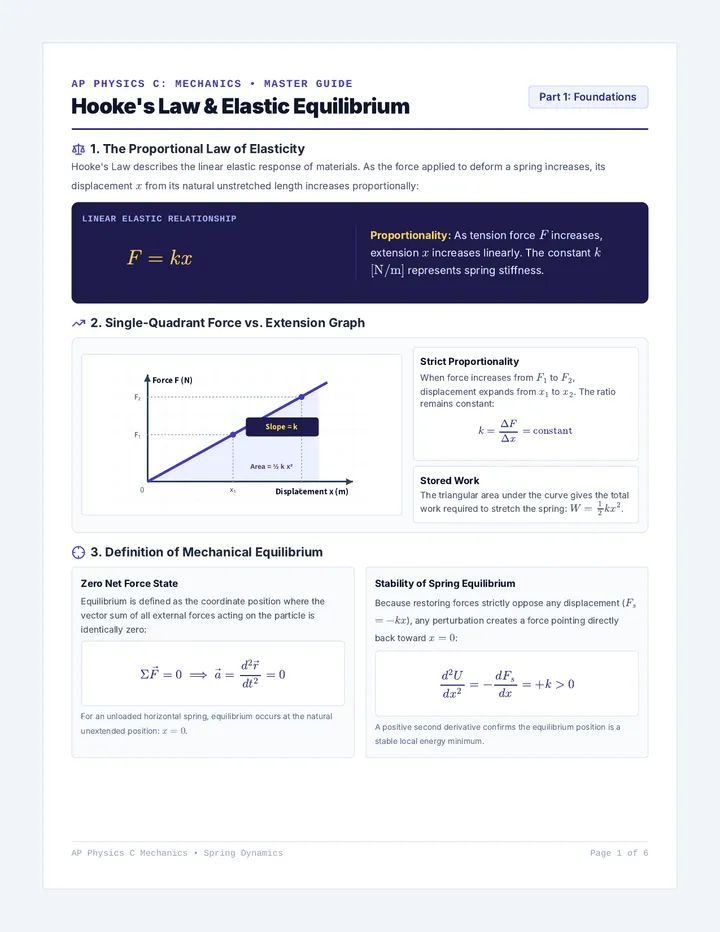
Capacitor Cheat SheetMCAT Physics • High-Yield Review Capacitor Cheat Sheet Capacitance, Series vs. Parallel, Dielectric Traps & RC Circuits Core Capacitor Formulas Definition: \(C = \dfrac{Q}{V}\) (units: Farad, \(\text{F} = \text{C/V}\)). Parallel-Plate Geometry: \(C = \dfrac{\kappa \varepsilon_0 A}{d}\) (\(\uparrow A\) or \(\uparrow \kappa \implies \uparrow C\); \(\uparrow d \implies \downarrow C\)) Stored Energy: \(U = \dfrac{1}{2}QV = \dfrac{1}{2}CV^2 = \dfrac{Q^2}{2C}\) Electric Field: \(E = \dfrac{V}{d}\) (uniform between plates) Series vs. Parallel (Opposite of Resistors!) Parallel Capacitors: Same \(V\) across each. \(C_{\text{eq}} = C_1 + C_2 + \dots\) (adding in parallel increases \(C_{\text{eq}}\)). Series Capacitors: Same \(Q\) on each. \(\dfrac{1}{C_{\text{eq}}} = \dfrac{1}{C_1} + \dfrac{1}{C_2} + \dots\) (adding in series decreases \(C_{\text{eq}}\)). Memory Hook: Parallel capacitors effectively add plate Area (\(A\)) \(\implies\) bigger \(C\)! #1 AAMC Trap: Inserting a Dielectric (\(\kappa > 1\)) Inserting a dielectric always increases \(C\) (\(C' = \kappa C\)). What happens to \(Q\), \(V\), and \(U\) depends on whether the battery is still connected: Case 1: Battery CONNECTED (\(V\) = Constant) • \(C\): Increases (\(\times \kappa\)) • \(V\): Constant (pinned by battery) • \(Q = CV\): Increases (\(\times \kappa\)) • \(U = \frac{1}{2}CV^2\): Increases (\(\times \kappa\)) Case 2: Battery DISCONNECTED (\(Q\) = Constant) • \(C\): Increases (\(\times \kappa\)) • \(Q\): Constant (charge is trapped!) • \(V = Q/C\): Decreases (\(\div \kappa\)) • \(U = \frac{Q^2}{2C}\): Decreases (\(\div \kappa\)) RC Circuits (Resistors + Capacitors) Time Constant (\(\tau\)) \(\tau = R C\) (seconds). After \(1\tau\), capacitor reaches ~\(63\%\) charge (or drops to ~\(37\%\) when discharging). At \(t = 0\) (Just Closed) Uncharged capacitor acts like a plain wire (\(V_C = 0\), maximum current \(I\) flows). At \(t \to \infty\) (Steady State) Fully charged capacitor acts like an open switch (\(I = 0\) in its branch; \(V_C = V_{\text{branch}}\)). High-Yield Tip: Biological cell membranes act as parallel-plate capacitors! Page 1 of 2 The \(\frac{1}{2}Ax^2\) Cross-Domain Energy Pattern MCAT Memory Shortcut Notice how energy formulas across MCAT physics share the exact same quadratic structure: \(\text{Energy} = \frac{1}{2} (\text{Inertia / Capacity Term } A) \times (\text{Changing State } x)^2\). All of them arise from integrating a linear relationship (\(\int A x\, dx = \frac{1}{2}Ax^2\)). Domain Formula Constant / Inertia (\(A\)) Changing State (\(x\)) Linear Motion \(K = \frac{1}{2}mv^2\) Mass (\(m\)) Velocity (\(v\)) Rotational Motion \(K_{\text{rot}} = \frac{1}{2}I\omega^2\) Moment of inertia (\(I\)) Angular velocity (\(\omega\)) Springs / Elasticity \(U_s = \frac{1}{2}kx^2\) Spring constant (\(k\)) Displacement (\(x\)) Capacitors (Electric) \(U_C = \frac{1}{2}CV^2\) Capacitance (\(C\)) Voltage (\(V\)) Inductors (Magnetic) \(U_L = \frac{1}{2}LI^2\) Inductance (\(L\)) Current (\(I\)) Fluid Pressure (Dynamic) \(P_{\text{dyn}} = \frac{1}{2}\rho v^2\) Fluid density (\(\rho\)) Flow speed (\(v\)) Quick Capacitor Practice 1. Stored Energy & Charge: A \(4.0\text{ }\mu\text{F}\) capacitor is charged to \(10.0\text{ V}\). Calculate the stored charge \(Q\) and stored electrical potential energy \(U_C\). 2. Dielectric Trap: The capacitor above is disconnected from the battery, and a dielectric with \(\kappa = 2.0\) is inserted. What are the new capacitance \(C'\), voltage \(V'\), and energy \(U_C'\)? Answers: 1) \(Q = 40\text{ }\mu\text{C},\; U_C = 200\text{ }\mu\text{J}\); 2) \(C' = 8.0\text{ }\mu\text{F},\; V' = 5.0\text{ V},\; U_C' = 100\text{ }\mu\text{J}\). Page 2 of 2