CHEM 1406 Finals Review Key
CHEM 1406 • Introductory General, Organic & Biological Chemistry
Comprehensive Finals Review Answer Key
Official Solutions, Answer Grid & Detailed Rationales (Questions 1–50)
50 Multiple-Choice Items
Complete Key & Explanations
50-Question Master Answer Key Grid Rapid Grading Matrix
1C
2A
3E
4E
5B
6A
7E
8D
9A
10E
11A
12E
13C
14E
15B
16C
17D
18D
19D
20E
21E
22A
23D
24B
25A
26A
27E
28D
29D
30C
31D
32B
33C
34D
35B
36B
37E
38D
39E
40C
41B
42E
43B
44C
45B
46B
47C
48C
49B
50C
Coverage: General Chemistry (Q2–3, 5–7, 9, 11–28, 31–32, 34–35, 38–41, 43–44, 46–50) Organic & Biochem: Q1, 4, 8, 10, 29–30, 33, 36–37, 42, 45
Questions 1 – 4: Detailed Solutions & Rationales
1. Dipeptide Nomenclature (Serine N-terminal, Phenylalanine C-terminal) Answer: C
Rationale: In peptide naming conventions, amino acids are listed sequentially from the free amine (N-terminal) residue to the free carboxylate (C-terminal) residue. Non-terminal residues drop their standard suffix and add -yl (Serine → seryl). The terminal amino acid retains its unmodified name (phenylalanine), producing serylphenylalanine. Option E reverses the sequence; A fails to modify the prefix.
2. Mole-to-Mass Calculation for Sodium (Na) Answer: A
Rationale: The atomic molar mass of sodium (Na) from the periodic table is \(22.99\text{ g/mol}\approx 23.0\text{ g/mol}\). Calculating total mass: \(\text{Mass} = 4.00\text{ mol} \times 22.99\text{ g/mol} = 91.96\text{ g} \approx \mathbf{92.0\text{ g}}\). Option D (23.0 g) is the mass of only 1.00 mol; B divides by moles instead of multiplying.
3. Density Determination by Water Displacement Answer: E
Rationale: The volume occupied by the iron sample equals the displaced water: \(V = 72\text{ mL} - 57\text{ mL} = 15\text{ mL}\). Applying the density equation: \(\text{Density} = \frac{\text{Mass}}{\text{Volume}} = \frac{119\text{ g}}{15\text{ mL}} = 7.933\dots\text{ g/mL} \approx \mathbf{7.9\text{ g/mL}}\). This precisely reflects the known physical density of elemental iron.
4. Characteristics of Organic Compounds Answer: E
Rationale: Organic compounds are covalently bonded molecules that characteristically contain carbon and hydrogen (statement i) and are readily flammable/combustible (statement iv). Because they are governed by weak intermolecular forces rather than ionic crystal lattices, they have low melting points (disproving ii) and are largely nonpolar and insoluble in water (disproving iii). Thus, only i and iv are correct.
CHEM 1406 Comprehensive Finals Review • Answer Key & Rationales Page 1 of 7
Questions 5 – 12: Changes, Scientific Method, Proteins & Periodic Table
Exam Items 5–12
5. Distinguishing Chemical vs. Physical Change Answer: B
Rationale: Burning natural gas is a combustion reaction (\(\text{CH}_4 + 2\text{O}_2 \rightarrow \text{CO}_2 + 2\text{H}_2\text{O}\)) breaking and reforming covalent bonds to create entirely new chemical substances. Hammering gold foil, melting ice, and cutting paper or tomatoes alter only physical form or state.
6. Scientific Method: Classifying Empirical Statements Answer: A
Rationale: Directly noting that traffic increases between 8:00 and 9:00 AM is raw sensory data gathered about an event without an explanatory mechanism (hypothesis), experimental trial, or deduced conclusion, classifying it as an observation.
7. Percentage Calculation from Sample Distribution Answer: E
Rationale: Total exams \(= 30\text{ (A's)} + 20\text{ (B's)} + 10\text{ (C's)} = 60\text{ students}\). Calculating percentage of B's: \(\frac{20}{60} \times 100\% = 33.33\% \approx \mathbf{33\%}\). Distractor C (20%) results from erroneously dividing by 100 instead of the true total cohort.
8. Functional Protein Classification (Collagen) Answer: D
Rationale: Collagen forms insoluble fibrous triple-helical fibers that provide tensile strength and architectural integrity to connective tissues (tendons, cartilage, ligaments, skin, and bone matrix), defining it as a structural protein.
9. Molecular Nomenclature of Binary Nonmetals (\(\text{SeO}_3\)) Answer: A
Rationale: Both selenium and oxygen are nonmetals, forming a molecular compound named using Greek numerical prefixes. One selenium is "selenium" (prefix mono- is omitted on the first element) and three oxygens are "trioxide": selenium trioxide.
10. Base Hydrolysis (Saponification) of an Amide Answer: E
Rationale: Alkaline hydrolysis of an amide with \(\text{NaOH}\) cleaves the carbonyl-nitrogen bond, producing a carboxylate salt and a free neutral amine: \(\text{CH}_3\text{CONH-C}_6\text{H}_5 + \text{NaOH} \rightarrow \text{CH}_3\text{COO}^-\text{Na}^+\text{ (sodium acetate)} + \text{C}_6\text{H}_5\text{NH}_2\text{ (aniline)}\).
11. Molecular Geometry of Hydrogen Cyanide (\(\text{HCN}\)) Answer: A
Rationale: The Lewis structure is \(\text{H}-\text{C}\equiv\text{N}:\). The central carbon has two electron charge domains (one single bond and one triple bond) with zero nonbonding lone pairs (\(\text{AX}_2\)), producing a \(180^\circ\) bond angle and linear shape.
12. Periodic Table Organization: Sodium, Magnesium & Silicon Answer: E
Rationale: \(\text{Na}\) (\(Z=11\)), \(\text{Mg}\) (\(Z=12\)), and \(\text{Si}\) (\(Z=14\)) all occupy horizontal row 3 of the periodic table, meaning they are in the same period of elements (Period 3). Their valence groups and neutron numbers differ.
CHEM 1406 Comprehensive Finals Review • Answer Key & Rationales Page 2 of 7
Questions 13 – 20: Solutions, Dalton's Theory, Reactions & Sig Figs
Exam Items 13–20
13. Osmotic Pressure in Blood Solutions Answer: C
Rationale: An isotonic solution has an identical solute concentration and osmolarity to blood serum, exerting equal osmotic pressure across red blood cell membranes and preventing cell shrinkage (crenation) or swelling/bursting (hemolysis).
14. Defining Matter vs. Energy Answer: E
Rationale: A chemical is any form of matter with mass and spatial volume (\(\text{H}_2\text{O}\), \(\text{CO}_2\), \(\text{NaCl}\), sugar). Light is radiant electromagnetic energy made of massless photons, so it is not a chemical substance.
15. Postulates of Dalton's Atomic Theory Answer: B
Rationale: According to Dalton's Atomic Theory and the Law of Conservation of Mass, atoms are neither created nor destroyed in chemical reactions; atoms are only combined, separated, or rearranged.
16. Reaction Classification: \(\text{SO}_3 + \text{H}_2\text{O} \rightarrow \text{H}_2\text{SO}_4\) Answer: C
Rationale: Two distinct reactant molecules join together to synthesize one single, more complex product molecule (\(\text{A} + \text{B} \rightarrow \text{AB}\)), defining it as a combination (synthesis) reaction.
17. Solution Terminology (2 g \(\text{KCl}\) in 100 g \(\text{H}_2\text{O}\)) Answer: D
Rationale: In a homogenous solution, the substance present in the lesser quantity that undergoes dissolution is the solute (\(\text{KCl}\)). Water (\(\text{H}_2\text{O}\)) is the solvent.
18. Electron Configuration Shell Arrangement (2, 8, 8) Answer: D
Rationale: Summing the electrons across shells: \(2 + 8 + 8 = 18\text{ total electrons}\). In a neutral atom, the atomic number \(Z = 18\), identifying the noble gas Argon (\(\text{Ar}\)).
19. Place Value Identification (12.345) Answer: D
Rationale: In the decimal number \(12.345\), moving right from the decimal point: 3 is in tenths (\(10^{-1}\)), 4 is in hundredths (\(10^{-2}\)), and 5 is in thousandths (\(10^{-3}\)).
20. Rounding to Three Significant Figures Answer: E
Rationale: \(20.0332\) rounds to \(20.0\). Here, the initial digit \(2\), the captive zero, and the trailing zero after the decimal point are all significant, giving exactly 3 significant figures. (Option A has 2 sig figs; B and D have 4).
CHEM 1406 Comprehensive Finals Review • Answer Key & Rationales Page 3 of 7
Questions 21 – 28: Isotopes, Formulas, Valence Electrons, Metric & Redox
Exam Items 21–28
21. Isotopic Atomic Mass Range for Chlorine Answer: E
Rationale: The atomic mass is the weighted average of the naturally occurring isotopes: \((35 \times 0.758) + (37 \times 0.243) \approx 35.45\text{ amu}\). This mathematical average lies strictly between 35 and 37.
22. Ionic Compound Formula: Potassium and Phosphorus Answer: A
Rationale: Potassium (\(\text{K}\), Group 1A) loses 1 electron to form \(\text{K}^+\). Phosphorus (\(\text{P}\), Group 5A) gains 3 electrons to form phosphide \(\text{P}^{3-}\). Balancing net charge requires three \(\text{K}^+\) per one \(\text{P}^{3-}\), giving \(\mathbf{K_3P}\).
23. Total Valence Electrons in Dinitrogen Tetroxide (\(\text{N}_2\text{O}_4\)) Answer: D
Rationale: Nitrogen (Group 5A) contributes 5 valence electrons: \(2 \times 5 = 10\). Oxygen (Group 6A) contributes 6 valence electrons: \(4 \times 6 = 24\). Total valence electrons \(= 10 + 24 = \mathbf{34}\).
24. Non-Characteristic Property of Group 1A Alkali Metals Answer: B
Rationale: Group 1A alkali metals are soft, lustrous solids at room temperature that conduct heat and electricity and react violently with water. Stating that "Most are liquids at room temp" is false (mercury is the only liquid metal at standard room conditions).
25. Metric Unit Mass Equivalency (9.31 g) Answer: A
Rationale: The prefix milli- (\(\text{m}\)) represents \(10^{-3}\) (\(1\text{ g} = 1000\text{ mg}\)). Converting: \(9.31\text{ g} \times \frac{1000\text{ mg}}{1\text{ g}} = \mathbf{9310\text{ mg}}\).
26. Stock System Naming of \(\text{Fe}_2(\text{SO}_4)_3\) Answer: A
Rationale: Sulfate is \(\text{SO}_4^{2-}\). Three sulfate anions carry a net \(-6\) charge. The two iron cations must provide \(+6\), meaning each cation is \(\text{Fe}^{3+}\). In the Stock system, the cation oxidation state is indicated with Roman numerals: iron(III) sulfate.
27. Temperature Conversion (Celsius to Fahrenheit) Answer: E
Rationale: Applying the standard conversion formula: \(T_{^\circ\text{F}} = 1.8(T_{^\circ\text{C}}) + 32 = 1.8(20) + 32 = 36 + 32 = \mathbf{68\text{ }^\circ\text{F}}\).
28. Identifying Oxidized and Reduced Species: \(2\text{Al} + 3\text{Br}_2 \rightarrow 2\text{AlBr}_3\) Answer: D
Rationale: Elemental \(\text{Al}^0\) loses 3 electrons to form \(\text{Al}^{3+}\) (oxidation), so \(\text{Al}\) is oxidized. Elemental \(\text{Br}_2^0\) gains electrons to become bromide \(\text{Br}^-\) (reduction), so \(\text{Br}_2\) is reduced.
CHEM 1406 Comprehensive Finals Review • Answer Key & Rationales Page 4 of 7
Questions 29 – 36: Stereochemistry, Concentrations, Functional Groups & IMFs
Exam Items 29–36
29. Carbohydrate Stereochemistry: L-Enantiomer Definition Answer: D
Rationale: In a Fischer projection of a monosaccharide, the D- or L-designation is determined by the chiral carbon furthest from the carbonyl. An L-enantiomer has this chiral \(-\text{OH}\) group projected on the Left side (D is on the Right).
30. Monosaccharide Classification of Ribulose Answer: C
Rationale: A 5-carbon monosaccharide is a pentose. Because ribulose contains a ketone carbonyl group (\(\text{C}=\text{O}\) at C2), it is classified as a ketopentose.
31. Mass/Volume Percent Concentration (\(15\%\text{ m/v}\)) Answer: D
Rationale: A \(15\%\text{ (m/v)}\) solution contains \(15\text{ g NaOH}\) per \(100\text{ mL solution}\). Setting up conversion factor: \(\text{Volume} = 120\text{ g NaOH} \times \frac{100\text{ mL}}{15\text{ g NaOH}} = \mathbf{800\text{ mL}}\).
32. Multiplication of Negative Signed Integers Answer: B
Rationale: Multiplying two negative values produces a positive mathematical product: \((-4) \times (-5) = \mathbf{+20}\).
33. Aldehyde Functional Group Identification Answer: C
Rationale: An aldehyde possesses a carbonyl group bonded to at least one terminal hydrogen atom, condensed as \(-\text{CHO}\). Hence, \(\text{CH}_3\text{-CHO}\) (ethanal / acetaldehyde) is an aldehyde. (A is an ether, B an alcohol, D a ketone, E an alkane).
34. Intermolecular Forces in Diiodomethane (\(\text{CH}_2\text{I}_2\)) Answer: D
Rationale: \(\text{CH}_2\text{I}_2\) is an asymmetric tetrahedral molecule whose bond dipoles do not cancel, establishing a net permanent dipole. Lacking hydrogen directly attached to N, O, or F, it cannot form hydrogen bonds; its defining polar intermolecular attraction is dipole-dipole forces.
35. Energy Conversion: Kilojoules to Kilocalories Answer: B
Rationale: Since \(1\text{ cal} = 4.184\text{ J}\), \(1\text{ kcal} = 4.184\text{ kJ}\). Calculating: \(13.2\text{ kJ} \times \frac{1\text{ kcal}}{4.184\text{ kJ}} = 3.1548\dots\text{ kcal} \approx \mathbf{3.15\text{ kcal}}\).
36. Organic Oxidation Pathways of Aldehydes Answer: B
Rationale: The conversion of an aldehyde (\(\text{R-CHO}\)) into a carboxylic acid (\(\text{R-COOH}\)) represents an oxidation reaction (gain of oxygen / loss of hydrogen), as seen in diagnostic Benedict's and Tollens' tests.
CHEM 1406 Comprehensive Finals Review • Answer Key & Rationales Page 5 of 7
Questions 37 – 44: Enzymes, Solids, Combustion, Dilution, Acids & Esters
Exam Items 37–44
37. Mechanism of Enzyme Action (Enzyme-Substrate Complex) Answer: E
Rationale: When an enzyme binds substrates to form the enzyme-substrate (ES) complex, it stabilizes the transition state and lowers the activation energy (\(E_a\)), accelerating reaction rates without altering overall free energy \(\Delta G\) or equilibrium.
38. States of Matter: Non-Characteristic of Solids Answer: D
Rationale: In a solid, particles are arranged in close, fixed positions and possess only vibrational motion. Rapid translational motion is characteristic of gas particles, making "Particles move fast" incorrect for solids.
39. Balancing Hydrocarbon Combustion: \(\text{C}_5\text{H}_8 + \underline{?}\text{ O}_2 \rightarrow 5\text{CO}_2 + 4\text{H}_2\text{O}\) Answer: E
Rationale: Balancing oxygen: The product side has \((5 \times 2) + (4 \times 1) = 10 + 4 = 14\text{ oxygen atoms}\). Diatomic \(\text{O}_2\) molecules needed: \(\frac{14}{2} = \mathbf{7}\).
40. Solution Dilution Equation (\(M_1 V_1 = M_2 V_2\)) Answer: C
Rationale: Using \(M_1 V_1 = M_2 V_2\): \(M_2 = \frac{M_1 V_1}{V_2} = \frac{(0.200\text{ M})(75.0\text{ mL})}{100\text{ mL}} = \frac{15.0}{100} = \mathbf{0.150\text{ M}}\).
41. Brønsted-Lowry Base Identification Answer: B
Rationale: In \(\text{H}_2\text{O} + \text{CO}_3^{2-} \rightleftharpoons \text{HCO}_3^- + \text{OH}^-\), the Brønsted-Lowry base is the proton (\(\text{H}^+\)) acceptor. Carbonate (\(\mathbf{CO_3^{2-}}\)) accepts a proton from water to form bicarbonate (\(\text{HCO}_3^-\)), functioning as the base.
42. IUPAC Nomenclature of Esters Answer: E
Rationale: Esters are named with the alkyl group from the alcohol first, followed by the carboxylate parent name ending in -oate. Ethanol provides the ethyl group, and butanoic acid provides the butanoate group: ethyl butanoate. (Ethyl butyrate is common nomenclature).
43. Moles from Molarity and Solution Volume Answer: B
Rationale: Convert volume to liters: \(250\text{ mL} = 0.250\text{ L}\). Calculating: \(\text{Moles} = \text{Molarity } (M) \times \text{Liters } (L) = 3.0\text{ mol/L} \times 0.250\text{ L} = \mathbf{0.75\text{ mole}}\).
44. Physical Quantities and Metric Units (36 mL) Answer: C
Rationale: Milliliters (\(\text{mL}\)) measure three-dimensional fluid capacity, which is the physical measurement of volume.
CHEM 1406 Comprehensive Finals Review • Answer Key & Rationales Page 6 of 7
Questions 45 – 50: Alkanes, Periodic Trends, Buffers & Nuclear Structure
Exam Items 45–50
45. IUPAC Branched Alkane Nomenclature Answer: B
Rationale: A 5-carbon continuous parent chain is pentane. Having methyl substituents located at carbon-2 and carbon-4 requires the numerical locants and prefix di-: 2,4-dimethylpentane.
46. Periodic Trends: First Ionization Energy Down a Group Answer: B
Rationale: Descending down a group, additional electron shells increase atomic radius. Increased distance and shielding from core electrons reduce effective nuclear pull on valence electrons, causing ionization energy to decrease.
47. Dimensional Analysis: Currency and Mass Units Answer: C
Rationale: Convert mass to pounds: \(2.5\text{ kg} \times 2.205\text{ lb/kg} = 5.5125\text{ lb}\). Multiplying by unit cost: \(5.5125\text{ lb} \times \frac{\$0.67}{\text{lb}} = \$3.6933\dots \approx \mathbf{\$3.69}\).
48. Chemical Composition of Buffer Systems Answer: C
Rationale: A buffer resists \(\text{pH}\) changes and must consist of a weak acid and its conjugate base (or a weak base and its conjugate acid). Hydrofluoric acid (\(\text{HF}\)) is a weak acid, and sodium fluoride (\(\text{NaF}\)) provides its conjugate base (\(\text{F}^-\)); thus, \(\text{HF(aq)} + \text{NaF(aq)}\) forms a true buffer.
49. Unit Conversion (Inches to Centimeters) Answer: B
Rationale: Using the exact equivalence \(1\text{ in} = 2.54\text{ cm}\): \(57.0\text{ in} \times 2.54\text{ cm/in} = 144.78\text{ cm}\). Rounding to 3 significant figures yields 145 cm.
50. Nuclear Structure: Isotopic Mass Number Answer: C
Rationale: Mass number (\(A\)) is the sum of protons (atomic number \(Z=47\)) and neutrons (\(n=62\)): \(A = 47 + 62 = \mathbf{109}\). (Option A, \(107.9\), is the weighted average atomic weight of natural silver, not an individual isotope's integer mass number).
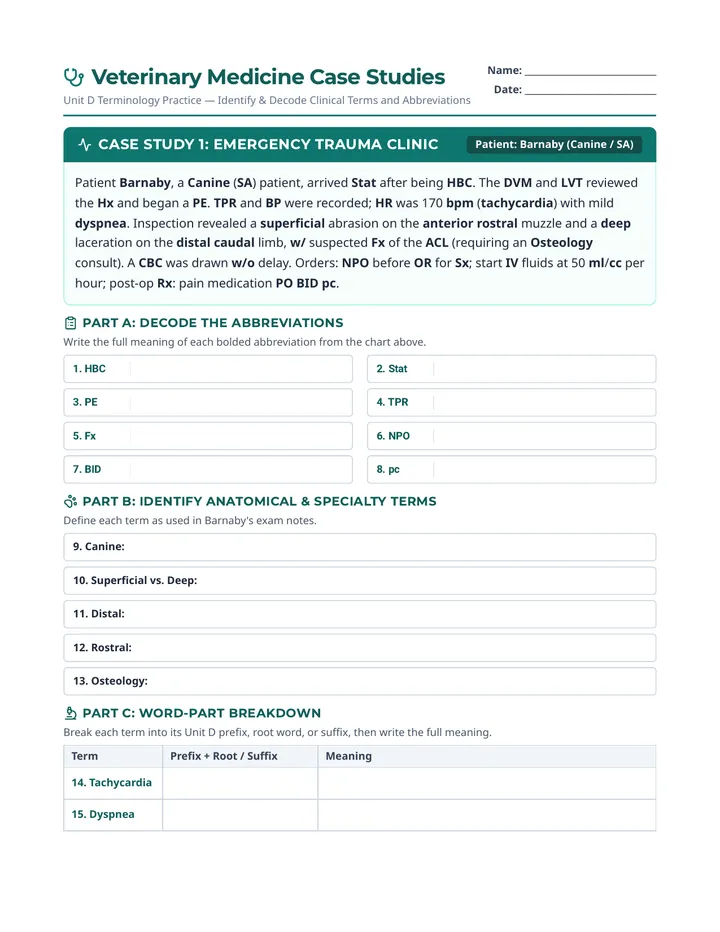
High-Yield CHEM 1406 Finals Reference & Conversion Cheat Sheet
General & Physical Chemistry Formulas
- Density: \(d = \frac{m}{V}\) (water displacement: \(V = V_f - V_i\))
- Temperature: \(T_{^\circ\text{F}} = 1.8(T_{^\circ\text{C}}) + 32\)
- Energy: \(1\text{ cal} = 4.184\text{ J} \implies 1\text{ kcal} = 4.184\text{ kJ}\)
- Solutions: \(M = \frac{\text{moles}}{\text{liters}}\); Dilution: \(M_1V_1 = M_2V_2\)
- Mass %: \(\%(\text{m/v}) = \frac{\text{g solute}}{100\text{ mL solution}} \times 100\%\)
- Nuclear: Mass # (\(A\)) = Protons (\(Z\)) + Neutrons (\(n^0\))
Organic & Biological Chemistry Rules
- Peptides: N-terminus gets -yl; C-terminus retains full name
- Aldehyde (\(-\text{CHO}\)) \(\xrightarrow{\text{[O]}}\) Carboxylic Acid (\(-\text{COOH}\))
- Esters: Alcohol alkyl first + Carboxylic acid -oate
- Amide base hydrolysis: \(\text{Amide} + \text{NaOH} \rightarrow \text{Carboxylate salt} + \text{Amine}\)
- Carbohydrates: D = Right, L = Left at furthest chiral carbon
- Buffers: Weak acid + Conjugate base salt (e.g., \(\text{HF} + \text{NaF}\))
CHEM 1406 Comprehensive Finals Review • Answer Key & Rationales Page 7 of 7
CHEM 1406 Formula Flashcards
CHEM 1406 • Study Flashcards
High-Yield Formula Flashcards
Printable 24-Card Review Set • Cards 1–8: Measurement, Density, Atomic & Bonding
Cut or Fold Format
Dashed lines indicate cut boundaries
Card 01 • Density CHEM 1406
Density & Water Displacement
Prompt: How do you calculate the density of an irregular solid using liquid displacement?
Formula: \(d = \frac{m}{V} = \frac{\text{mass}}{\text{volume}}\)
\(V_{\text{solid}} = V_{\text{final}} - V_{\text{initial}}\)
Exam Example: \(119\text{ g}\) placed in \(57\text{ mL} \rightarrow 72\text{ mL}\) (\(15\text{ mL}\)): \(d = \frac{119}{15} = \mathbf{7.9\text{ g/mL}}\).
Card 02 • Temperature CHEM 1406
Celsius to Fahrenheit Conversion
Prompt: What is the formula to convert between Celsius and Fahrenheit?
Formula: \(T_{^\circ\text{F}} = 1.8(T_{^\circ\text{C}}) + 32\)
Reverse: \(T_{^\circ\text{C}} = \frac{T_{^\circ\text{F}} - 32}{1.8}\)
Exam Example: \(20\text{ }^\circ\text{C} \implies 1.8(20) + 32 = 36 + 32 = \mathbf{68\text{ }^\circ\text{F}}\).
Card 03 • Energy Units CHEM 1406
Joules to Calories Conversion
Prompt: What is the exact relationship between Joules, calories, kJ, and kcal?
Equivalence: \(1\text{ cal} = 4.184\text{ J}\)
\(1\text{ kcal} = 4.184\text{ kJ} \implies 1\text{ kJ} = \frac{1}{4.184}\text{ kcal}\)
Exam Example: \(13.2\text{ kJ} \times \frac{1\text{ kcal}}{4.184\text{ kJ}} = \mathbf{3.15\text{ kcal}}\).
Card 04 • Conversions CHEM 1406
High-Yield Metric & Imperial Factors
Prompt: What are the key conversion factors for length and mass?
Length: \(1\text{ in} = 2.54\text{ cm}\) (exact)
Mass: \(1\text{ kg} = 2.205\text{ lb}\); \(1\text{ g} = 1000\text{ mg}\)
Exam Example: \(57.0\text{ in} \times 2.54 = \mathbf{145\text{ cm}}\); \(9.31\text{ g} = \mathbf{9310\text{ mg}}\).
Card 05 • Nuclear CHEM 1406
Atomic Mass Number (\(A\))
Prompt: How is the integer mass number (\(A\)) of a specific isotope determined?
Formula: \(\text{Mass Number } (A) = p^+ + n^0\)
\(A = \text{Atomic Number } (Z) + \text{Neutrons } (n^0)\)
Exam Example: Silver (\(Z=47\)) with \(62\text{ n}^0 \implies 47 + 62 = \mathbf{109}\). (107.9 is periodic avg, not isotope mass).
Card 06 • Moles CHEM 1406
Mole-to-Mass Calculation
Prompt: How do you calculate the mass in grams from a given number of moles?
Formula: \(\text{Mass (g)} = \text{Moles} \times \text{Molar Mass}\)
\(\text{Moles} = \frac{\text{Mass (g)}}{\text{Molar Mass (g/mol)}}\)
Exam Example: \(4.00\text{ mol Na} \times 23.0\text{ g/mol} = \mathbf{92.0\text{ g}}\).
Card 07 • Ionic CHEM 1406
Ionic Charge Balancing & Stock System
Prompt: How are ionic formulas and transition metal names constructed?
Rule: \(\sum \text{Positive Charges} = \sum \text{Negative Charges}\)
\(\text{K}^+ + \text{P}^{3-} \rightarrow \mathbf{K_3P}\); Roman numeral = cation charge.
Exam Example: \(\text{Fe}_2(\text{SO}_4)_3\) has \(3 \times (-2) = -6\); each \(\text{Fe}\) is \(+3 \implies \mathbf{\text{iron(III) sulfate}}\).
Card 08 • VSEPR CHEM 1406
Molecular Geometry: Linear (\(180^\circ\))
Prompt: Why is hydrogen cyanide (\(\text{HCN}\)) classified as linear?
Lewis: \(\text{H}-\text{C}\equiv\text{N}:\)
Central C has 2 electron groups & 0 lone pairs (\(\text{AX}_2\)).
Geometry: Bond angle \(= 180^\circ \implies \mathbf{\text{Linear}}\).
CHEM 1406 Formula Flashcards • Print on Cardstock & Cut Page 1 of 3
CHEM 1406 • Study Flashcards
High-Yield Formula Flashcards
Printable 24-Card Review Set • Cards 9–16: Reactions, Solutions, Osmosis & Buffers
Cut or Fold Format
Dashed lines indicate cut boundaries
Card 09 • Balancing CHEM 1406
Hydrocarbon Combustion Stoichiometry
Prompt: How do you balance oxygen in combustion reactions?
Rule: \(\text{Hydrocarbon} + \text{O}_2 \rightarrow \text{CO}_2 + \text{H}_2\text{O}\)
Balance C, then H, and finally O: \(\text{Moles }\text{O}_2 = \frac{\text{Total O in products}}{2}\).
Exam Example: \(\text{C}_5\text{H}_8 + \mathbf{7}\text{O}_2 \rightarrow 5\text{CO}_2 + 4\text{H}_2\text{O}\) (\(10 + 4 = 14\text{ O} \div 2 = 7\)).
Card 10 • Redox CHEM 1406
Oxidation vs. Reduction (OIL RIG)
Prompt: How do you identify what is oxidized and reduced?
Mnemonic: OIL RIG
Oxidation Is Loss of \(\text{e}^-\); Reduction Is Gain of \(\text{e}^-\).
Exam Example: \(2\text{Al}^0 + 3\text{Br}_2^0 \rightarrow 2\text{Al}^{3+}\text{Br}_3^-\): \(\mathbf{\text{Al is oxidized}}\); \(\mathbf{\text{Br}_2\text{ is reduced}}\).
Card 11 • Percent CHEM 1406
Mass/Volume Percent \(\%(\text{m/v})\)
Prompt: What does \(\%(\text{m/v})\) mean and how do you calculate volume?
Definition: \(\%(\text{m/v}) = \frac{\text{g solute}}{100\text{ mL solution}}\)
\(\text{Volume (mL)} = \text{g solute} \times \frac{100\text{ mL}}{\%}\)
Exam Example: \(120\text{ g NaOH}\) in \(15\%\text{ (m/v)} \implies 120 \times \frac{100}{15} = \mathbf{800\text{ mL}}\).
Card 12 • Molarity CHEM 1406
Molarity Equation (\(M = \text{mol/L}\))
Prompt: How do you calculate moles from molarity and volume?
Formula: \(M = \frac{\text{moles}}{\text{Liters}} \implies \text{Moles} = M \times V_{(\text{L})}\)
Always convert mL to Liters (\(\text{mL} \div 1000\)).
Exam Example: \(250\text{ mL } (0.250\text{ L})\) of \(3.0\text{ M } \text{CaCl}_2 \implies 3.0 \times 0.250 = \mathbf{0.75\text{ mol}}\).
Card 13 • Dilution CHEM 1406
Solution Dilution Formula
Prompt: What equation links initial and diluted concentration and volume?
Formula: \(M_1V_1 = M_2V_2\)
Solute moles remain constant; volume increases.
Exam Example: Diluting \(75.0\text{ mL}\) of \(0.200\text{ M}\) to \(100\text{ mL}\): \(M_2 = \frac{0.200 \times 75.0}{100} = \mathbf{0.150\text{ M}}\).
Card 14 • Osmosis CHEM 1406
Tonicity & Osmotic Pressure
Prompt: What is a solution with the same osmotic pressure as blood?
Isotonic: Same osmotic pressure (e.g. \(0.9\%\text{ NaCl}\)).
Hypotonic: Lower pressure \(\rightarrow\) water enters cell \(\rightarrow\) hemolysis.
Hypertonic: Higher pressure \(\rightarrow\) water leaves cell \(\rightarrow\) crenation.
Card 15 • Acid-Base CHEM 1406
Brønsted-Lowry Base Definition
Prompt: How do you identify the Brønsted-Lowry base in an equilibrium?
Definition: Base = Proton (\(\text{H}^+\)) Acceptor
Acid = Proton (\(\text{H}^+\)) Donor.
Exam Example: \(\text{H}_2\text{O} + \text{CO}_3^{2-} \rightleftharpoons \text{HCO}_3^- + \text{OH}^-\): \(\mathbf{\text{CO}_3^{2-}}\) accepts \(\text{H}^+\) \(\implies\) Base.
Card 16 • Buffers CHEM 1406
Chemical Composition of a Buffer
Prompt: What two components must be present to form an effective buffer?
Buffer = Weak Acid + Conjugate Base Salt
Strong acids (like \(\text{HCl}\)) cannot make buffers.
Exam Example: \(\mathbf{\text{HF(aq)} + \text{NaF(aq)}}\) is a true buffer (\(\text{HF}\) is weak acid; \(\text{NaF}\) supplies conjugate \(\text{F}^-\)).
CHEM 1406 Formula Flashcards • Print on Cardstock & Cut Page 2 of 3
CHEM 1406 • Study Flashcards
High-Yield Formula Flashcards
Printable 24-Card Review Set • Cards 17–24: Organic Naming, Biomolecules & Enzymes
Cut or Fold Format
Dashed lines indicate cut boundaries
Card 17 • IUPAC CHEM 1406
Branched Alkane Nomenclature
Prompt: How do you name an alkane with multiple substituents?
Rule: Longest chain + Lowest locants
5-carbon chain \(= \text{pentane}\); 2 methyls \(= \text{dimethyl}\).
Exam Example: 5-carbon alkane with methyls on C2 and C4 \(\implies \mathbf{\text{2,4-dimethylpentane}}\).
Card 18 • Aldehydes CHEM 1406
Aldehyde Identification & Oxidation
Prompt: What is the functional group of an aldehyde and what does it oxidize to?
Structure: \(-\text{CHO}\) (e.g., \(\text{CH}_3\text{-CHO}\))
Oxidation: \(\text{R-CHO} \xrightarrow{\text{[O]}} \mathbf{\text{R-COOH}}\) (Carboxylic acid).
Basis for Benedict's & Tollens' diagnostic sugar tests.
Card 19 • Esters CHEM 1406
IUPAC Ester Nomenclature
Prompt: How do you name an ester formed from a carboxylic acid and alcohol?
Rule: Alcohol Alkyl + Acid -oate
Ethanol \(\rightarrow\) ethyl; Butanoic acid \(\rightarrow\) butanoate.
Exam Example: Forms \(\mathbf{\text{ethyl butanoate}}\). (Common name: ethyl butyrate).
Card 20 • Amides CHEM 1406
Base Hydrolysis of Amides
Prompt: What are the products when an amide is hydrolyzed with \(\text{NaOH}\)?
\(\text{Amide} + \text{NaOH} \rightarrow \text{Carboxylate Salt} + \text{Amine}\)
The basic medium deprotonates the acid into its sodium salt.
Exam Example: Acetanilide \(+ \text{NaOH} \rightarrow \mathbf{\text{sodium acetate}} + \mathbf{\text{aniline}}\).
Card 21 • Carbohydrates CHEM 1406
D- vs. L-Enantiomers & Sugar Classes
Prompt: How do you assign D/L stereochemistry and sugar class?
Look at furthest chiral \(-OH\) from carbonyl:
D-enantiomer: Right; L-enantiomer: Left.
Class Example: Ribulose (5-carbon ketone) \(= \mathbf{\text{ketopentose}}\).
Card 22 • Peptides CHEM 1406
Dipeptide Naming Rules
Prompt: How do you name a peptide given its N- and C-terminal amino acids?
Rule: N-terminal -yl + C-terminal full name
Always name from free \(\text{NH}_3^+\) to free \(\text{COO}^-\).
Exam Example: Serine (N-term) + Phenylalanine (C-term) \(\implies \mathbf{\text{serylphenylalanine}}\).
Card 23 • Proteins CHEM 1406
Functional Classes of Proteins
Prompt: What is the biological classification of collagen in tendons?
Structural: Collagen, keratin (support/strength).
Catalytic: Enzymes; Transport: Hemoglobin.
Hormonal: Insulin; Storage: Ferritin.
Card 24 • Enzymes CHEM 1406
Enzyme Catalysis & Activation Energy
Prompt: What is the primary function of the enzyme-substrate complex?
Function: Lower Activation Energy (\(E_a\))
Stabilizes transition state; accelerates reaction rate.
Key: Does NOT change reactant/product energy or \(\Delta G\).
CHEM 1406 Formula Flashcards • Print on Cardstock & Cut Page 3 of 3