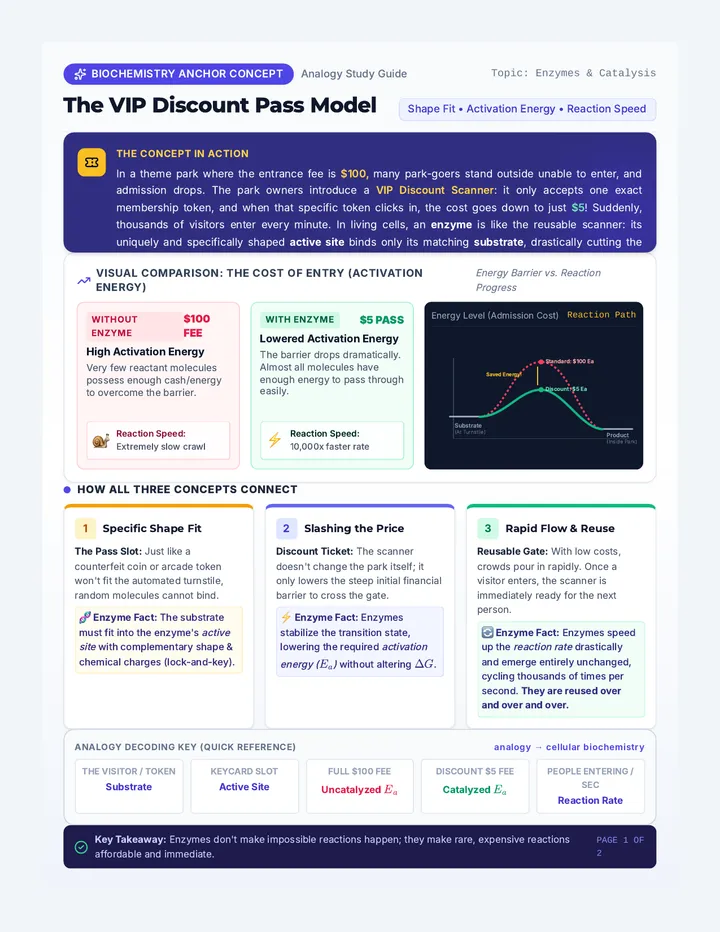
A comprehensive biology lesson investigating how enzymes accelerate biochemical reactions by lowering activation energy. Students analyze reaction coordinate graphs, trace molecular mechanics, and apply energy diagrams to metabolic processes.
6. Look at the table above. Which enzyme saves more total energy: Catalase or Sucrase? By how many kilojoules?
7. In your own words, why does lowering the energy hurdle allow food to digest in seconds instead of years?
5 Part 5: Easy Graph Drawing Challenge
Student Coordinate Grid Sketch both curves
Energy [kJ] Progress \(\rightarrow\)
Sketch an Endergonic Reaction:
Use these super-simple target numbers:
• Start (Reactants) = \(20\text{ kJ}\)
• End (Products) = \(60\text{ kJ}\)
• High Peak (No Enzyme) = \(100\text{ kJ}\)
• Lower Peak (With Enzyme) = \(50\text{ kJ}\)
Label which curve is "With Enzyme" and which curve is "Without Enzyme".
Barrier Breakers • Biology Instructional Series Page 2 of 2 • Assessment Ready
Rubric: 1 pt for explaining shape change/detaching; 1 pt for stating enzyme is undamaged and reusable.
Teaching Tip: Use the "speed bump" analogy. An uncatalyzed reaction is a massive hill that requires a lot of gas to climb; an enzyme bulldozes the hill into a small speed bump.
Barrier Breakers • Teacher Guide Page 1 of 2 • Solutions Continued →
Teacher Key • Page 2
Parts 3, 4 & 5 Solutions
Standards-Aligned Solutions
3 Part 3 Solutions: Understanding Energy Rules (4 pts)
4. Why Net Energy Released Never Changes (2 pts)
Solution: The net energy released depends only on the starting fuel (\(50\text{ kJ}\)) and the final products (\(30\text{ kJ}\)). Because an enzyme only speeds up the middle step and never changes what the starting or ending molecules are, the net difference is always \(50 - 30 = \mathbf{20\text{ kJ}}\).
5. Why Cells Cannot Just Heat Up (2 pts)
Solution: Heating a cell to \(100^\circ\text{C}\) would cook and denature its proteins and melt its cell membranes, destroying the cell. Enzymes allow reactions to happen at high speeds at safe, moderate body temperatures (\(37^\circ\text{C}\)).
4 Part 4 Solutions: Real-World Energy Numbers (4 pts)
6. Comparison Calculation (2 pts)
• Catalase: \(75 - 10 = 65\text{ kJ saved}\)
• Sucrase: \(100 - 30 = 70\text{ kJ saved}\)
Answer:Sucrase saves more total energy by \(5\text{ kJ}\) (\(70 - 65 = 5\)).
7. Speed Explanation in Plain Words (2 pts)
Solution: When the hurdle is tall (\(100\text{ kJ}\)), almost no molecules have enough natural energy to get over it, so the reaction is extremely slow. When the enzyme cuts the hurdle to \(30\text{ kJ}\), almost every molecule has enough natural heat energy to jump over immediately.
5 Part 5: Easy Graph Drawing Solution (6 pts)
Energy [kJ] Progress \(\rightarrow\) Start: 20 kJ End: 60 kJ No Enzyme: 100 kJ With Enzyme: 50 kJ
Grading Checklist (6 pts):
• 1 pt: Starting level at \(20\text{ kJ}\)
• 1 pt: Ending level higher at \(60\text{ kJ}\)
• 1 pt: Red curve reaches \(100\text{ kJ}\)
• 1 pt: Green curve reaches \(50\text{ kJ}\)
• 1 pt: Clearly labeled "With" and "Without"
• 1 pt: Clean curves starting & ending together
Simple Check: Did Students Subtract Correctly?
Make sure students subtract from the reactant baseline (\(50\text{ kJ}\)) rather than from zero. The hurdle without enzyme is \(150 - 50 = \mathbf{100\text{ kJ}}\), not \(150\text{ kJ}\).