Atomic Scale Presentation Slides
NYS P-12 SCIENCE • GRADE 8 Unit 1: Foundations of Living Matter
NYSSLS MS-PS1-1 & MS-LS1-1
Complete Student Lesson Deck • Mirroring Student Packet
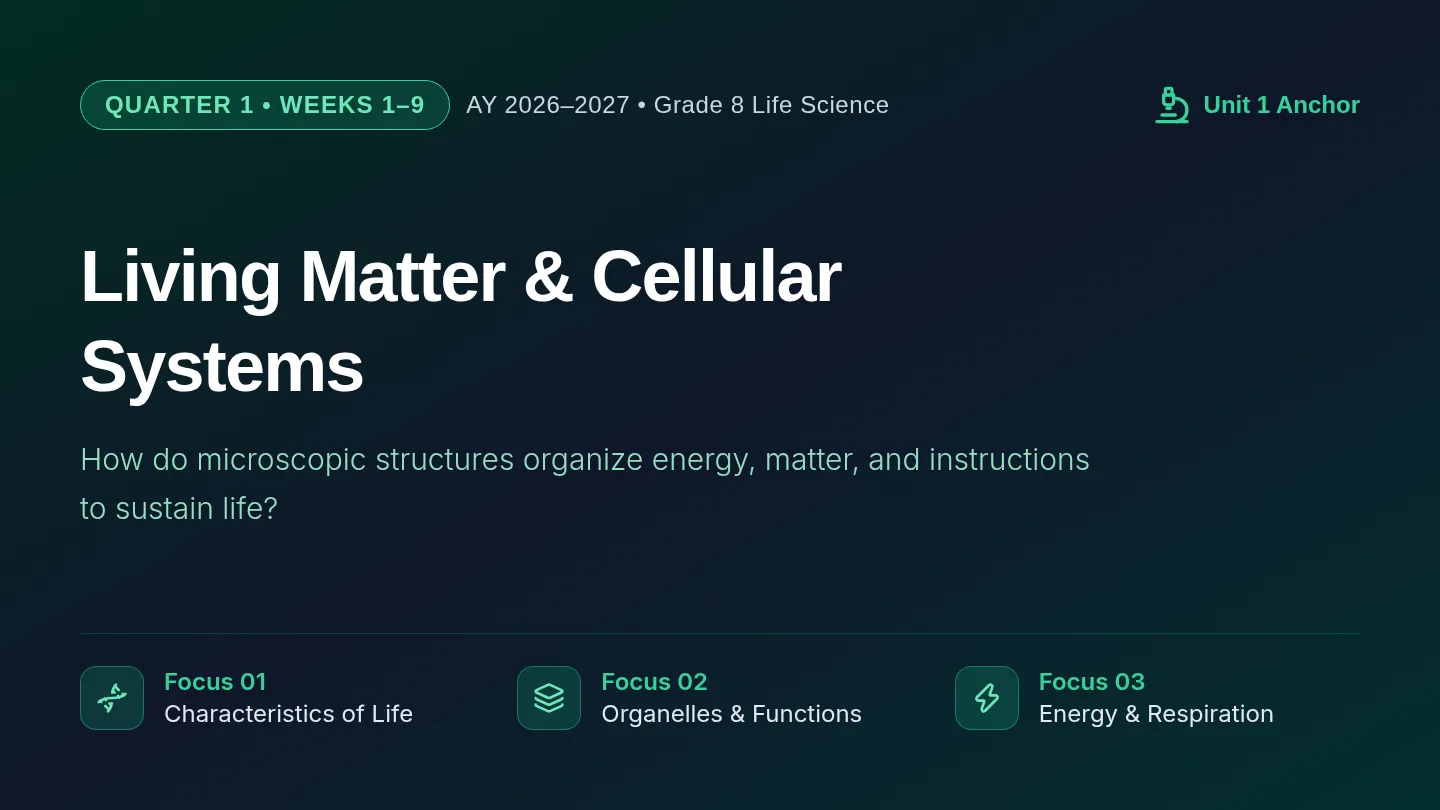
Atomic & Molecular Scale
How atoms bond to form molecules, store vital chemical energy, and power living organisms.
Target Classes: 8A 8B 8C 8D
NOTICE: All unfinished packet work is homework!
GOAL & PURPOSE
Student Learning Objective
Sheet 1 • Front & Back
ENGLISH OBJECTIVE
“I can understand that all matter is made of tiny particles called atoms, that chemical bonds connect atoms to form molecules, and that chemical bonds store chemical energy that living things use.”
OBJETIVO EN ESPAÑOL
“Puedo entender que toda la materia está hecha de partículas diminutas llamadas átomos, que los enlaces químicos conectan átomos para formar moléculas, y que los enlaces químicos almacenan energía química que los seres vivos utilizan.”
Step 1: Atoms Basic Particles
Step 2: Chemical Bonds Form Molecules
Step 3: Stored Energy Powers Life
PART 1 • 5 MIN DO NOW
NYS Grade 8 ILS Test (June 2015, Q14)
Exam Verbatim
Official Exam Question:
“Which statement best describes all matter?”
¿Qué afirmación describe mejor a toda la materia?
(1)
Has mass & space Tiene masa y ocupa espacio
(2)
Only solid Solo sólida
(3)
Made of cells Hecha de células
(4)
Naked eye only Simple vista
Packet Prompt: “Give one example of matter in this classroom / Ejemplo de materia en el salón.”
Write on your packet page!
PART 2 • ACADEMIC VOCABULARY
The Building Blocks of Matter
8th-Grade Scientific Reference
MATTER Materia
Anything with mass and volume (takes up space). All matter is composed of basic particles called atoms.
Key Rule: If it has weight & takes up space, it is matter!
ATOM Átomo
The smallest particle of an element and the fundamental basic building block that makes up all matter.
Key Rule: Cannot be broken down chemically into smaller parts!
ELEMENT Elemento
A pure substance made entirely of only one specific type of atom (such as pure carbon, oxygen, or hydrogen).
Examples: Carbon (C), Oxygen (O), Hydrogen (H)
All non-living and living structures begin with atoms of specific elements! Matter ➔ Elements ➔ Atoms
PART 2 • ACADEMIC VOCABULARY
Bonds, Molecules & Stored Energy
8th-Grade Scientific Reference
CHEMICAL BOND Enlace
The physical attraction connecting two or more atoms together securely in a molecule.
Key Action: Bonds act like chemical glue holding atoms in place.
MOLECULE Molécula
A particle formed when two or more atoms connect by chemical bonds (examples: water H₂O, glucose sugar C₆H₁₂O₆).
Examples: Water (H₂O), Carbon Dioxide (CO₂), Sugar
CHEMICAL ENERGY Energía
The form of energy stored in chemical bonds holding atoms; released when cells break those bonds.
Living Function: Released during cellular respiration to make ATP!
Atoms connect with Bonds ➔ Creates Molecules ➔ Bonds Store Chemical Energy! Essential for All Life
PART 3 • 4 MIN WORD WALL CHECK
NYS ILS June 2016 (Question 18 Verbatim)
Quick Assessment
OFFICIAL WORD WALL BANK
MATTER ATOM BOND MOLECULE ENERGY
Prompt: “All matter is made of:”
(1) cells
(2) atoms
(3) organs
(4) tissues
Packet Written Challenge:
“Circle answer (2) and use the definition of atom to explain your choice.”
Hint: An atom is the basic building block that makes up all matter, both living and non-living!
PART 4 • 10 MIN MINI-LESSON
Law of Conservation of Matter
Core Science Principle
Fundamental Law of the Universe:
“Matter cannot be created or destroyed in chemical reactions.”
La materia no se crea ni se destruye en reacciones químicas.
Atoms Only Rearrange
During chemical reactions, bonds break and atoms are simply rearranged to form new molecules. No atoms are lost or gained.
The Sugar & Water Evidence
The combined mass of water and sugar before stirring equals the exact combined mass after stirring them together.
Total Count of Carbon, Hydrogen & Oxygen in Inputs = Total Count of Carbon, Hydrogen & Oxygen in Products
PART 4 • 10 MIN MINI-LESSON
The Yield Sign (➔) & Living Reactions
Direct Guide
STARTING FORMULAS (LEFT) [ INPUTS / REACTANTS ]
Yields (➔)
RESULTING FORMULAS (RIGHT) [ PRODUCTS / OUTPUTS ]
Aerobic Respiration: (With Oxygen O₂)
C₆H₁₂O₆ + 6 O₂ ➔ 6 CO₂ + 6 H₂O + Energy Released
Anaerobic Respiration: (No Oxygen O₂)
C₆H₁₂O₆ ➔ Lactic Acid + Energy Released
Photosynthesis: (Plants / Light)
6 CO₂ + 6 H₂O + Light ➔ C₆H₁₂O₆ + 6 O₂
* Critical Fact: Cells use released chemical energy to build ATP molecules, the usable energy currency in plant and animal cells.
PART 4 • VISUAL MODELS
Molecular Models: Water & Carbon Dioxide
Counting Atoms
WATER MOLECULE H₂O
O
H
H
2 Hydrogen atoms + 1 Oxygen atom
Total: 3 atoms in 1 water molecule
CARBON DIOXIDE CO₂
O
C
O
1 Carbon atom + 2 Oxygen atoms
Total: 3 atoms in 1 CO₂ molecule
The subscripts (small numbers like ₂ in H₂O) indicate how many atoms of that specific element exist in one molecule.
PART 5 • 20 MIN ACTIVITY (PAGE 3)
NYS Grade 8 Exam Questions: Q1 & Q2
Sheet 2 • Practice
Q1 • June 2019, Q24 Verbatim
“A student dissolves 20 grams of sugar in 100 mL of water. Which statement best explains why the sugar can no longer be seen?”
(1) Molecules destroyed.
(2) Dissolved into particles too small to be seen.
(3) Evaporated as gas.
(4) Reacted to form a new element.
Q2 • June 2017, Q23 Verbatim
“The diagram represents a model of a water molecule. Based on the diagram and chemical formula H₂O, how many total atoms are present in one water molecule?”
O
H
H
(1) 1
(2) 2
(3) 3
(4) 4
Record and circle your answers on Sheet 2 (Page 3 of the packet). Check with your partner!
PART 5 • EXTENDED RESPONSE
NYS Exam Question: Q3
June 2016, Q53 [1 Pt]
Question Prompt: Conservation Proof
“Explain how the equation for cellular respiration confirms that no atoms are lost during this chemical reaction.”
C₆H₁₂O₆ + 6 O₂ ➔ 6 CO₂ + 6 H₂O + Energy
Carbon (C) Atoms 6 in ➔ 6 out
Hydrogen (H) Atoms 12 in ➔ 12 out
Oxygen (O) Atoms 18 in ➔ 18 out
Model Student Written Response: “The total number and types of atoms on the input side (6 C, 12 H, 18 O) exactly equals the total count on the product side, proving no atoms were lost.”
PART 5 • EXTENDED RESPONSE
NYS Exam Question: Q4
June 2019, Q46 [1 Pt]
Question Prompt: Photosynthesis Stored Energy
“State the form of energy stored in the food made by the plant during photosynthesis.”
Indica la forma de energía almacenada en el alimento producido en la fotosíntesis.
Input Energy: Light Energy (Luz)
Stored in Food (Glucose): Chemical Energy
Correct Packet Answer: Chemical Energy (Energía Química)
Stored inside the bonds connecting atoms in glucose sugar!
PART 5 • EXTENDED RESPONSE
NYS Exam Question: Q5
Sheet 2 • Page 3 [1 Pt]
Q5 • NYS June 2018, Q51 Verbatim [1 Pt] Core Life Function
“Explain why organisms break down food molecules during cellular respiration.”
Explica por qué los organismos descomponen moléculas de alimentos en la respiración celular.
Step 1: Chemical Bonds
Food molecules like glucose contain energy stored in their bonds.
Step 2: Breaking Bonds
Cells break down these bonds during respiration to release that energy.
Step 3: Powering Life
The released energy is transferred into ATP to power all cellular life functions.
Packet Response Key: “Organisms break down food molecules to release stored chemical energy needed to carry out life processes and build ATP molecules.”
PART 6 • 5-MINUTE EXIT SLIP
Final Assessment & Self-Check
Sheet 2 • Page 3 & 4
NYS Grade 8 ILS Test (June 2015, Question 49 Verbatim) [1 Pt] Independently Completed
“Identify one reason organisms need to break down food molecules during cellular respiration.” [1]
Identifica una razón por la cual los organismos necesitan descomponer las moléculas de alimento durante la respiración celular.
Student Self-Check:
✓ Mastered Conservation & Formulas
? Need Review Before Next Class
Activity Score: ______ / 4 Pts
Teacher Evaluation Rubric:
Exceeds (Supera) Meets (Cumple) Dev (Desarr.)
Reminder: Hand in your packet or finish for homework!
Unit 1: Foundations of Living Matter • Great work on Atomic & Molecular Scale today!
Atomic Scale Teacher Answer Key
NEW YORK STATE P-12 SCIENCE • GRADE 8 LIFE SCIENCE • UNIT 1 TEACHER SCORING GUIDE
Atomic & Molecular Scale: Answer Key
Standards: NYSSLS MS-PS1-1 & MS-LS1-1 • Classes: 8A, 8B, 8C, 8D
Packet Mapping Sheet 1 • Front (Page 1)
Mastery Goal (Bilingual Benchmark)
“Students must explain that all matter is composed of atoms, chemical bonds hold atoms together into molecules, and bonds store chemical energy that cells release to make ATP.”
PART 1 5-Minute Do Now [NYS Grade 8 ILS Test, June 2015, Q14 Verbatim]
Correct: Choice (1)
Exam Question: “Which statement best describes all matter?”
Correct Answer & Rationale:
(1) Has mass & space (Tiene masa y espacio)
By scientific definition, matter is anything that has mass and takes up volume.
Distractor Analysis:
(2) Only solid: False; liquids and gases are matter.
(3) Made of cells: False; only living matter has cells.
(4) Naked eye only: False; atoms and air cannot be seen.
Acceptable Room Examples: Desk, pencil, air, student, water bottle, paper, notebook, chair, floor tile, door, backpack. (Non-examples: light, heat, sound, electricity).
PART 2 Academic Vocabulary List (Complete 8th-Grade Definitions)
Student Reference Key
Matter (Materia)
Anything with mass and volume. Composed of basic particles called atoms.
Atom (Átomo)
Smallest particle of an element and basic building block that makes up all matter.
Element (Elemento)
Pure substance made entirely of one specific type of atom (e.g., C, H, O).
Chemical Bond (Enlace)
Physical attraction connecting two or more atoms together in a molecule.
Molecule (Molécula)
Particle formed when 2+ atoms connect by chemical bonds (water H₂O, glucose).
Chemical Energy (Energía)
Form of energy stored in bonds; released when cells break bonds to build ATP.
PART 3 4-Minute Word Wall Check [NYS ILS June 2016, Question 18]
Correct: Choice (2) atoms
Prompt: “All matter is made of: (1) cells (2) atoms (3) organs (4) tissues”
Scoring Criterion for Written Explanation:
Student must state that atoms are the basic building blocks of all matter, including non-living substances. Cells, tissues, and organs only apply to living organisms, but even cells are constructed out of atoms bonded into molecules.
NYS Grade 8 Life Science • Unit 1 Foundations of Living Matter Page 1 of 3 • Turn to Sheet 1 Back (Mini-Lesson & Equations)