Science Scope Curriculum Guide
Curriculum Blueprint Grade 7 • Academic Year Pacing
Middle School Science Scope & Sequence
36-Week Integrated State & NGSS Science Standards Alignment Matrix
Instructional Target
180 Days / 4 Quarters
Integrated Progression
3-Dimensional Science Pedagogical Vision
This Grade 7 curriculum anchors student learning in phenomenon-driven inquiry, synthesizing Disciplinary Core Ideas (DCI) across Physical, Life, and Earth systems with rigorous Science & Engineering Practices (SEP) and Crosscutting Concepts (CCC). Students transition from observation to evidence-based mechanical explanations.
Yearlong Instructional Pacing & Unit Sequence
4 Core Instructional Units • 9 Weeks Per Quarter
| Quarter | Unit Title & Focus | Standards | Anchoring Phenomenon | Key Milestone |
|---|
| Q1 Wks 1–9 | Unit 1: Matter & Thermal Transformations Atomic structure, thermal energy transfer, chemical reactions | MS-PS1-1 | | |
| MS-PS1-2 | | | | |
| MS-PS1-4 | The Self-Heating MRE Ration: How molecular collisions generate rapid thermal shifts without a flame. | Thermal Device Prototype | | |
| Q2 Wks 10–18 | Unit 2: Cellular Systems & Organization Cell anatomy, organelle roles, system hierarchy & homeostasis | MS-LS1-1 | | |
| MS-LS1-2 | | | | |
| MS-LS1-3 | The Marathon Runner Collapse: How cellular oxygen starvation and cellular membrane breakdown halts muscle systems. | Homeostasis Model Defense | | |
| Q3 Wks 19–27 | Unit 3: Dynamic Earth & Climate Cycles Plate tectonics, rock cycling, geoscience processes & atmospheric change | MS-ESS2-1 | | |
| MS-ESS2-2 | | | | |
| MS-ESS2-4 | The Submerged Ancient City: How seafloor spreading and tectonic uplift reconfigure coastlines over deep time. | Geologic Hazard Mitigation Plan | | |
| Q4 Wks 28–36 | Unit 4: Ecological Networks & Human Impact Trophic energy flows, symbiosis, biodiversity loss & conservation | MS-LS2-1 | | |
| MS-LS2-3 | | | | |
| MS-ESS3-3 | The Kelp Forest Collapse: How apex predator removal cascades into barren sea urchin dominated ecosystems. | Ecosystem Restoration Proposal | | |
Crosscutting Concepts
Threaded consistently across all units: Patterns in matter and cellular structure, Energy & Matter conservation, and Scale, Proportion & Quantity in deep geologic time and microscopic cells.
Inquiry & Lab Ratios
Instructional time is mandated at 40% hands-on laboratory investigation, 30% collaborative modeling & data synthesis, and 30% direct concept consolidation and formative evaluation.
State Performance Gates
Quarterly summative assessments incorporate standard-calibrated three-dimensional cluster items alongside performance-based laboratory rubrics to evaluate authentic problem-solving.
7th Grade Science Instructional Guide • Core Standards Alignment Page 1 of 4 • Curriculum Roadmap Overview
Semester 1 Coursework • 18 Weeks
Physical & Cellular Systems Detail
Q1: Matter Q2: Cells & Systems
UNIT 1
Matter, Energy Transfer & Chemical Reactions
Weeks 1–9 • Focus Standards: MS-PS1-1, MS-PS1-2, MS-PS1-4, MS-PS1-5, MS-PS3-4
45 Class Periods
Essential Questions
- How does atomic rearrangement dictate physical & chemical properties?
- How does thermal energy transfer alter particle kinetic states?
- What evidence confirms that total mass is conserved during reactions?
Core Laboratory Inquiries
- Lab 1.1: Thermal Particle Chamber: Investigating molecular motion of gas and liquid particles across temperature gradients.
- Lab 1.2: Conservation of Mass: Closed vs. open system reaction tracking baking soda and acetic acid.
Pacing Breakdown
Wks 1–3: Atomic Models & Molecules MS-PS1-1
Wks 4–6: Thermal Energy & State Changes MS-PS1-4
Wks 7–9: Chemical Reactions & Conservation MS-PS1-2, 5
Summative Capstone Challenge
Engineering Design Task: Construct an insulated portable food/beverage thermal pack utilizing an endo- or exothermic salt dissolution reaction that maintains desired temp for 15+ minutes.
UNIT 2
Cellular Anatomy, Organization & Homeostasis
Weeks 10–18 • Focus Standards: MS-LS1-1, MS-LS1-2, MS-LS1-3, MS-LS1-8
45 Class Periods
Essential Questions
- What defines a living organism at the microscopic scale?
- How do specialized organelles coordinate life functions?
- How do organ systems interconnect to maintain internal homeostasis?
Core Laboratory Inquiries
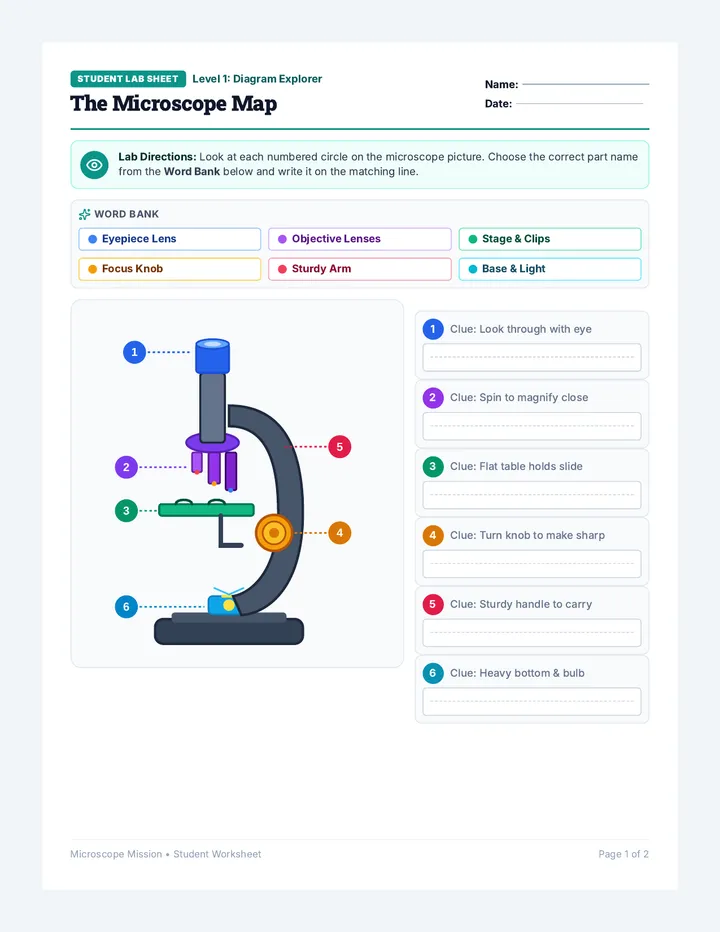
- Lab 2.1: Microscopic Living World: Slide preparation and organelle identification using Elodea, cheek epithelial cells, and pond microorganisms.
- Lab 2.2: Cellular Diffusion & Membrane Dynamics: Dialysis tubing and starch/iodine investigation testing selective permeability.
Pacing Breakdown
Wks 10–12: Cell Theory & Microscopic Anatomy MS-LS1-1
Wks 13–15: Organelles, Nucleus & Cell Membrane MS-LS1-2
Wks 16–18: Tissue-Organ Hierarchies & Sensory Reflexes MS-LS1-3, 8
Summative Capstone Challenge
Human Body Defense Case Study: Trace how cardiovascular, respiratory, and nervous systems dynamically readjust heartbeat and oxygen distribution during intense aerobic stress.
7th Grade Science Instructional Guide • Core Standards Alignment Page 2 of 4 • Semester 1 Scope Detail
Semester 2 Coursework • 18 Weeks
Earth Dynamics & Ecological Networks
Q3: Dynamic Earth Q4: Ecology & Humans
UNIT 3
Dynamic Earth Systems & Geologic Change
Weeks 19–27 • Focus Standards: MS-ESS2-1, MS-ESS2-2, MS-ESS2-3, MS-ESS2-4, MS-ESS3-2
45 Class Periods
Essential Questions
- How does energy from Earth’s interior drive rock cycling and tectonic shifts?
- How do weathering and erosion reshape landforms across varying timescales?
- What evidence from fossil layers supports continental drift theory?
Core Laboratory Inquiries
- Lab 3.1: Mantle Convection Currents: Fluid-density tank modeling heat transfer mechanisms driving seafloor spreading.
- Lab 3.2: Stream Table Sedimentation: Simulating hydraulic erosion rates, delta deposition, and structural stability.
Pacing Breakdown
Wks 19–21: Rock Cycle & Mineral Composition MS-ESS2-1
Wks 22–24: Plate Tectonics & Continental Evidence MS-ESS2-2, 3
Wks 25–27: Geoscience Hazards & Earth Surface Reshaping MS-ESS3-2
Summative Capstone Challenge
Natural Hazard Mitigation Proposal: Engineer and evaluate a low-cost municipal building foundation or early-warning sensor protocol for earthquake or landslide prone zones.
UNIT 4
Ecosystem Interactions, Biodiversity & Human Impact
Weeks 28–36 • Focus Standards: MS-LS2-1, MS-LS2-2, MS-LS2-3, MS-LS2-4, MS-LS2-5, MS-ESS3-3
45 Class Periods
Essential Questions
- How does energy move through trophic pyramids while matter cycles?
- How do symbiotic and competitive relationships regulate population sizes?
- How does biodiversity loss undermine ecological resilience and human wellbeing?
Core Laboratory Inquiries
- Lab 4.1: Micro-Ecosystem Terrariums: Tracking dissolved oxygen, nitrogen cycles, and carbon flux in closed aquatic/terrestrial chambers.
- Lab 4.2: Schoolyard Biodiversity Audit: Quadrant sampling of native vs. invasive flora to calculate Simpson’s Diversity Index.
Pacing Breakdown
Wks 28–30: Trophic Energy Flow & Matter Cycles MS-LS2-3
Wks 31–33: Population Dynamics & Symbiotic Ties MS-LS2-1, 2
Wks 34–36: Biodiversity Services & Conservation Solutions MS-LS2-5, MS-ESS3-3
Summative Capstone Challenge
Ecological Resilience Proposal: Develop an evidence-based management plan to remediate a damaged watershed or local woodland impacted by agricultural runoff or urban fragmentation.
7th Grade Science Instructional Guide • Core Standards Alignment Page 3 of 4 • Semester 2 Scope Detail
Instructional Framework & Support
Inquiry Practices, Assessment & Equity
Implementation Standards
Universal Design for Learning (UDL)
Science & Engineering Practices (SEP) Targeted Mastery
1. Developing Models
Draw, simulate, and physicalize molecular & cellular dynamics.
2. Planning Inquiries
Isolate independent variables; establish controlled baseline trials.
3. Analyzing Data
Construct scatterplots, calculate mean rates, identify trends.
4. CER Explanations
Articulate Claim, Evidence & Scientific Reasoning frameworks.
Grading & Assessment Architecture
Lab Investigations & Engineering Practicals 35%
Summative Unit Performance Assessments 30%
Formative Checks, CER Exit Slips & Models 20%
Scientific Notebooks & Data Logs 15%
Laboratory Safety & Protocols (NSTA)
- Pre-Lab Assessment: 100% mastery on safety contract required prior to chemical handling.
- PPE Adherence: Indirectly vented chemical splash goggles worn during all liquid reagents.
- Safe Waste Disposal: Neutralization protocols enforced; no hazardous reagents drain-disposed.
Universal Differentiation & Scaffolding Matrix
English Language Learners (ELL)
- • Visual vocabulary word walls with morphological roots (e.g., thermo-, endo-).
- • Sentence starters for CER writing (e.g., "The evidence indicates... because...").
- • Dual-language science concept diagrams and video captions.
IEP & 504 Accommodations
- • Chunked multi-step lab procedures with pictorial checkpoints.
- • Tactile manipulative models (magnetic atoms, 3D organelle replicas).
- • Speech-to-text options for digital observation logs.
Advanced & Extension Learners
- • Open inquiry: Student-designed independent variable lab modifications.
- • Mathematical modeling: Quantitative reaction rate calculating.
- • Real-world citizen science data sets (USGS, NOAA, NASA databases).
7th Grade Science Instructional Guide • Core Standards Alignment Page 4 of 4 • Practices, UDL & Assessment Architecture