Lenny.com
Explore
Create
ActivitiesNewMathEnglish Language ArtsScience & EngineeringSocial StudiesGlobal LanguagesHealth & Physical EducationSpecial EducationCounseling & Life SkillsArts & CreativityESL
Lenny.com
Lenny.com
Explore
Create
ActivitiesNewMathEnglish Language ArtsScience & EngineeringSocial StudiesGlobal LanguagesHealth & Physical EducationSpecial EducationCounseling & Life SkillsArts & CreativityESL
Lenny.com
Science & EngineeringLife ScienceLiving ThingsAnimalsPlantsBody SystemsTraitsAdaptationsCellsEcosystemsHeredityGenes to TraitsCell DivisionPhysicsComparing MaterialsShapes and PropertiesMagnetsMagnetismLightSoundLight and SoundMatterStates of MatterChanges of StateMixturesPhysical and Chemical ChangeHeating and CoolingHeat and Thermal EnergyEnergyForce and MotionElectrical CircuitsAtoms and MoleculesPeriodic TableMotion in One DimensionMotion in Two DimensionsScalars and VectorsForces and Laws of MotionCircular Motion and GravityMomentum and ImpulseWork, Energy, and PowerWavesElectromagnetic WavesGeometric OpticsElectricity and MagnetismSimple Harmonic MotionThermodynamicsNuclear PhysicsEarth Science & AstronomyWeatherWater CycleRocks and MineralsFossilsEarth's FeaturesEarth's ResourcesEarth's StructureWeather and ClimateEarth EventsFossils and Geologic TimePlate TectonicsHuman ImpactsAstronomyChemistryUnits and MeasurementAtomic StructurePeriodic TrendsChemical BondingNomenclatureMolecular StructureIntermolecular ForcesThe MoleStoichiometryProperties of GasesSolutionsChemical ReactionsBalancing EquationsEnergy ChangesRates of ReactionsEquilibriumAcids and BasesQuantum ModelBiologyClassificationCell StructureThe Chemistry of LifeBiomoleculesCellular TransportCell EnergyCell Growth and DivisionDNAProtein SynthesisMeiosis and Sexual ReproductionPatterns of InheritanceMulticellular OrganismsEvolutionEcologyBiodiversityComputer ScienceAlgorithms and Computational ThinkingProgramming LanguagesComputing SystemsNetworks and InternetData AnalysisCybersecurityAI and Machine LearningSoftware Design and DevelopmentBlockchainEngineering & AIDesigning ExperimentsEngineering PracticesDesign ThinkingEngineering Design ProcessMechanical EngineeringElectrical EngineeringMaterials and StructuresCAD and 3D DesignRoboticsArtificial Intelligence BasicsVibe CodingMachine LearningAI Ethics and SocietySystems ThinkingEntrepreneurship & InnovationEntrepreneurial MindsetBusiness Idea DevelopmentBusiness Plan BasicsMarketing & Customer DiscoveryFinancial Management for Startups

Water Cycle

Evaporation, condensation, precipitation, and collection processes driven by solar energy. Examines the continuous movement of water through Earth's atmosphere, land, and oceans.

Lenny.com

Solutions

Lenny for EducatorsLenny for SchoolsLenny for Districts

Product

ExploreSign inCreateSupportAbout

Resources

Getting startedMTSS Acceleration Program

© 2026 Lenny Learning Inc.

TermsPrivacyAccessibility
LinkedInInstagramX
Lenny

Videos

How Water and Carbon Cycle Through Earth

How Water and Carbon Cycle Through Earth

In this engaging episode of Crash Course Ecology, Hank Green explores the fundamental recycling systems of our planet: the Hydrologic (Water) Cycle and the Carbon Cycle. The video explains that Earth is essentially a closed system regarding matter, meaning every atom currently on Earth has been here since the planet's formation, constantly being repurposed through biogeochemical cycles. The narration breaks down complex processes into understandable components, moving from the movement of water through states of matter to the movement of carbon through living and non-living reservoirs.

CrashCourseCrashCourse

10mins 4s

How Clouds, Wind, and Temperature Create Weather

How Clouds, Wind, and Temperature Create Weather

This engaging Earth Science video explores the fundamental mechanics of weather, breaking down how invisible factors like temperature, humidity, and wind interact to create the conditions we experience every day. Hosted by an energetic narrator, the lesson explains the science behind atmospheric changes, moving from basic concepts to the formation of specific cloud types. It uses clear visuals and animations to demonstrate how air masses move and interact to form clouds like Cirrus, Cumulus, Stratus, and the massive Cumulonimbus. The video progresses from everyday weather to severe weather events, providing scientific explanations for blizzards, hurricanes, and tornadoes. It details the specific conditions required for each of these dangerous phenomena to form, such as warm ocean waters fueling hurricanes or the interaction of hot and cool air masses creating the spin of a tornado. The content emphasizes the physical processes behind these events rather than just describing them. For educators, this resource serves as an excellent core lesson for units on meteorology or the water cycle. It effectively bridges the gap between simple observation (looking at clouds) and scientific understanding (knowing why those clouds formed). The video encourages critical thinking by asking students to predict weather based on cloud types and highlights the vital role of meteorologists in keeping communities safe through prediction and preparation.

Miacademy & MiaPrep Learning ChannelMiacademy & MiaPrep Learning Channel

10mins 14s

Exploring the World's Major Mountain Ranges

Exploring the World's Major Mountain Ranges

This educational video takes students on a global tour of Earth's most significant mountain ranges, beginning with a clear explanation of geological formation. It illustrates how tectonic plate collisions and volcanic activity push the Earth's crust upward to create these massive structures. The video defines what a mountain range is and sets the stage for a detailed exploration of specific ranges across different continents. The content dives deep into four major mountain systems: the Alps in Europe, the Rockies in North America, the Andes in South America, and the Himalayas in Asia. For each range, the video highlights unique characteristics, including specific flora (like Edelweiss) and fauna (such as bears, llamas, and condors). It also touches upon human geography, discussing how local cultures—from Swiss cheesemakers to Sherpa guides and Inca farmers—have adapted to life at high altitudes. This resource is highly valuable for geography and earth science classrooms as it bridges physical geography with biology and social studies. It provides concrete examples of altitude zonation, showing how ecosystems change as one moves up a mountain. The video serves as an excellent tool for teaching about plate tectonics, animal adaptations, and the critical role mountains play in the global water cycle.

Next Generation ScienceNext Generation Science

6mins 34s

Exploring Earth's Four Spheres and Their Interactions

Exploring Earth's Four Spheres and Their Interactions

This comprehensive science video explores the four fundamental subsystems of Earth: the Geosphere, Hydrosphere, Atmosphere, and Biosphere. It begins by defining each sphere individually, establishing a clear understanding of the solid earth, water bodies, gaseous envelope, and living organisms that make up our planet. The narrative highlights that Earth's ability to sustain life is not a coincidence but the result of a delicate balance between these four distinct yet interconnected systems. The video delves deep into the complex interactions between these spheres, moving beyond simple definitions to systems thinking. It illustrates specific examples of interdependence, such as how volcanic eruptions (Geosphere) impact air quality (Atmosphere), how the water cycle (Hydrosphere/Atmosphere) distributes heat and moisture, and how photosynthesis (Biosphere) regulates atmospheric gases. Visuals range from diagrams of Earth's interior layers to footage of diverse ecosystems, weather phenomena, and geological processes. For educators, this resource serves as an excellent anchor for units on Earth Systems and Ecology. It supports Next Generation Science Standards (NGSS) regarding Earth's systems and their interactions. The clear segmentation of the video allows teachers to either show the entire overview or focus on specific spheres and their relationships. It is particularly useful for demonstrating cause-and-effect relationships in nature and introducing the concept of Earth as a dynamic, integrated system.
Next Generation ScienceNext Generation Science

16mins 21s

Exploring the World's Rainiest Places and Measuring Rainfall

Exploring the World's Rainiest Places and Measuring Rainfall

In this engaging episode of SciShow Kids, host Jessi and her robot friend Squeaks explore the science behind rainfall and discover why weather patterns vary so drastically across the globe. After Squeaks gets rained out of his kite-flying plans, the duo investigates why some locations on Earth are much wetter than others. The video introduces young viewers to the concept of global weather variance, explaining how geography—specifically mountains, valleys, and proximity to oceans—creates unique climates. It takes students on a virtual field trip to record-breaking locations like Mount Waiʻaleʻale in Hawaii and the villages of Cherrapunji and Mawsynram in India, using fun comparisons like giraffes and buildings to visualize rainfall amounts. The video covers key earth science themes including the water cycle, the influence of topography on weather (orographic lift simplified), and the seasonal impact of monsoons. It also integrates mathematics and measurement by introducing rain gauges and the metric unit of millimeters. The narrative explains complex concepts through accessible analogies, such as comparing wind moving through valleys to gravy flowing through a mashed potato channel, helping students understand how landscapes direct storm clouds. For educators, this video is an excellent dual-purpose resource that combines Earth Science with practical measurement skills. It seamlessly transitions from theoretical learning about global climates to a hands-on engineering activity where students learn to build their own rain gauge using simple household items. This allows teachers to bridge the gap between learning about weather and actually observing and recording data, making it a perfect launchpad for a weather observation unit or a lesson on climate geography.

SciShow KidsSciShow Kids

7mins 7s

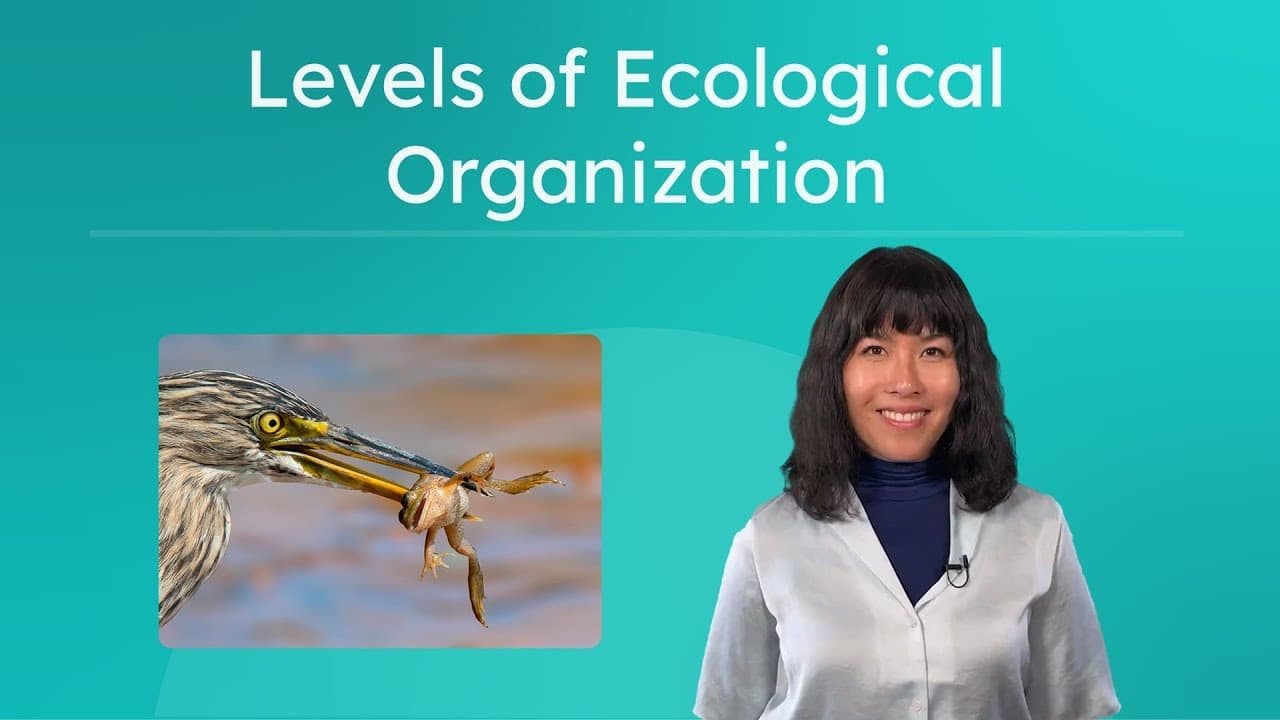
How Nature Is Organized: From Communities to the Biosphere

How Nature Is Organized: From Communities to the Biosphere

This educational video provides a clear and structured exploration of ecological organization, moving beyond the cellular level to examine how life is organized on a macro scale. It systematically breaks down the hierarchy of life, starting with biological communities (biocenosis), expanding to ecosystems which include non-living factors, and culminating in the global biosphere. The narrator uses clear definitions, diagrams, and real-world examples—such as coral reefs and predator-prey relationships—to illustrate how these levels interact and function together.

Miacademy & MiaPrep Learning ChannelMiacademy & MiaPrep Learning Channel

11mins 39s

Materials

Earth Spheres Reading Worksheet

Earth Spheres Reading Worksheet

A two-page printable reading comprehension worksheet on Earth's four spheres (geosphere, hydrosphere, atmosphere, and biosphere) and their interactions, featuring the reading passage and scaffolded short-answer questions with sentence frames.

EG

Emily Gianni

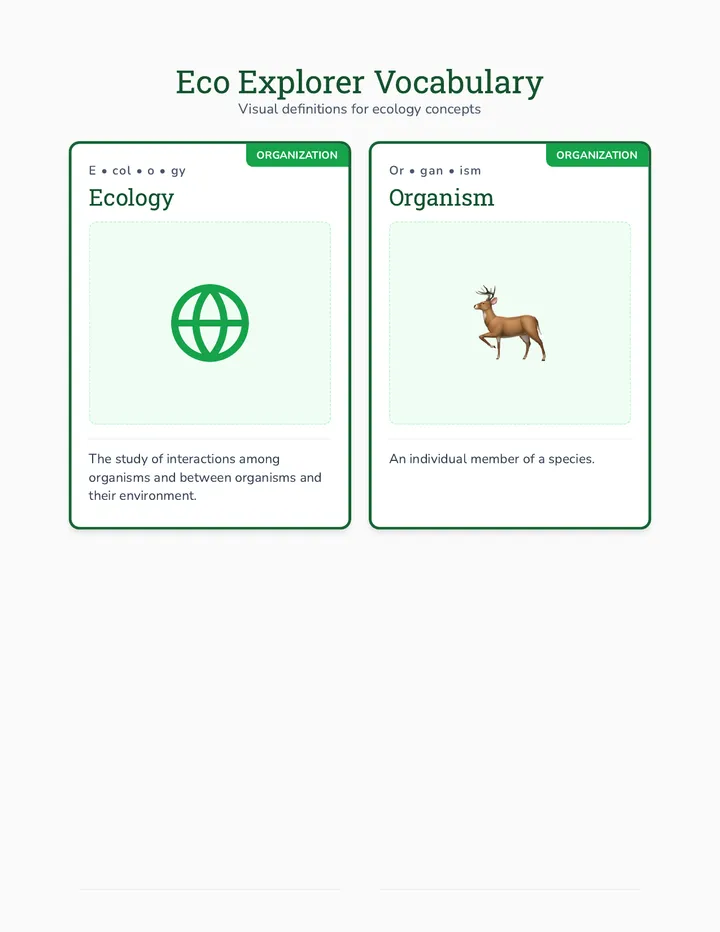
Eco Explorer Flashcards

Eco Explorer Flashcards

A comprehensive set of 29 visual vocabulary flashcards for Ecology. Each card features the term broken into syllables, a thematic visual icon or emoji, and a clear definition, categorized by Levels of Organization, Energy, and Biogeochemical Cycles. Updated to fix page break issues and chemical formula rendering.

J

Jodi.Denton

OSU Science Stay Behind Work Worksheet

OSU Science Stay Behind Work Worksheet

An updated 3rd-grade science worksheet with 12 questions. It features a simplified reading passage on Page 1 and a complete 12-question assessment (Word Bank, multiple choice, true/false, fill-in-the-blank, and short answer) on Page 2 to ensure no content is cut off during printing.

AC

Aaron Conlin

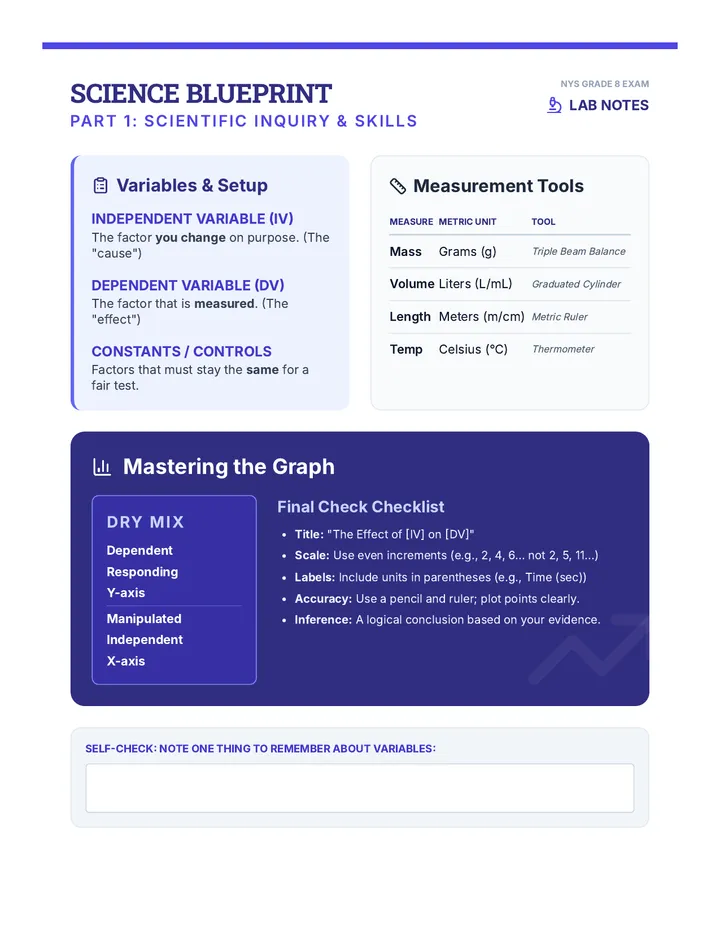
NYS Science Power Pack Study Guide

NYS Science Power Pack Study Guide

A fully optimized 4-page science study guide for the 8th-grade NYS science exam, featuring tight layout, fixed character encoding for chemical formulas with <sub> tags, improved student self-check areas, and clear domain summaries.

AW

Austin WIllis

Earth Systems Atlas Reference

Earth Systems Atlas Reference

A comprehensive 2-page Earth Science anchor chart and student reference guide. It covers Grade 5 topics (Weather, Water Cycle, Global Patterns) and Grade 8 topics (Plate Tectonics, Rock Cycle, Hydrosphere, Atmosphere, and Earth's History) with key vocabulary and diagrams.

KH

Kristina Homesley

Water Works Rubric

Water Works Rubric

A professional, single-page rubric for a Water Cycle project. It includes specific grading criteria for scientific accuracy, vocabulary, diagrams, and organization, with a dedicated feedback area and score box. Cohesive hydrology theme with blue accents.

MB

Marsha Bolden

Sequences

Planet Profile Slides

Infinite Frontier

A comprehensive Hi-Lo unit for 6th graders exploring the scale of the universe, our place in the Milky Way, the technology used to explore space, and the history of human spaceflight.

JS

Janette Sullivan

54
Water World Slides

Earths Dynamic Systems

A series of lessons exploring Earth's major systems, starting with the hydrosphere and its impact on the planet's processes.

JS

Janette Sullivan

36
Science Squad Student Booklet

Science Literacy Journals

A multi-grade collection of scientific reading comprehension and response booklets designed to build disciplinary literacy in Earth, Life, and Physical sciences across elementary and middle school levels.

N

nmack

4
Matter and Mixes Worksheet

Science Summit

A comprehensive end-of-year review for 5th Grade NGSS science standards, organized by domain to ensure mastery of physical, life, and Earth sciences.

MA

Madelyne Ashbaugh

9
Turtle Field Log Handbook Acton

Watershed Guardians

A Grade 5 PBL sequence focused on the hydrosphere and human impact, partnered with Zoo New England. Students investigate the connection between the particulate nature of matter and the survival of fostered endangered turtles in the Nashoba Brook Watershed.

K

kthompson

11
Biosphere Blueprint Slides

Biosphere Dynamics

A comprehensive unit exploring the biosphere, ecosystem stability, and human impact, designed for 9th-grade biology students.

PB

Priyadarshini Bharath

4