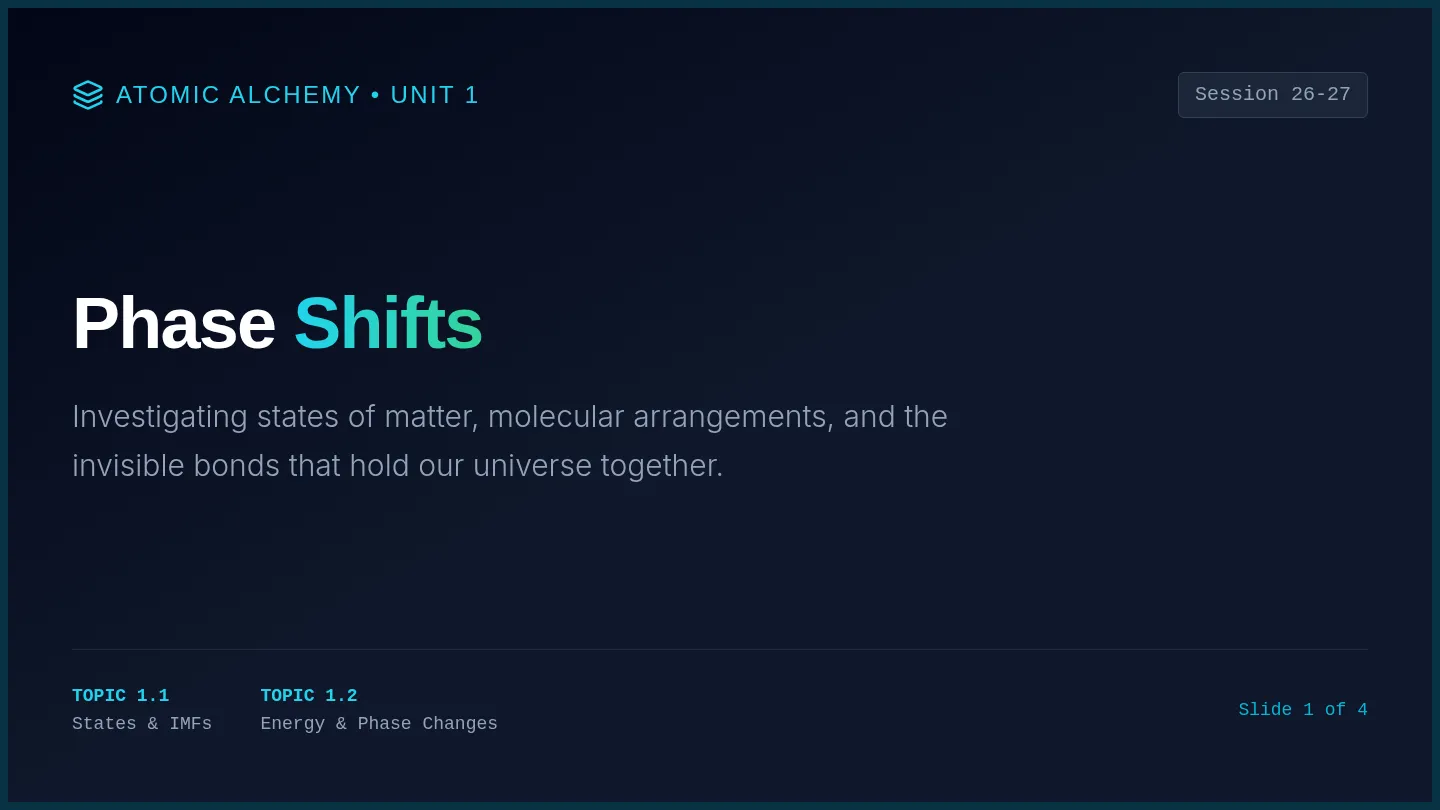
Examines hydrogen bonding, dipole-dipole interactions, and London dispersion forces. Connects molecular polarity to physical properties like boiling points, solubility, and phase changes.
This video provides a comprehensive exploration of the biological importance of water, bridging the gap between molecular chemistry and macroscopic biological functions. It begins by contrasting the diverse life of the Amazon Rainforest with the sparse life of the Sahara Desert to illustrate water's critical role in ecosystems. The narrator then zooms in to the molecular level, explaining the chemical structure of water ($H_2O$), the difference between elements and compounds, and the concept of polarity, using magnets as an analogy for how positive hydrogen and negative oxygen atoms interact.
15mins 32s
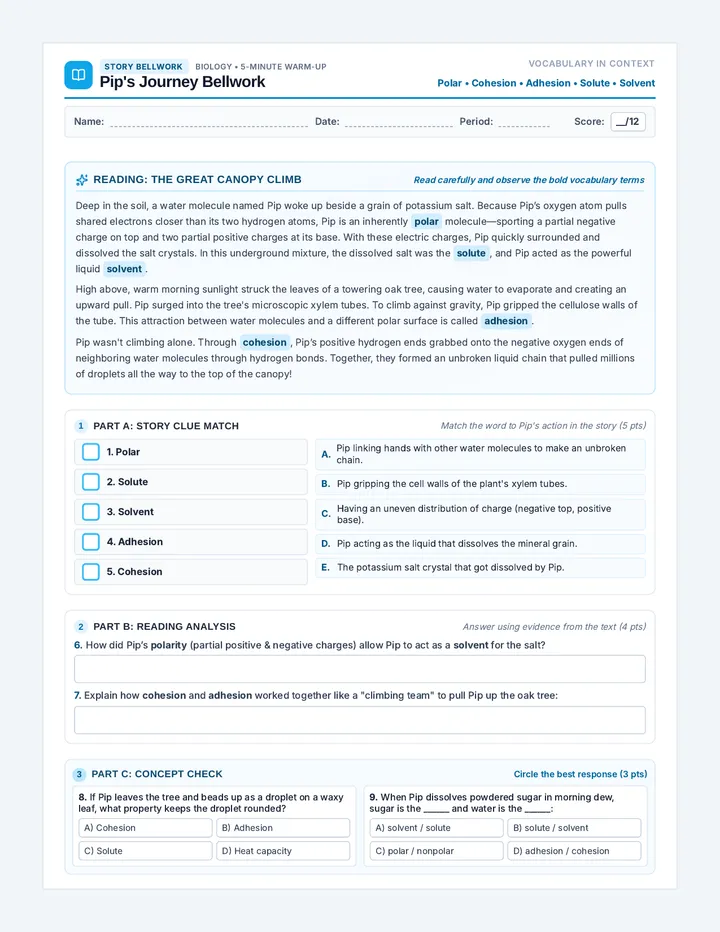
A bellwork review featuring an engaging short story about a water molecule named Pip that demonstrates polarity, cohesion, adhesion, solute, and solvent, paired with story-based vocabulary matching and comprehension questions.
A 2-page interactive science notebook resource featuring color-coded vocabulary in distinct dotted cut-out sections and a unified single-tab 3-flap states of matter particle foldable with increasing energy progression.
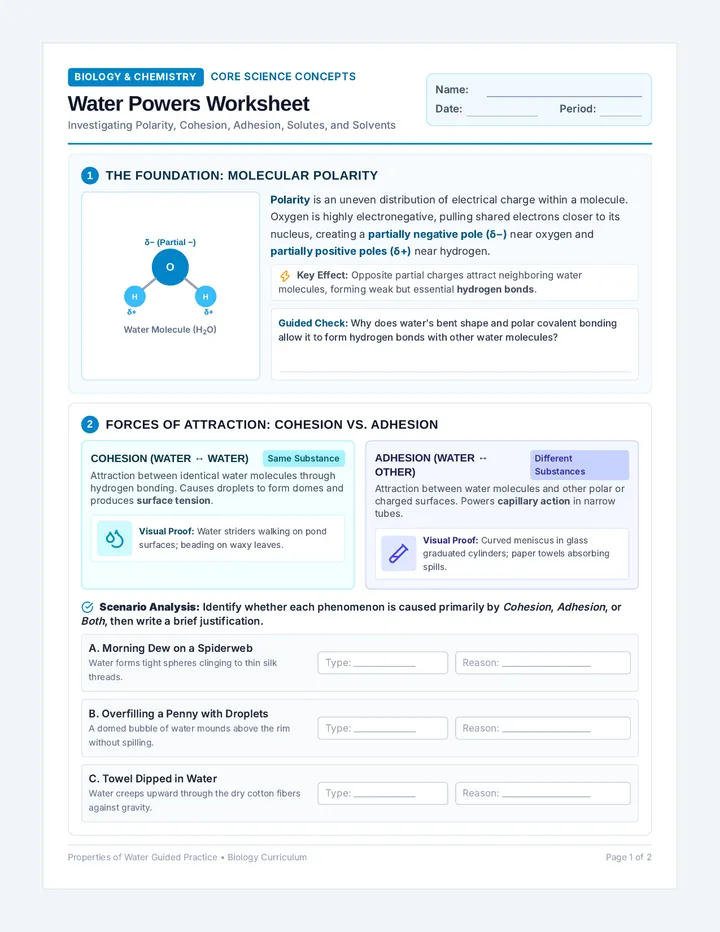
A comprehensive two-page guided practice worksheet exploring the unique properties of water, updated with crystal-clear concrete solute/solvent examples, an explicit modeled anchor row, and labeled hydration diagrams.
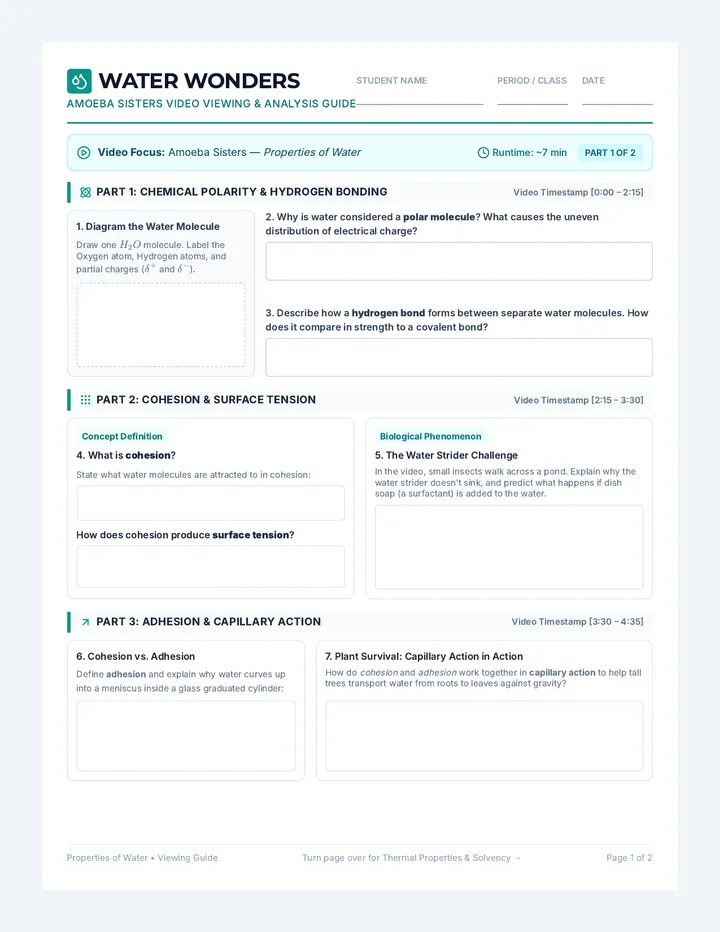
A comprehensive, print-ready two-page video viewing guide for the Amoeba Sisters Properties of Water video. Covers molecular polarity, hydrogen bonding, cohesion, adhesion, capillary action, high specific heat, evaporative cooling, ice density, and solvent properties with clear student response areas.
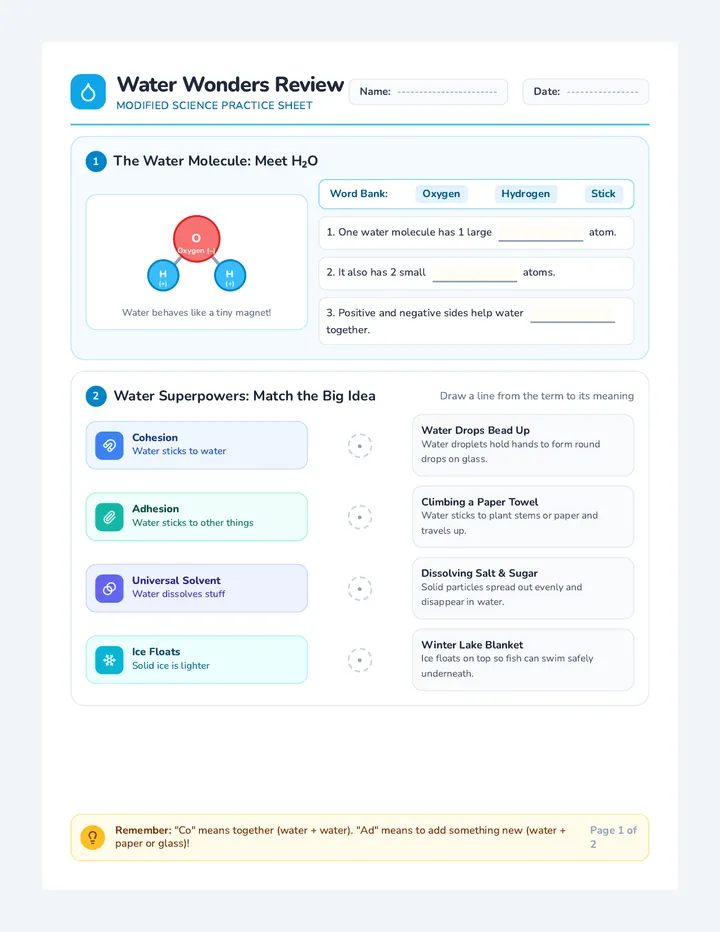
A modified review worksheet on the properties of water designed for students with significant learning disabilities, featuring visual diagrams, simplified language, reduced question count, and scaffolded practice.
A 3-slide projected bell work presentation tailored for a Biology class, reviewing ionic, covalent, hydrogen, and carbon bonding through cellular examples, macromolecule structures, and living phenomena.
A five-day high school chemistry unit exploring thermochemistry, collision theory, enthalpy diagrams, and calorimetry through the lens of body heat and chemical reactions. Students investigate the anchoring phenomenon of exercise-induced heat while mastering TEKS C.13 standards.
A comprehensive 5-day chemistry unit investigating the relationships between gas pressure, volume, temperature, and moles using lab inquiries, mathematical modeling, and real-world applications.
A 10-day exploration of the Behavior of Gases using Kinetic Molecular Theory, various gas laws, and real-world phenomena to understand gas behavior at both molecular and macroscopic scales. Students will investigate compressibility, gas variables, ideal behavior, and mixtures.
A comprehensive review package for CHEM 1406, featuring in-depth study guides for key topics and a full practice exam with detailed solutions.
An immersive chemistry sequence exploring states of matter, physical and chemical transformations, conservation laws, and thermodynamics. Students investigate microscopic and macroscopic behaviors through structured notes, slides, and hands-on worksheets.
A comprehensive review sequence covering chemical bonding, VSEPR theory, covalent nomenclature, and intermolecular forces. Includes a structured study guide, a visual slide deck, and a detailed answer key.
This lesson explores the fundamental properties of fluids, including the molecular differences between solids, liquids, and gases, the concept of density, and the characteristics of ideal fluids. Students will learn to distinguish states of matter through atomic interactions and apply the density formula to various substances.
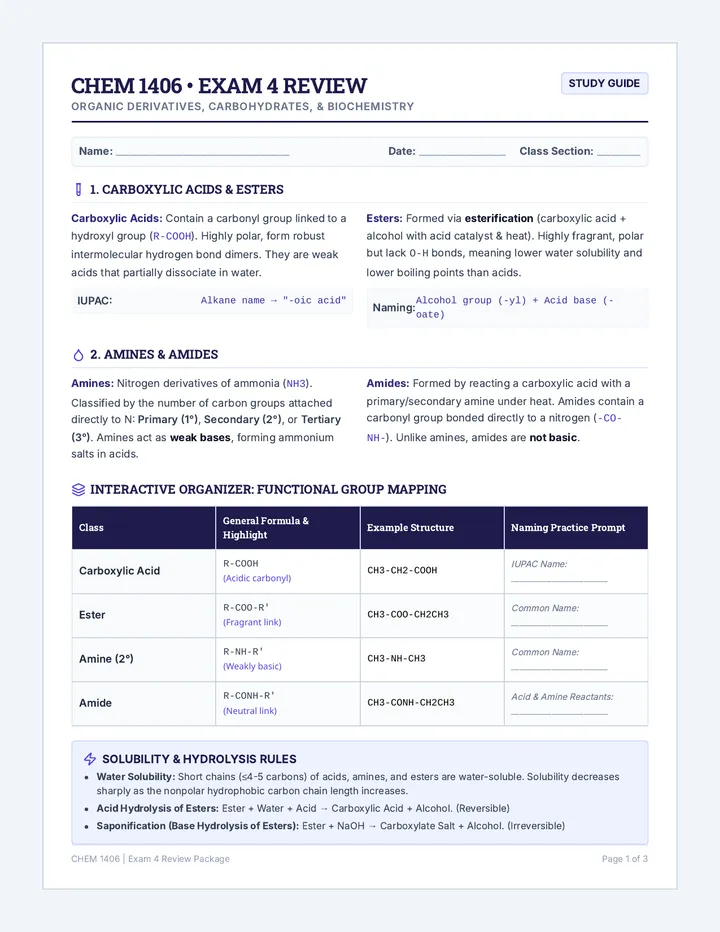
A comprehensive review package designed for CHEM 1406 Exam 4. It covers organic chemistry (carboxylic acids, esters, amines, amides), carbohydrates, stereochemistry, amino acids, proteins, and basic metabolic pathways through high-impact study summaries, a full practice test, and detailed explanations.
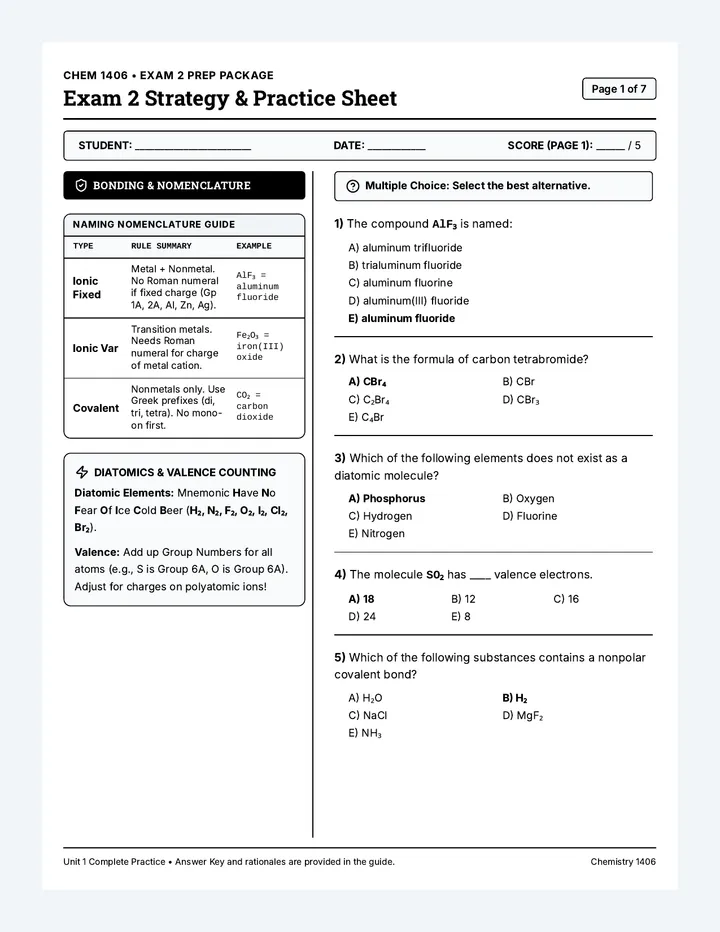
A comprehensive study and practice package for Chemistry 1406 Exam 2. It contains a highly structured, side-by-side strategy guide paired with a 30-question practice exam, and a matching detailed answer key with step-by-step rationales.
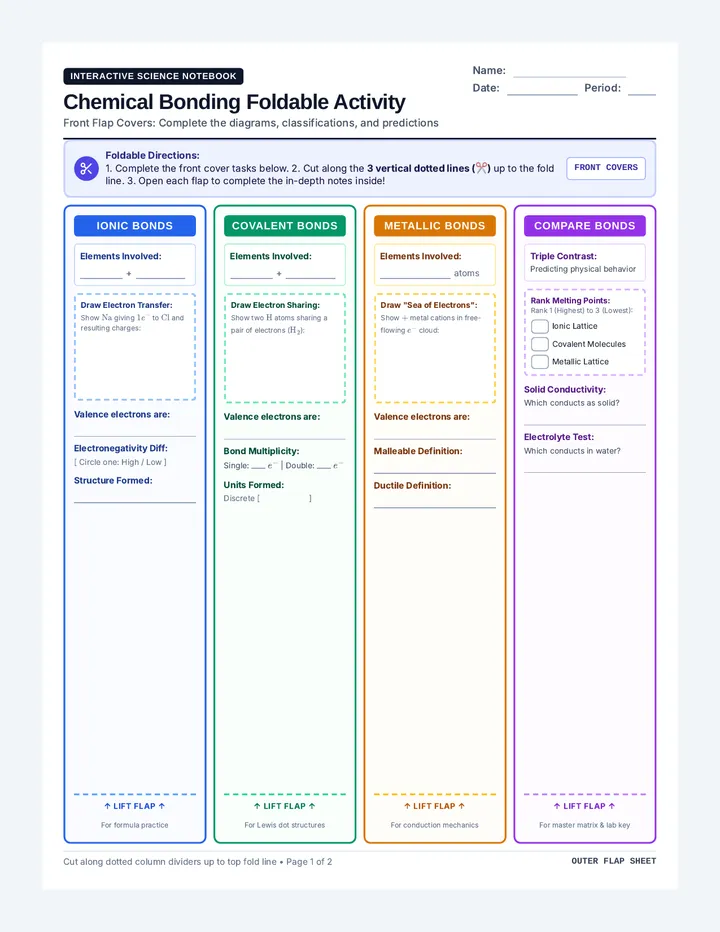
A foundational chemistry lesson exploring ionic, covalent, and metallic bonding through interactive modeling, detailed reference notes, and comparative property analysis.
A rigorous high school biology lab investigating macromolecular structure, hydrogen bonding in cellulose fibers, and starch-based biopolymers. Students engineer and analyze carbohydrate-based adhesives to study structure-function relationships without expanding experimental working times.
A comprehensive chemistry midterm review covering chemical reactions, water properties, planetary science, and atomic structure based on the Spring 2026 exam.