Sun Catchers Slides Plant Power Detectives
Mission 1
Sun Catchers
Cracking the case of the secret leaf pigments hiding in plain sight.
Investigator Briefing
Let's Begin
The Investigation
Case File #1
Meet the Green Thief: Chlorophyll!
Plants are masters of trapping energy from sunlight. They use a special molecule called chlorophyll to steal solar energy and make food!
But here is the big question: Are green pigments the only colors inside a leaf?
Solar Powered!
Without chlorophyll, plants couldn't capture sunlight to start photosynthesis!
Sun Catchers Presentation
Slide 2 of 7
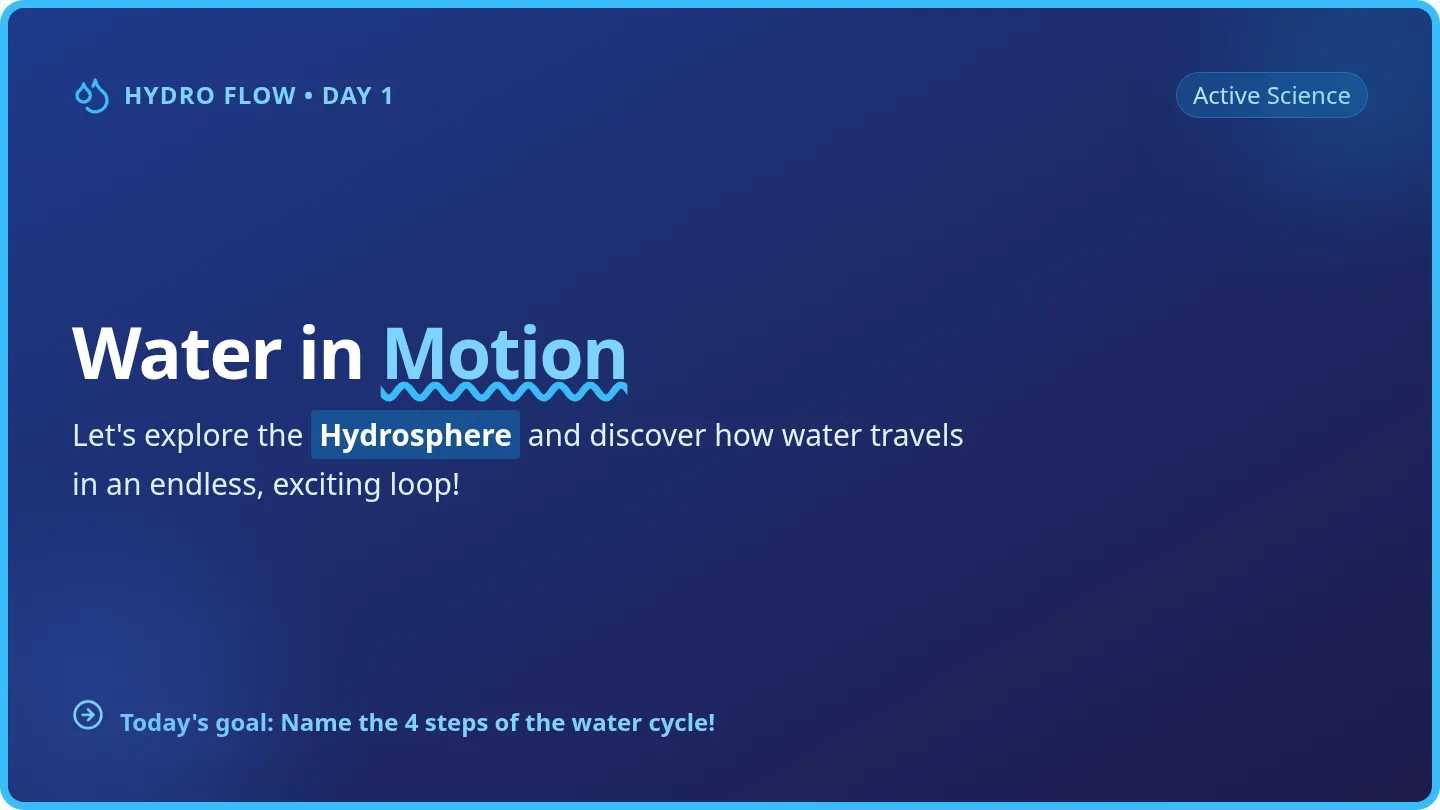
Scientific Technique
The Secret Tool
What is Chromatography?
Scientists use a cool technique called chromatography (crow-mah-tog-ruh-fee) to separate a mixture into its different parts.
Today, we will use it to pull apart a leaf's chemical juice and see if other colors are hiding behind the green chlorophyll!
1
Chroma means color in Greek!
2
Graphy means writing or drawing!
We are literally going to let the colors "write" themselves out on paper!
Sun Catchers Presentation
Slide 3 of 7
Preparation
Lab Briefing
Detective Equipment
Filter Strips
Green Leaves
Penny Coin
Rubbing Alcohol
Safety Rules First!
• Do not taste or drink the liquid alcohol!
• Keep your hands away from your eyes and nose.
• Wash your hands immediately if you get sap or liquid on them.
Sun Catchers Presentation
Slide 4 of 7
Procedure
How-To Guide
1
Mark the Strip
Draw a light pencil line 2 cm from the bottom of your filter strip. Do not use pen!
2
Penny Rubbing
Place a leaf on top of the line. Rub the edge of a penny firmly over the leaf to transfer green juice!
3
Dip and Wait
Suspend the strip so only the tip touches the alcohol. Keep the green line above the liquid!
Sun Catchers Presentation
Slide 5 of 7
Observation
Lab Action
What is Happening?
The alcohol travels up the filter paper by capillary action.
As it moves, it dissolves the plant pigments and carries them up the strip.
💡 Why do they separate? Some pigments are small and light, so they run fast and high. Others are heavy and sticky, so they move very slowly!
A spectrum of secret leaf pigments will slowly appear right before your eyes!
Sun Catchers Presentation
Slide 6 of 7
Discussion
The Wrap-Up
The Pigment Spectrum Revealed!
Look at your chromatogram. Do you see colors other than green?
Chlorophyll
Green colors (a & b) that capture sunlight for making food.
Xanthophyll
Bright yellow bands that also protect the leaf from too much sun.
Carotenoids
Orange and reddish bands. These are the same colors in carrots!
Sun Catchers Presentation
Slide 7 of 7
Pigment Detective Lab Guide Mission File 01
Pigment Detective Lab Sheet
Uncover the hidden colors inside a green leaf!
PLANT DETECTIVES
Lead Detective:
Date:
Lab Crew ID:
The Mystery: Leaves look green because of a pigment called chlorophyll , which absorbs sunlight. But are there secret colors hiding underneath the green? Today we will use paper chromatography to crack the case!
1. Detective Hypothesis
What colors do you think are hidden inside your green leaf? Why do you think so?
2. Equipment & Gear Check
Filter paper strip (Chromatogram) Fresh green leaf (Spinach or Ivy) 1 Shiny copper penny coin Clear plastic cup with lid Rubbing alcohol (Solvent) Pencil (No pens allowed!)
3. Initial Setup Sketch
Your Strip Setup
Green Rub Line
Setup Check:
Is your line 2 cm from the bottom of the paper?
Did you write your initials in PENCIL at the top?
Did you press firmly with the penny so a solid dark green line appeared on the pencil mark?
Unit: Plant Power Detectives Turn page for Results & Analysis Page 1 of 2
Mission File 01
Lab Results & Analysis
Deconstruct your chromatogram and solve the pigment case!
PLANT DETECTIVES
My Final Strip Diagram
Top Solvent Front
Color 1:
Color 2:
Color 3:
Start Line
Use coloring pencils to draw and label the color bands you see on your physical paper strip!
Pigment Key Chart
Chlorophyll a: Cool green/blue-green (absorbs light)
Chlorophyll b: Lime green/yellow-green (absorbs light)
Xanthophyll: Bright yellow (protects leaf)
Carotenoids: Warm orange (helps capture energy)
Color Spectrum Record
Band Position Observed Color Matching Pigment Top Band (Fastest) Middle Band Bottom Band (Slowest)
4. Detective Analysis & Debrief
Q1: Why did the different pigments separate rather than traveling up together as one single green smear?
Pigment Detective Teacher Guide Teacher Resource
Pigment Detective Facilitation Guide
Instructional Pacing, Troubleshooting, and Answer Keys
FACILITATION GUIDE
Target Grade Grades 3-5
Prep Time 20 Minutes
Lab Runtime 15-20 Mins
Subject Plant Science
Pacing Guide (50 Minutes)
Duration
Phase
Key Teacher Action
10 mins
Hook & Mystery Setup
Present Sun Catchers Slides. Introduce plant pigments. Brainstorm what colors hide in leaves.
10 mins
Chromatography Prep
Model drawing line in pencil, leaf rubbing with penny, and suspending paper in cup.
20 mins
Lab Running & Observe
Strips run. Students observe capillary action. Students draw initial chromatogram sketch.
10 mins
Debrief & Cleanup
Gather strips to dry. Discuss why pigments split. Answer post-lab questions.
Preparation Tips & Troubleshooting
Materials Advice:
Use spinach or kale leaves (high pigment concentrations).
Use Isopropyl Alcohol (70%+) as solvent. Water won't dissolve pigments.
Draw lines ONLY in pencil. Ink dyes will run and ruin results.
Troubleshooting:
If line dissolves completely: Ensure pigment line sits ABOVE alcohol, not submerged.If colors are too faint: Instruct students to repeat penny rubbing 2-3 times firmly.
Post-Lab Discussion & Answer Key
Q1: Why did the different pigments separate rather than traveling up together as one single green smear?
Expected Answer: Pigments have different sizes and dissolve differently in alcohol. Smaller pigments travel faster and further up the paper strip, while heavier ones travel slowly and stay near the bottom.
Q2: In autumn, leaves change from green to brilliant yellows, oranges, and reds. Based on your lab, why do you think this happens?
Expected Answer: The yellow/orange pigments are inside leaves all year, but they are masked by massive amounts of green chlorophyll. In autumn, chlorophyll breaks down and fades, revealing yellow/orange pigments already present.
Unit: Plant Power Detectives Mission 1: Green Thief Investigation Guide Page 1 of 1
Bubble Factory Slides Plant Power Detectives
Mission 2
The Bubble Factory
Investigating oxygen production and counting the microscopic bubbles made by plants.
Investigator Briefing
Dive In
The Recipe
Case File #2
The Photosynthesis Recipe
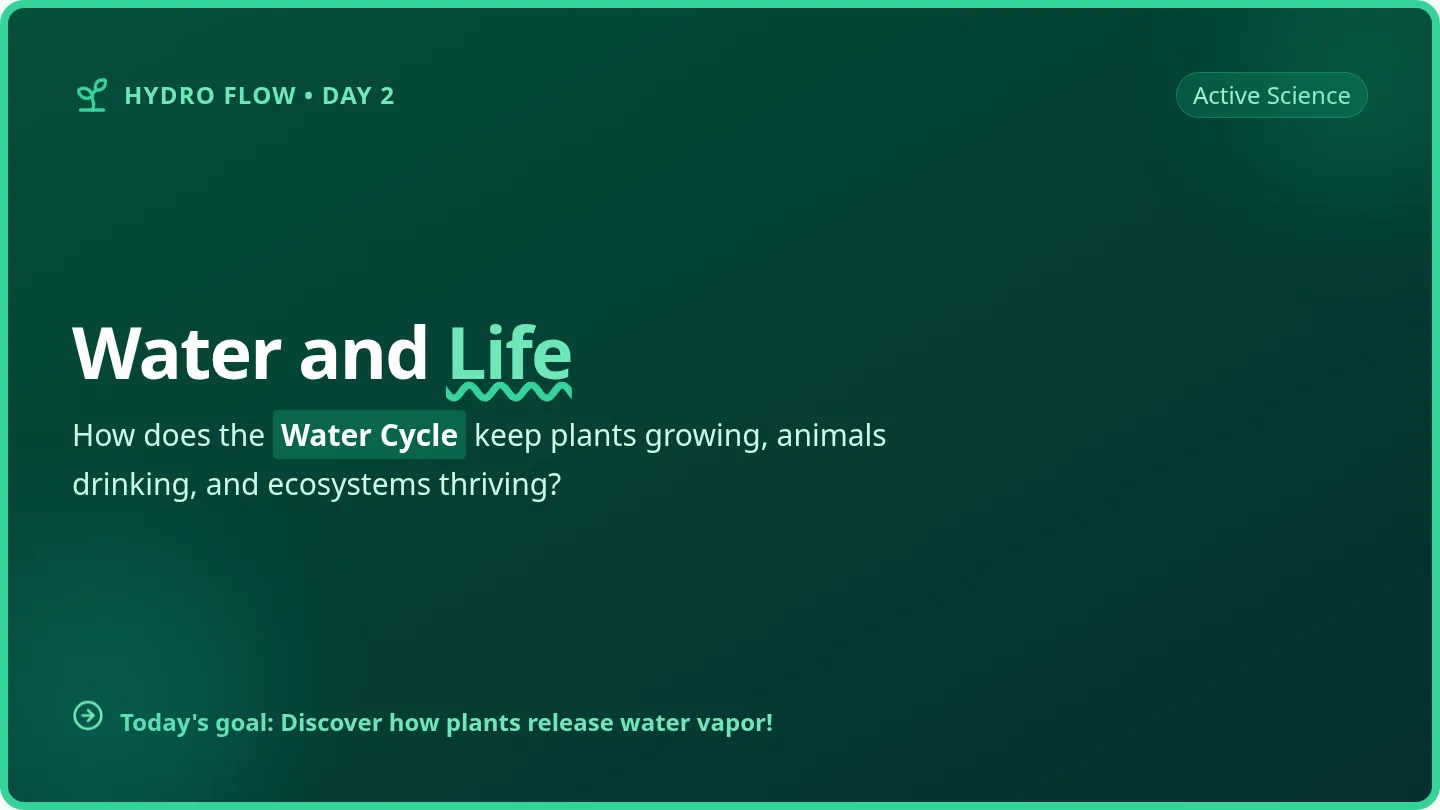
Plants make their own food! To do this, they combine:
Sunlight
Water
Carbon Dioxide
What is Left Over?
After plants combine these ingredients, they make sugar (food) and have OXYGEN gas left over!
🌬️ Oxygen is released into the atmosphere for humans and animals to breathe!
Bubble Factory Presentation
Slide 2 of 7
Special Agent
The Plant
Meet Elodea!
How can we see oxygen? Since oxygen is an invisible gas, it's hard to see in the air.
But if we use an aquatic water plant called Elodea (eh-low-dee-uh), the oxygen gas will escape underwater as visible, countable bubbles!
Bubble Factory!
The faster the plant does photosynthesis, the more bubbles it releases! We can literally measure its speed by counting bubbles!
Bubble Factory Presentation
Slide 3 of 7
Inquiry Question
Hypothesis Time
Our Detective Challenge:
How does the distance of our light source affect the speed of oxygen bubble production?
Scenario A: Light is close (10 cm)
Will the plant produce MORE bubbles because it has more solar power?
Scenario B: Light is far (30 cm)
Will the plant produce FEWER bubbles because it has less solar power?
Bubble Factory Presentation
Slide 4 of 7
Materials Checklist
Lab Setup
Gather Your Gear
Elodea Plant
Water & Beaker
Baking Soda
Ruler / Meter Stick
Desk Lamp
Stopwatch
Why Baking Soda?
Plants underwater need carbon dioxide to make food.
We dissolve a pinch of baking soda in the water to give our Elodea plant plenty of carbon dioxide food!
Bubble Factory Presentation
Slide 5 of 7
Procedure
Active Lab
1
Prepare the Soda
Bubble Counter Lab Sheet Mission File 02
Bubble Counter Lab Sheet
Measure plant productivity by counting oxygen bubbles!
PLANT DETECTIVES
Lead Detective:
Date:
Lab Crew ID:
1. Inquiry Challenge
The Question:
How does the distance of a light source (10 cm vs. 30 cm) affect the speed of oxygen production (bubble count) in an Elodea water plant?
2. My Hypothesis
I predict that the Elodea plant placed at 10 cm from the lamp will produce ( circle one: more / fewer ) bubbles than when placed at 30 cm . My scientific reason is:
3. Lab Observations & Bubble Records
Light Distance Minute 1 Bubbles Minute 2 Bubbles Minute 3 Bubbles Total Count 10 cm (Close) 30 cm (Far)
💡 Investigation Tip: Ensure that you wait 2 minutes after adjusting the light before starting the 3-minute stopwatch! This allows the plant's chloroplasts to adapt to the new light intensity.
Unit: Plant Power Detectives Turn page for Data Graphing & Questions Page 1 of 2
Mission File 02
Data Analysis & Claims
Deconstruct your bubble data and complete the investigation.
PLANT DETECTIVES
4. Visual Data Graphing
Construct a bar graph to compare your total bubble counts.
High
Med
Zero
Bubbles Counted
Close (10 cm)
Far (30 cm)
5. Post-Lab Discovery Questions
Q1: Look at your data. What happens to the bubble count when the lamp is moved further away from the plant? Explain why.
Q2: Why was it important to add baking soda to the water before starting the experiment? What ingredient did it provide?
Unit: Plant Power Detectives Mission 2: Aquatic Oxygen Lab Page 2 of 2
Bubble Counter Teacher Key Teacher Key
Bubble Counter Facilitation Guide
Expected Experimental Data, Explanations, and Troubleshooting
ANSWER KEY
Target Grade Grades 3-5
Prep Level Medium
Lab Runtime 30 Minutes
Topic Oxygen Byproduct
Key Scientific Concepts
We want students to realize that photosynthesis is a chemical reaction that depends on energy input. Underwater, Elodea plants perform photosynthesis and release excess oxygen gas as bubbles. By changing the light bulb distance, we vary light intensity (energy input). Brighter light accelerates the reaction, resulting in a higher rate of oxygen bubbles!
Expected Experimental Results
Distance
Typical Observation
Explanation of Action
10 cm (Close)
15 - 40 bubbles per minute
High light energy drives maximum chloroplast activity, releasing oxygen at high speed.
30 cm (Far)
1 - 5 bubbles per minute
Low light energy slows photosynthesis. The bubble rate drops significantly.
Post-Lab Questions Answer Key
Q1: What happens to the bubble count when the lamp is moved further away? Explain why.
Expected: The bubble count decreases because moving the light source away reduces light intensity (energy input). Photosynthesis slows down, so less oxygen byproduct is created.
Q2: Why was it important to add baking soda to the water? What ingredient did it provide?
Expected: Baking soda (sodium bicarbonate) dissolves and releases carbon dioxide gas into the water. This provides the plant with carbon dioxide, which is a critical reactant/ingredient in photosynthesis.
Troubleshooting & Preparation Advice
What if a group gets NO bubbles at all?
Stem is crushed: Check the cut stem. If crushed or dull, snip 1 cm off with a sharp razor/scissors on a fresh 45-degree angle.Water is too cold: Use room temperature water (68-72°F). Cold water stunts plant activity.Light is too cold: Standard energy-saving fluorescent bulbs don't emit enough heat or the right spectrum. Incandescent or full-spectrum LED desk lamps work best.
Unit: Plant Power Detectives Mission 2: Oxygen Makers Lab Guide Page 1 of 1
Great Gas Exchange Slides Plant Power Detectives
Mission 3
The Great Gas Exchange
Investigating how humans and plants share the breath of life in a perfect recycling loop.
Investigator Briefing
Complete the Cycle
The Connection
Case File #3
We are Partners!
Every single second, humans and animals take a breath.
We inhale Oxygen (O₂) to power our cells, and we exhale Carbon Dioxide (CO₂) as a waste gas.
But where does that oxygen come from? And what happens to that carbon dioxide?
Perfect Recycling!
What is our waste is the plant's favorite food! And what is the plant's waste is our breath of life!
Great Gas Exchange Presentation
Slide 2 of 7
The Cycle
The Loop
Human Breathing
1. Humans take in Oxygen from plants.
2. We use oxygen to stay active.
3. We release Carbon Dioxide .
Plant Breathing
1. Plants take in Carbon Dioxide .
2. Chloroplasts use sunlight to make sugar food.
3. Plants release Oxygen byproduct.
Great Gas Exchange Presentation
Slide 3 of 7
Scientific Mystery
Ecosystems
A Sealed Biosphere
Imagine taking a plant, placing it in a glass jar with moist soil, and sealing the lid completely airtight.
Will the plant suffocate and die?
No! It can live for decades!
The plant recycles its own carbon dioxide, water, and oxygen over and over again! As long as there is light , it lives!
Great Gas Exchange Presentation
Slide 4 of 7
Investigation Path
Gas Paths
The CO₂ Path
Microbes in soil and plant respiration produce Carbon Dioxide. Leaves take it in to build sugars.
The Water Path
Roots drink water. Leaves sweat it out (transpire). It condenses on glass walls and falls back to soil!
The O₂ Path
Chloroplasts release oxygen. The plant uses a tiny bit to breathe, and stores the rest in the jar.
Great Gas Exchange Presentation
Slide 5 of 7
Mission briefing
Your Turn
Design an Ecosystem Blueprint!
Now, you will act as a bio-engineer to create a blueprint diagram of a miniature closed ecosystem!
Ecosystem Builder Blueprint Mission File 03
Ecosystem Builder Blueprint
Design and map a self-sustaining sealed mini-world!
BIO-ENGINEERING
Lead Bio-Engineer:
Launch Date:
Biosphere Class:
The Design Challenge:
A closed ecosystem (like a sealed glass jar) can recycle its water, carbon, and oxygen gases endlessly. Below, complete the blueprint of your closed biosphere by sketching the recycling loop and labeling the critical systems.
BIOSPHERE JAR SCHEMATIC
Moist Soil Layer
Scale: 1:1 Print Ready
Blueprint Tasks
Using color arrows and symbols on your blueprint, draw and label these 4 critical pathways:
A. Sunlight: Draw energy rays entering from the outside of the jar.
B. Water Cycle: Draw arrows showing evaporation and droplets condensing on the glass.
C. CO₂ Gas: Draw a loop showing Carbon Dioxide moving into the leaf.
D. O₂ Gas: Draw a loop showing Oxygen escaping from the leaf into the jar's air.
Critical System Analysis
Investigation Scenario: If you completely wrap this sealed biosphere jar in a thick black cloth so that NO light can enter, what will happen to the plant? Trace the breakdown of the gas exchange cycle.
Unit: Plant Power Detectives Mission 3: Ecosystem Blueprint Handout Page 1 of 1
Secret Agent Exit Ticket Confidential Debrief
Secret Agent Exit Ticket
Final Evaluation: Photosynthesis Case Decoded
UNIT CLEARANCE
Agent Name:
Date:
🕵️♂️ Agent Clearance: To successfully close the "Plant Power Detectives" investigation, answer these final three science review questions. Use your lab knowledge to prove your findings!
1
Identify the Plant Reactants (Inputs)
Which combination represents the three critical ingredients plants need to perform photosynthesis?
A. Oxygen, Soil, Sugar, and Fertilizers
B. Helium, Water vapor, Sugar, and Soil nutrients
C. Sunlight, Carbon Dioxide, and Water
D. Nitrogen, Oxygen, Soil, and Plant seeds
2
The Gas Exchange Equation
Complete the sentence below to describe the loop of breathing between plants and animals.
"During photosynthesis, plants release gas into the air, which humans and animals need to breathe. In return, humans and animals breathe out gas, which plants absorb to build their food!"
3
Chlorophyll's Secret Mission
Explain what chlorophyll is and why leaves would not be able to perform photosynthesis without it.
Classification: CLASSROOM CLASS-1 Mission Complete Page 1 of 1