Serpent Senses Lesson Plan
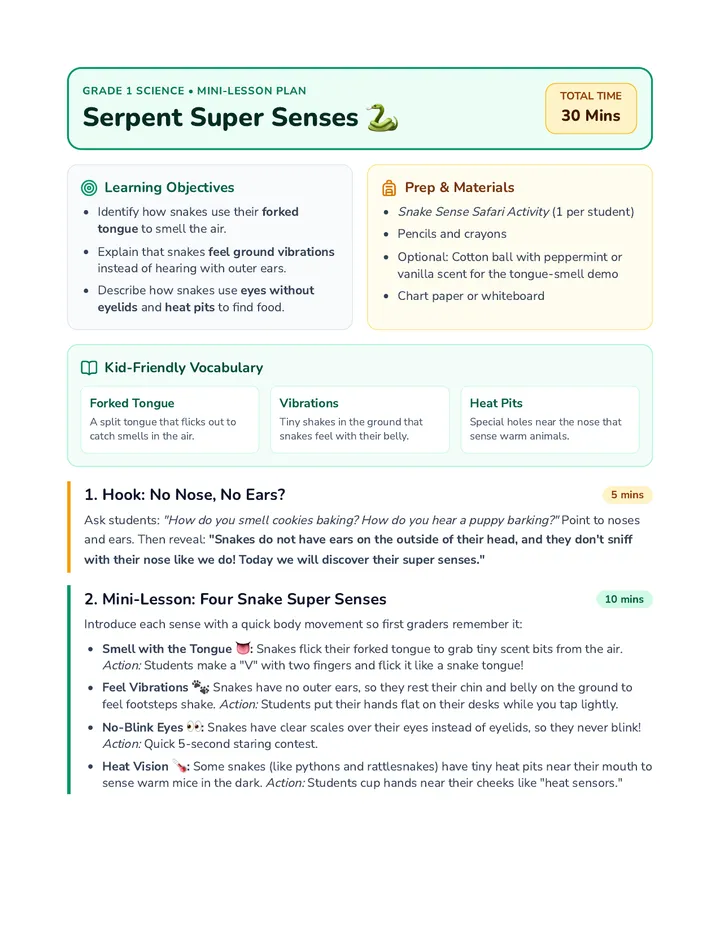
Grade 1 Science • Mini-Lesson Plan
Serpent Super Senses 🐍
Total Time
30 Mins
Learning Objectives
- Identify how snakes use their forked tongue to smell the air.
- Explain that snakes feel ground vibrations instead of hearing with outer ears.
- Describe how snakes use eyes without eyelids and heat pits to find food.
Prep & Materials
- Snake Sense Safari Activity (1 per student)
- Pencils and crayons
- Optional: Cotton ball with peppermint or vanilla scent for the tongue-smell demo
- Chart paper or whiteboard
Kid-Friendly Vocabulary
Forked Tongue
A split tongue that flicks out to catch smells in the air.
Vibrations
Tiny shakes in the ground that snakes feel with their belly.
Heat Pits
Special holes near the nose that sense warm animals.
1. Hook: No Nose, No Ears?
5 mins
Ask students: "How do you smell cookies baking? How do you hear a puppy barking?" Point to noses and ears. Then reveal: "Snakes do not have ears on the outside of their head, and they don't sniff with their nose like we do! Today we will discover their super senses."
2. Mini-Lesson: Four Snake Super Senses
10 mins
Introduce each sense with a quick body movement so first graders remember it:
- Smell with the Tongue 👅: Snakes flick their forked tongue to grab tiny scent bits from the air. Action: Students make a "V" with two fingers and flick it like a snake tongue!
- Feel Vibrations 🐾: Snakes have no outer ears, so they rest their chin and belly on the ground to feel footsteps shake. Action: Students put their hands flat on their desks while you tap lightly.
- No-Blink Eyes 👀: Snakes have clear scales over their eyes instead of eyelids, so they never blink! Action: Quick 5-second staring contest.
- Heat Vision 🌡️: Some snakes (like pythons and rattlesnakes) have tiny heat pits near their mouth to sense warm mice in the dark. Action: Students cup hands near their cheeks like "heat sensors."
3. Student Activity: Snake Sense Safari
10 mins
Hand out the Snake Sense Safari Activity sheet. Read the directions aloud together for emerging readers:
- Page 1 (Match & Circle): Complete the first matching item together as a model. Have students draw lines from each snake body part to what it senses, then circle the best answer for each question.
- Page 2 (Draw & True/False): Students draw a snake using one super sense (e.g., flicking its tongue near a mouse or feeling footsteps) and complete the quick True/False check.
4. Wrap-Up: Snake Sense Share
5 mins
Invite 2–3 students to show their drawings and finish the sentence: "My snake is using its ________ to ________." Review that even without outer ears or eyelids, snakes are amazing at finding food and staying safe!
Differentiation Tips
- Extra Support: Pair students with a buddy to read the True/False statements, or let them verbally explain their drawing to you.
- Ready for More: Ask early finishers to label the snake's tongue, eye, and belly in their drawing.
Watch Out For
- "Snakes are deaf": Clarify that snakes do have inner ears—they just don't have outer ear flaps, so they feel ground vibrations instead.
- "Tongues are stingers": Remind students that a snake's tongue is soft and only used for smelling, never biting!
Optional 2-Minute Demo: Scent Trail
Place one scented cotton ball (e.g., vanilla or peppermint) inside an open cup and an unscented cotton ball in another. Have a student close their eyes and "flick" their fingers near each cup to guess which has the scent—just like a snake's forked tongue!
Snake Sense Safari Activity
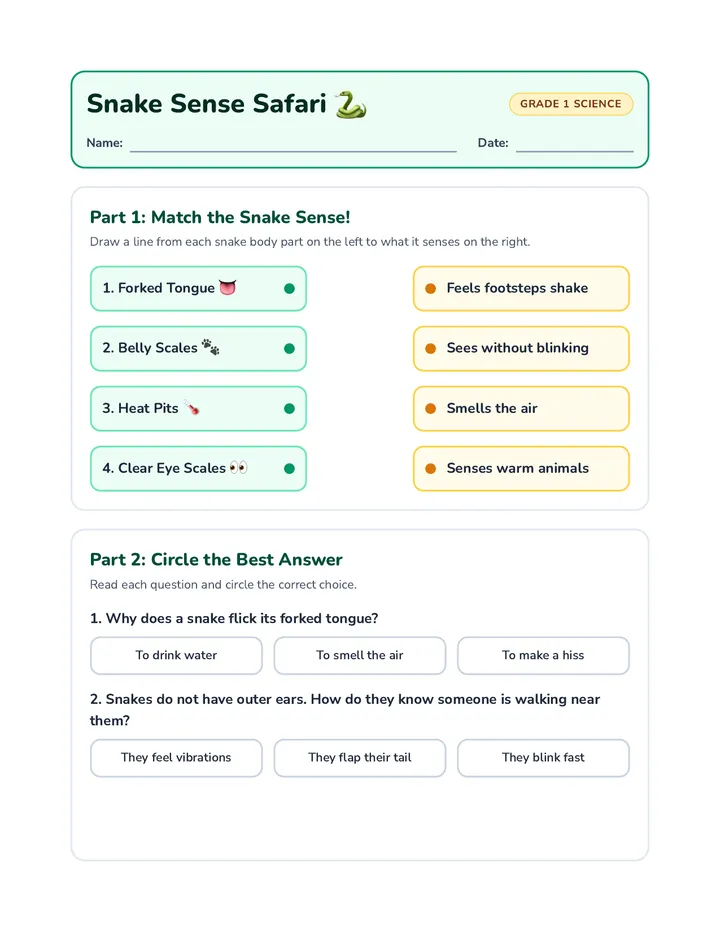
Snake Sense Safari 🐍
Grade 1 Science
Name:
Date:
Part 1: Match the Snake Sense!
Draw a line from each snake body part on the left to what it senses on the right.
1. Forked Tongue 👅
2. Belly Scales 🐾
3. Heat Pits 🌡️
4. Clear Eye Scales 👀
Feels footsteps shake
Sees without blinking
Smells the air
Senses warm animals
Part 2: Circle the Best Answer
Read each question and circle the correct choice.
1. Why does a snake flick its forked tongue?
To drink water
To smell the air
To make a hiss
2. Snakes do not have outer ears. How do they know someone is walking near them?
They feel vibrations
They flap their tail
They blink fast
Part 3: Be a Snake Scientist! 🔍
Draw a snake using one of its super senses (like smelling with its tongue or feeling footsteps). Then finish the sentence below.
My snake is using its
to .
Part 4: True or False?
Circle True or False for each snake fact.
1. Snakes can blink their eyes just like people.
True False
2. Some snakes have heat pits to sense warm animals in the dark.
True False
3. A snake's forked tongue is soft and used for smelling.
True False
Snake Safari Answer Key
Teacher Resource • Grade 1 Science
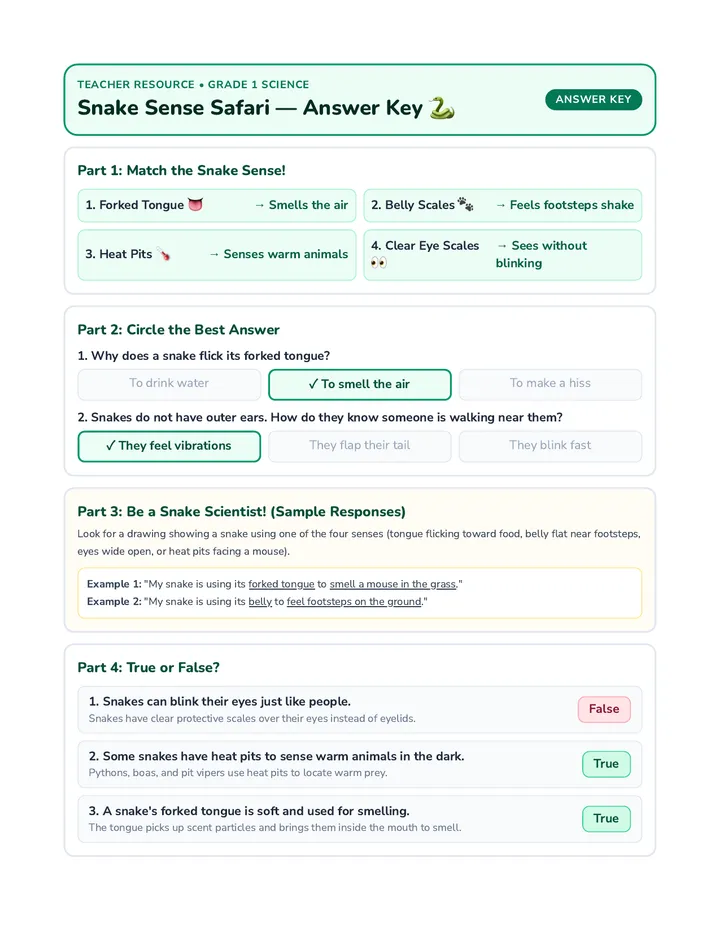
Snake Sense Safari — Answer Key 🐍
Answer Key
Part 1: Match the Snake Sense!
1. Forked Tongue 👅 → Smells the air
2. Belly Scales 🐾 → Feels footsteps shake
3. Heat Pits 🌡️ → Senses warm animals
4. Clear Eye Scales 👀 → Sees without blinking
Part 2: Circle the Best Answer
1. Why does a snake flick its forked tongue?
To drink water
✓ To smell the air
To make a hiss
2. Snakes do not have outer ears. How do they know someone is walking near them?
✓ They feel vibrations
They flap their tail
They blink fast
Part 3: Be a Snake Scientist! (Sample Responses)
Look for a drawing showing a snake using one of the four senses (tongue flicking toward food, belly flat near footsteps, eyes wide open, or heat pits facing a mouse).
Example 1: "My snake is using its forked tongue to smell a mouse in the grass."
Example 2: "My snake is using its belly to feel footsteps on the ground."
Part 4: True or False?
1. Snakes can blink their eyes just like people.
Snakes have clear protective scales over their eyes instead of eyelids.
False
2. Some snakes have heat pits to sense warm animals in the dark.
Pythons, boas, and pit vipers use heat pits to locate warm prey.
True
3. A snake's forked tongue is soft and used for smelling.
The tongue picks up scent particles and brings them inside the mouth to smell.
True