Bees Needs Lesson Plan Bee's Needs
Lesson Plan • Science K-3
Duration
60 Minutes
Subject
Life Science / Systems
Level
Elementary (K-3)
Lesson Objective
"Students will be able to describe how bees and flowers help each other through pollination and simulate the transfer of pollen using a hands-on model."
Key Concepts
• Mutualism: Both bee and flower benefit.
• Pollen Transfer: How seeds are made.
• Pollinators: Animals that carry pollen.
Materials Needed
□ Large paper flowers (yellow and blue)
□ Cheetos (or cheese puffs) in bowls
□ Paper towels / wet wipes
□ "Pollen Pickup" Recording Sheets
Essential Questions
Why do bees visit flowers?
How does sticky pollen travel from one flower to another?
What would happen to the world without bees?
Instructional Sequence
1
The Buzzing Hook (10 min)
Ask students: "Who likes apples, strawberries, or chocolate?" Explain that without bees, we wouldn't have many of our favorite foods. Introduce the term pollinator . Use the slide deck to show different types of flowers and bees.
2
Direct Instruction (15 min)
Show the "Flower Parts" slide. Explain that bees aren't trying to help the flower on purpose—they are looking for nectar (sweet food). While drinking nectar, pollen sticks to their fuzzy bodies.
Pro Tip
Use a hand puppet or a fuzzy pom-pom to demonstrate how "pollen" (flour or glitter) sticks to fuzz better than smooth skin.
3
The Cheeto Simulation (25 min)
Give each student a "Pollen Pickup" sheet and a small bowl of Cheetos.
Place paper flowers at different "garden stations" around the room.
Students are "bees." They eat a Cheeto (land on flower 1). Do not lick fingers!
Fly to a paper flower at another station and touch it (pollinate flower 2).
Observe the orange "pollen" left behind on the white paper flower.
4
Review & Cleanup (10 min)
Have students complete the "Flower Power" worksheet. Discuss: "Was it easy to move the pollen? What happened to the second flower you visited?" End with a "Thank You Bees" song or chant.
Support
Provide a word bank for the worksheet. Use visual cues (colored dots) for the simulation path.
Extension
Research other pollinators (bats, butterflies, wind). Draw a "super bee" with extra pollen-catching tools.
Pollination Partners Slides Pollination Partners
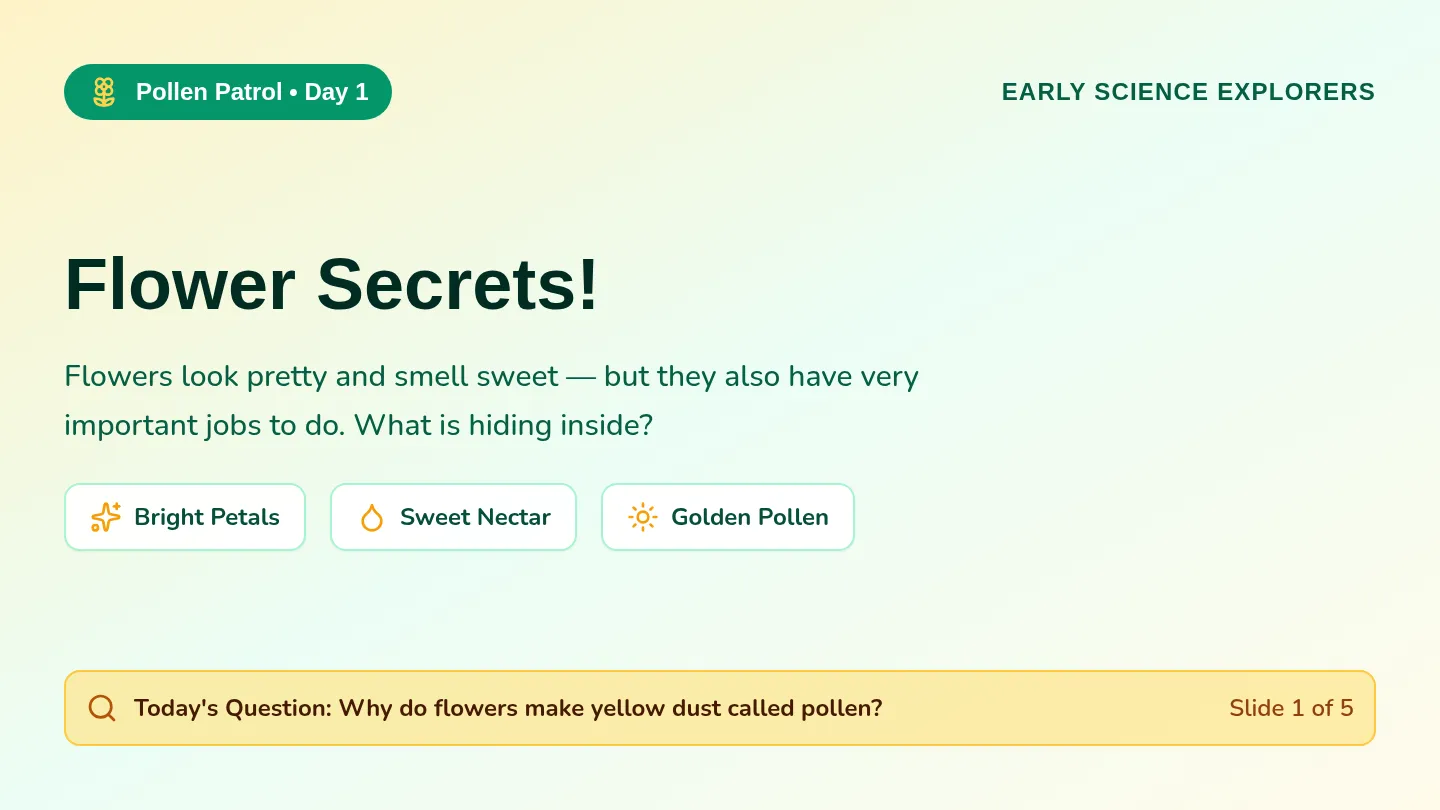
The Bee's Needs
What's for Lunch?
🍓
Strawberries
🍫
Chocolate
🍎
Apples
"Without bees, these delicious foods wouldn't grow!"
What is a Pollinator?
A pollinator is an animal that moves pollen from one flower to another.
This helps the flower make seeds and fruit !
🐝
Bees
🦋
Butterflies
🦇
Bats
🐦
Birds
The Secret Deal
The Bee wants...
Sweet, sugary NECTAR to eat!
The Flower wants...
To send its POLLEN to a new home!
It's a "win-win" partnership!
Pollen is Sticky!
Bees are very fuzzy . Their hair acts like a magnet for pollen.
When they drink nectar, the pollen dusts their bodies like tiny yellow sprinkles.
When they move to the next flower, some of that pollen drops off !
Simulation Time!
01
You are the Bee
02
Eat your Pollen (Cheetos)
03
Visit a New Flower
DO NOT LICK YOUR FINGERS!
Why does it matter?
Food for Everyone
Most of the fruits and vegetables we eat need pollinators to grow.
Seeds for Tomorrow
Plants need to make seeds so new plants can grow next year!
Healthy Bees = A Healthy Earth! 🌎
Pollen Pickup Activity Pollen Pickup Activity
Name:
Date:
Today, you are a busy bee! Let's see how much pollen you can move.
1 Draw your hand (the bee) before you land on a flower:
2 Draw your finger after landing on Flower #1 (The Cheetos):
3 Draw Flower #2 after you touched it with your "pollen finger":
My Bee Observations
1. Did the "pollen" stay on your finger or move to the flower?
It stayed on me
It moved to the flower
Both!
2. How did the pollen feel? (Circle one)
Sticky
Dusty
Wet
Sandy
3. Why do you think flowers need bees to visit them?
Flower Power Answer Key Flower Power!
Teacher Key
ANSWER KEY
1
Label the Flower Parts
POLLEN
PETAL
STEM
Word Bank
PETAL
POLLEN
STEM
2
What Happens First?
3
The bee flies to a new flower and drops off the pollen.
1
The bee lands on a flower to drink sweet nectar.
2
Sticky pollen sticks to the bee's fuzzy body.
3
Bee Facts
Bees visit flowers to find food (nectar).
TRUE
FALSE
Pollen is very slippery like ice.
TRUE
FALSE
Only bees can be pollinators.
TRUE
FALSE
Flower Power Worksheet Flower Power!
Name:
Date: ___________
1
Label the Flower Parts
Word Bank
PETAL
POLLEN
STEM
Write the words in the boxes next to the flower!
2
What Happens First?
Write the numbers 1, 2, and 3 in the circles to show the right order.
The bee flies to a new flower and drops off the pollen.
The bee lands on a flower to drink sweet nectar.
Sticky pollen sticks to the bee's fuzzy body.
3
Bee Facts
Circle the correct answer for each sentence.
Bees visit flowers to find food (nectar).
TRUE
FALSE
Pollen is very slippery like ice.
TRUE
FALSE
Only bees can be pollinators.
TRUE
FALSE
Bonus Question
Draw a picture on the back of your favorite pollinator! Is it a butterfly, a bat, or a bee?