New Moon Exit Ticket
Astronomy Quick Check
New Moon Mystery
Name:
Date:
PART 1
Diagnostic Question
Which statement best explains why the New Moon phase cannot be seen from an observer on Earth?
1
The Moon is located on the opposite side of Earth relative to the Sun.
2
Earth’s shadow completely blocks sunlight from reaching the Moon.
3
The unlit side of the Moon faces Earth while it is located in the same direction as the Sun.
4
The Moon is moving at its slowest orbital velocity during this phase.
PART 2
Model the Alignment
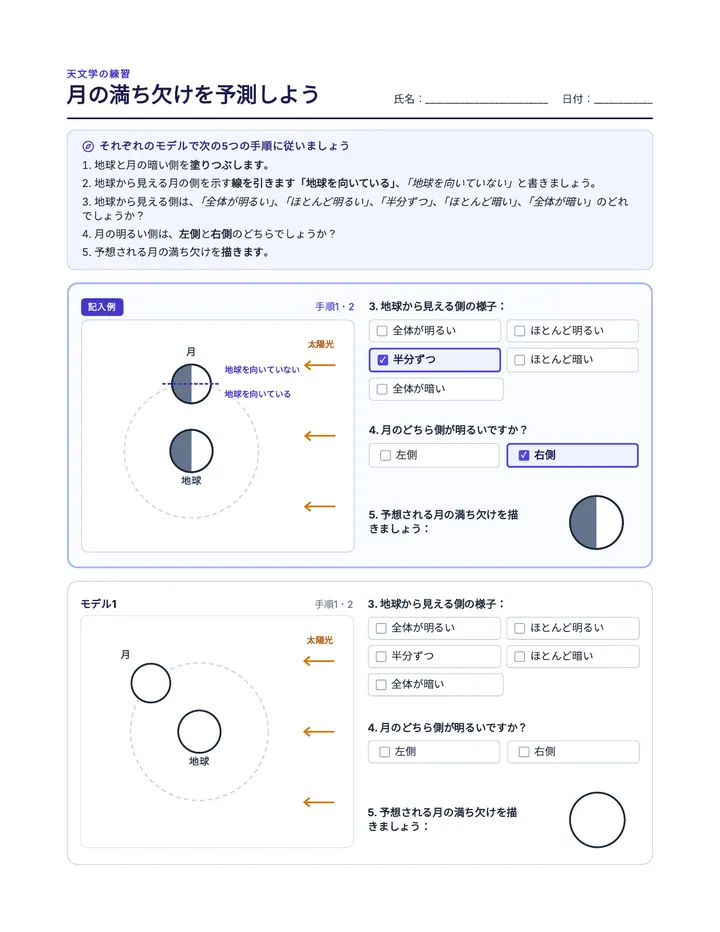
In the space below, draw and label the Moon in its New Moon position relative to the Sun and Earth. Shade the unlit side of the Moon.
Sun
Earth
PART 3
Explain Your Reasoning
In your own words, explain why we cannot see the Moon during the New Moon phase, and why Earth’s shadow is not the cause.
Astronomy Quick Check • Page 2
Moonrise Timing
Name:
PART 4
Daily Moonrise Shift
On average, approximately how much later does the Moon rise each day?
1
24 minutes
2
50 minutes
3
90 minutes
4
120 minutes
PART 5
Calculate & Explain
The Moon completes one full orbit around Earth in about 27.3 days (moving in the same direction Earth spins). Show how this orbital motion causes the Moon to rise later each day, and estimate the daily delay.
PART 6
Predict Tomorrow’s Moonrise
If the Moon rises at 6:15 PM tonight, approximately what time will it rise tomorrow night?
Astronomy Quick Check • Page 3
Lunar Illumination
Name:
PART 7
Illuminated Sphere
What fraction of the total lunar sphere is illuminated by sunlight at any given moment in space?
1
One-fourth (25%)
2
One-half (50%)
3
Three-fourths (75%)
4
It depends on the Moon’s phase.
PART 8
Shade the Unlit Side
Suppose sunlight is coming from the left. Shade the unlit side of each Moon below as seen from space.
New Moon
First Quarter
Full Moon
PART 9
Space vs. Earth Perspective
If the same fraction of the Moon is always lit by the Sun, why does the Moon appear to change shape from Earth?
Astronomy Quick Check • Page 4
First Quarter Geometry
Name:
PART 10
Angular Separation
As observed from Earth, what is the angular separation between the Sun and the Moon during the First Quarter phase?
1
0°
2
45°
3
90°
4
180°
PART 11
Sketch the Sun–Earth–Moon Angle
Draw the First Quarter Moon in orbit around Earth and draw lines from Earth to the Sun and from Earth to the Moon to show the angle between them.
Sun
Earth
PART 12
Connect Phases to Angles
Write the approximate Sun–Earth–Moon angular separation for each phase below.
| Moon Phase |
Angular Separation |
| New Moon |
|
| First Quarter |
|
| Full Moon |
|
Astronomy Quick Check • Page 5
All-Night Moonrise
Name:
PART 13
Visibility Window
Which moon phase rises around sunset and remains visible in the night sky for the entire night?
1
New Moon
2
First Quarter
3
Full Moon
4
Third Quarter
PART 14
Lunar Rise & Set Schedule
Complete the table with the approximate rise and set times (e.g., sunrise, noon, sunset, midnight) for each major phase.
| Moon Phase |
Approximate Rise |
Approximate Set |
| New Moon |
|
|
| First Quarter |
|
|
| Full Moon |
|
|
| Third Quarter |
|
|
PART 15
Explain the Opposite-Sky Rule
Why does a Full Moon rise right as the Sun sets?
New Moon Answer Key
Teacher Resource • Answer Key
New Moon Mystery
Part 1: Option 3
Correct Answer: Statement 3
“3) The unlit side of the Moon faces Earth while it is located in the same direction as the Sun.”
Key Concept: Sunlight always illuminates half of the Moon. During a New Moon, the Moon sits between Earth and the Sun (in the same general direction in the sky), so its sunlit half faces away from Earth and its dark, unlit half faces us.
Distractor & Misconception Analysis
1
Moon is on the opposite side of Earth relative to the Sun
Why it’s incorrect: That alignment produces a Full Moon, where the entire sunlit side of the Moon faces Earth.
2
Earth’s shadow completely blocks sunlight from reaching the Moon
Why it’s incorrect: This is the most common misconception. Earth’s shadow only hits the Moon during a Lunar Eclipse (at Full Moon), not during a New Moon.
4
The Moon is moving at its slowest orbital velocity during this phase
Why it’s incorrect: Orbital speed changes slightly due to the Moon’s elliptical orbit, not its phase, and speed does not make the Moon invisible.
Part 2: Model Alignment
Sun
Sunlight → (hits left half)
New Moon Unlit side faces Earth
← View from Earth
Earth
Part 3: Sample Student Explanation
“During a New Moon, the Moon is located between the Sun and Earth. The Sun still lights up half of the Moon, but that lit half is facing away from us, so we only see the dark, unlit side. Earth’s shadow is not blocking the Moon because Earth is behind the Moon, not between the Moon and the Sun.”
Teacher Resource • Answer Key Page 2
Moonrise Timing
Part 4: Option 2
Correct Answer: 2) 50 minutes
Key Concept: Because the Moon orbits Earth in the same eastward direction that Earth rotates, Earth must spin slightly more than one full rotation (about 24 hours and 50 minutes) each day to catch up to the Moon’s new position.
Distractor Analysis
1
24 minutes
Why it’s incorrect: Too short; students may confuse the 24-hour day with 24 minutes.
3
90 minutes / 4) 120 minutes
Why they’re incorrect: Both are far too large; at 90–120 minutes per day, the Moon would complete a cycle in 12–16 days instead of ~29.5 days.
Part 5: Sample Calculation & Explanation
One full day is 1,440 minutes (\(24 \times 60\)). Over a ~29.5-day synodic month (from New Moon to New Moon), the Moon completes one full cycle relative to the Sun:
\[ \frac{1,440\text{ minutes}}{29.5\text{ days}} \approx 48.8\text{ minutes/day} \approx 50\text{ minutes/day} \]
“While Earth spins once in 24 hours, the Moon moves forward in its orbit in the same direction. Earth has to rotate for about 50 extra minutes to bring the Moon back above the eastern horizon.”
Part 6: Sample Answer
Approximately 7:05 PM
Adding 50 minutes to 6:15 PM gives 7:05 PM (accept responses between 7:00 PM and 7:10 PM).
Teacher Resource • Answer Key Page 3
Lunar Illumination
Part 7: Option 2
Correct Answer: 2) One-half (50%)
Key Concept: Like any sphere lit by a single distant star (the Sun), exactly half of the Moon is always illuminated (except briefly during a lunar eclipse). Phases are caused by our changing viewing angle from Earth, not by changes in how much of the Moon is lit.
Distractor & Misconception Analysis
4
It depends on the Moon’s phase.
Why it’s incorrect: This is the primary distractor. Students confuse the fraction of the near side visible from Earth with the fraction of the entire lunar sphere lit by the Sun.
1
One-fourth (25%) / 3) Three-fourths (75%)
Why they’re incorrect: Sunlight strikes a sphere in parallel rays, illuminating a full hemisphere (50%), never 25% or 75%.
Part 8: Model Shading (Sunlight from Left)
New Moon (50% lit)
First Quarter (50% lit)
Full Moon (50% lit)
Part 9: Sample Student Explanation
“Even though half of the Moon is always lit by the Sun, the Moon orbits Earth so we view that lit half from different angles. When the lit half faces away from us we see a New Moon, and when it faces toward us we see a Full Moon.”
Teacher Resource • Answer Key Page 4
First Quarter Geometry
Part 10: Option 3
Correct Answer: 3) 90°
Key Concept: During the First Quarter phase, the Moon has completed one-quarter (\(90^\circ\) of \(360^\circ\)) of its synodic orbit from New Moon. From Earth’s perspective, the Moon and the Sun are separated by a right angle (\(90^\circ\)).
Distractor Analysis
1
0° (New Moon) / 4) 180° (Full Moon)
Why they’re incorrect: \(0^\circ\) occurs at New Moon when the Sun and Moon are in the same direction; \(180^\circ\) occurs at Full Moon when they are on opposite sides of Earth.
2
45°
Why it’s incorrect: \(45^\circ\) corresponds to a Waxing Crescent (one-eighth of the cycle), halfway between New Moon and First Quarter.
Part 11: Model Sun–Earth–Moon Angle
Sun
← \(90^\circ\) angle at Earth
First Quarter Moon
Earth
Part 12: Phase-to-Angle Key
| Moon Phase |
Angular Separation |
| New Moon |
0° |
| First Quarter |
90° |
| Full Moon |
180° |
Teacher Resource • Answer Key Page 5
All-Night Moonrise
Part 13: Option 3
Correct Answer: 3) Full Moon
Key Concept: At Full Moon, the Moon is \(180^\circ\) opposite the Sun in Earth’s sky. As the Sun sets in the west, the Full Moon rises in the east, peaks around midnight, and sets in the west at sunrise.
Distractor Analysis
1
New Moon: Rises around sunrise and sets around sunset (in the daytime sky, and unlit side faces Earth).
2
First Quarter: Rises around noon and sets around midnight (visible only during the first half of the night).
4
Third Quarter: Rises around midnight and sets around noon (visible only during the second half of the night).
Part 14: Rise & Set Schedule Key
| Moon Phase |
Approximate Rise |
Approximate Set |
| New Moon |
Sunrise (~6 AM) |
Sunset (~6 PM) |
| First Quarter |
Noon (~12 PM) |
Midnight (~12 AM) |
| Full Moon |
Sunset (~6 PM) |
Sunrise (~6 AM) |
| Third Quarter |
Midnight (~12 AM) |
Noon (~12 PM) |
Part 15: Sample Student Explanation
“During a Full Moon, the Moon is on the exact opposite side of Earth from the Sun. As Earth rotates so that the Sun dips below the western horizon at sunset, the opposite eastern horizon rotates into view of the Full Moon, making it rise right as the Sun sets.”