Atom Builders Worksheet 8th Grade Physical Science • 90-Minute Lab
Atom Builders
Name:
Date:
Period:
Today's Learning Targets
✓I can identify the three subatomic particles of an atom and their charges.
✓I can model the structure of an atom using protons, neutrons, and electrons.
✓I can determine the element name, symbol, and atomic mass based on subatomic composition.
Part 1: Bellringer
Zooming Into Matter
10 min
Everything around you—your desk, the air, and even your own body—is made of tiny building blocks called atoms . Imagine cutting a piece of aluminum foil in half over and over until you reach a single atom.
1. What do you think is inside a single atom?
2. Why do different elements (like gold and oxygen) act differently?
Part 2: I Do
Inside the Atom — Teacher Model
20 min
Follow along as we record the three subatomic particles that build every atom:
Particle
Charge
Location in Atom
Relative Mass (amu)
Proton (p+)
+1 (Positive)
Inside the nucleus (center)
1 amu
Neutron (n0)
0 (Neutral)
Inside the nucleus (center)
1 amu
Electron (e−)
−1 (Negative)
Electron cloud (energy levels)
~0 amu (tiny!)
6 p+ 6 n0
Worked Example: Neutral Carbon Atom
1. Element Identity: Protons determine the element! 6 protons = Atomic Number 6 = Carbon (C) .
2. Neutral Charge: In a neutral atom, Protons = Electrons (6 p+ and 6 e−).
3. Atomic Mass: Protons + Neutrons = 6 + 6 = 12 amu .
Shell Rule: Energy level 1 holds up to 2 electrons; level 2 holds up to 8 electrons.
Part 3: We Do
Guided Practice — Build & Decode Together
Work with your teacher and table partner using your Periodic Table to complete both activities.
25 min
Activity A: Subatomic Detective Table
Use the clues in each row to find the missing particle counts, element name, symbol, and atomic mass. Assume all atoms are neutral .
Element Name
Symbol
Protons (p+)
Neutrons (n0)
Electrons (e−)
Atomic Mass (amu)
Lithium
3
4
O
8
8
11
12
Helium
He
2
4
Activity B: Model an Atom Together
An atom has 5 protons , 6 neutrons , and 5 electrons . Draw its Bohr model below (write p+ and n0 in the nucleus, and draw dots for e− on the shells), then identify the element.
1. Element Name & Symbol:
2. Atomic Mass (show your math):
3. Why is this atom electrically neutral? Explain using charges.
Partner Check: Which particle decides an element's identity?
Discuss with your partner, then write a 1-sentence rule you can use during independent practice:
Part 4: You Do
Independent Practice & Mastery Check
Complete this page on your own to show you have mastered all three learning targets.
35 min
Section A: Subatomic Particles & Charges
1. Which subatomic particle has a negative (−1) charge and orbits outside the nucleus?
A. Proton
B. Neutron
C. Electron
D. Nucleus
2. Which two particles make up almost all of an atom's mass?
A. Protons and electrons
B. Protons and neutrons
C. Neutrons and electrons
D. Electrons only
Section B: Build & Identify Two Atoms
For each atom below, draw the protons, neutrons, and electrons on the model, then fill in the element details.
Atom 1: 4 p+, 5 n0, 4 e−
Element Name:
Symbol:
Atomic Mass:
Atom 2: 9 p+, 10 n0, 9 e−
Element Name:
Symbol:
Atomic Mass:
Section C: Mystery Element & Exit Check
3. A neutral atom has 13 electrons and an atomic mass of 27 amu . Find its protons, neutrons, element name, and symbol.
4. Exit Reflection: If an atom gains a neutron, does it become a different element? Explain why or why not.
Atom Builders Slides 8th Grade Physical Science
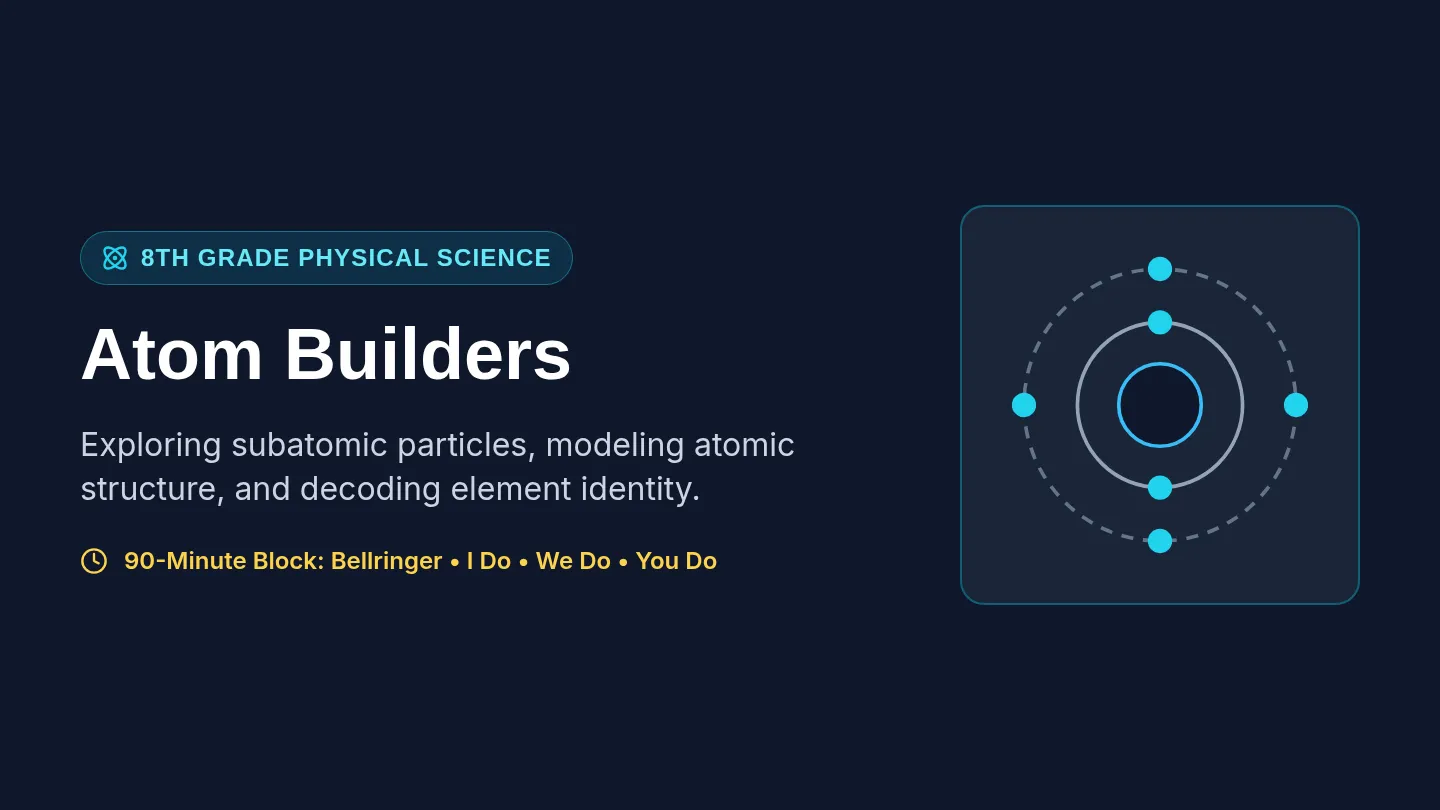
Atom Builders
Exploring subatomic particles, modeling atomic structure, and decoding element identity.
90-Minute Block: Bellringer • I Do • We Do • You Do
Today's Learning Targets
1
I can identify the three subatomic particles of an atom and their charges.
2
I can model the structure of an atom using protons, neutrons, and electrons.
3
I can determine the element name, symbol, and atomic mass based on subatomic composition.
Part 1: Bellringer
Zooming Into Matter
10 min
Imagine cutting a piece of aluminum foil in half over and over until you reach a single atom . Answer both questions on your worksheet:
Question 1
What do you think is inside a single atom?
Question 2
Why do different elements (like gold and oxygen) act differently?
Part 2: I Do
The 3 Subatomic Particles
20 min
Proton (p+)
+1
Charge: Positive (+1)
Location: Inside the nucleus
Mass: 1 amu
Neutron (n0)
0
Charge: Neutral (0)
Location: Inside the nucleus
Mass: 1 amu
Electron (e−)
−1
Charge: Negative (−1)
Location: Electron cloud
Mass: ~0 amu (tiny!)
Part 2: I Do
Worked Example: Neutral Carbon
6 p+ 6 n0
1. Element Identity: Protons = Atomic Number. 6 p+ = Carbon (C) .
2. Neutral Charge: Protons = Electrons (6 p+ and 6 e−).
3. Atomic Mass: Protons + Neutrons = 6 + 6 = 12 amu .
Shell Rule: Level 1 holds up to 2 electrons; Level 2 holds up to 8 electrons.
Part 3: We Do
Guided Practice Together
25 min
Activity A: Detective Table
Use your Periodic Table with your partner to decode Lithium, Oxygen, Sodium, and Helium.
Tip: Atomic Mass = Protons + Neutrons
Activity B: Build Boron-11
Model an atom with 5 protons , 6 neutrons , and 5 electrons .
Partner Check: Which particle decides an element's identity?
Part 4: You Do
Independent Mastery Check
35 min
A
Particles & Charges: Answer the two multiple-choice questions.
B
Build & Identify: Draw Bohr models for Atom 1 (4 p+) and Atom 2 (9 p+).
C
Mystery Element & Exit Check: Solve the 13-electron puzzle and reflect.
Atom Builders Answer Key Teacher Resource • 90-Minute Lab
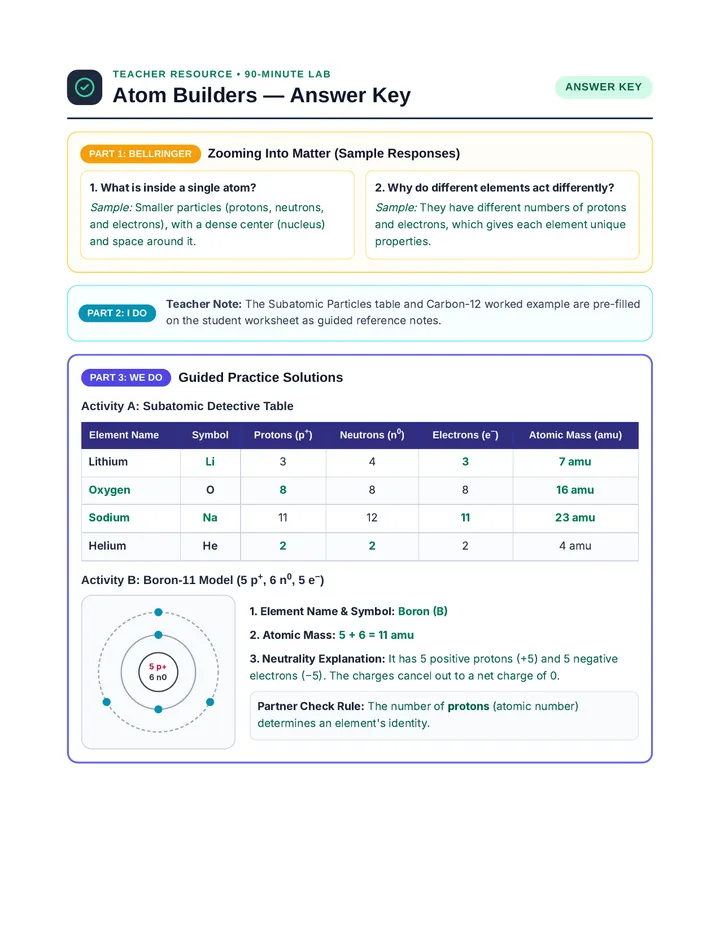
Atom Builders — Answer Key
Answer Key
Part 1: Bellringer
Zooming Into Matter (Sample Responses)
1. What is inside a single atom?
Sample: Smaller particles (protons, neutrons, and electrons), with a dense center (nucleus) and space around it.
2. Why do different elements act differently?
Sample: They have different numbers of protons and electrons, which gives each element unique properties.
Part 2: I Do
Teacher Note: The Subatomic Particles table and Carbon-12 worked example are pre-filled on the student worksheet as guided reference notes.
Part 3: We Do
Guided Practice Solutions
Activity A: Subatomic Detective Table
Element Name
Symbol
Protons (p+)
Neutrons (n0)
Electrons (e−)
Atomic Mass (amu)
Lithium
Li
3
4
3
7 amu
Oxygen
O
8
8
8
16 amu
Sodium
Na
11
12
11
23 amu
Helium
He
2
2
2
4 amu
Activity B: Boron-11 Model (5 p+, 6 n0, 5 e−)
5 p+ 6 n0
1. Element Name & Symbol: Boron (B)
2. Atomic Mass: 5 + 6 = 11 amu
3. Neutrality Explanation: It has 5 positive protons (+5) and 5 negative electrons (−5). The charges cancel out to a net charge of 0.
Partner Check Rule: The number of protons (atomic number) determines an element's identity.
Part 4: You Do
Independent Practice & Mastery Check — Solutions
Page 2 of 2
Section A: Subatomic Particles & Charges
1. Negative (−1) particle outside nucleus:
Answer: C. Electron
2. Two particles making up atomic mass:
Answer: B. Protons and neutrons
Section B: Build & Identify Two Atoms
Atom 1: 4 p+, 5 n0, 4 e−
4 p+ 5 n0
Element Name: Beryllium
Symbol: Be
Atomic Mass: 9 amu (4 + 5)
Atom 2: 9 p+, 10 n0, 9 e−
9 p+ 10 n0
Element Name: Fluorine
Symbol: F
Atomic Mass: 19 amu (9 + 10)
Section C: Mystery Element & Exit Check
3. Neutral atom with 13 electrons and atomic mass of 27 amu:
Protons: 13 • Neutrons: 14 (27 − 13) • Element: Aluminum (Al )
4. Exit Reflection: Does gaining a neutron create a different element?
No. Only the number of protons determines an element's identity. Gaining a neutron changes the atomic mass (creating an isotope), not the element itself.
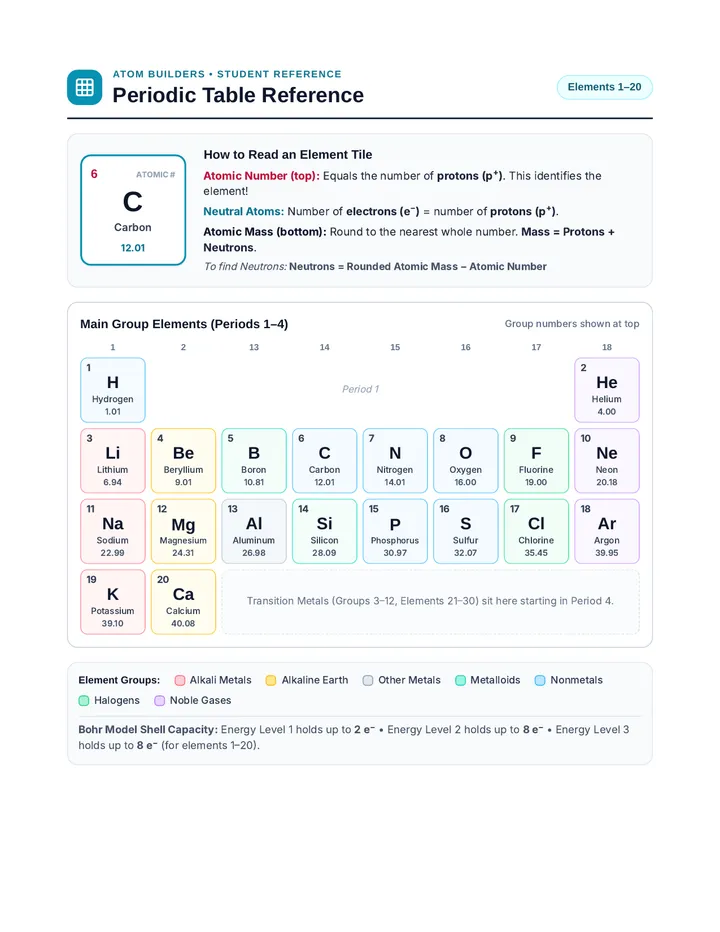
Periodic Table Reference Sheet Atom Builders • Student Reference
Periodic Table Reference
Elements 1–20
6 Atomic #
C
Carbon
12.01
How to Read an Element Tile
Atomic Number (top): Equals the number of protons (p+) . This identifies the element!
Neutral Atoms: Number of electrons (e−) = number of protons (p+) .
Atomic Mass (bottom): Round to the nearest whole number. Mass = Protons + Neutrons .
To find Neutrons: Neutrons = Rounded Atomic Mass − Atomic Number
Main Group Elements (Periods 1–4)
Group numbers shown at top
1
2
13
14
15
16
17
18
1
H
Hydrogen
1.01
Period 1
2
He
Helium
4.00
3
Li
Lithium
6.94
4
Be
Beryllium
9.01
5
B
Boron
10.81
6
C
Carbon
12.01
7
N
Nitrogen
14.01
8
O
Oxygen
16.00
9
F
Fluorine
19.00
10
Ne
Neon
20.18
11
Na
Sodium
22.99
12
Mg
Magnesium
24.31
13
Al
Aluminum
26.98
14
Si
Silicon
28.09
15
P
Phosphorus
30.97
16
S
Sulfur
32.07
17
Cl
Chlorine
35.45
18
Ar
Argon
39.95
19
K
Potassium
39.10
20
Ca
Calcium
40.08
Transition Metals (Groups 3–12, Elements 21–30) sit here starting in Period 4.
Element Groups: Alkali Metals Alkaline Earth Other Metals Metalloids Nonmetals Halogens Noble Gases
Bohr Model Shell Capacity: Energy Level 1 holds up to 2 e− • Energy Level 2 holds up to 8 e− • Energy Level 3 holds up to 8 e− (for elements 1–20).
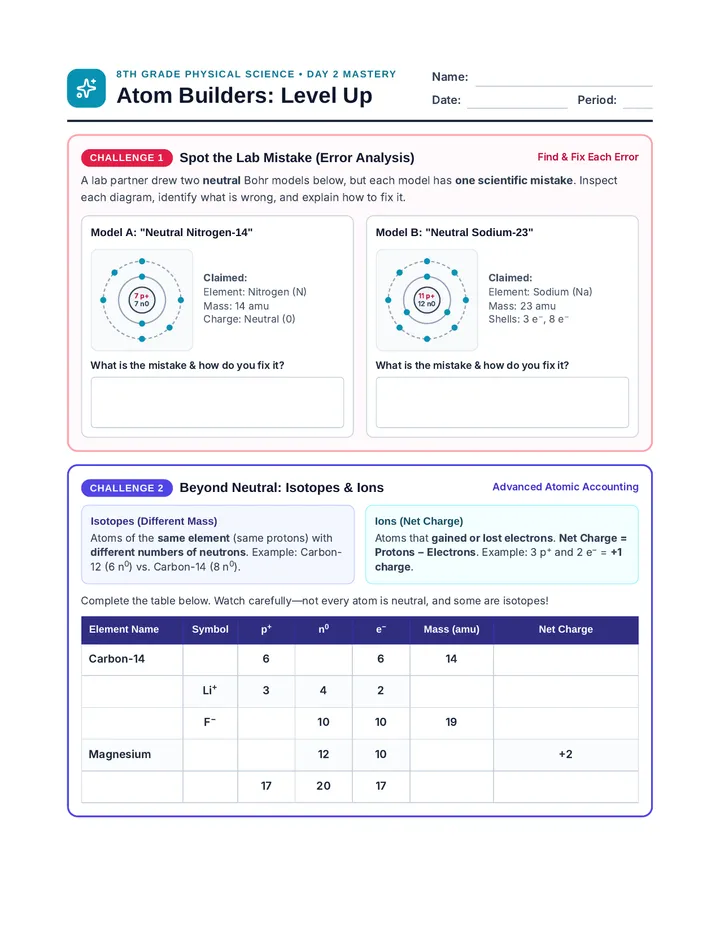
Atom Builders Enrichment Activity 8th Grade Physical Science • Day 2 Mastery
Atom Builders: Level Up
Name:
Date:
Period:
Challenge 1
Spot the Lab Mistake (Error Analysis)
Find & Fix Each Error
A lab partner drew two neutral Bohr models below, but each model has one scientific mistake . Inspect each diagram, identify what is wrong, and explain how to fix it.
Model A: "Neutral Nitrogen-14"
7 p+ 7 n0
Claimed:
Element: Nitrogen (N)
Mass: 14 amu
Charge: Neutral (0)
What is the mistake & how do you fix it?
Model B: "Neutral Sodium-23"
11 p+ 12 n0
Claimed:
Element: Sodium (Na)
Mass: 23 amu
Shells: 3 e−, 8 e−
What is the mistake & how do you fix it?
Challenge 2
Beyond Neutral: Isotopes & Ions
Advanced Atomic Accounting
Isotopes (Different Mass)
Atoms of the same element (same protons) with different numbers of neutrons . Example: Carbon-12 (6 n0) vs. Carbon-14 (8 n0).
Ions (Net Charge)
Atoms that gained or lost electrons . Net Charge = Protons − Electrons . Example: 3 p+ and 2 e− = +1 charge .
Complete the table below. Watch carefully—not every atom is neutral, and some are isotopes!
Element Name
Symbol
p+
n0
e−
Mass (amu)
Net Charge
Carbon-14
6
6
14
Li+
3
4
2
F−
10
10
19
Magnesium
12
10
+2
17
20
17
Challenge 3
Period 3 Architects: 3-Shell Bohr Models
Shells: 2 • 8 • 8
Use your Periodic Table Reference Sheet to build neutral Bohr models for two Period 3 elements. Write p+ and n0 in the nucleus, draw e− dots on the shells, and record the valence electrons (outermost shell).
1. Neutral Aluminum-27 (Al)
Total Electrons:
Valence Electrons:
2. Neutral Sulfur-32 (S)
Total Electrons:
Valence Electrons:
Challenge 4
Mystery Element Riddles
Riddle 1: I am a neutral atom with 2 more protons than Neon , and my nucleus has 12 neutrons . What is my element name, symbol, and atomic mass?
Riddle 2: I have 3 energy levels , 18 neutrons , and 7 valence electrons in my outermost shell (neutral). Who am I?
Riddle 3: I have an atomic mass of 40 amu and 20 neutrons . If I lose 2 electrons, what is my element symbol and new net charge?
Challenge 5
Final Mastery Synthesis (Claim • Evidence • Reasoning)
Two atoms both have an atomic mass of 14 amu . Atom X has 6 protons , and Atom Y has 7 protons . Are Atom X and Atom Y the same element? Support your answer with particle counts.