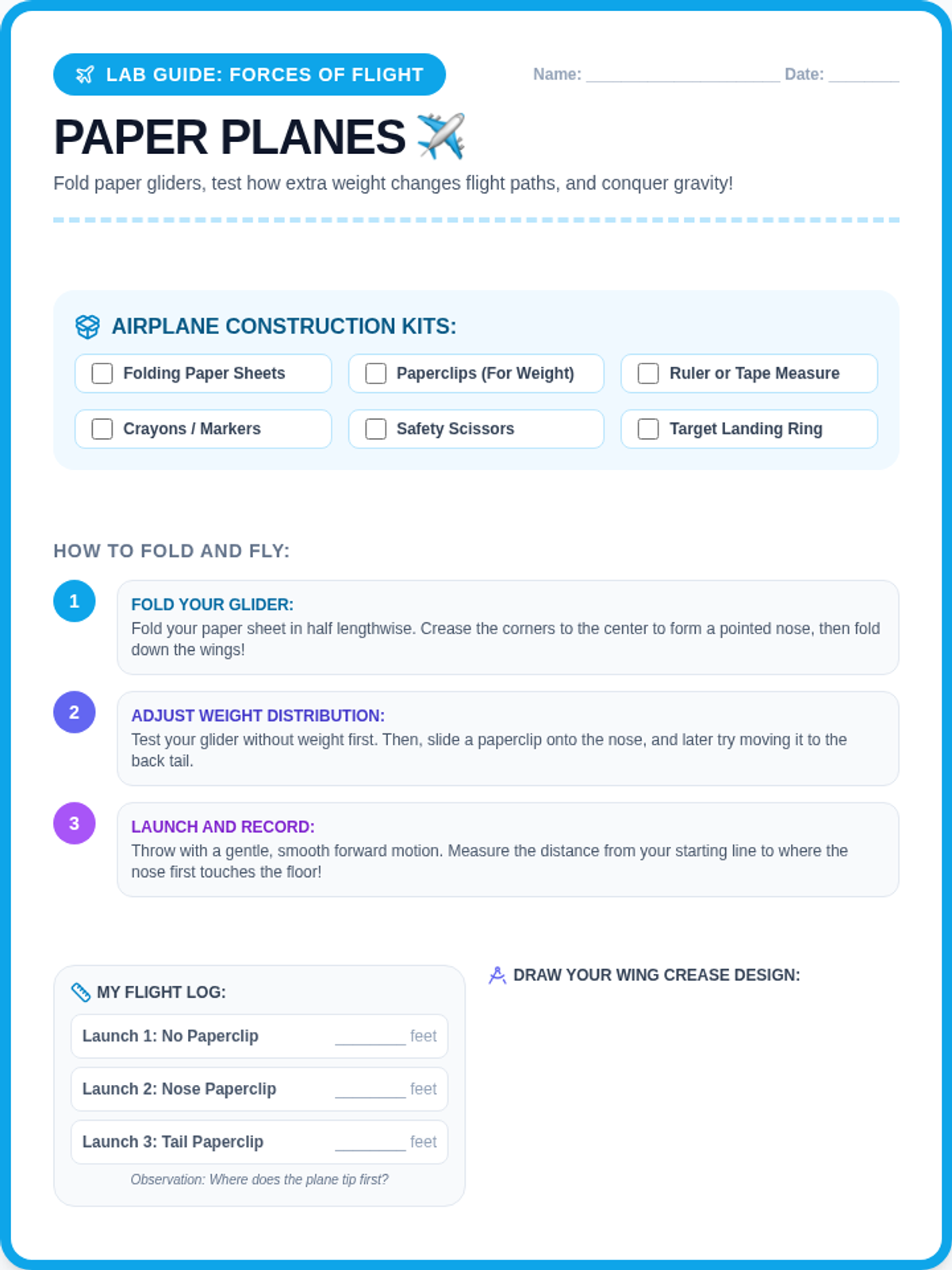
Flight School Lesson PlanFlight School Paper Airplane Design Lesson Plan Duration 90 Min Objective Students will explore the principles of flight by designing, building, and testing paper airplanes. Through this process, they will identify how aerodynamics (lift, thrust, drag, and gravity) impact flight performance. Audience 2nd and 3rd Grade Students Why This Matters This lesson encourages creativity and critical thinking by turning simple paper into an experimental tool. Students learn that failure is part of the engineering process through iterative design and testing. Materials Construction/Copy Paper Scissors Tape & Rulers Markers Design Log Worksheet Aero Basics Slides Instructional Path 1 Introduction to Aerodynamics (15 mins) Hook: Ask students "What makes things fly?" and "Why don't they just fall down?" Introduce the 4 Forces: Lift (up), Weight/Gravity (down), Thrust (forward), and Drag (backward). Use simple analogies: Hand out the window of a car (Lift/Drag) or throwing a ball (Thrust). 2 Designing Paper Airplanes (20 mins) Distribute paper and markers. Students design and decorate their first model. Challenge: "Think about which part of your plane helps it create Lift." Hand out the Design Log Worksheet to record the initial design. 3 Testing and Iteration (30 mins) Create a "Flight Zone" in the classroom or hallway. Students fly their planes and observe: Did it nose-dive? Did it veer left? Iteration: Encourage making one small change (tape, a fold, a cut) and re-testing. 4 Reflection and Discussion (15 mins) Gather students. Use the Discussion Guide to explore findings. Key Question: "What was the most successful design change you made?" 5 Closure (10 mins) Summarize the 4 forces. Celebrate the diversity of designs. Emphasize that engineers learn more from planes that crash than from planes that fly perfectly the first time!
Paper Airplane Design WorksheetFlight School Design Log Project No. AERO-2026-X Engineer: Launch Date: 1. Blueprint & Labels Draw your paper airplane design below. Label the wings, body, and any special features (like folds or tape). Scale: 1:1 Paper Weight © Aero Design Bureau 2. Testing & Re-Design What changes did you make to your design after testing? Consider what worked well and what didn't. Force Check: Lift Thrust Gravity Drag
Principles of Flight Discussion GuideConfidential: Teacher's Eyes Only Pre-Flight Briefing Principles of Flight Discussion Guide Use this guide to facilitate a post-testing reflection. These questions are designed to help students connect their hands-on building experience with the scientific principles of aerodynamics. 1 What did you learn about how airplanes fly? Key Concepts to Listen For: Lift (Going up) Thrust (Pushing forward) Drag (Slowing down) Gravity (Pulling down) Prompt: "Which force did you find the most difficult to control while you were throwing your plane?" 2 How did your airplane design change after testing? Guidance for Teacher: Focus on the importance of iteration. Engineering isn't about getting it right the first time; it's about making small, smart adjustments. "Did anyone change the shape of their wings? Did adding tape to the nose make it fly straighter or just crash faster?" 3 What was the most challenging part of the mission? Problem-Solving & Creativity: Encourage students to share specific technical difficulties. Was it the folding? The weight of the paper? The throwing technique? Highlight that problem-solving is what real aerospace engineers do every day. Mission Accomplished End of Briefing Document // Flight School 2026

Aero Basics SlidesFlight School The Science of Paper Aviation AERO-101 What Makes Things Fly? Is it magic? Is it just speed? "Aerodynamics is the study of how air moves around things." Everything that flies has to deal with 4 Main Forces. The 4 Forces of Flight Lift Weight Thrust Drag The Tug-of-War UP vs DOWN Lift The air pushes UP against the wings. The faster the air moves, the more lift you get! Weight Gravity pulls the plane DOWN. To stay in the air, your LIFT must be stronger than your WEIGHT! Speed & Struggle FORWARD vs BACK Thrust The power that pushes the plane FORWARD. For paper planes, YOU are the engine! Drag Air resistance that pulls BACK. Think of it like walking through water—it slows you down. Your Mission 1 Build Fold your first design. Think about the wings! 2 Test Fly it in the zone. Did it nose-dive or soar? 3 Adjust Make ONE change to improve its flight. Ready for Takeoff?