A lesson exploring the science of common clothing fibers (cotton, polyester, spandex) and the chemistry of detergents used to clean them. Students learn about fabric properties and how to select the best cleaning agents for different materials.
A comprehensive review of Earth's atmospheric layers, the crucial role of the ozone layer, and the chemical impact of CFCs on our planetary shield.
A comprehensive review of scientific inquiry through the lens of genetic engineering and CRISPR technology, covering the scientific method, variables, and the distinction between scientific models, theories, and laws.
A comprehensive biology review focusing on homeostasis, cell transport, body systems, and speciation to prepare students for their May exams.
A hands-on biology lab where students use the scientific method to investigate the characteristics of life through the observation and experimentation of pill bugs (Armadillidium vulgare).
Students compile all evidence, review suspect statements, and present their final verdict to solve the case.
The investigation moves to the lab to perform ink chromatography on the ransom note and compare results with suspect writing samples.
Detectives analyze physical evidence, focusing on fingerprint classification and handwriting analysis of a recovered ransom note.
Students are introduced to the crime scene, learn proper observation techniques, and create a scale sketch of the missing trophy's location.
An assessment-focused lesson on carbon cycling in ecosystems, focusing on matter cycling and energy flow in aerobic and anaerobic conditions as per HS-LS2-3.
A comprehensive unit on the flow of energy and matter within ecosystems, focusing on bioenergetics (photosynthesis and respiration) and population dynamics. Students explore how organisms interact with their environment and how energy is transferred through trophic levels.
An independent project where students explore cosmological concepts from the birth of the universe to its ultimate fate, choosing their own creative medium to demonstrate mastery.
A diverse collection of high-quality educational resources spanning history, science, and language arts. This bundle includes graphic organizers, rubrics, writing prompts, and scientific diagrams.
Explore the process of identifying problems and developing innovative solutions, culminating in an elevator pitch for a new business idea.
Discover the characteristics of an entrepreneur, the importance of a growth mindset, and the balance between risk and reward.
A comprehensive lesson on photosynthesis, focusing on the biological machinery of plants, the inputs and outputs of the process, and the specific structures involved like chloroplasts and roots.
This lesson concludes the unit on business presentation skills and company valuation, testing students on the FIT model, the Rule of Three, and core financial assessment concepts.
A creative project-based lesson where students identify an environmental issue, research its impact, and propose actionable solutions through a structured presentation.
The final mission involves assessing environmental damage caused by humans and predicting the long-term effects on the ecological grid.
Detectives investigate the impact of human technology and daily habits on the surrounding environment.
Agents document natural environmental shifts and create creative intelligence reports on how these changes impact local food webs.
Detectives analyze how ecosystems maintain equilibrium and identify factors that could destabilize the natural order.
Agents classify the roles of producers, consumers, and decomposers within the ecosystem to map out complex biological relationships.
Agents track the flow of energy through ecosystems by decoding food chain terminology and constructing new energy links.
Eco-Detectives investigate how living things interact with their habitats and identify key research questions for the agency.
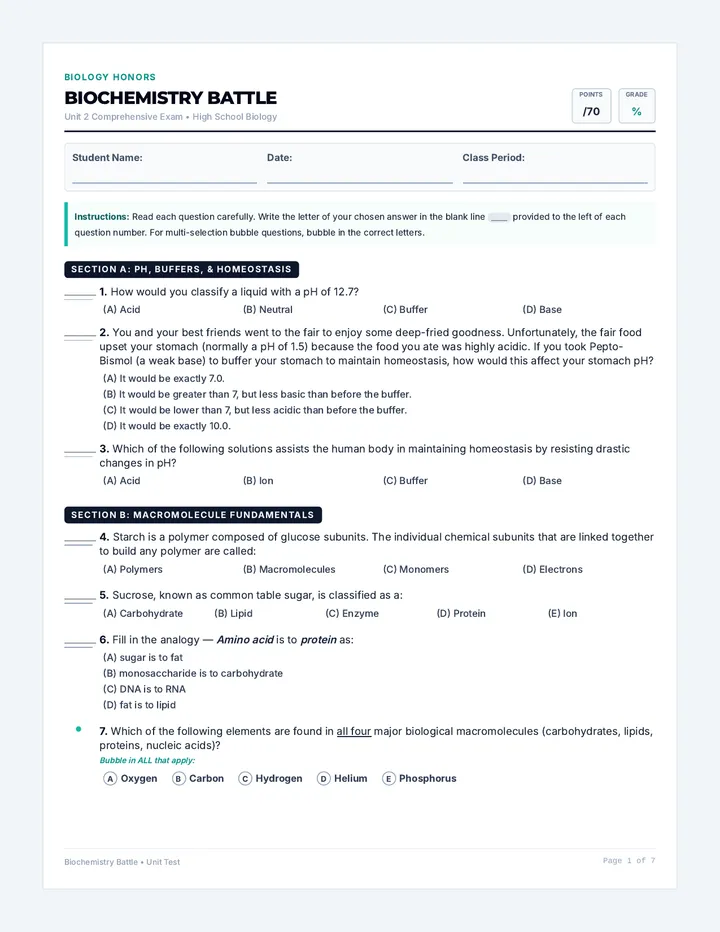
A comprehensive assessment covering the structure and function of macromolecules (carbohydrates, lipids, proteins, nucleic acids) and the catalytic role of enzymes. Aligned with Indiana State Standards for High School Biology.
An investigation into how substances dissolve, the roles of solutes and solvents, and how temperature affects solubility through reading, data analysis, and graphing.
A comprehensive lesson on the structural assembly of various sandwich types, focusing on culinary terminology and layering techniques through anatomical diagrams.
A deep dive into the demographic recovery of the bald eagle, exploring the impact of DDT and the success of the Endangered Species Act through data analysis and guided reading.
A 2-day hands-on engineering and art project where students build a paper zoetrope to explore the physics of light and the foundations of animation. Day 1 focuses on construction and the science of persistence of vision, while Day 2 focuses on creating and testing animation strips.
A comprehensive lesson on how energy moves through an ecosystem, from the sun to apex predators. Includes assessments on food chains, food webs, and the laws of thermodynamics in biology.
A comprehensive review of the unit's key concepts followed by a summative assessment to measure student understanding.
Peek inside the internal departments of a company to understand how functions like Marketing, Finance, and HR work together.
Compare different ways a business can be legally structured, including sole proprietorships, partnerships, and corporations.
Investigate how businesses satisfy human needs and wants through the production of goods and services within the framework of supply and demand.
Explore the fundamental purpose of a business, distinguishing between for-profit and non-profit organizations and identifying the role of profit.
A warm-up lesson introducing the concept of recombinant DNA through the real-world example of insulin production, using a guided drawing approach for 6th grade students.
An introductory lesson on the four principles of natural selection, specifically designed for students who benefit from visual support and simplified language. Students will explore variation, overproduction, selection, and adaptation.
A comprehensive introduction to invasive species, exploring how non-native plants and animals disrupt ecosystems and what can be done to stop them. Students will analyze real-world case studies of biological 'invaders' through a high-stakes dossier-style presentation.
This lesson covers the foundational principles of biological science, focusing on the scientific method (SEPs) and the fundamental characteristics that define living organisms (LS1). Students will demonstrate their understanding through a comprehensive assessment aligned with Indiana state standards.
A comprehensive study of John Green's 'Everything Is Tuberculosis', exploring the history, science, and advocacy surrounding the world's deadliest infectious disease. Students will analyze personal narratives, scientific discovery, and global health equity.