Catalyst Clues Station Cards
01
ENZYME BASICS
The Perfect Fit
Station 1
Background Intel
Enzymes are special protein "helpers" in the cell. Every enzyme has a uniquely shaped pocket called an active site. Only one specific food or target molecule (called the substrate) has the matching shape to fit inside, just like a key fitting into a specific lock.
Testing Different Substrate Keys on Lactase Enzyme
Substrate Shape (Food Key) Reaction Speed Slow Fast Triangle Shape 0% Speed Square Shape 0% Speed Circle Shape 100% (Fits!)
DOK 3 Challenge Prompt
A student says: "Since enzymes are just general biological helpers, the lactase enzyme in our stomach can easily break down any food we eat, whether it's dairy, bread, or protein."
Your Task: Evaluate the student's statement using the graph and the "lock and key" model. Predict what would physically happen to digestion if a mutation accidentally changed the shape of the lactase enzyme's active site from a round pocket to a square pocket.
Unit: Intro to Enzymes Record your answers on Page 1 of the Tracker
02
ENVIRONMENTAL EFFECTS
Too Hot to Helper
Station 2
Background Intel
Enzymes need the right temperature to do their job. When it is too cold, enzymes move too slowly to find their substrate. When it is just right, they work quickly. But if it gets too hot, the high heat actually melts and warps the enzyme's delicate shape. This permanent shape damage is called denaturation.
Human Enzyme Speed vs. Temperature
Temperature Enzyme Speed Freezing Normal Body Temp (37°C) Extremely Hot Stopped Max Speed Enzyme Warps/Melts!
DOK 3 Challenge Prompt
When a human gets very sick, they might run a high fever of 104°F (40°C) or higher. Doctors get extremely worried if a patient's fever stays this high for too long.
Your Task: Why is an extremely high fever so dangerous to a human's survival? Use the concepts of "enzyme shape" and "denaturation" to explain what is happening inside the patient's cells based on the graph coordinates.
Unit: Intro to Enzymes Record your answers on Page 1 of the Tracker
03
ENVIRONMENTAL EFFECTS
Acidic Environments
Station 3
Background Intel
pH is a scale that measures how acidic an environment is. A low pH (1 to 3) is highly acidic, like stomach acid. A neutral pH (around 7) is safe and mild, like water or saliva. Different enzymes are shaped to work in different pH environments. If an enzyme goes to the wrong pH, it unravels and loses its shape!
Enzyme Speed vs. pH Environment
pH Level (Acidic vs Neutral) Enzyme Speed pH 2 (Stomach) pH 7 (Mouth Saliva) pH 12 (Basic) Stopped Max Speed Pepsin (Stomach) → Solid Line Amylase (Mouth) → Dashed Line
DOK 3 Challenge Prompt
Salivary amylase is an enzyme in your mouth saliva (pH 7) that breaks down starch into sugar. When you swallow your food, that amylase travels down with it straight into your stomach, which is filled with strong stomach acid (pH 2).
Your Task: Using the graph curves (solid vs. dashed), predict whether salivary amylase will continue to digest starches inside your stomach. Explain what physically happens to the saliva amylase's "lock" shape when it plunges into the stomach acid.
Unit: Intro to Enzymes Record your answers on Page 1 of the Tracker
04
ENZYME BASICS
The Untouchable Workers
Station 4
Background Intel
In chemical reactions, raw materials are used up to make products. For example, wood turns to ashes, or sugar is broken down. But enzymes are different: they are the workers. They grab the substrate, do the job, release the product, and then turn around and do it again. They are reusable and never get used up!
Amounts of Molecules Over Time During a Reaction
Time (Seconds) Amount of Molecules Start Finish None A Lot Food Substrate (Solid Line) Products (Dotted Line) Lactase Enzymes / Workers (Dashed Line)
DOK 3 Challenge Prompt
A glass of milk contains billions of lactose (milk sugar) molecules. However, your body only needs to produce a relatively tiny amount of the lactase enzyme to digest all of it.
Your Task: Explain using the graph trends why our cells do not need to make one new enzyme for every single sugar molecule we swallow. Contrast the physical fates of "substrates" vs. "enzymes" by the end of a reaction.
Unit: Intro to Enzymes Record your answers on Page 2 of the Tracker
05
SYSTEM DYNAMICS
More Hands, Faster Work
Station 5
Background Intel
If you have a giant pile of leaves to rake, 10 workers can finish it much faster than 1 worker because there are more hands to do the work. It is the same inside a cell. Enzyme helpers act like workers. When the cell adds more enzyme molecules to a pile of substrates, the reaction goes much faster.
Time Required to Clean a Toxin vs. Number of Enzyme Workers
Number of Enzyme Workers Time to Clean Toxin (Mins) 1 Helper 5 Helpers 20 Helpers 0 Mins 60 Mins (Slow) 55 Min 25 Min 5 Min
DOK 3 Challenge Prompt
A liver cell absorbs a dangerous chemical toxin and needs to break it down immediately before the cell sustains permanent damage.
Your Task: If the cell must break down this toxic chemical as fast as physically possible, analyze whether the cell should produce more toxin molecules (substrate) or more enzyme helper molecules. Use the graph data and the worker analogy to justify your design solution.
Unit: Intro to Enzymes Record your answers on Page 2 of the Tracker
06
SYSTEM LIMITS
The Assembly Line
Station 6
Background Intel
Imagine a factory assembly line with exactly 5 worker enzymes wrapping chocolate packages. If 2 packages are on the belt, they are wrapped instantly. If 5 arrive, all 5 workers are busy. If 100 packages arrive at once, the wrapping speed cannot go any faster because every worker is already working with no downtime!
Overall Packaging Speed vs. Amount of Food (Substrate)
Amount of Food Substrate Wrapping Speed Few Packages Massive Pile of Packages Stopped Max Limit Speed increases as more packages arrive All 5 workers are busy! (Flat Line plateau)
DOK 3 Challenge Prompt
In the graph, as you add more and more food substrate, the overall speed of the reaction eventually stops rising and hits a completely flat ceiling.
Your Task: Using the factory assembly line analogy, explain why the overall speed of the reaction flattens out even when you continue to throw more packages (substrates) onto the conveyor belt. What is the bottleneck, and how could the cell speed up the process again?
Unit: Intro to Enzymes Record your answers on Page 2 of the Tracker
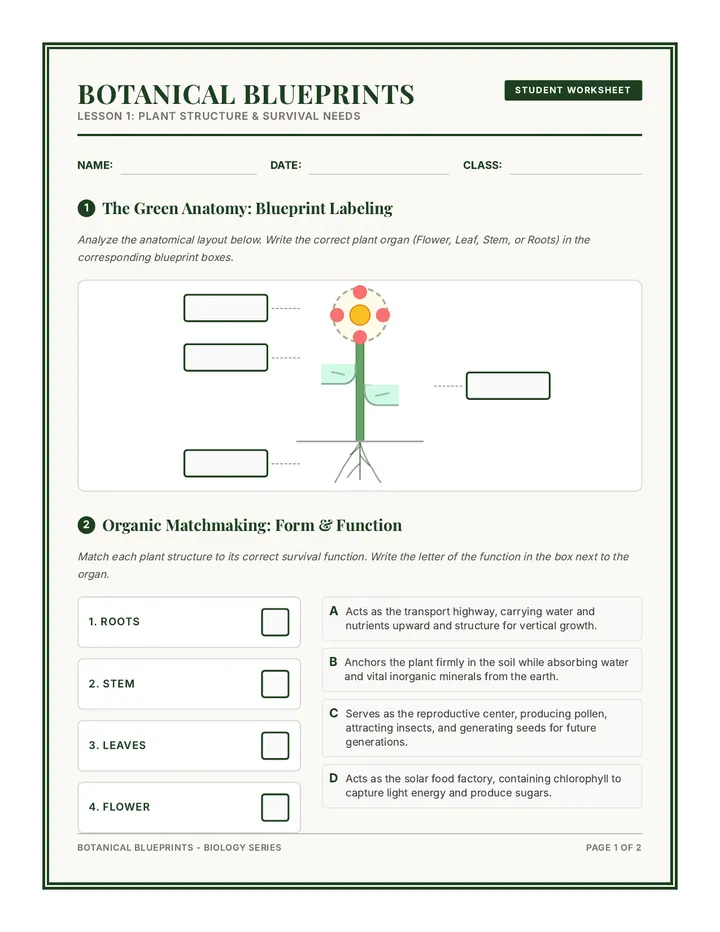
Catalyst Clues Student Tracker
Biology Inquiry Lab
Catalyst Clues Evidence Tracker
9th Grade Intro to Enzymes
Student Name:
Date:
Class Period / Group #:
01
Station 1: The Perfect Fit (Shapes)
Matching Active Sites
Define the "Lock" & "Key":
Which substrate shape fit the lactase enzyme?
DOK 3 Explanation: Evaluate the student's digestion claim & Predict a shape mutation
02
Station 2: Too Hot to Helper (Temperature)
Heat & Proteins
What is "Denaturation"?
Optimal Temp for Human Enzymes:
DOK 3 Explanation: Why a prolonged 104°F fever is extremely dangerous to survival
03
Station 3: Acidic Environments (pH)
Acid vs. Neutral Mouth saliva
Stomach Acid pH vs. Mouth saliva pH:
What happens to an enzyme in the wrong pH?
DOK 3 Explanation: Predict salivary amylase's fate and "lock" shape in stomach acid
Unit: Intro to Enzymes Page 1 of 2
Biology Inquiry Lab
Catalyst Clues Tracker
Stations 4 - 6
04
Station 4: The Untouchable Workers (Reusability)
Worker Stability
What happens to food (substrate) over time?
What happens to the enzymes over time?
DOK 3 Explanation: Why cells don't need one enzyme per sugar molecule (Lactase vs. Lactose)
05
Station 5: More Hands, Faster Work (Concentration)
Enzyme Workers
Time taken by 1 worker vs 20 workers:
What represents "workers" in a cell?
DOK 3 Explanation: To destroy an active toxin fastest, make more substrate or more enzyme?
06
Station 6: The Assembly Line (Saturation)
Max Capacity Limits
Why does speed go up at first?
What is the "bottleneck" on the flat line?
DOK 3 Explanation: Why speed plateaus even with extra packages, and how the cell bypasses it
Unit: Intro to Enzymes Page 2 of 2
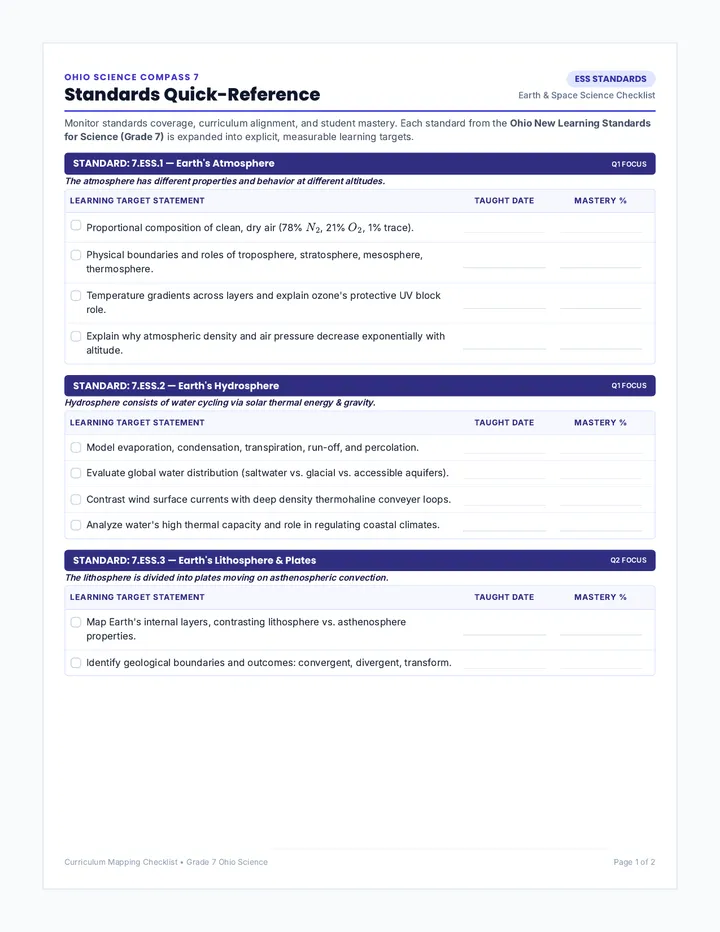
Catalyst Clues Teacher Guide
Educator Support Document
Catalyst Clues Teacher Guide
Pacing Guide (45 Min)
- 0-5 Min: Group pairing & setup.
- 5-35 Min: Station rotations (6 stations × 5 minutes each).
- 35-45 Min: Whole-class strategic debrief.
Early Year Collaboration Strategy
For on-level 9th graders with no chemistry background, focus entirely on shapes, workers, and locks/keys. Form groups of 3-4. Circulate during rotations. Do not give away answers; instead, ask socratic questions that connect the graph trends to everyday physical analogies (like a conveyor belt or key matching).
Exemplary Answer Key & Rubric (Stations 1 - 3)
Station 1: The Perfect Fit (Specificity) Key: Lock & Key Concept
DOK 3 Explanation: The student's claim is incorrect. Enzymes are not general helpers; they are highly specific. The graph shows that only the circular substrate (lactose) fits the lactase enzyme to trigger reaction speed, while triangle and square shapes yield 0% speed. If a mutation warps the active site pocket into a square shape, the round lactose key will no longer fit. The cell will fail to break down milk sugar, resulting in lactose intolerance.
Station 2: Too Hot to Helper (Temperature) Key: Heat Denaturation
DOK 3 Explanation: A fever of 104°F or higher is dangerous because excessive heat physically changes the shape of our body's enzymes (called denaturation). According to the graph, human enzymes work best at normal body temperature (~37°C/98.6°F) and crash to zero speed in extremely hot environments. When enzymes denature, their active site lock pocket melts, preventing vital life-supporting reactions from happening in the cell, which can be fatal.
Station 3: Acidic Environments (pH) Key: Environmental Matching
DOK 3 Explanation: Salivary amylase will stop working once it enters the stomach. The graph shows salivary amylase works at maximum speed around pH 7 (neutral mouth saliva) but is completely stopped at pH 2 (acidic stomach). The intense stomach acid physically alters and unravels (denatures) the salivary amylase's pocket shape, making it impossible to bind and digest starches in the stomach.
Socratic Scaffolding: Shape & Worker Focus
For Struggling Groups: "Look at the graphs. Is the line flat or curving? What does a flat line mean in our assembly line or worker analogy? Who is waiting on whom?"
For Advanced Groups: "If we look at Station 4, why is it beneficial for a cell that enzymes are reusable? How does this save the cell's energy and resources?"